A single missed inspection on a critical relief valve, a management-of-change form that never made it to the right engineer, an operating procedure last updated before the unit's last major turnaround — none of these look like a disaster in isolation. But OSHA's Process Safety Management standard exists precisely because catastrophic releases in oil and gas facilities almost never trace back to one dramatic failure. They trace back to small, unremarkable gaps across a 14-element system that quietly compounded until a Tuesday afternoon shift became a headline. Plants that treat PSM as a document exercise tend to find this out the hard way, usually during an OSHA inspection or, worse, after an incident. Facility teams working through their own 14-element gaps can book a demo to see how a connected compliance system closes them before either happens.
PROCESS SAFETY MANAGEMENT · OSHA 29 CFR 1910.119 · OIL & GAS
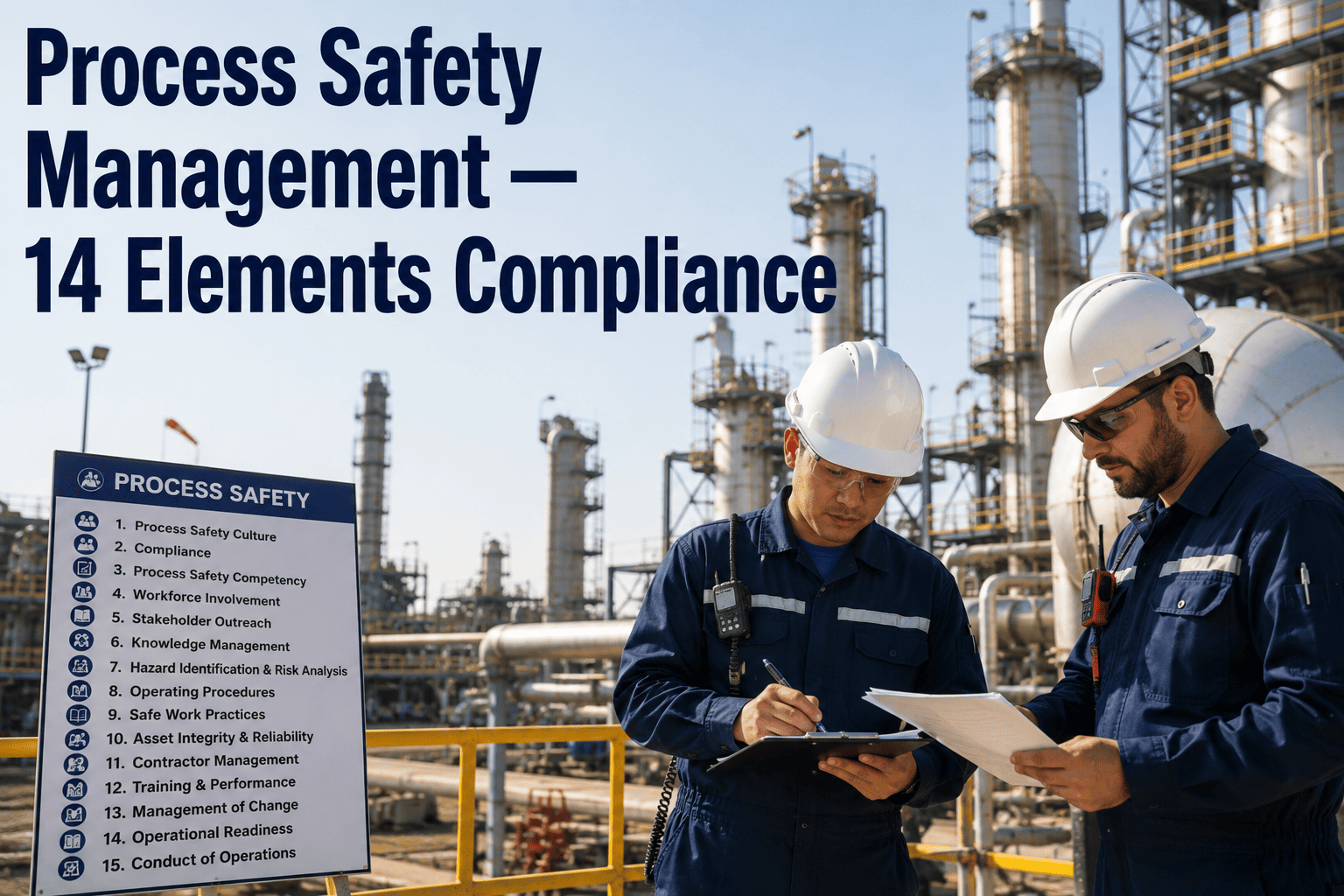
14 Elements, One System, Zero Guesswork
PSM was never meant to live in 14 separate binders. See how facilities connect process hazard analysis, MOC, mechanical integrity, and audit records into one system that survives a real OSHA inspection.
14
Interconnected elements required under 29 CFR 1910.119
10,000 lb
Threshold quantity of flammable liquids or gases that triggers PSM coverage
3 yrs
Maximum interval between required compliance audits of the full program
$156K+
Per-instance penalty for willful or repeat PSM violations under current OSHA schedules
Why Facilities Pass on Paper and Fail on the Floor
Most oil and gas facilities can produce a PSM binder on request. Process safety information is filed, a process hazard analysis exists somewhere in the shared drive, and operating procedures are printed and laminated in the control room. The trouble starts when an OSHA compliance officer stops reading the summary and starts tracing records end to end, pulling five years of management-of-change forms or twenty randomly selected critical valve inspections to see if the paper trail actually matches what happened on the unit.
That is where disconnected systems fall apart. A PHA recommendation that never turned into a tracked action, a mechanical integrity inspection that was completed but never logged against the right asset tag, an operating procedure revision that was approved but never redistributed to the shift that needed it — each one is a small administrative miss, but each one is also exactly what a National Emphasis Program inspection is built to find. The 14 elements were designed to function as one interlocking system, and treating them as 14 separate compliance projects is the single most common reason facilities fail an audit they believed they were ready for.
The 14 Elements, Grouped by What They Actually Protect
Reading the standard top to bottom makes the 14 elements feel like a flat checklist. In practice, they cluster into four functional groups, and understanding those clusters makes it far easier to see where a facility's real gaps sit.
Where the Paper Trail Usually Breaks
Open PHA Recommendation
High risk
MOC Missing PSSR Sign-off
High risk
Overdue MI Inspection
Moderate
Procedure Not Redistributed
Moderate
Relative frequency of the record gaps that most often surface during a full 14-element compliance audit.
AUDIT-READY PSM
Stop Reconstructing Records the Night Before an Audit
See how a connected PSM system keeps every element current automatically, instead of scrambling before the compliance officer arrives.
Building an Audit-Ready Program in Four Moves
1
Centralize the PSI and PHA
Put process safety information and the current PHA in one place tied to specific assets, not a shared folder no one owns.
2
Close the Loop on MOC
Route every management-of-change request through approval, PSSR, and procedure updates so nothing goes live unreviewed.
3
Track Mechanical Integrity Live
Schedule and log inspections against asset tags directly, so overdue critical equipment surfaces before it becomes a finding.
4
Feed Incidents Back In
Turn incident investigation findings into tracked actions against training, procedures, and PHA revalidation, not a filed report.
What Safety Leads Are Saying
We used to spend the two weeks before an audit reconstructing MOC and MI records from six different spreadsheets. Now the system shows us the open items every week, not just before the inspector shows up, and our last audit closed with zero major findings for the first time in years.
EHS Manager, Gulf Coast Refinery
The Element Most Facilities Underestimate: Management of Change
Ask any process safety auditor which element causes the most citations and management of change tends to top the list. The reason is structural rather than accidental. MOC sits at the intersection of nearly every other element in the standard, since a change to equipment, chemicals, technology, procedures, or staffing can invalidate the existing process hazard analysis, require a pre-startup safety review, demand new training, and shift what mechanical integrity needs to inspect going forward. A facility can run a technically sound MOC review and still fail an audit if the change never gets traced through to those downstream elements.
The failure pattern is usually predictable. A temporary bypass gets approved under time pressure during a shutdown, gets formally reviewed, and then never gets removed once the unit restarts because no one owned the follow-up. A replacement part that is not truly identical to the original gets installed without triggering a replacement-in-kind review, because the person making the swap did not recognize the change as material. Each of these looks minor at the moment it happens. Traced back after an incident, they are almost always sitting at the center of the causal chain, which is exactly why OSHA compliance officers treat MOC records as one of the highest-value samples to pull during an inspection.
Process Safety Information Is the Foundation, Not a Formality
Process safety information is listed first among the 14 elements for a reason. Every other element depends on it being accurate: a PHA built on outdated piping and instrumentation diagrams will miss real hazards, operating procedures written against superseded equipment specifications will instruct operators incorrectly, and mechanical integrity inspections scheduled against the wrong material-of-construction data will check for the wrong failure mode entirely. PSI is not a one-time compilation completed to open a facility. It is a living dataset that has to stay synchronized with every MOC, every equipment replacement, and every process modification for the rest of the elements to mean anything.
Facilities frequently discover this the hard way when a PHA revalidation team pulls the current PSI and finds it no longer matches the as-built plant. Metallurgy that changed during a repair, a relief valve set point adjusted years earlier without updating the master record, or a control loop reconfigured during a DCS migration all quietly erode the accuracy of PSI over time if there is no discipline forcing updates back into the record at the moment the change happens. Auditors who find PSI gaps tend to treat every downstream element that relied on that information as suspect, which is why PSI accuracy has an outsized effect on how the rest of an audit unfolds.
Frequently Asked Questions
Which facilities actually fall under OSHA PSM?
PSM applies to any facility holding 10,000 pounds or more of a listed flammable liquid or gas in one process, plus operations handling any of the 130-plus specific highly hazardous chemicals in threshold quantities. Refineries, gas processing plants, chemical distributors, and ammonia refrigeration sites are the most commonly covered oil and gas operations. Coverage is determined at the process level, so a single site can have some units covered and others exempt depending on inventory. Teams unsure of their exact coverage boundary can review their setup through
support before an audit forces the question.
How often does OSHA actually inspect a covered facility?
Programmed inspections under the Process Safety Management National Emphasis Program target facilities by NAICS code, with refineries and chemical distributors receiving the highest priority for scheduling. Inspections also follow directly from any reportable incident, regardless of a facility's programmed schedule. A compliance officer typically works through all 14 elements over several days to weeks, requesting documentation that can run to dozens of pages of records. Facilities that keep records current year-round face far less disruption than those reconstructing history during the visit itself.
What does an OSHA compliance officer actually sample during an audit?
Officers typically pull a random sample rather than reviewing every record, such as five years of management-of-change forms or twenty randomly selected critical valve inspection histories, and trace each one end to end. A single broken link in that chain, like an MOC without a documented pre-startup safety review, is treated as evidence of a systemic gap rather than an isolated miss. This is why consistency across every record matters more than having any single element look polished in isolation.
How does mechanical integrity connect to the other 13 elements?
Mechanical integrity inspection schedules should trace directly back to equipment identified as safety-critical in the process hazard analysis, and any inspection finding that reveals a design gap should feed back into MOC or the next PHA revalidation. When these links are missing, mechanical integrity becomes an isolated maintenance checklist rather than part of the safety case for the unit. Facilities exploring how to connect these elements can
book a demo to see a live example.
What is the fastest way to close existing PSM gaps?
Start with a focused internal audit against all 14 elements to identify where records are missing, outdated, or disconnected from one another, rather than trying to fix everything simultaneously. Prioritize open PHA recommendations and MOC records missing a pre-startup safety review first, since these represent the highest-risk gaps in most audits. Most facilities see the fastest improvement by centralizing records for one or two units before expanding the approach site-wide.
PROCESS SAFETY MANAGEMENT
Turn 14 Binders Into One Living System
Walk through how a connected PSM system tracks PHA, MOC, mechanical integrity, and audits for your own facility.