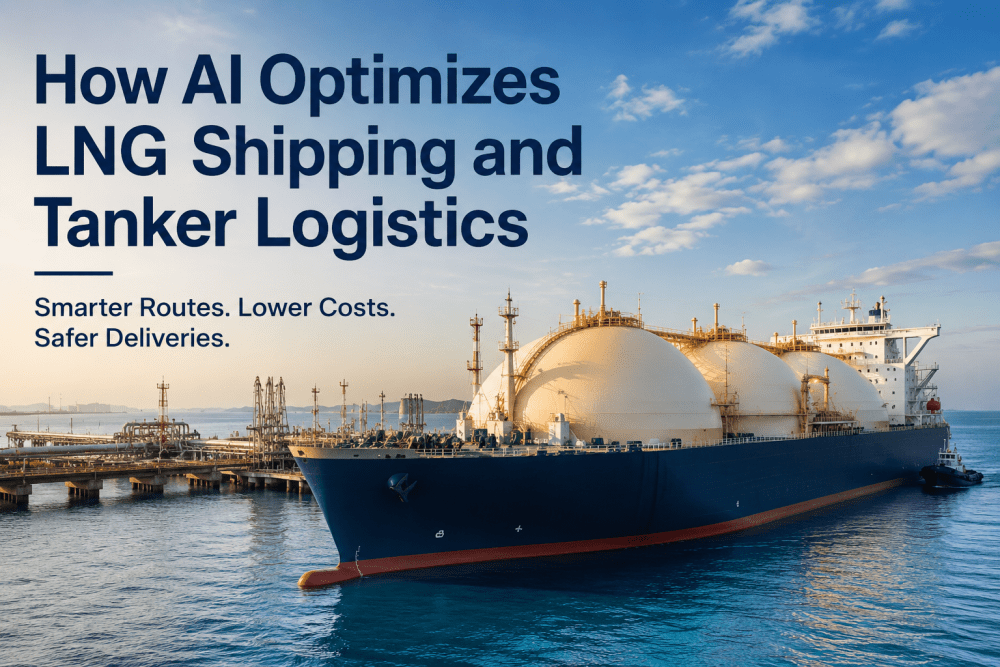
Artificial intelligence is reshaping how LNG cargoes move across the world's oceans — from algorithmic fleet routing and predictive vessel maintenance to real-time terminal slot optimization and AI-powered demand forecasting. For midstream operators managing fleets of LNG tankers, the shift from experience-driven scheduling to data-driven logistics intelligence is no longer a future ambition; it is a present competitive requirement. This article examines how AI is applied across the LNG shipping value chain, where the measurable performance gains are concentrated and what a realistic AI deployment roadmap looks like for a mid-size tanker operator in 2025.
Optimize Your LNG Fleet Operations with AI-Driven Logistics Intelligence
iFactory's midstream AI platform delivers real-time cargo routing, predictive vessel maintenance, and terminal slot optimization — measurable cost reduction within 90 days of deployment.
Why AI Is Now Essential in LNG Shipping and Tanker Logistics
The LNG shipping industry operates under a convergence of pressures that make manual logistics management increasingly untenable. Spot market volatility, tightening IMO emissions regulations, global demand seasonality across Asia-Pacific and European import terminals, and fleet utilization targets below 82% on many routes create a decision-making environment too complex for spreadsheet-based operations planning. AI systems process these multi-variable environments in real time — continuously optimizing voyage sequences, fuel consumption profiles, and port call scheduling against a live view of weather, market rates, and cargo commitments.
The financial stakes are significant. A 2% improvement in fleet fuel efficiency across a 10-vessel LNG fleet translates to approximately $4.2 million in annual bunker cost avoidance. AI-powered route optimization consistently delivers 3–6% fuel savings versus manually planned voyages — a return that dwarfs the cost of AI platform deployment within the first operational year. For operators ready to move from reactive scheduling to intelligent logistics, iFactory's AI midstream platform is designed specifically for this transition — book a demo to see the economics.
Where AI Creates Measurable Value Across the LNG Tanker Logistics Chain
AI is not applied uniformly across LNG shipping — the highest-value deployment zones are concentrated in six operational domains, each with distinct data requirements and measurable performance metrics.
AI Voyage Route Optimization
Machine learning models ingest real-time weather routing data, current speed profiles, port congestion forecasts, and fuel price indices to compute the optimal voyage plan — balancing ETA commitments against bunker consumption on a continuous basis throughout the voyage, not just at departure.
Predictive Vessel Maintenance
IoT sensors on LNG carrier propulsion systems, cargo pumps, and reliquefaction units generate continuous condition data that AI models analyze to detect developing mechanical failures 14–21 days before they produce operational disruption — enabling planned dry-dock scheduling rather than emergency repairs at off-route ports.
Terminal Slot & Berth Optimization
AI scheduling engines coordinate multi-vessel arrival windows against LNG terminal berth capacity, sendout rate constraints, and storage tank levels — eliminating the costly idle time at anchorage that typically runs $45,000–$80,000 per waiting day on large LNG carriers. Dynamic slot re-sequencing adapts to vessel delays in real time.
AI Demand Forecasting for LNG
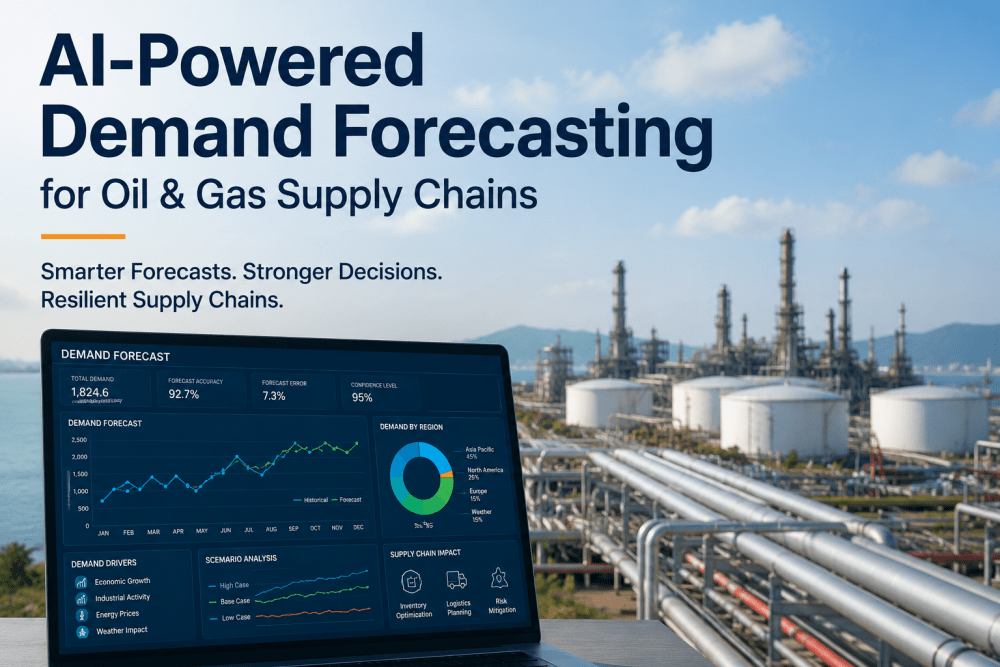
Deep learning models trained on global LNG import/export data, regional power demand patterns, weather temperature anomalies, and gas-to-power switching rates produce 30-, 60-, and 90-day cargo demand forecasts with accuracy significantly exceeding analyst-driven projections — enabling fleet positioning decisions that capitalize on spot market price windows.
Boil-Off Gas Management AI
LNG carriers continuously lose cargo volume through boil-off gas — a loss that averages 0.1–0.15% of cargo per day on standard Q-Flex vessels. AI systems optimize reliquefaction unit operations and voyage speed profiles to minimize boil-off losses against fuel equivalency calculations, turning an unavoidable physical process into a manageable and partially recoverable cost.
AI-Driven Charter Rate Intelligence
Natural language processing models continuously monitor Platts, Spark Commodities, and broker fixture reports to generate real-time charter rate trend signals — giving commercial teams an AI-derived view of market direction 5–10 days ahead of consensus broker sentiment. This intelligence layer directly informs vessel positioning and spot cargo acceptance decisions.
Traditional vs. AI-Driven LNG Shipping Operations: A Direct Comparison
The operational gap between conventional LNG shipping management and AI-augmented logistics is measurable across every performance dimension. The following comparison reflects documented outcomes from LNG operators who have deployed AI logistics platforms across fleet routing, maintenance, and terminal coordination functions. Operators considering the transition can book a demo with iFactory's LNG logistics team to benchmark their current operations against AI-optimized performance targets.
| Operations Dimension | Traditional Approach | AI-Optimized Approach | Performance Delta |
|---|---|---|---|
| Voyage Fuel Efficiency | Manual speed/route planning | Real-time AI route optimization | 3–6% bunker reduction |
| Fleet Utilization Rate | 78–82% average | 89–93% with AI scheduling | +9–11 percentage points |
| Unplanned Vessel Downtime | 12–18 days/year per vessel | Under 4 days/year | -74% downtime events |
| Terminal Waiting Time | 28–42 hrs avg anchorage | Under 9 hrs avg anchorage | $1.8M savings per vessel/yr |
| Demand Forecast Accuracy | ±22% 60-day forecast | ±7% 60-day AI forecast | 3x improvement in accuracy |
| Boil-Off Gas Loss Rate | 0.13–0.15% per day | 0.08–0.10% with AI control | $340K cargo savings/voyage |
| Carbon Intensity (CII Rating) | CII C/D ratings common | CII A/B maintained | Regulatory compliance secured |
The 90-Day AI Deployment Roadmap for LNG Tanker Operators
Deploying AI logistics intelligence across an LNG fleet requires integration with existing vessel management systems, VSAT data pipelines, and shore-based scheduling platforms — a process that can be executed without operational disruption when structured correctly. iFactory's deployment methodology is built around active vessel operations, with data integration and model training running in parallel with live fleet scheduling.
Data Integration & Fleet Mapping
VSAT vessel data feeds, AIS position streams, ERP charter party data, and terminal scheduling systems are integrated into the iFactory midstream AI platform. Each vessel is mapped to its equipment monitoring profile, cargo history, and operational constraint set. No vessel operational changes occur during this phase.
AI Model Training & Baseline Establishment
Machine learning models train on historical voyage performance, maintenance event records, and terminal waiting time data for each vessel in the fleet. Normal operating envelopes are established for propulsion systems, cargo handling equipment, and reliquefaction units. Demand forecasting models are calibrated to the operator's specific trade routes.
Live AI Recommendations & Alert Activation
AI voyage optimization recommendations are delivered to fleet controllers alongside traditional planning outputs — operators validate AI suggestions against real-world conditions, building confidence in system outputs. First predictive maintenance alerts are generated; typically 2–4 developing equipment issues are identified across the fleet during this validation phase.
Full Fleet AI Operations & Performance Reporting
Complete AI-driven fleet logistics management goes live. Shore-based scheduling, terminal coordination, predictive maintenance work orders, and CII carbon intensity dashboards are fully activated. Performance reporting against pre-deployment baseline is automated monthly. ROI metrics are visible within the first 30 days of full operations.
AI LNG Logistics Readiness: Is Your Operation Ready to Deploy?
Before committing to an AI platform deployment, LNG operators should assess their current data infrastructure against the minimum viable requirements for effective AI model training and real-time optimization. The checklist below covers the key readiness dimensions — and iFactory's deployment team can bridge gaps in any of these areas through IoT sensor retrofit and legacy system integration. Speak with an iFactory LNG logistics engineer to assess your deployment readiness.
Data Infrastructure
Operational Systems
Industry Expert Review: What AI Actually Delivers in LNG Shipping
The expectations gap between AI platform marketing and on-vessel reality is narrowing rapidly — but it is still present. Operators who have deployed AI LNG logistics systems consistently identify three areas where AI delivers beyond expectations, and one area where realistic calibration is essential before deployment.
Delivers Beyond Expectations
- Terminal coordination efficiency — Operators consistently report that AI-managed berth scheduling eliminates virtually all avoidable anchorage waiting time, with savings exceeding pre-deployment projections by 20–35%.
- Cross-fleet pattern recognition — AI models identify mechanical failure patterns across a fleet of 8+ vessels that no single vessel superintendent could detect — catching systematic component issues before fleet-wide failure events.
- CII compliance management — AI route and speed optimization keeps fleets within CII A/B ratings without requiring operational speed reductions that compromise charter party ETA commitments.
Requires Realistic Calibration
- Demand forecast accuracy in black swan events — AI models trained on historical LNG demand data perform well under normal market conditions but require human override protocols during unprecedented market disruptions (e.g., the 2021–2022 European gas crisis). The AI is a powerful decision support tool in these scenarios, not an autonomous decision-maker.
LNG operators running 5–15 vessel fleets are the fastest-growing adopters of AI logistics intelligence — the ROI case is clearest at this scale. Book a demo with iFactory to see a live LNG fleet AI dashboard and receive a fleet-specific ROI projection for your operation.
The Financial Case for AI LNG Shipping Logistics: ROI by Fleet Size
The return on investment from AI LNG logistics platforms scales with fleet size but is compelling at every scale above a single vessel. The table below reflects conservative estimates based on documented operator outcomes — actual results at top-performing deployments have exceeded these benchmarks by 25–40%. Operators can request a fleet-specific ROI model by scheduling a demo with iFactory's LNG logistics advisory team.
| Value Category | 5-Vessel Fleet | 10-Vessel Fleet | 20-Vessel Fleet |
|---|---|---|---|
| Bunker Cost Reduction (3–5%) | $2.1M / year | $4.2M / year | $8.4M / year |
| Terminal Waiting Time Elimination | $3.2M / year | $6.5M / year | $13.0M / year |
| Unplanned Dry-Dock Avoidance | $1.8M / year | $3.5M / year | $6.9M / year |
| BOG Loss Reduction | $0.7M / year | $1.4M / year | $2.8M / year |
| Fleet Utilization Improvement | $2.4M / year | $4.8M / year | $9.6M / year |
| Total Conservative Annual Value | $10.2M | $20.4M | $40.7M |
| Typical AI Platform Cost | $0.9M / year | $1.6M / year | $2.8M / year |
| Net Annual ROI | $9.3M (10x) | $18.8M (12x) | $37.9M (14x) |
AI in LNG Shipping: From Competitive Advantage to Operational Baseline
The window during which AI LNG logistics platforms represent a competitive differentiator is narrowing. As more operators deploy AI voyage optimization, predictive maintenance, and terminal coordination intelligence, the question shifts from "should we invest in AI?" to "how quickly can we close the gap with AI-enabled competitors?" Operators running manual or spreadsheet-based scheduling face compounding disadvantages in fleet utilization, bunker cost, and CII compliance ratings that are already visible in charter rate negotiations and cargo allocation decisions.
The 90-day deployment roadmap outlined in this article is operational today for fleets of 3 vessels and above. The integration methodology is designed around active operations — no dry-dock requirement, no operational pause. iFactory's LNG AI platform connects to your existing VMS, ERP, and VSAT infrastructure and delivers measurable ROI metrics within the first 30 days of full operation. To understand what AI-optimized LNG logistics would deliver for your specific fleet and trade routes, the most direct path is a 30-minute demo with iFactory's midstream AI team — book your session here.
Frequently Asked Questions: AI in LNG Shipping and Tanker Logistics
What minimum fleet size makes AI LNG logistics economically viable?
AI logistics platforms deliver positive ROI at fleet sizes as small as 3 LNG vessels, though the strongest payback occurs at 8–12 vessels where cross-fleet pattern recognition and coordinated terminal scheduling multiply the value of individual vessel optimization. At 3 vessels, the primary ROI driver is predictive maintenance and voyage fuel optimization — combined, these typically return 6–8x the platform investment cost annually.
How does AI handle LNG cargo optimization across different containment systems (Moss vs. membrane)?
iFactory's vessel models are containment-system-aware. Moss-type vessels and membrane-type (GTT, KC Mk III) carriers have different BOG rate profiles, reliquefaction system configurations, and allowable heel quantities — the AI maintains separate operating envelopes and cargo management models for each vessel type within a mixed fleet. Cargo plan optimization accounts for these physical differences at the individual voyage level.
Can AI platforms integrate with existing maritime VMS systems like ShipNet, AMOS, or DNV Nauticus?
Yes. iFactory maintains pre-built API connectors for all major maritime vessel management and PMS platforms, including ShipNet, AMOS, DNV Nauticus, Mastex, and Helm Operations. For legacy systems without API access, structured data extraction via standardized file export formats is supported. Integration timelines for standard VMS connections are 5–10 business days.
How does the AI platform address IMO CII Carbon Intensity Indicator compliance?
CII rating management is a core output of iFactory's LNG route optimization engine. The platform models each voyage's projected CII contribution against the vessel's annual CII budget in real time — adjusting speed profiles and route selections to maintain target A or B ratings without sacrificing charter party ETA commitments. CII compliance records and voyage-level carbon intensity reports are auto-generated in IMO-aligned documentation format for DCS reporting.
What data security standards does an AI LNG platform need to meet for a major oil company's approval?
iFactory's platform meets SOC 2 Type II, ISO 27001, and IMO Maritime Cyber Risk Management (MSC-FAL.1/Circ.3) standards. Data transmission between vessel and shore is encrypted end-to-end via TLS 1.3. Vessel operational data remains within the operator's designated cloud region with no third-party data sharing. The platform passes standard vendor security questionnaires used by major oil companies including NOCs and IOCs for supplier technology approval processes.
Your Competitors Are Already Deploying AI — Don't Let the Gap Compound
iFactory's AI LNG shipping platform is already deployed across midstream operations at leading tanker operators and energy companies. See a live walkthrough of the fleet logistics AI dashboard — no obligation, 30 minutes.

.png)