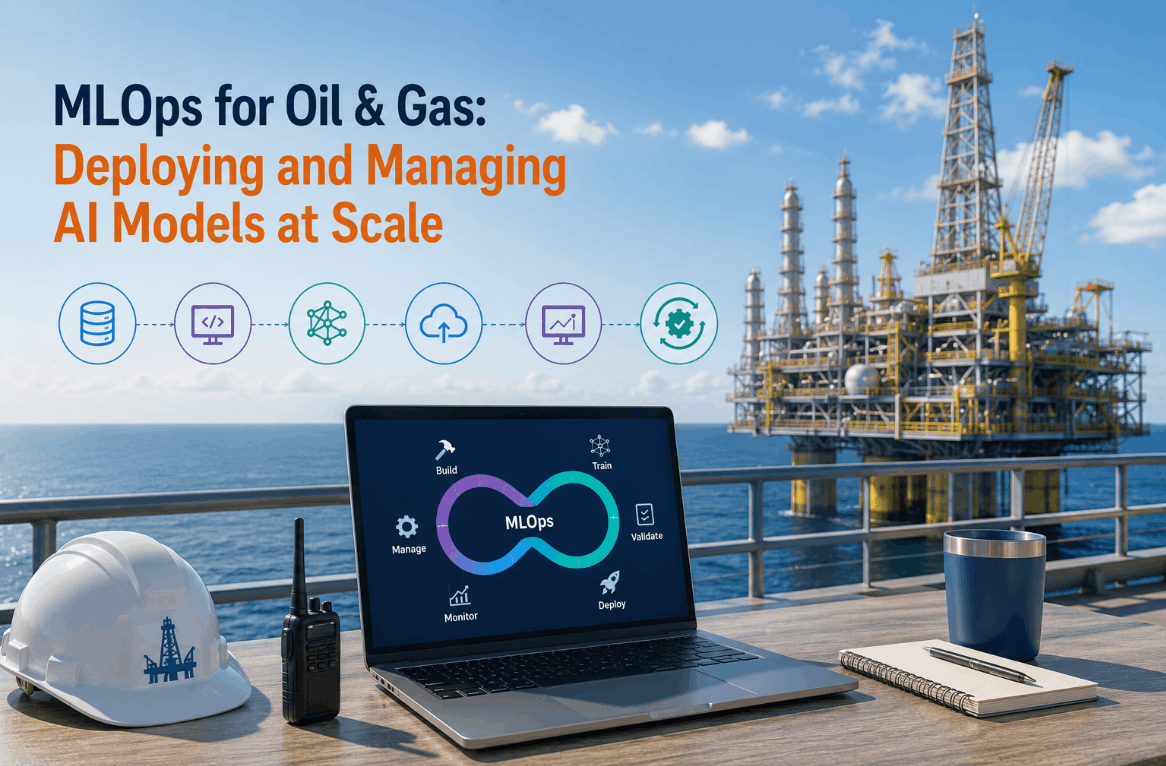
Machine learning models that perform brilliantly in a controlled pilot environment routinely fail within six months of production deployment in oil and gas operations. The reason is rarely the algorithm — it is the absence of a disciplined operational framework to manage those models once they leave the data science lab and enter the live SCADA, DCS, and field sensor environment where production decisions actually happen. MLOps — machine learning operations — is the engineering discipline that closes this gap. It applies the rigor of software DevOps to AI model deployment, monitoring, retraining, and governance, ensuring that predictive models for equipment health, production optimization, and safety compliance continue to deliver accurate, trustworthy outputs across the full operational lifecycle. For oil and gas operators pursuing enterprise-scale AI deployment in 2025, Book a Demo to see how iFactory AI's industrial MLOps platform is purpose-built for the OT data environments and regulatory demands of upstream, midstream, and downstream operations.
Are Your AI Models Still Performing 12 Months After Deployment?
iFactory AI's industrial MLOps platform continuously monitors, retrains, and governs AI models for predictive maintenance, production optimization, and safety analytics — keeping your oil and gas AI investment delivering operational value at scale.
Why MLOps Has Become Non-Negotiable for Oil & Gas AI Programs
The oil and gas industry's AI adoption has moved past the pilot phase. Machine learning algorithms now account for the majority of active AI spending in the sector, embedded across commercial predictive maintenance platforms, production optimization tools, and seismic interpretation systems. The competitive dynamic has shifted from experimenting with isolated AI pilots to building enterprise-scale rollouts that require MLOps, data governance, and change management expertise. Yet most operators still treat model deployment as a finish line rather than a starting point — and that assumption is where production AI programs quietly collapse.
In oil and gas, AI models degrade for reasons that are structurally unique to the industry. Equipment wear cycles shift the vibration signatures that bearing health models were trained on. Reservoir depletion changes the flow dynamics that production optimization models depend on. Seasonal temperature swings alter the baseline thermals that compressor anomaly detection relies on. Without an MLOps layer that continuously monitors model performance against incoming data and triggers retraining when statistical drift is detected, every AI model deployed in oil and gas has a shelf life — and that shelf life is typically shorter than operators expect. Operations teams that have already Book a Demo with iFactory AI consistently discover that their highest-priority need is not a better model — it is a managed operational layer that keeps existing models accurate as conditions evolve.
Model Drift in OT Environments
Equipment wear, reservoir changes, and process condition shifts continuously alter the data distributions that deployed AI models were trained on — degrading prediction accuracy without triggering any visible alarm.
Fragmented OT/IT Data Pipelines
SCADA historians, ERP maintenance records, and field sensor streams operate independently — creating data synchronization gaps that invalidate model inputs and produce confident but incorrect predictions.
Regulatory Governance Requirements
PSM, OSHA, and EPA regulations require documented AI decision audit trails that most commercial MLOps platforms were not designed to produce for operational technology environments.
Edge Deployment Complexity
Remote wellheads, offshore platforms, and pipeline segments with limited connectivity require edge inference capabilities that add model versioning and deployment complexity beyond standard cloud MLOps patterns.
The Five Components of a Production-Grade MLOps Stack for Oil & Gas
An MLOps architecture designed for oil and gas must address requirements that generic cloud MLOps platforms were not built for: real-time OT data ingestion, industrial-grade edge deployment, consequence-weighted model monitoring, and regulatory audit trail generation. iFactory AI's industrial MLOps platform integrates all five components required for production-grade AI model management in oil and gas operations — connecting data pipelines, model registries, deployment targets, monitoring systems, and governance frameworks into a single managed layer.
| MLOps Component | Function | Oil & Gas Specific Requirement | Failure Without It | Priority |
|---|---|---|---|---|
| Data Pipeline Management | Real-time OT/IT data ingestion and quality validation | OPC-UA, MQTT, PI Historian integration with automated quality tagging | Models consume stale or corrupted sensor data; predictions become unreliable | Critical |
| Model Registry & Versioning | Centralized model artifact storage with version control | Every deployed model version linked to the training dataset and operational context in which it was validated | No audit trail for which model version made a safety-critical prediction | Critical |
| Automated Deployment Pipeline | CI/CD pipelines for model deployment to cloud and edge targets | Edge deployment to remote sites with limited connectivity; staged rollout with production shadow testing | Manual deployments introduce delays, version inconsistencies, and untested model releases | Critical |
| Drift Detection & Monitoring | Continuous statistical performance monitoring with automated retraining triggers | Equipment wear and reservoir depletion-driven concept drift; consequence-weighted alert thresholds | Models silently degrade; operations teams lose trust and revert to manual methods within 90 days | Critical |
| Governance & Audit Framework | Regulatory-grade documentation of model decisions and data lineage | PSM Mechanical Integrity compliance; OSHA and EPA audit response documentation | Cannot demonstrate AI model integrity to regulators; audit response requires costly manual reconstruction | High |
Deploying MLOps in Oil & Gas: A Phased Implementation Framework
Most oil and gas AI programs stall not because the technology is unavailable, but because the deployment sequence is wrong. Organizations that attempt to build a comprehensive MLOps infrastructure before deploying any models create an 18-month implementation project with no operational output. The correct sequence inverts this approach: deploy a focused predictive model on the highest-consequence asset class first, demonstrate measurable results within 90 days, and build the MLOps infrastructure iteratively around real production models. Quality directors and operations technology managers regularly Book a Demo with iFactory AI to walk through how this phased methodology applies to their specific asset portfolio and current infrastructure state.
Asset Criticality Assessment & Data Connectivity Audit
Define the AI-priority asset register based on failure consequence and data availability. Audit existing SCADA, historian, and CMMS data streams for quality and completeness against the minimum data requirements for each target model type. Identify sensor gaps that require hardware investment before model deployment.
Data Pipeline Deployment & OT/IT Integration
Establish real-time OT data pipelines for the Tier 1 asset class using OPC-UA and MQTT protocols. Connect CMMS maintenance history and ERP records to the unified data layer with automated quality scoring applied at ingestion. Validate data completeness and temporal alignment before model training begins.
Model Training, Validation, and Registry Onboarding
Train initial predictive models on validated historical data with documented feature engineering rationale. Register each model artifact with its training dataset version, validation metrics, and operational context in the model registry. Establish performance baseline metrics that will anchor ongoing drift detection monitoring.
Production Deployment with Shadow Testing
Deploy models to production with a parallel shadow testing period during which model outputs are validated against operator judgment before alerts are escalated to the maintenance workflow. Configure consequence-weighted alert thresholds specific to each asset class. Connect model outputs to CMMS work order generation for the first confirmed predictive maintenance intervention.
Continuous Monitoring, Drift Response & Scale-Out
Activate automated drift detection with statistical monitoring of model input distributions and prediction accuracy against confirmed work order outcomes. Configure retraining triggers and rollback procedures. Expand MLOps coverage to Tier 2 assets using the validated pipeline architecture from Tier 1 deployment as a template.
The Six MLOps Gaps That Cause Oil & Gas AI Programs to Fail at Scale
Understanding where oil and gas AI programs fail is the most direct path to building one that does not. The operational gaps below represent the consistent failure patterns identified across oil and gas AI deployments — each of which MLOps discipline is specifically designed to close. Operations managers and digital transformation leads who Book a Demo with iFactory AI frequently discover that their program is experiencing two or more of these gaps simultaneously, which compounds the failure rate exponentially.
Models are deployed once and assumed to remain accurate indefinitely. Without continuous performance tracking, accuracy degradation is invisible until operations teams stop trusting the outputs and revert to manual methods.
Historian polling intervals of 15 minutes or longer, missing sensor coverage, and no automated data quality validation mean models regularly receive stale or corrupted inputs — producing confident but incorrect predictions.
When concept drift is detected, the retraining process requires manual data science intervention — creating weeks-long gaps during which a degraded model continues to inform operational decisions at full authority.
Predictive models without maintenance history context cannot distinguish between a genuine failure signature and a recently serviced asset. Without automated OT/IT integration, models generate false alarms that erode operator trust within 60 days.
No documented model version history, no data lineage tracking, and no audit trail for AI-driven decisions creates regulatory exposure when OSHA PSM or EPA audit cycles require proof of AI system integrity.
Remote wellheads and offshore platforms with constrained connectivity require edge inference capability. AI programs without an edge deployment strategy leave the most isolated — and often the highest-consequence — assets outside the predictive monitoring footprint.
Industry Perspective: Why Most Oil & Gas AI Models Don't Survive Their First Year
"I have watched more than twenty AI deployments fail in this industry over the past decade, and the pattern is identical every time. The pilot works. The model is accurate. The data science team is proud of it. And then six months after production deployment, the maintenance manager tells me the alerts are wrong half the time and his team has stopped looking at them. The model didn't fail. The operational infrastructure around the model failed. Nobody was watching the input data quality. Nobody noticed that the bearing signature had shifted because the pump had been rebuilt with different clearances. Nobody had a process for retraining. MLOps is not a data science problem — it is an operations problem. The oil and gas operators who understand that are the ones seeing AI deliver sustained value. The ones who don't are funding their third pilot."
How iFactory AI's Industrial MLOps Platform Addresses Each Critical Requirement
Native OPC-UA, MQTT, and PI Historian integration with sub-second polling for AI-critical assets — eliminating the data latency that degrades model inputs in standard SCADA architectures.
Statistical monitoring of model input distributions and prediction accuracy with configurable retraining triggers — detecting concept drift before it causes false alarms that erode operational trust.
AI model outputs filtered through consequence-based scoring and converted to prioritized CMMS work orders — so maintenance teams receive actionable alerts, not raw model scores in a data science dashboard.
Automated model decision audit trails and data lineage records that satisfy OSHA PSM Mechanical Integrity documentation requirements and EPA compliance reporting obligations without manual reconstruction.
MLOps Is the Difference Between an AI Pilot and an AI Program
The oil and gas industry has demonstrated that AI models work. Predictive maintenance models catch compressor failures weeks in advance. Production optimization models identify well performance decline before it appears in daily reports. Safety analytics models detect gas accumulation before fixed-point detectors trigger. The evidence from deployments across upstream, midstream, and downstream operations is consistent: AI produces operational value when it has clean data to work with and accurate predictions to deliver. What the industry has not yet solved at scale is keeping those models working six, twelve, and twenty-four months into production — which is precisely what MLOps discipline provides.
iFactory AI's industrial MLOps platform is purpose-built for the OT data environments, edge deployment requirements, and regulatory compliance obligations that generic cloud MLOps tools cannot address. From real-time OT data pipeline management and automated drift detection to consequence-weighted alert delivery and PSM-grade governance documentation, iFactory provides the complete operational layer that sustains AI value in oil and gas at enterprise scale. The operators generating measurable, sustained returns from AI are not the ones with the most sophisticated models — they are the ones with the most disciplined MLOps infrastructure beneath those models.
Build an MLOps Foundation That Keeps Your Oil & Gas AI Performing at Scale
Deploy iFactory AI's industrial MLOps platform across your upstream, midstream, or downstream operations — with real-time OT data connectivity, automated drift detection, and regulatory-grade governance built in from day one.
MLOps for Oil & Gas — Common Questions Answered
MLOps is the engineering discipline that manages AI models in production — handling deployment, monitoring, retraining, and governance. Oil and gas requires it because equipment wear, reservoir changes, and seasonal shifts continuously degrade model accuracy without any visible alert.
Concept drift occurs when the real-world data distribution shifts away from what the model was trained on — driven in oil and gas by equipment rebuilds, reservoir depletion, and process condition changes that alter the sensor signatures the model relies on.
Yes — iFactory AI connects to SCADA, OSIsoft PI, Aspentech IP21, and major ERP systems using OPC-UA, MQTT, and REST APIs, delivering real-time data to AI models without replacing existing infrastructure.
A governance-capable MLOps layer generates automated model decision audit trails, data lineage records, and version history documentation that satisfy PSM Mechanical Integrity requirements and can be produced during regulatory inspections without manual reconstruction.
A phased deployment targeting the top-priority asset class can deliver the first AI-driven predictive alerts within 45 days; full MLOps infrastructure including drift monitoring, automated retraining, and governance reporting is typically live within 4–6 months.