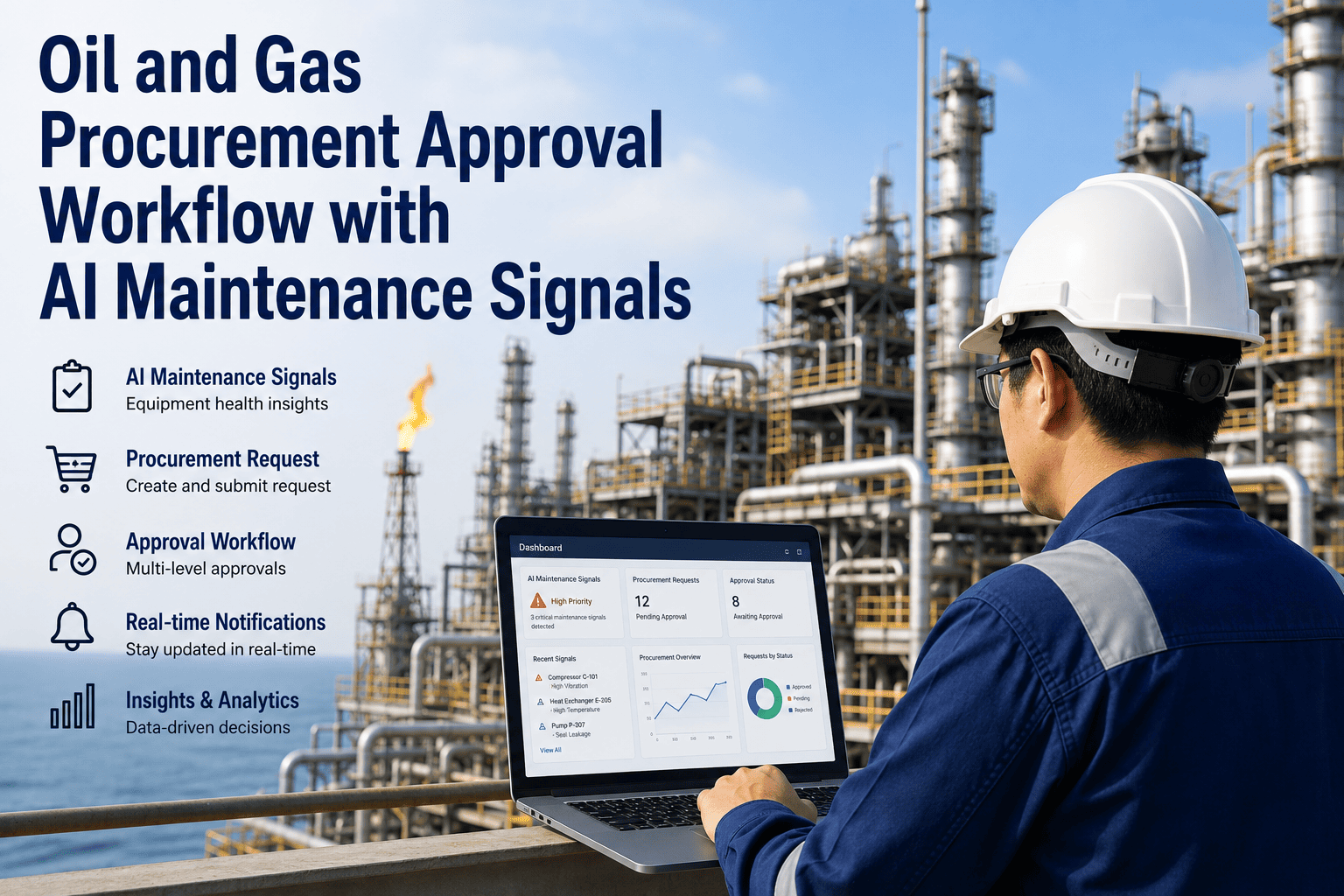
A pump seal starts drifting past its vibration threshold on a Thursday afternoon somewhere on the unit, and the maintenance team already knows a stockout is three weeks away. Procurement doesn't know that yet, because the purchase requisition that eventually lands in their queue looks exactly like every other routine line item waiting for sign-off. By the time that requisition gets flagged as urgent, the lead time on the seal has already eaten into the safety margin, and an approval that should have taken a day stretches into a week of chasing signatures across three departments. Most refinery and gas plant procurement teams lose that margin constantly, not because anyone is careless, but because the approval workflow has no way of knowing which requisition is tied to a bearing about to fail and which one is for shop rags. iFactory connects maintenance risk signals directly into the procurement approval workflow so the requisitions that matter get routed, prioritized, and approved before downtime becomes unavoidable, and you can book a demo to see it applied against your own current requisition queue.
Your Maintenance Team Sees the Failure Coming Weeks Before Procurement Ever Sees the Requisition
iFactory's Procurement Intelligence links AI-driven maintenance risk scores to the purchase approval workflow, so critical spare parts requisitions are automatically prioritized, routed, and approved ahead of the failure they're meant to prevent.
Why the Most Urgent Requisition Sits in the Same Queue as the Least Urgent One
MRO spend typically accounts for a large share of an operator's non-hydrocarbon operating budget, yet the systems that approve that spend rarely know anything about the asset behind the request. A requisition for a critical compressor bearing and a requisition for janitorial supplies enter the same generic approval chain, wait for the same generic sign-offs, and get no priority signal that separates one from the other. The maintenance team already has a vibration reading, a wear trend, or a failure prediction that says this part matters more than most, but that context almost never travels with the paperwork.
The result is a procurement function that reacts to emergencies it could have seen coming. An unplanned shutdown triggered by a missing part can cost far more in lost production than the planned intervention would have, yet the requisition for that same part often waited in a queue for days because nobody upstream of procurement flagged it as connected to a live risk. Closing that gap means giving the approval workflow the same visibility the maintenance team already has, at the exact moment a requisition is created.
This isn't a problem unique to one operator or one region. Upstream drilling rigs, midstream pipeline compressor stations, and downstream refinery units all generate the same pattern of disconnected requisitions, because most ERP and e-procurement platforms were built to manage spend categories and approval hierarchies, not asset condition. Maintenance planners end up keeping their own informal priority lists outside the official system, and procurement teams learn to read between the lines of a requisition's comments field to guess at urgency. That workaround is fragile, undocumented, and impossible to audit consistently across a multi-site operation.
Six Stages Connect a Maintenance Signal to an Approved Purchase Order
A disconnected procurement process treats every requisition as a blank slate. A connected one carries the asset's risk context through every stage of approval, from the moment a sensor trend crosses a threshold to the moment a supplier confirms delivery.
Three Recurring Breakdowns Show Up Across Nearly Every Refinery and Gas Plant Procurement Audit
Blind Approval Routing
Every requisition follows the same fixed approval chain regardless of which asset it protects, so a bearing feeding a compressor train waits behind a stationery order with no way to jump the queue.
Emergency Buying Premium
When a part is discovered missing only after a failure, procurement pays rush freight, off-contract pricing, and unapproved-vendor premiums that a few days of advance notice would have avoided entirely.
Disconnected Inventory Data
Warehouse stock levels, maintenance demand forecasts, and open purchase orders often live in separate systems, so teams simultaneously overstock slow-moving parts and stock out on the ones that actually matter.
Every Requisition Should Arrive at Procurement Already Ranked by What It Protects
iFactory scores each maintenance-driven requisition against asset criticality before it ever reaches an approver's inbox.
What Actually Changes When Procurement Approval Is Linked to Maintenance Risk
| Workflow Stage | Manual / ERP-Only Process | AI-Linked Procurement Workflow |
|---|---|---|
| Requisition prioritization | First-in, first-out queue with no asset context | Ranked automatically by live maintenance risk score |
| Approval routing | Fixed chain regardless of urgency or spend category | Dynamic thresholds that fast-track critical-asset requests |
| Emergency purchases | Discovered after a failure, sourced under time pressure | Anticipated days or weeks ahead through predictive signals |
| Inventory visibility | Warehouse, maintenance, and procurement data kept separate | Single connected view of stock, demand, and open orders |
How iFactory Turns a Maintenance Signal Into a Faster, Better-Informed Purchase Decision
The Outcomes Operators Notice First After Connecting Procurement to Maintenance Risk
Questions Procurement and Maintenance Leaders Ask About Risk-Linked Approval Workflows
Give Procurement the Same Warning Maintenance Already Has
iFactory routes, prioritizes, and approves critical spare parts requisitions before the failure they're meant to prevent.