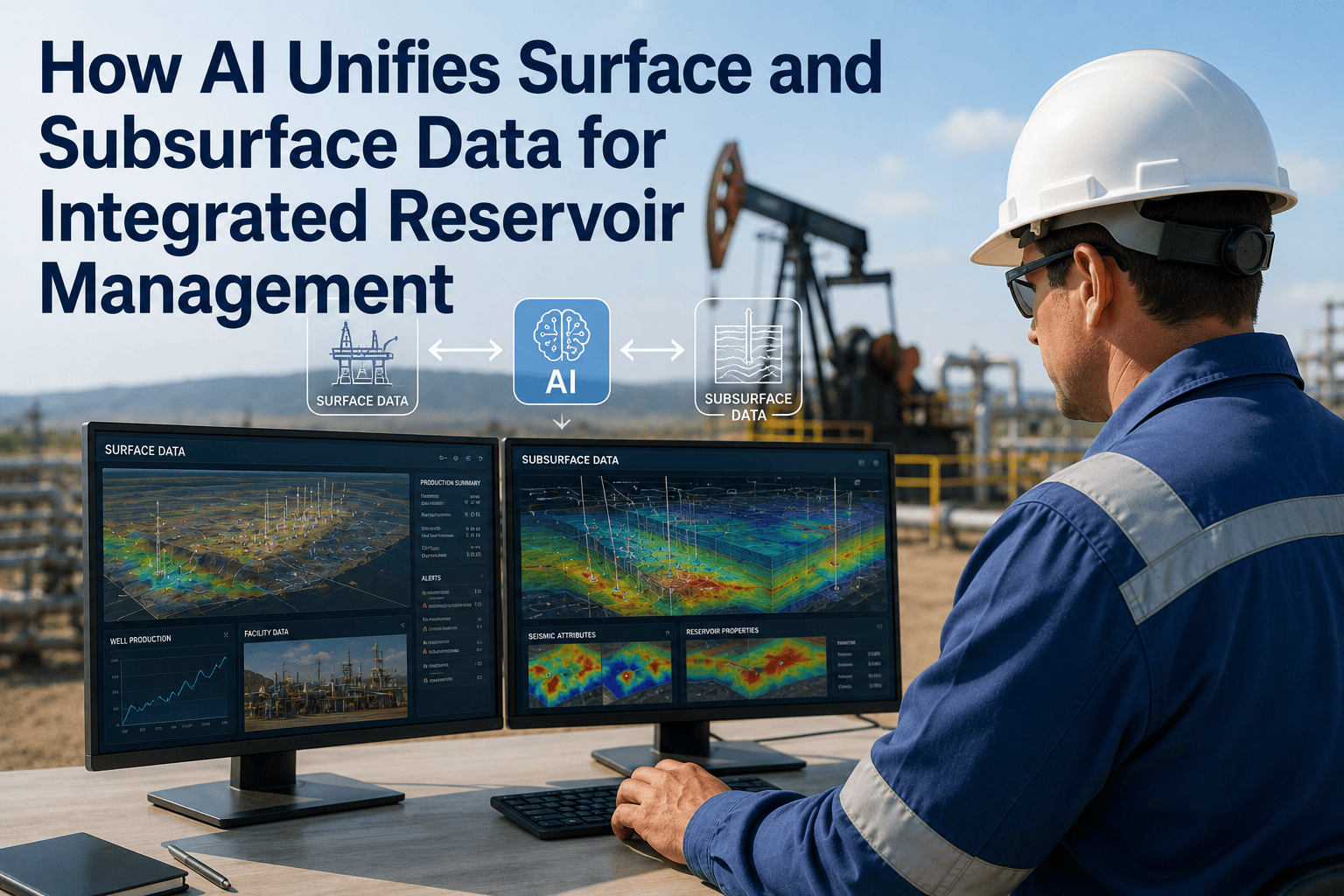
Somewhere in your organization, a geoscientist is digging through a spreadsheet to find which application holds the seismic survey for a field your team evaluated three years ago. A drilling engineer is emailing three different teams to track down well logs that should take seconds to find. This is not a talent gap, it is a data architecture problem, and it quietly costs upstream operators millions in delayed decisions and stalled AI initiatives. The Open Subsurface Data Universe, known industry-wide as OSDU, was built to solve exactly this. Talk to our team about what an OSDU-aligned rollout looks like for your operation.
OSDU Implementation That Actually Unifies Your Subsurface Data
Exploration, drilling, and production data trapped in a dozen proprietary systems is the single biggest blocker to AI-ready upstream workflows. A well-executed OSDU implementation changes that, giving your geoscience, engineering, and data teams one shared foundation instead of a patchwork of disconnected tools, and this guide walks through exactly how to get there.
The Real Cost of Subsurface Data Silos
Every upstream operator has some version of the same story: valuable data exists somewhere in the organization, but finding it, trusting it, and combining it with data from another domain takes far longer than it should. These four patterns show up again and again across exploration and production teams, regardless of company size or basin.
Fragmented Systems
Seismic interpretation, well logs, core data, and production history each live in separate vendor-specific applications that were never designed to talk to one another, so cross-domain analysis becomes a manual, error-prone exercise that eats into the hours engineers should be spending on interpretation instead of data hunting.
Slow Exploration Decisions
Finding the best placement for an expensive exploration well depends on stitching together seismic, core, and log data from multiple platforms, and every hour spent hunting for data is an hour not spent interpreting it, which directly delays the capital decisions that matter most to a project's economics.
AI Initiatives Stall
Machine learning models for reservoir characterization or production forecasting need clean, unified, well-tagged data to train on, and most subsurface archives simply are not structured that way today.
Vendor Lock-In
When data lives inside a proprietary application layer, switching tools or adopting new analytics platforms means expensive, risky migrations instead of simple integrations.
What OSDU Actually Is
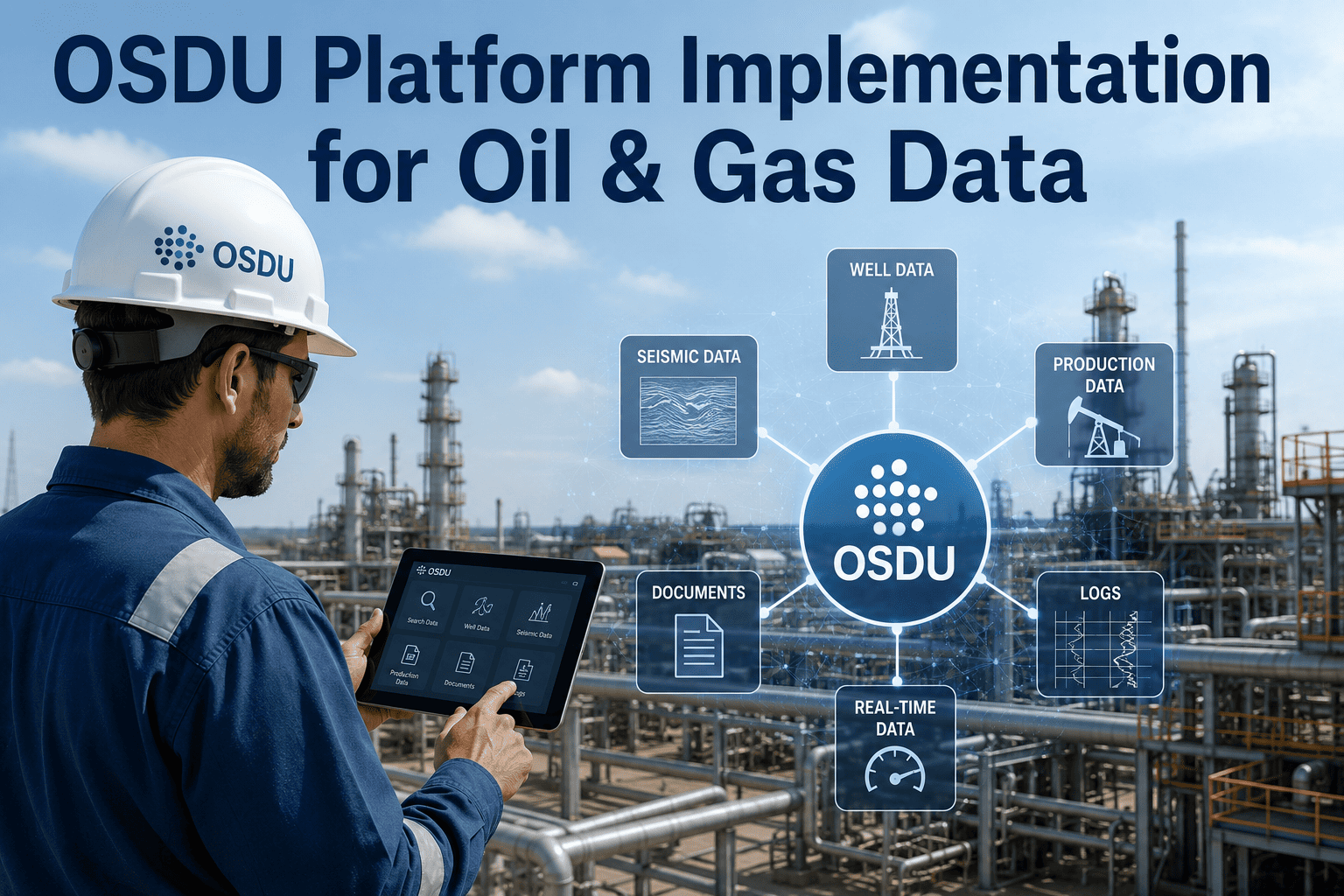
The Open Subsurface Data Universe is an open, standards-based data platform built by a cross-industry forum of operators, service companies, and cloud providers to separate subsurface data from the applications that consume it. Instead of your seismic, well, and production data being locked inside individual software products, OSDU defines a common schema and a set of standard APIs so any conformant application can discover, access, and work with the same underlying data. The result is a shift from an applications-driven organization to a data-driven one, where the data itself becomes the durable asset and applications become interchangeable tools that plug into it.
This matters more now than it did five years ago because AI and machine learning workflows are only as good as the data feeding them. A platform built on standardized, well-tagged, cross-domain subsurface data is dramatically easier to layer predictive models, generative copilots, and automated reporting on top of, which is precisely where iFactory's industrial AI tools plug in once your OSDU foundation is in place.
Governance is the piece organizations underestimate most. Standardizing a schema is a technical exercise, but deciding who owns data quality, who approves new tagging conventions, and how legacy datasets get reconciled against the new standard is an organizational one. Operators who assign clear governance roles before ingestion begins tend to see faster, cleaner rollouts than those who treat governance as an afterthought to be figured out once the platform is already live.
The Five-Stage OSDU Implementation Path
Every successful deployment we have supported follows roughly the same sequence, though the pace and depth vary by organization size, existing infrastructure maturity, and how many domains are brought into scope during the first phase. Skipping steps or rushing the assessment phase is the single most common cause of budget overruns we see in the field.
Assess
Inventory existing subsurface systems, data quality, and integration points before any migration work begins.
Model
Map your internal data structures against the OSDU schema to identify gaps, custom fields, and transformation rules.
Ingest
Load seismic, well, and production data into the platform with standardized metadata tagging applied consistently.
Integrate
Connect existing and new applications to the platform through standard APIs instead of point-to-point integrations.
Operationalize
Roll the platform into daily geoscience and engineering workflows, with governance and access controls in place.
Your Subsurface Data Shouldn't Be Your Biggest Bottleneck
iFactory helps upstream teams pair an OSDU-aligned data foundation with AI-driven procurement, inventory, and predictive maintenance tools built for industrial operations.
Business Use Cases Unlocked by a Unified Platform
The table below reflects patterns we have seen repeatedly across upstream operators once subsurface data moves from fragmented systems to a shared, standardized platform. The gains compound over time as more applications and teams connect to the same foundation.
| Use Case | Before OSDU | After OSDU |
|---|---|---|
| Well Placement Analysis | Manual data gathering across systems takes days | Unified access cuts research time to hours |
| Reservoir Modeling | Incomplete data sets limit model accuracy | Cross-domain data improves model confidence |
| AI Model Training | Inconsistent tagging blocks automation | Standard schema enables scalable ML pipelines |
| Vendor Flexibility | Application switching requires costly migration | New tools plug in through standard APIs |
| Regulatory Reporting | Data reconciliation across silos is manual | Single source of truth speeds compliance |
Why AI-Ready Subsurface Data Depends on OSDU
Predictive maintenance models, procurement forecasting, and vision-based quality systems all share one requirement: consistent, structured, discoverable data. An OSDU-aligned foundation gives upstream teams that structure at the subsurface layer, which means the same discipline that makes drilling and reservoir data usable for AI also makes it far easier to extend AI into adjacent operations like inventory planning and maintenance scheduling, where iFactory's platform is purpose-built to help.
Consider reservoir characterization. A machine learning model trying to predict porosity or permeability from sparse well data performs dramatically better when it can pull consistent, cross-domain training data instead of piecing together mismatched formats from a dozen legacy systems. The same is true for production forecasting models, which improve when they can reference standardized decline curves alongside maintenance and equipment history rather than isolated production numbers. Once a platform enforces a common schema, every downstream AI initiative inherits that consistency for free, instead of each team having to rebuild data pipelines from scratch every time a new model gets proposed.
Common Implementation Pitfalls to Avoid
Most stalled OSDU rollouts fail for predictable reasons. Watching for these early saves months of rework later.
Treating It as an IT-Only Project
Data platform decisions made without geoscience and engineering input tend to miss the metadata and workflow details that actually matter to end users, leading to low adoption after go-live.
Attempting a Full Migration on Day One
Trying to move every historical dataset before launching anything delays value for years. Phased ingestion tied to active projects gets teams using the platform far sooner.
Skipping Data Governance
Without clear ownership of tagging standards and access policies, a unified platform can quietly become just as inconsistent as the silos it replaced.
Underestimating Change Management
Engineers who have used the same interpretation tools for a decade need training and a clear reason to change habits, not just new infrastructure sitting behind the scenes.
How iFactory Supports Your OSDU Journey
We are not here to replace your existing subsurface toolset or reinvent OSDU itself. Instead, iFactory focuses on what happens after your data foundation is in place: turning unified, well-structured operational and subsurface data into working AI tools your teams actually use day to day. That includes procurement intelligence that forecasts material needs before a shortage delays a well program, inventory AI that keeps critical spare parts available across remote sites, and predictive maintenance models that catch equipment degradation before it becomes unplanned downtime.
The organizations that get the most value from an OSDU implementation are the ones that treat it as the first step in a broader AI strategy rather than the finish line. A clean data foundation without an operational AI layer on top of it is still an underused asset. Pairing the two is where the real return shows up, in fewer stalled decisions, faster exploration cycles, and maintenance teams that stop reacting to failures and start anticipating them well before they happen, which is ultimately what separates operators who treat data as overhead from those who treat it as a genuine competitive asset.
Frequently Asked Questions
How long does a typical OSDU implementation take?
Timelines vary widely based on data volume and existing system complexity, but most operators see an initial working deployment within four to nine months. Full operationalization across all domains often extends longer. Our team can help you scope a realistic timeline during a planning session.
Do we need to migrate all our historical data at once?
No, and most successful deployments avoid a big-bang migration entirely. A phased approach that prioritizes active fields and high-value datasets first reduces risk and lets teams start realizing value before the full archive is ingested. Reach out through our support team for a phasing framework.
Does OSDU replace our existing interpretation software?
No, OSDU is a data platform, not an application. Your existing seismic, geology, and engineering software continues to run, but instead of storing data in a proprietary silo, it connects to the shared platform through standard APIs. This is what enables you to add or swap applications without re-migrating data.
How does OSDU connect to AI and predictive analytics tools?
Because OSDU enforces standardized schemas and metadata, machine learning models can query consistent, well-labeled data across domains instead of being trained on fragmented, inconsistently tagged archives. This is the foundation iFactory builds on to extend AI-driven forecasting and monitoring into upstream operations, something worth exploring in a demo walkthrough.
What internal roles should be involved in an implementation?
A successful rollout typically involves subsurface IT, geoscience and engineering leads, data governance owners, and an executive sponsor who can prioritize the roadmap against competing initiatives. Bringing these groups together early avoids the most common cause of stalled deployments: unclear ownership.
Ready to Turn Subsurface Data Into a Competitive Advantage
Let's map out what an OSDU-aligned data foundation and AI-powered operations layer could look like for your fields.