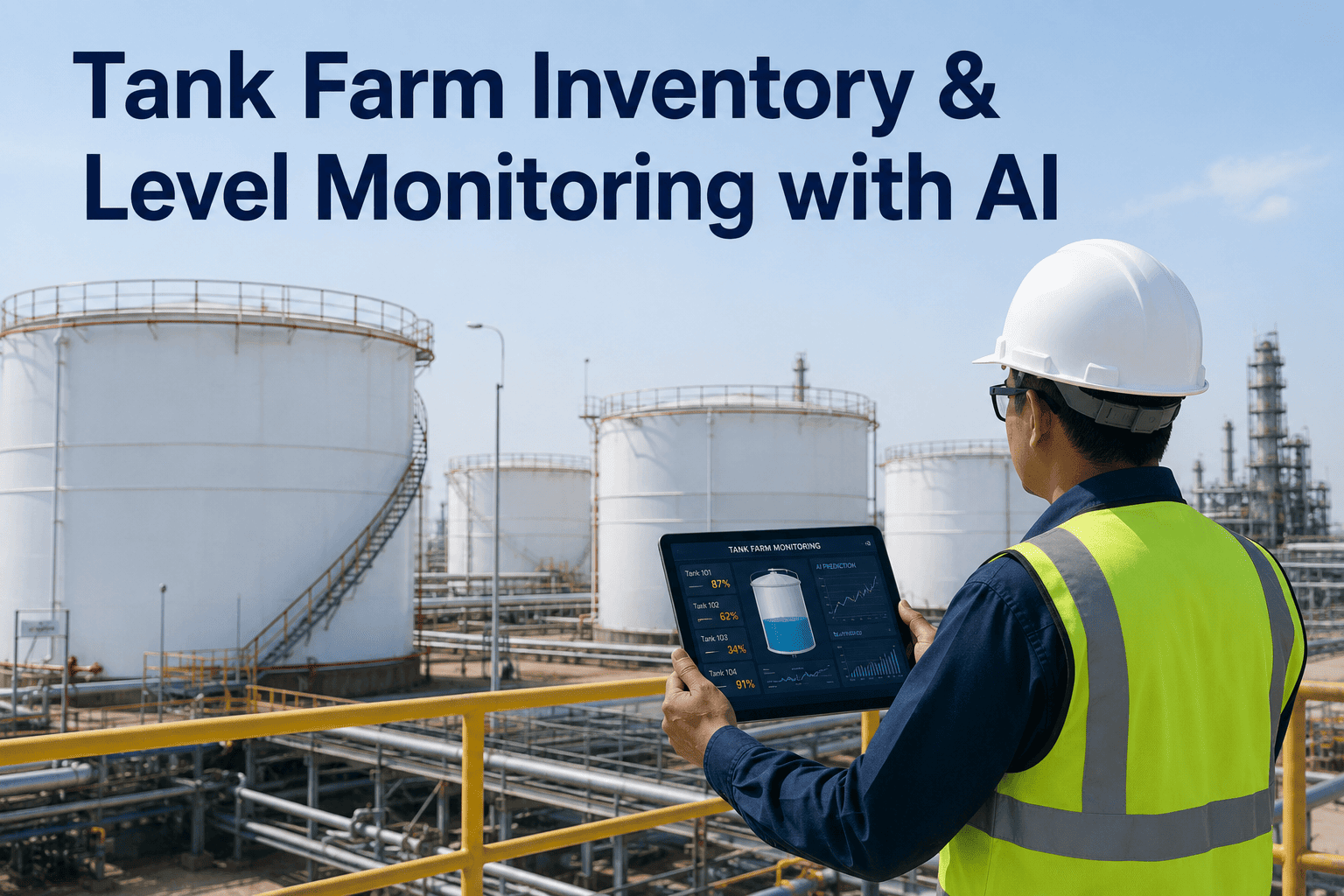
Manual tank gauging — sending a technician to climb every tank, drop a gauge tape, and record the level on a clipboard — remains the primary inventory method at a surprising number of oil storage terminals. This approach was acceptable when terminals handled a few tanks with low throughput, but modern tank farms managing dozens of crude and product tanks with continuous custody transfers cannot operate safely or efficiently with periodic manual measurements. The gap between manual readings creates inventory uncertainty, increases overfill risk, introduces custody transfer disputes, and makes it impossible to detect slow leaks before they become reportable environmental events. If your terminal still relies on manual gauging for daily inventory, Book a Demo to see how AI-driven tank level monitoring transforms inventory accuracy in real time.
Replace Manual Gauging with Continuous AI-Driven Tank Inventory Management
iFactory delivers real-time tank level monitoring, automated custody transfer calculations, and AI-powered stock reconciliation across every tank in your terminal — from a single dashboard.
The Hidden Cost of Manual Tank Gauging
Oil storage terminals that rely on manual gauging accept a set of operational risks and costs that are invisible in day-to-day operations but accumulate into significant financial and safety exposure over time. The metrics below represent industry-averaged performance gaps reported by terminals that have subsequently transitioned to automated tank level monitoring — providing a benchmark for evaluating your own operation's exposure.
Average volume discrepancy between book inventory and actual tank contents at facilities using periodic manual gauging without automated reconciliation.
Percentage of manual gauge readings that deviate beyond acceptable custody transfer tolerance when cross-checked against automated level measurement systems.
Custody transfer disputes that require manual investigation, re-measurement, or third-party arbitration due to reliance on manual gauging at transfer points.
Slow leaks that go undetected for more than 48 hours at manually gauged terminals because the volume loss falls within the accepted measurement uncertainty band.
Tank Level Measurement Technologies: Accuracy and Application
Selecting the right level measurement technology for each tank depends on product type, tank geometry, operational conditions, and custody transfer requirements. No single technology is optimal for every application — best-practice tank farms deploy a mix of technologies matched to each tank's specific requirements. The comparison below covers the six primary measurement technologies used in oil and gas tank farms, with accuracy ratings reflecting performance under standard operating conditions.
Non-contact measurement using microwave radar pulses. Ideal for crude oil, diesel, and gasoline storage. Unaffected by vapor density, temperature gradients, or product dielectric changes. Preferred technology for custody transfer applications requiring highest accuracy.
Mechanical displacer that tracks the liquid surface with high precision. Long-established technology with proven custody transfer performance. Requires regular mechanical maintenance but delivers consistent accuracy across a wide range of product densities and temperatures.
Mechanical float connected to a tape that indicates level on a local head gauge. Widely installed as the legacy standard in older terminals. Suitable for inventory monitoring but typically not accepted for custody transfer without independent verification.
Non-contact measurement using ultrasonic sound waves. Cost-effective for general inventory monitoring in simple applications. Performance affected by foam, vapor layers, and temperature stratification — limiting use in custody transfer or challenging product conditions.
Radar signal guided along a probe extending into the tank. Excellent for tanks with narrow nozzles, internal obstructions, or turbulent surfaces where free-space radar performance may be compromised. Suitable for both custody transfer and inventory monitoring.
Calculates level from pressure measurements at the tank bottom combined with density and temperature inputs. Provides mass-based inventory directly. Requires accurate density measurement and is affected by tank stratification but eliminates some surface measurement challenges.
AI-Powered Inventory Reconciliation Pipeline
Raw tank level data alone does not give you accurate inventory. The transformation from a sensor reading to a verified stock position requires a multi-stage data pipeline that corrects for temperature, density, tank geometry, and measurement uncertainty — then reconciles the calculated volume against all inflows, outflows, and known losses. The pipeline below represents the five-stage reconciliation process that iFactory automates for tank farm operators, replacing spreadsheet-based calculations that are slow, error-prone, and impossible to audit in real time.
Level, temperature, and pressure readings collected from every tank at configurable intervals. Data validated for sensor health, communication status, and out-of-range detection before entering the pipeline.
Observed level converted to gross volume using tank strapping tables. Temperature compensation applied using ASTM tables to calculate standard volume at reference conditions for each product.
Standard volume converted to mass using measured or calculated density. Net volume derived by subtracting sediment and water from gross observed volume per API measurement standards.
Calculated inventory compared against book inventory from all receipt, transfer, and shipment transactions. AI identifies discrepancies, flags potential leaks, and auto-corrects for known measurement biases.
Final reconciled inventory published to the operations dashboard, custody transfer system, and enterprise ERP. Full audit trail maintained with every calculation step, correction, and variance flag documented.
Custody Transfer Measurement Standards
Custody transfer transactions — where ownership of bulk liquid product changes hands — require measurement systems that meet specific accuracy standards defined by industry bodies. The table below consolidates the key custody transfer requirements that tank farm operators must satisfy, along with the measurement technology and documentation that iFactory's platform automates for each standard.
| Standard | Accuracy Requirement | Measurement Method | Documentation | iFactory Automation |
|---|---|---|---|---|
| API MPMS Chapter 3 | Level measurement within defined tolerance per tank size and type | Automatic tank gauge with proven custody transfer accuracy | Gauge calibration records, strapping table verification, uncertainty analysis | Automated calibration scheduling with deviation alerts and digital record storage |
| API MPMS Chapter 11 | Temperature measurement within 0.5 degrees F of true product temperature | Multiple temperature sensors at prescribed tank heights | Temperature sensor calibration, average temperature calculation records | Automated average temperature calculation with sensor validation and audit logging |
| API MPMS Chapter 12 | Density measurement within prescribed tolerance for volume correction | In-tank density probe or laboratory sample analysis | Density measurement records, sample analysis reports, density correction factors | Density data integration from probes and lab systems with automatic volume correction |
| ASTM D1250 | Volume correction factors applied per standard temperature and pressure tables | Calculated correction based on measured temperature, density, and product type | Volume correction calculation records with input parameters and results | Automated ASTM table lookup and correction factor application with full traceability |
Overfill Prevention: Defense in Depth
Tank overfill remains one of the most catastrophic failure modes in oil storage operations — a single overfill event can cause environmental damage, facility destruction, and fatalities. Effective overfill prevention requires multiple independent protection layers, each capable of preventing overfill if the upstream layer fails. The layered defense model below represents the five-level protection architecture that regulatory standards like API 2350 and IEC 61511 require, and that iFactory's tank monitoring platform enforces through automated alarm management and safety system integration.
Primary automatic tank gauge provides real-time level display with high-level and high-high-level alarm setpoints configured at predefined percentages of tank capacity.
Configurable alarm triggers when level reaches the first warning threshold. Operator notified via dashboard, mobile push notification, and audible alarm. Requires operator acknowledgment and response action.
Critical alarm at the second threshold automatically stops inflow pumps and closes inlet valves through hardwired safety system integration. Independent of the primary monitoring system to eliminate common-cause failure.
Safety Instrumented System with SIL-rated logic solver initiates facility-wide emergency shutdown when overfill is detected by an independent level sensor. Bypass prevention and proof-testing enforced per IEC 61511.
Secondary containment — bund walls, dykes, and impoundment basins — provides the final physical barrier to prevent product release to the environment. Containment integrity verified through periodic inspection and capacity certification.
See AI-Driven Tank Monitoring Live for Your Terminal
Continuous level measurement, automated volume correction, AI reconciliation, and overfill prevention — configured for crude oil and product storage terminals.
Tank Farm Dashboard: Unified Operations View
The operational value of automated tank level monitoring is realized through the dashboard interface that presents all tank data, alarms, trends, and reconciliation status in a format that operators can scan quickly and act on decisively. The dashboard architecture below represents the layout model that iFactory deploys for tank farm operators — organizing information into functional zones that mirror how operators actually think about terminal operations during a shift.
Measurable Outcomes After AI Tank Monitoring Deployment
Storage terminals that have deployed iFactory's AI-driven tank inventory management platform report consistent, measurable improvements across inventory accuracy, operational efficiency, and safety compliance. The figures below represent aggregated performance data from tank farm deployments across crude oil terminals, product distribution terminals, and refinery tank farms.
Frequently Asked Questions
Every Tank. Every Reading. Every Transfer — Verified Automatically.
Continuous level monitoring, AI reconciliation, custody transfer automation, and overfill prevention — deployed in 10 to 14 weeks for any tank farm configuration.