Every year, hospitals lose accreditation status, face CMS penalties, and expose patients to preventable harm — not because of clinical failure, but because Environment of Care (EC) documentation was incomplete, inspection rounds were missed, or utility systems went unmonitored. The Joint Commission does not forgive administrative gaps when lives are at stake. If your EC program is running on spreadsheets, paper logs, and memory, you are not managing compliance — you are gambling with it.
Is Your Environment of Care Program Audit-Ready?
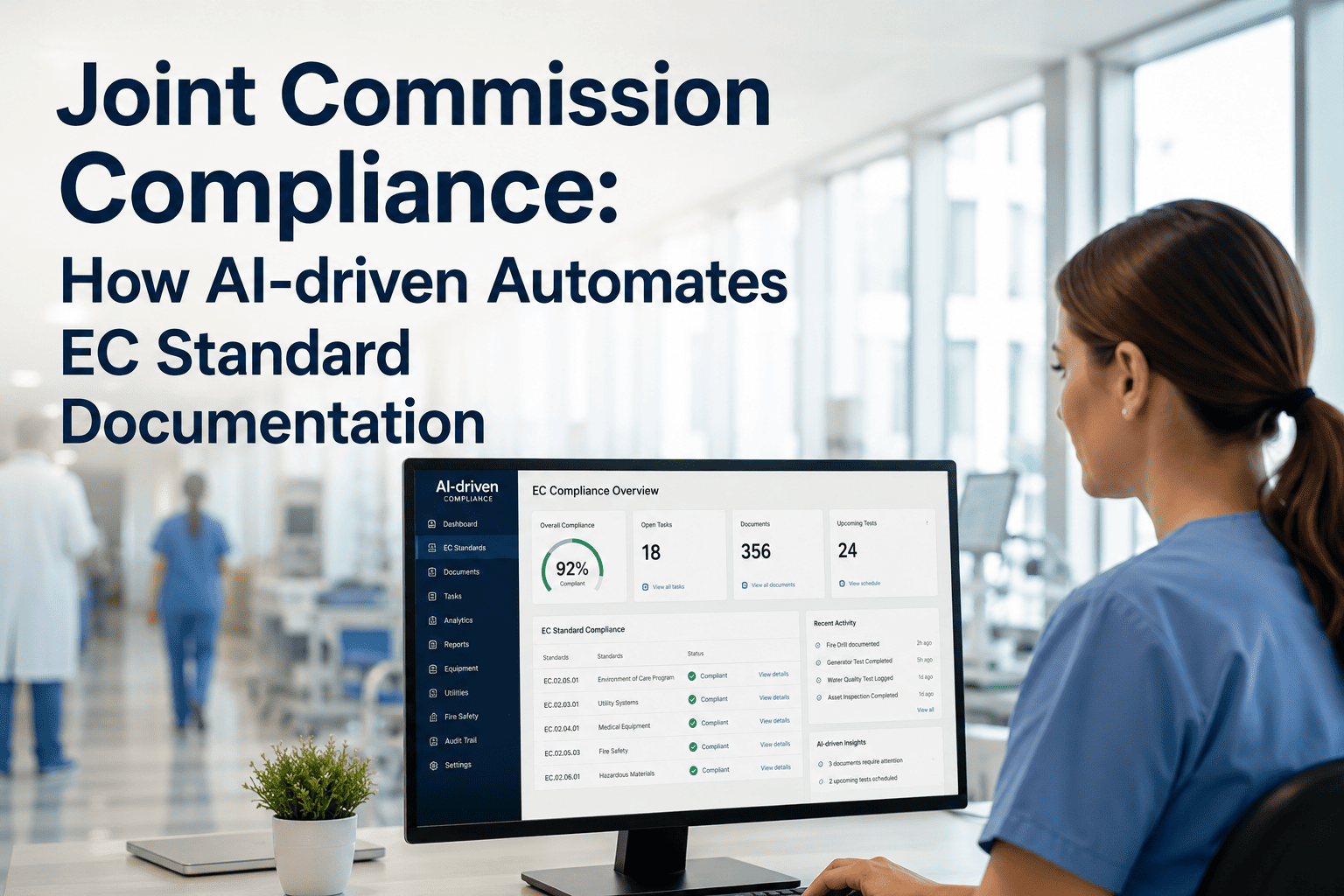
iFactory centralizes EC management plans, inspection rounds, hazmat tracking, and utility systems compliance into one defensible, survey-ready dashboard.
What EC Non-Compliance Actually Costs Your Hospital
Joint Commission EC standards span six management plans — Safety, Security, Hazardous Materials, Fire Safety, Medical Equipment, and Utility Systems. Each plan demands documented policies, active monitoring, staff training, and audit trails. The financial and reputational cost of gaps is significant.
Accreditation Risk
- Immediate Threat to Life (ITL) findings trigger on-site revisit
- Conditional accreditation is publicly disclosed by TJC
- Loss of accreditation ends Medicare/Medicaid billing eligibility
Financial Exposure
- CMS penalties reach up to $10,000 per day per violation
- Deferred maintenance escalates capital repair costs 3–5x
- Litigation from patient harm linked to EC failures is uninsurable
Operational Drain
- Manual EC round documentation consumes 8–12 hours per week
- Missing logs require costly remediation before survey windows
- Staff time diverted from care to paperwork increases burnout
Patient Safety
- Undetected utility failures create life-safety emergencies
- Hazmat mismanagement exposes patients and clinical staff
- Fire safety lapses remain the top-cited EC deficiency category
The Six EC Management Plans: Compliance Obligations at a Glance
Every Joint Commission-accredited hospital must maintain six active EC management plans. Each plan requires documented scope, defined goals, performance objectives, and measurable outcomes — reviewed and updated at minimum annually.
| EC Management Plan | Core Standard | Key Requirement | Survey Focus | iFactory Capability |
|---|---|---|---|---|
| Safety Management | EC.02.01.01 | Safety officer designation, hazard surveillance | Risk assessments, incident logs | Automated Rounds |
| Security Management | EC.02.01.03 | Access control, infant security, workplace violence | Incident response documentation | Incident Tracking |
| Hazardous Materials | EC.02.02.01 | MSDS/SDS management, spill response plans | Chemical inventory, disposal records | Hazmat Register |
| Fire Safety | EC.02.03.01–05 | Fire drills, extinguisher checks, sprinkler testing | Drill logs, equipment inspection dates | Automated Alerts |
| Medical Equipment | EC.02.04.01–03 | Preventive maintenance schedules, recall tracking | PM completion rates, CMMS integration | PM Scheduling |
| Utility Systems | EC.02.05.01–09 | Emergency power, water management, medical gas | Testing logs, failure response records | Utility Dashboard |
Legacy EC Programs vs. iFactory-Optimized Compliance
The gap between manual EC management and a centralized compliance platform is not a matter of convenience — it is a measurable difference in survey outcomes, staff capacity, and institutional risk. The matrix below reflects where hospitals lose points and accreditation standing.
| Compliance Dimension | Legacy Friction | iFactory Optimized Excellence |
|---|---|---|
| EC Rounds Documentation | Paper forms, Excel logs, manual filing — prone to gaps | Mobile-first digital rounds with geo-tagged, timestamped records |
| Fire Safety Drill Tracking | Spreadsheet entries updated retroactively before surveys | Real-time drill logging with automated frequency compliance alerts |
| Utility System Testing Logs | Decentralized binders across departments — unverifiable | Centralized utility dashboard with test schedule enforcement |
| Medical Equipment PM Rates | Missed PMs discovered during survey tracer activity | Proactive PM scheduling with overdue escalation and CMMS sync |
| Hazmat Inventory Control | Outdated SDS binders, inconsistent disposal documentation | Digital chemical register with current SDS links and disposal logs |
| Corrective Action Follow-Up | Email threads and verbal handoffs — no accountability chain | Assigned work orders with due dates, status tracking, and sign-off |
| Survey Readiness Score | Unknown until surveyor arrives — reactive scramble | Live compliance score with gap identification 365 days a year |
| Reporting for EC Committee | Hours of manual compilation from multiple sources | One-click EC committee reports with trend analytics and benchmarks |
How EC Compliance Excellence Drives Clinical & Operational Outcomes
Environment of Care compliance is not a back-office function — it directly shapes patient safety, clinical throughput, and staff retention. When the physical environment is proactively managed, care delivery operates at full capacity.
Staff Burnout Reduction
- Eliminate manual documentation burden with digital rounds
- Automated alerts replace memory-dependent compliance tracking
- Engineers focus on repairs — not paperwork and filing
- Facilities teams recover 6–10 hours per week per manager
Patient Safety Assurance
- Utility failures detected and escalated before patient exposure
- Hazmat incidents documented and reviewed in real time
- Fire safety deficiencies corrected proactively, not reactively
- Medical equipment failures prevented through PM compliance
Throughput & Capacity
- Faster bed turnover when environment defects are resolved promptly
- Reduced survey prep disruption — no emergency documentation pulls
- Departments stay operational during TJC visits with confidence
- Capital planning optimized via predictive maintenance data
How iFactory Deploys EC Compliance Management in 5 Phases
Operational Gap Audit
- Benchmark current EC documentation against TJC standards
- Identify highest-risk deficiency categories for your facility type
- Produce a prioritized remediation roadmap before go-live
Management Plan Configuration
- Load all six EC management plan templates into the platform
- Map existing policies to required TJC standard references
- Set annual review reminders and ownership assignments
Rounds & Inspection Activation
- Deploy mobile EC round checklists mapped to your floor plans
- Configure fire, utility, and hazmat inspection schedules
- Activate automated alerts for overdue inspections and failed items
Corrective Action Workflow
- Auto-generate work orders from failed inspection line items
- Assign owners, due dates, and escalation paths for every deficiency
- Close-out requires photographic evidence and supervisor sign-off
Continuous Survey Readiness
- Live compliance dashboard updated with each completed inspection
- EC committee reports generated automatically on a defined cadence
- Full audit trail exportable for TJC surveyors on arrival
Top TJC EC Findings That iFactory Eliminates
Joint Commission publishes its most frequently cited EC standards each year. These recurring findings are not complex clinical failures — they are documentation and process gaps that a centralized platform resolves systematically.
Missing annual fire door inspection records under EC.02.03.05 — resolved with scheduled inspection workflows and automatic completion logging.
Generator load testing and medical gas inspections not completed on required intervals — resolved with calendar-enforced utility test scheduling.
Chemicals in use without current SDS documentation or disposal records — resolved with a live digital hazmat register linked to approved SDS sources.
Preventive maintenance completion rates below 100% at time of survey — resolved with CMMS-synced PM scheduling and overdue escalation.
Environment of care rounds not completed at required frequency or with insufficient detail — resolved with mobile round checklists and geo-tagged completion records.
Open deficiencies from prior rounds without documented resolution — resolved with mandatory close-out workflows requiring evidence upload and sign-off.
Stop Reacting to Surveys. Start Leading Them.
iFactory gives your Environment of Care program the documentation infrastructure, automation, and visibility to achieve and sustain Joint Commission compliance year-round.
Joint Commission Environment of Care — Frequently Asked Questions
How often must EC management plans be reviewed under TJC standards?
All six EC management plans must be reviewed and approved at minimum annually. iFactory automates review reminders and tracks approval signatures within the platform, ensuring the annual cycle is never missed.
What documentation does TJC request for EC.02.05.01 utility systems compliance?
Surveyors will request testing logs for emergency generators, medical gas systems, and water management programs. iFactory maintains all test records in a centralized, date-stamped repository exportable on demand.
Can iFactory integrate with our existing CMMS for medical equipment management?
Yes. iFactory provides API-based integration with leading CMMS platforms to synchronize PM schedules, completion records, and equipment recall notices directly into the EC compliance dashboard. Book a Demo to review integration specifications.
How does iFactory support multi-campus health systems with multiple TJC programs?
The platform supports multi-site hierarchy with campus-level dashboards and system-level rollup reporting. Each facility maintains its own EC documentation while leadership gains enterprise-wide compliance visibility in a single view.
What is the typical time to full EC compliance deployment?
Most facilities achieve full EC program deployment within 30–45 days. The process begins with an Operational Gap Audit, followed by phased configuration of management plans, inspection workflows, and reporting cadences. Consult our architects to build your deployment timeline.
Start Your Joint Commission EC Compliance Transformation
iFactory's compliance management platform is purpose-built for hospital Environment of Care programs. Achieve survey readiness. Eliminate documentation risk. Protect your accreditation.