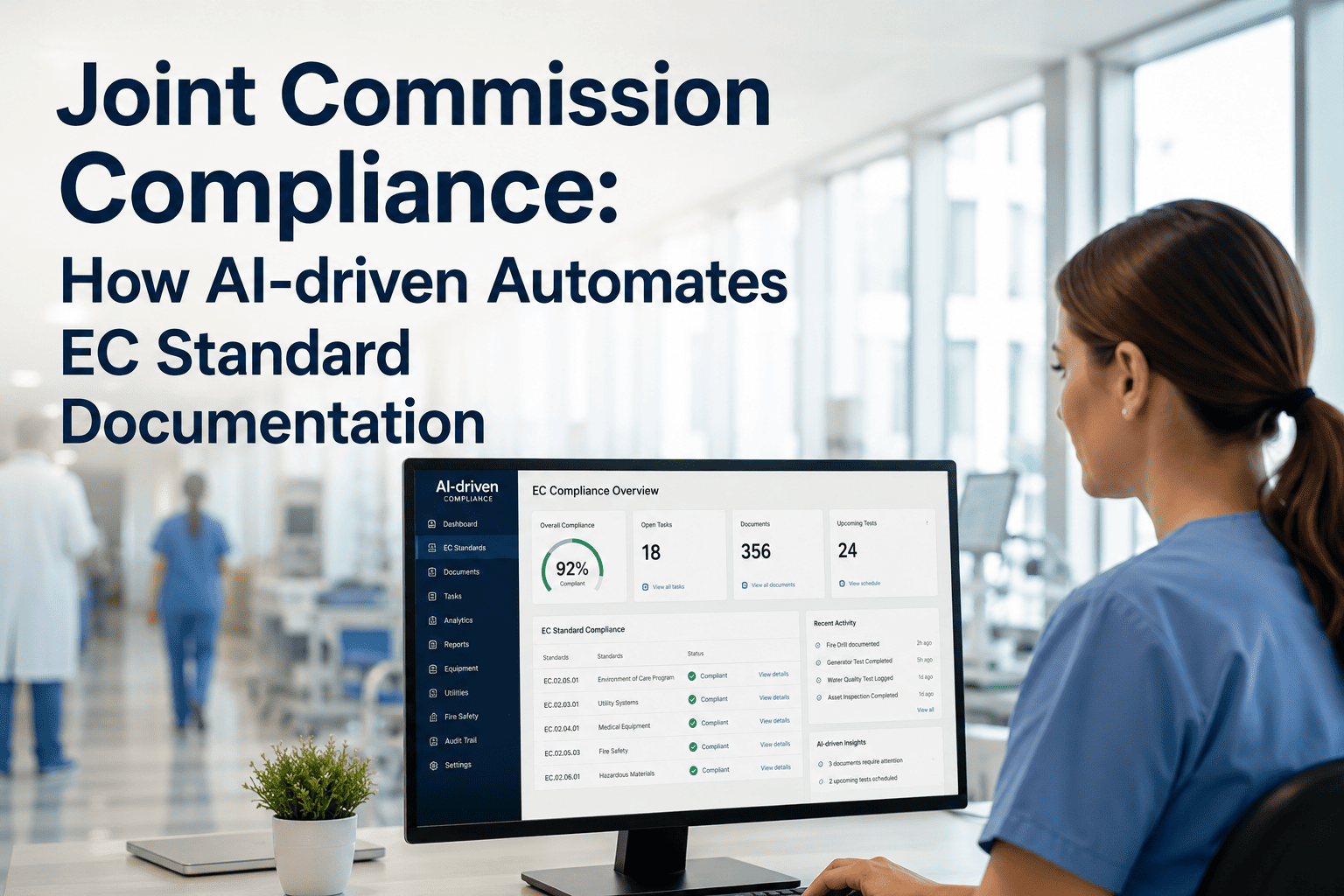
Every hospital compliance officer who wakes up in 2026 still mapping Environment of Care standards to a spreadsheet is quietly hemorrhaging accreditation readiness—and most don't realize it until a surveyor is already on-site.
Is Your Facility Ready for the New PE Standards?
iFactory maps your compliance workflows to the 2026 Physical Environment structure—before your next survey cycle.
What the 2026 TJC Overhaul Actually Means for Operations
The Joint Commission's 2026 restructure replaces the legacy EC and LS chapter format with a unified Physical Environment (PE) standards framework. For compliance teams, this is not a cosmetic rename—it is a complete reorganization of survey logic, evidence requirements, and scoring methodology.
- EC and LS chapters consolidated into single PE chapter
- New standard numbering across all Elements of Performance
- Revised survey scoring weights for life safety findings
- Updated documentation evidence requirements per standard
- Mapped evidence gaps trigger Requirement for Improvement
- Life safety deficiencies escalate to Conditional Accreditation
- CMS reimbursement linkage amplifies non-compliance cost
- Retroactive survey findings tied to legacy chapter mapping
- Effective date: January 1, 2026 for all TJC-accredited hospitals
- First PE-framework surveys already underway in Q1 2026
- Policy and procedure updates required before next survey window
- Staff training on new PE structure required for frontline leads
How the New PE Chapter Replaces EC & LS
The legacy structure required teams to cross-reference two separate chapters to build a complete compliance picture. The 2026 PE framework eliminates that duplication—but demands a complete remapping of existing policies, rounding tools, and audit workflows.
| Legacy Chapter | Legacy Standard Focus | New PE Equivalent | Key Shift | Survey Impact |
|---|---|---|---|---|
| EC.01.01.01 | Environment of Care planning | PE.01.01.01 | Unified plan scope | High |
| EC.02.03.05 | Fire safety systems | PE.02.03.xx | LSC integrated | High |
| LS.02.01.10 | Building construction features | PE.02.01.xx | Consolidated scoring | High |
| EC.04.01.01 | Environment of Care evaluation | PE.04.01.01 | Outcome metrics added | Medium |
| EM.11.01.01 | Emergency management | PE.06.01.xx | Hazard linkage required | Medium |
| EC.02.05.01 | Utility systems management | PE.02.05.xx | Criticality tiers revised | Lower |
Legacy Friction vs. iFactory Optimized Compliance
Most facilities are still managing 2026 PE compliance with workflows built for the old EC/LS structure. The operational gap this creates is measurable—in surveyor findings, staff hours, and remediation cost.
- Manual crosswalk of EC standards to new PE numbers
- Spreadsheet-based rounding logs with no audit trail
- Siloed life safety and environment of care data
- Policy updates managed via email threads
- Survey prep reactive—triggered by scheduled survey notice
- Evidence retrieval averaged 4–6 hours per surveyor request
- Staff uncertainty on which PE standard applies per finding
- Automated PE standard mapping with version control
- Digital rounding with timestamped, surveyor-ready logs
- Unified compliance dashboard across all PE domains
- Policy workflow with approval routing and version history
- Continuous survey readiness—always-on gap monitoring
- Evidence retrieval in under 60 seconds per standard
- Staff guided by built-in PE standard tagging per task
How PE Compliance Gaps Translate to Patient & Staff Risk
Compliance failures under the new PE framework are not administrative inconveniences. They are direct risk vectors for patient safety incidents, staff burnout, and accreditation status—each with measurable financial consequence.
Patient Safety
- Delayed life safety deficiency remediation increases sentinel event exposure
- Utility system gaps disrupt critical care continuity
- Fire and egress findings carry CMS citation risk
- Documentation failures invalidate corrective action evidence
Staff Burnout
- Manual crosswalk work consumes 10–15 hours per compliance cycle
- Redundant rounding documentation lowers frontline engagement
- Survey anxiety peaks when readiness tools are fragmented
- Reactive remediation culture drives turnover in plant ops teams
Operational Throughput
- Survey findings trigger work order backlogs affecting bed availability
- Conditional accreditation status stalls capital project approvals
- Evidence retrieval delays extend on-site survey duration by hours
- Automated compliance frees leadership for strategic priorities
2026 PE Survey Preparation: Priority Action Steps
Remap All Policies to PE Standard Numbers
- Audit every EC and LS policy reference and update to PE numbering
- Flag policies with no direct PE equivalent for leadership review
- Establish version control with effective date tracking
Rebuild Rounding Tools Around PE Elements of Performance
- Replace EC/LS checklist fields with PE EOP-aligned questions
- Tag each rounding item to its PE standard for surveyor traceability
- Digitize logs to enable instant evidence retrieval during surveys
Conduct a PE Gap Analysis Before Your Survey Window
- Assess current documentation coverage per PE standard category
- Prioritize life safety and fire system standards as high-risk domains
- Assign remediation owners with deadline accountability
Train Frontline and Plant Operations Teams on PE Framework
- Deliver role-specific training on new standard applicability
- Equip rounding staff with PE-tagged digital workflows
- Brief department heads on escalation triggers under new scoring
Implement Continuous Readiness Monitoring
- Replace annual mock surveys with rolling compliance dashboards
- Set automated alerts for overdue PE-linked work orders
- Generate surveyor-ready evidence packages on demand
Top 2026 PE Compliance Gaps Surveyors Are Already Finding
Policies still referencing EC or LS chapter numbers rather than updated PE standard identifiers—automatically flagged as out-of-compliance during document review.
Life safety data managed separately from environment of care records, preventing the unified PE compliance picture surveyors now require.
Paper or spreadsheet rounding logs that cannot produce timestamped, standard-linked evidence within the response window surveyors allow on-site.
Work orders closed without linkage to the PE standard that triggered them, creating an evidence gap that surveyors treat as an unresolved deficiency.
Utility system inventories not updated to reflect the revised PE criticality tier definitions introduced in the 2026 framework overhaul.
Emergency operations plans not cross-referenced to the new PE.06 hazard vulnerability linkage requirements, creating a scoring exposure on EM standards.
Close Your 2026 PE Compliance Gap Before Your Next Survey
iFactory automates PE standard mapping, rounding documentation, and evidence retrieval—so your team is always survey-ready, not scrambling.
2026 Joint Commission PE Standards — Common Questions
When do the 2026 PE standards take effect for accredited hospitals?
The Physical Environment chapter framework is effective January 1, 2026 for all Joint Commission-accredited hospitals and health systems. Surveys conducted after this date use the new PE standard structure exclusively—legacy EC and LS numbering is no longer accepted as compliant policy reference.
Do we need to rewrite all our policies or just update the standard references?
At minimum, all standard number references in policies, procedures, and rounding tools must be updated to PE chapter numbering. However, many facilities find that the consolidation also requires substantive content updates—particularly where EC and LS policies previously overlapped and must now be merged under a single PE policy framework.
How does the new PE structure affect life safety scoring during surveys?
Life safety findings are now scored within the PE chapter framework rather than a separate LS chapter. This means life safety deficiencies aggregate with environment of care findings under a single PE compliance score—a configuration that increases the weight of any single life safety finding on overall accreditation status.
Can iFactory automatically map our existing compliance data to the new PE standards?
Yes. iFactory's Compliance Management module includes a structured PE crosswalk engine that maps existing EC and LS policy and rounding data to the corresponding PE standard identifiers. Teams can validate the mapping, flag gaps, and assign remediation owners without starting from scratch. Book a Demo to see a live walkthrough of this workflow.
What is the financial impact of a Requirement for Improvement under the new PE framework?
A Requirement for Improvement (RFI) under the 2026 PE framework triggers a mandatory Evidence of Standards Compliance submission within 45–60 days. Unresolved RFIs escalate to Conditional Accreditation, which activates CMS oversight and can freeze capital project approvals. Most health systems estimate direct remediation and administrative cost per RFI cycle between $50,000 and $200,000 depending on the deficiency scope.
Map Your Facility to 2026 PE Standards Before Your Survey Window
Join healthcare compliance teams already using iFactory to automate PE standard tracking, rounding evidence, and survey readiness reporting.