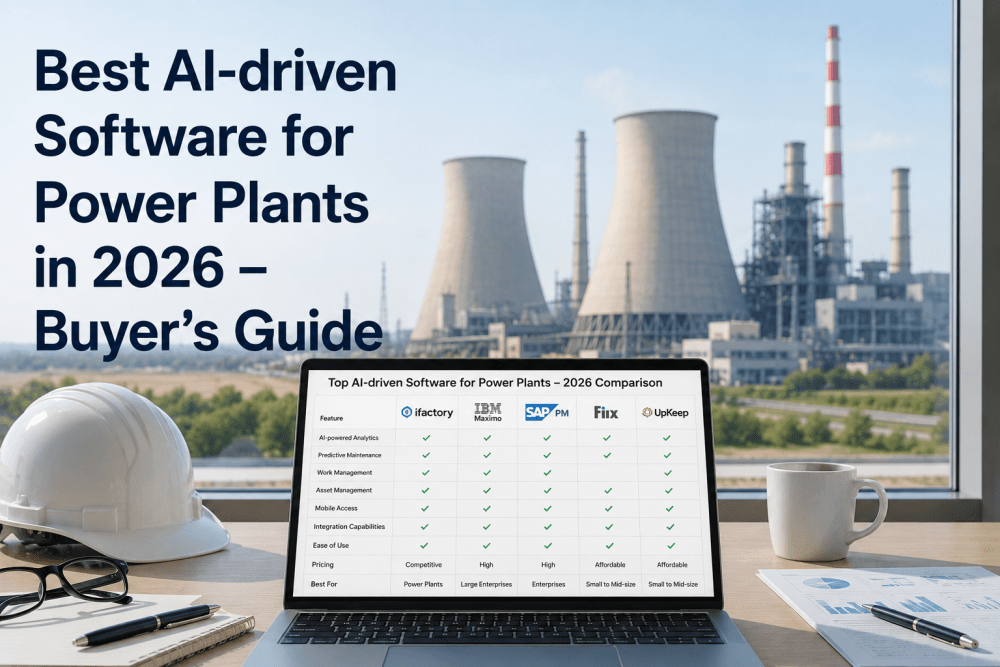
Most CMMS evaluations turn into a feature checklist comparison that never actually tests whether the system fits how a power plant operates, and the gap only becomes visible after go-live when work orders don't map cleanly to actual maintenance workflows or the integration with the DCS and asset history never quite works the way the sales demo suggested. A power plant's maintenance operation has requirements a generic CMMS built for facilities or light industrial use doesn't anticipate. iFactory works alongside whichever CMMS a plant selects, and the evaluation criteria below reflect what tends to separate a good fit from a costly one, worth reviewing before you Book a Demo.
A Generic CMMS Rarely Survives Contact With Power Plant Maintenance Reality
Power generation maintenance involves regulatory-driven inspection cycles, complex asset hierarchies, and integration needs that most off-the-shelf CMMS platforms weren't designed around. Evaluating on feature checklists alone misses the deployment and integration questions that actually determine whether the system gets adopted or quietly abandoned within a year.
Five Questions A Feature Checklist Won't Answer
Vendor demos are built to show the system at its best, on clean sample data, doing exactly what the sales script anticipates being asked. The questions that actually predict whether a CMMS will hold up in a power plant maintenance operation are rarely the ones a standard demo answers directly, and they're worth asking explicitly during evaluation rather than assuming the answer is yes.
Asset Hierarchy Depth
A power plant's asset structure runs many levels deep, from unit to system to component to individual instrument tag, and a CMMS with a shallow hierarchy model forces awkward workarounds that undermine reporting accuracy later.
Regulatory Inspection Scheduling
Boiler code inspections, relief valve testing, and other compliance-driven maintenance need scheduling logic that respects regulatory intervals specifically, not just a generic recurring work order template.
DCS And Historian Integration
Whether the CMMS can actually pull condition data from the plant historian and DCS to trigger condition-based work orders, versus requiring manual data entry, determines whether predictive maintenance workflows are realistic at all.
Where Integration Requirements Get Underestimated During Evaluation
A feature list rarely surfaces the integration architecture questions that end up consuming most of an implementation timeline. How the CMMS authenticates against existing plant systems, whether it supports a real-time data feed or only batch imports, and how it handles offline access in areas of the plant with poor connectivity are architecture-level decisions that are much harder to change after go-live than a configuration setting.
Offline And Field Access
Technicians working inside a turbine hall or switchyard often don't have reliable connectivity, so offline work order access and sync-on-reconnect behavior matters more in a power plant than in a typical office-based facilities deployment.
Real-Time vs Batch Data Feeds
A CMMS that only ingests condition data on a nightly batch cycle can't support same-shift condition-based dispatch, which limits how much of a predictive maintenance program can actually run through it.
Vendor Roadmap Alignment Matters More Than It Gets Credit For
A CMMS purchase is a multi-year commitment, and it's worth asking not just what the platform does today but where the vendor's product roadmap is actually headed, particularly around condition-based maintenance and analytics integration. A vendor still primarily focused on reactive work order management may be a perfectly fine fit for a plant not yet pursuing predictive maintenance, but a mismatch for one planning to scale a condition-monitoring program over the next few years, since retrofitting analytics integration onto a platform that wasn't architected for it tends to be far more painful than choosing correctly the first time.
API Openness
A platform with a well-documented, actively maintained API makes future integration with analytics tools, historians, and mobile field applications materially easier than one that only exposes limited or undocumented endpoints.
Vendor Roadmap Direction
Where the vendor is investing product development effort next, particularly around condition-based triggers and analytics integration, is a reasonable predictor of how well the platform will scale with a growing predictive maintenance program.
Evaluate Against How Your Plant Actually Runs Maintenance
iFactory works with your chosen CMMS to close the gap between raw condition data and an actionable work order.
What Changes When Selection Goes Beyond The Feature List
| Aspect | Feature Checklist Evaluation | Fit-Based Evaluation |
|---|---|---|
| Asset hierarchy suitability | Assumed adequate | Tested against actual plant structure |
| Regulatory scheduling accuracy | Generic recurring templates | Confirmed against real compliance intervals |
| Integration readiness | Discovered post-purchase | Validated during evaluation |
| Field usability | Assumed from office demo | Tested for offline and field conditions |
Field Technician Usability Is The Difference Between Deployed And Adopted
A CMMS can pass every technical evaluation criterion and still fail if the technicians actually closing work orders in the field find it slow or cumbersome to use on a mobile device between tasks. Adoption tends to hinge on how few taps it takes to close a routine work order, whether photo and note attachment is genuinely simple, and whether the mobile experience feels designed for a technician standing at an asset rather than a scaled-down version of the desktop interface. A system with strong back-end capability but poor field usability often ends up with work orders closed out in a batch at the end of a shift from memory, which quietly erodes the data quality the whole evaluation was meant to protect.
Mobile Workflow Friction
The number of steps required to close a routine work order in the field is a strong predictor of whether technicians will log data in real time or fall back to end-of-shift batch entry.
Data Quality Depends On Adoption
Even the most technically capable CMMS produces unreliable reporting if field usability friction pushes technicians toward delayed, memory-based data entry instead of real-time logging.
We picked our first CMMS almost entirely off a feature comparison spreadsheet and found out during rollout that it couldn't handle our asset hierarchy without a painful workaround, and the DCS integration we were promised turned into a manual export process. The second time around we tested asset hierarchy depth and integration architecture explicitly before signing anything, and the difference in how smoothly rollout went was night and day.
What Plants Report After A Fit-Based CMMS Selection Process
Frequently Asked Questions
Q: Does iFactory replace our CMMS or work alongside it?
iFactory is designed to work alongside whichever CMMS a plant already has or is evaluating, feeding condition-based insights and predictive maintenance triggers into the work order system rather than replacing the system of record itself. This means the CMMS selection criteria on this page still matter regardless of which analytics layer sits on top. Reach out through Support Contact to discuss your current or planned CMMS.
Q: How do we test integration readiness before committing to a vendor?
Requesting a proof-of-concept integration against a real, limited data feed from your historian or DCS, rather than relying on a sales demo using vendor-prepared sample data, is the most reliable way to confirm integration behavior before signing a contract. A vendor confident in their integration capability should be willing to support this kind of limited-scope test.
Q: What's a realistic implementation timeline for a power plant CMMS?
Timelines vary significantly with asset hierarchy complexity and the amount of historical data being migrated, but plants that validate architecture and hierarchy fit during evaluation generally see meaningfully shorter and less disruptive implementation timelines than those that discover mismatches after the contract is signed.
Q: How should we weigh cost against fit in the evaluation?
A lower-cost system that requires extensive manual workarounds for asset hierarchy or regulatory scheduling often ends up costing more in staff time and adoption friction than a higher-priced system that fits the plant's structure natively, so total cost of ownership rather than license price alone is the more useful comparison. Discuss your specific cost and fit tradeoffs during a Book a Demo session.
Q: Can existing maintenance history be migrated into a new CMMS?
Most modern CMMS platforms support historical work order and asset data migration, though the quality of that migration depends heavily on how clean and structured the historical data already is, and plants with years of inconsistent free-text work order descriptions often need a data cleanup pass before migration to get real value from the new system.
Choose A CMMS That Fits How Your Plant Actually Works
iFactory helps validate integration and condition-data readiness before you commit to a platform.