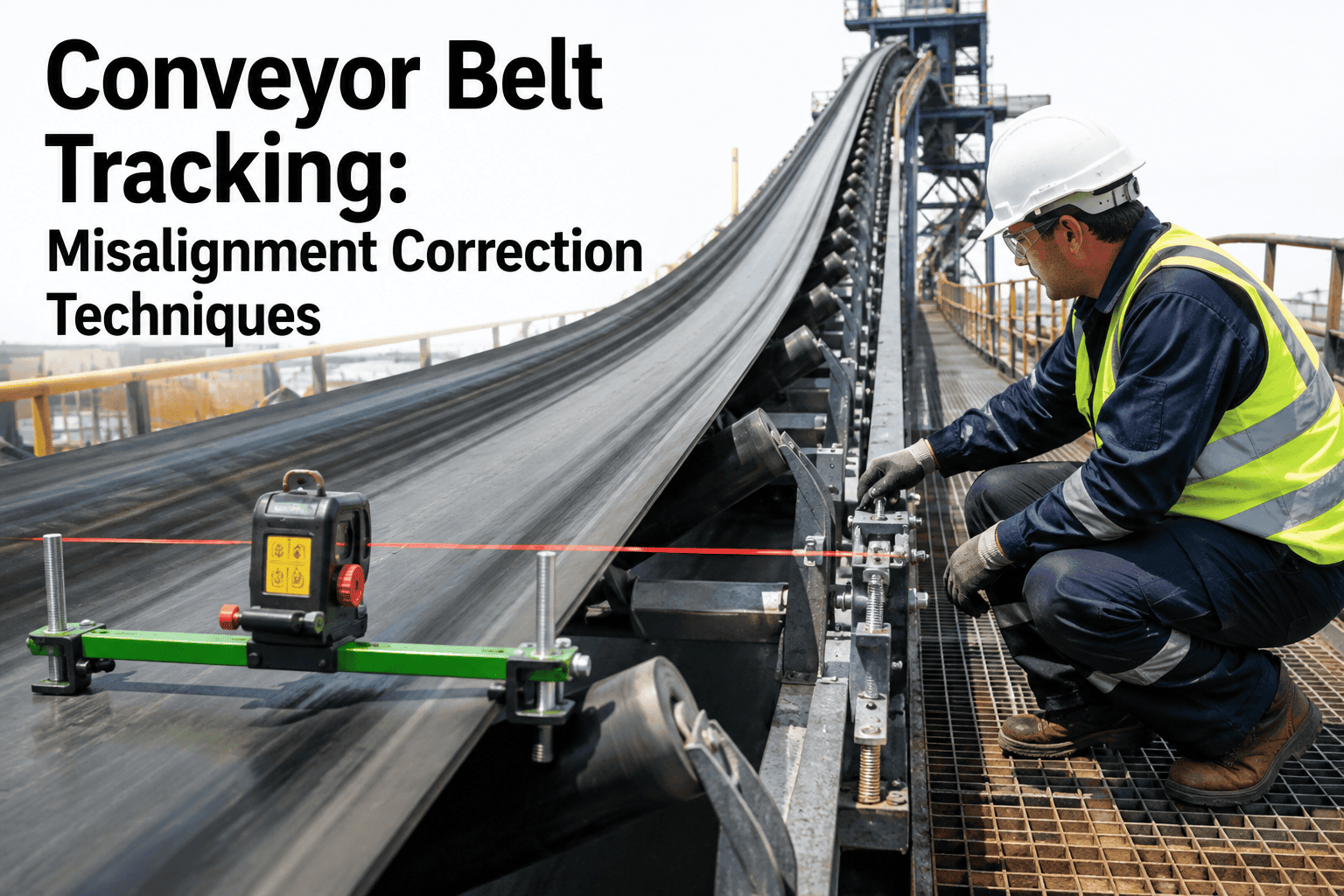
A belt that wanders two inches off center at the head pulley does not look urgent. It looks like something a shift supervisor can note and revisit next week. But left uncorrected, that same drift chews through skirting rubber, spills coal along the return run, and eventually forces an unplanned stop when the belt edge starts shredding against a stringer. Tracking problems are rarely a single-cause event, which is why so many plants chase the symptom for months without fixing the root. This guide walks through how mistracking actually starts, how to diagnose which of the several possible causes is driving it on your conveyor, and the specific adjustment sequence that corrects it without turning into a recurring job. Book a demo to see how continuous tracking data changes this from guesswork to a documented fix.
Coal Conveyor Reliability · Belt Tracking
Conveyor Belt Tracking: A Field Guide to Fixing Misalignment for Good
Mistracking is almost never one problem. It is usually two or three small ones stacking up — a skewed idler here, an off-center load there — until the belt runs out of room to correct itself.
Off-Track Left
Centered
Off-Track Right
A belt is considered mistracked once it runs more than 2 inches from center at any troughing idler or pulley for longer than a full belt revolution.
Root Cause Breakdown
Five Reasons a Belt Refuses to Run Straight
Before adjusting a single idler, it helps to know which category of problem is actually pushing the belt off center. Chasing the wrong cause wastes a shift and rarely holds for more than a few days.
01
Structural Misalignment
Idler frames, stringers, or the pulley shaft itself are not square to the conveyor centerline. This is a construction or installation defect and no amount of training idler adjustment will permanently fix it, since the belt is simply following the geometry it was given.
02
Off-Center Loading
Material lands consistently to one side of the belt at the loading point, usually because a chute or transfer point was never adjusted after a change in feed rate or material characteristics, and the imbalance simply became accepted as normal.
03
Belt Splice Defects
A splice that was cut or vulcanized even slightly out of square creates a permanent bias that shows up as a rhythmic drift once per belt revolution, distinct from a steady one-direction wander that persists no matter where the belt is in its travel cycle.
04
Buildup on Idlers or Pulleys
Coal fines and moisture cake onto idler rolls or the pulley face unevenly, effectively changing the diameter on one side and steering the belt without any frame misalignment at all, which is why this cause is so often missed during a visual inspection.
05
Belt Tension Imbalance
Uneven tension across the belt width, often from a takeup that has racked out of square, leaves one edge slacker than the other and lets that side wander under normal running load, a cause that is easy to overlook since the takeup sits far from the point of visible drift.
Diagnostic Sequence
How to Trace a Mistracking Belt Back to Its Actual Cause
Walk the belt at full speed and mark where the drift starts, not where it is worst. The point where the belt first leaves center is almost always closer to the true cause than the point of maximum deviation, because a small offset compounds as the belt travels further downstream.
1
Chalk the Edge and Walk the Full Length
Mark the belt edge at the head pulley with chalk, then walk the return and carry sides while the belt runs, noting every point where the edge position changes rather than only the worst spot. Take photos or written notes at each reference point so the pattern can be compared against future walks.
2
Check If the Drift Repeats Once Per Revolution
Time the drift against belt length. A wander that appears, disappears, and reappears at a fixed interval points to a splice defect or a localized belt defect, not a structural or loading issue.
3
Inspect the Loading Zone Independently
Stop the belt and check where material actually lands relative to the belt centerline at the loading skirt. An off-center load stream will bias the belt regardless of how well the idlers downstream are aligned, so this check should happen before any idler is touched.
4
Measure Squareness at the Pulleys
Use a tape measure diagonally from each pulley corner to the frame. A difference between the two diagonal measurements indicates the pulley shaft is not perpendicular to the belt travel direction.
5
Confirm Tension Is Even Across the Width
Check the takeup carriage for square travel and confirm both sides of the belt carry comparable tension, since a racked takeup will slacken one edge and let it wander under load. This step is frequently skipped simply because the takeup sits far from where the drift is visible.
iFactory Tracks Belt Position Continuously, Not Just When Someone Walks the Line.
Sensor-based edge tracking flags drift before it reaches the point of skirting damage or spillage, with a documented trend so maintenance can fix the actual cause instead of adjusting the same idler every week.
Correction Techniques
Adjustment Methods That Actually Hold
Each correction method addresses a different root cause. Applying the wrong one, such as adjusting training idlers to compensate for a structural problem, produces a temporary fix that returns within days.
Training Idler Adjustment
Training idlers pivot slightly to steer the belt back to center and work best for minor, intermittent drift. Adjust in small increments, no more than a few degrees at a time, and allow several belt revolutions before judging the effect. Overcorrecting a training idler creates an oscillating wander that is harder to diagnose than the original problem, so patience during this step pays off later.
Structural Squaring
Where diagonal measurements reveal an out-of-square pulley or frame, the fix is mechanical realignment of the structure itself, not an idler adjustment. This typically requires loosening pulley bearing housings, resetting them to measured square, and re-torquing to specification while the belt is stopped and locked out.
Load Point Correction
Adjusting chute plates, impact beds, or the discharge angle of the upstream conveyor to center the material stream on the belt resolves loading-induced drift permanently, since the belt no longer needs to fight an off-center load with every revolution.
Belt Cleaning Schedule
Where buildup on idlers or the pulley face is driving the drift, the fix is a cleaning interval that matches actual accumulation rate, along with primary and secondary belt cleaners set to the correct blade pressure so material does not carry around to the return side.
Before vs. After
What Changes Once Tracking Is Corrected at the Root
Impact Area
Chronic Mistracking
Root-Cause Corrected
Skirting Rubber
Worn through in weeks, replaced repeatedly on the same span without addressing why it wears unevenly
Wears evenly on both sides and reaches its normal service life
Belt Edge Condition
Frayed or cut edges from contact with structure, shortening belt life significantly
Edge remains intact, belt reaches its rated service life
Spillage and Cleanup
Regular manual cleanup along the return run, creating a slip hazard and labor cost
Material stays on the belt, cleanup labor drops substantially
Idler Wear
Uneven load on idler bearings accelerates failure on the side taking extra load
Load distributes evenly, idler bearing life extends
Unplanned Stops
Belt eventually contacts structure hard enough to trip a safety switch or damage the belt
Belt runs within its designed path, safety switches stay in reserve rather than routine
From the Field
A Belt That Kept Coming Back Off Track
We had a 900-foot overland conveyor that drifted right every few days no matter how many times the crew adjusted the training idlers. Eventually someone measured the takeup carriage and found it had racked nearly an inch out of square over the years, quietly slackening one side of the belt. Once we squared the carriage and reset tension evenly across the width, the drift stopped completely. The idler adjustments had been treating a symptom for months while the actual cause sat at the tail end of the conveyor the whole time.
— Maintenance Planner, Coal-Fired Generating Station, 750 MW Unit
6 monthsDrift persisted before root cause was found
1 inchTakeup carriage rack that caused the tension imbalance
0Recurrences since the carriage was squared
Staying Ahead of It
Preventive Checks Worth Adding to a Routine Round
Mistracking rarely appears overnight. Most cases build gradually over weeks, which means a short list of checks during normal rounds catches drift while a small idler adjustment can still fix it.
A
Walk the full belt length at least once per shift and note the edge position at three or four fixed reference points rather than relying on memory from the last round.
B
Check loading chutes and impact beds any time upstream feed rate or material moisture content changes, since both alter where material lands on the belt.
C
Inspect belt cleaners and skirting rubber for uneven wear patterns, which often show a tracking problem before the drift is visible to the eye during a normal walk.
D
Verify takeup travel remains square on gravity and screw takeup systems, since a racked carriage is one of the hardest causes to spot without a direct measurement.
Recordkeeping
Why a Tracking Log Matters More Than a Single Fix
A one-time correction rarely tells the full story on a conveyor that has drifted before. Without a written record of when adjustments were made, what was adjusted, and how long the fix held, the same root cause can resurface months later and get treated as a brand new problem rather than a recurrence worth investigating more deeply.
A useful tracking log captures four things for every adjustment: the date and shift, the specific idler, pulley, or component that was touched, the direction and magnitude of drift observed beforehand, and how long the correction held before the belt needed attention again. Reviewed over a few months, this record often reveals a pattern invisible in any single inspection, such as a drift that always reappears after heavy rain increases material moisture, or a wander that consistently follows a specific splice as it passes through the loading zone. That pattern is frequently the fastest route to the true root cause, faster than any single diagnostic walk could reveal on its own.
Plants that pair this kind of log with continuous sensor data get the clearest picture, since the sensor trend confirms whether a logged adjustment actually resolved the drift or only masked it for a few days before the belt wandered again. Without that confirmation, a training idler adjustment that appears successful during a single follow-up check can still be quietly failing over the following weeks.
Avoid These
Common Mistakes That Make Tracking Problems Worse
Even well-intentioned corrections can extend a tracking problem rather than resolve it. These are the mistakes that show up most often when reviewing conveyors with a long history of chronic drift.
Adjusting Multiple Idlers at Once
Changing several training idlers in the same visit makes it impossible to know which adjustment actually helped, and often introduces a new oscillating drift that is harder to trace than the original problem. One change at a time, with several belt revolutions to observe the result, is slower but far more reliable, and it builds a clearer record of what actually works on that specific conveyor.
Chasing the Point of Maximum Deviation
The spot where a belt looks worst is usually downstream of where the drift actually begins, since small offsets compound as the belt travels. Adjusting idlers at the worst-looking point instead of the origin point treats the amplified symptom rather than the source.
Overtightening a Training Idler
Large, aggressive adjustments to a training idler often overcorrect the belt, sending it drifting in the opposite direction. This creates a back-and-forth oscillation that can look like a new, more severe tracking problem when it is really just an overcorrected fix.
Ignoring Seasonal or Moisture-Driven Changes
A tracking fix applied during dry conditions can fail once material moisture content rises and changes how the load sits on the belt. Reviewing tracking performance across different weather and production conditions avoids mistaking a seasonal pattern for a permanently resolved issue, and prevents the same complaint from returning every year around the same season.
Conclusion
Fix the Cause, Not the Symptom, and the Adjustment Holds
Training idler adjustments will always be part of a tracking program, but they are a fine-tuning tool, not a repair for structural misalignment, off-center loading, or an uneven takeup. The plants that stop fighting the same drift every week are the ones that took the time to walk the full belt, measure squareness at the pulleys, and confirm tension is even before touching a single idler. That discipline, applied consistently across every conveyor in the coal handling system, is what separates a plant that resolves tracking issues permanently from one that keeps a crew on standby for the same recurring adjustment.
iFactory's monitoring platform tracks belt edge position continuously along the conveyor route, building the trend data that turns a guessing exercise into a documented diagnosis. Book a demo to see how continuous tracking applies to your coal handling conveyors.
Frequently Asked Questions
Belt Tracking — Common Questions From Maintenance Teams
How do I tell if mistracking is caused by the belt itself or the structure?
A drift that repeats at a fixed interval matching the belt's circumference, appearing and disappearing rhythmically as the belt cycles, usually points to a splice defect or a localized belt problem rather than the structure. A steady, one-direction wander that persists regardless of where you are along the belt's length is more consistent with a structural or takeup issue. Measuring pulley squareness with a diagonal tape check is the fastest way to confirm or rule out the structure, and comparing notes across several shifts helps separate a genuine pattern from a one-off event.
Contact support if you want help interpreting a specific drift pattern.
How often should training idlers need adjustment on a healthy conveyor?
On a conveyor with sound structure, square pulleys, and centered loading, training idlers should need only occasional fine adjustment, typically a few times a year rather than every week. If a training idler needs constant readjustment to keep the belt centered, that is a signal the idler is compensating for an unresolved root cause elsewhere on the conveyor, not evidence that tracking work is simply routine maintenance.
Can uneven material loading really cause a belt to run off center?
Yes, and it is one of the more common causes on coal handling conveyors where feed rate and moisture content change throughout a shift. When material lands consistently toward one edge, it adds uneven weight across the belt width, which biases the belt toward that side with every revolution. Correcting the loading point, rather than repeatedly adjusting downstream idlers, is usually the more durable fix for this specific cause.
What happens if mistracking is left uncorrected for an extended period?
Left uncorrected, a mistracking belt gradually wears through skirting rubber unevenly, frays or cuts its own edge against structure, and increases spillage along the return run that becomes a housekeeping and slip hazard. In more severe cases the belt can contact a stringer or frame member hard enough to trip a safety switch, forcing an unplanned stop, or sustain edge damage significant enough to shorten the belt's overall service life and require an early, costly replacement.
Book a demo to see how continuous edge monitoring catches drift before it reaches this stage.
Is it normal for a new belt to need more frequent tracking adjustments?
Yes, a newly installed belt typically requires more frequent tracking attention during the first few weeks as it stretches and seats into its running path, and splices settle under normal operating tension. Adjustments during this break-in period are expected and do not necessarily indicate a structural problem. If frequent adjustment continues well beyond the normal break-in window, it is worth revisiting the diagnostic sequence to rule out a structural or loading cause.
Stop Chasing the Same Idler Adjustment Every Week
Continuous belt position tracking, trend history by conveyor segment, and early drift alerts that reach maintenance before skirting rubber and belt edges take the damage.