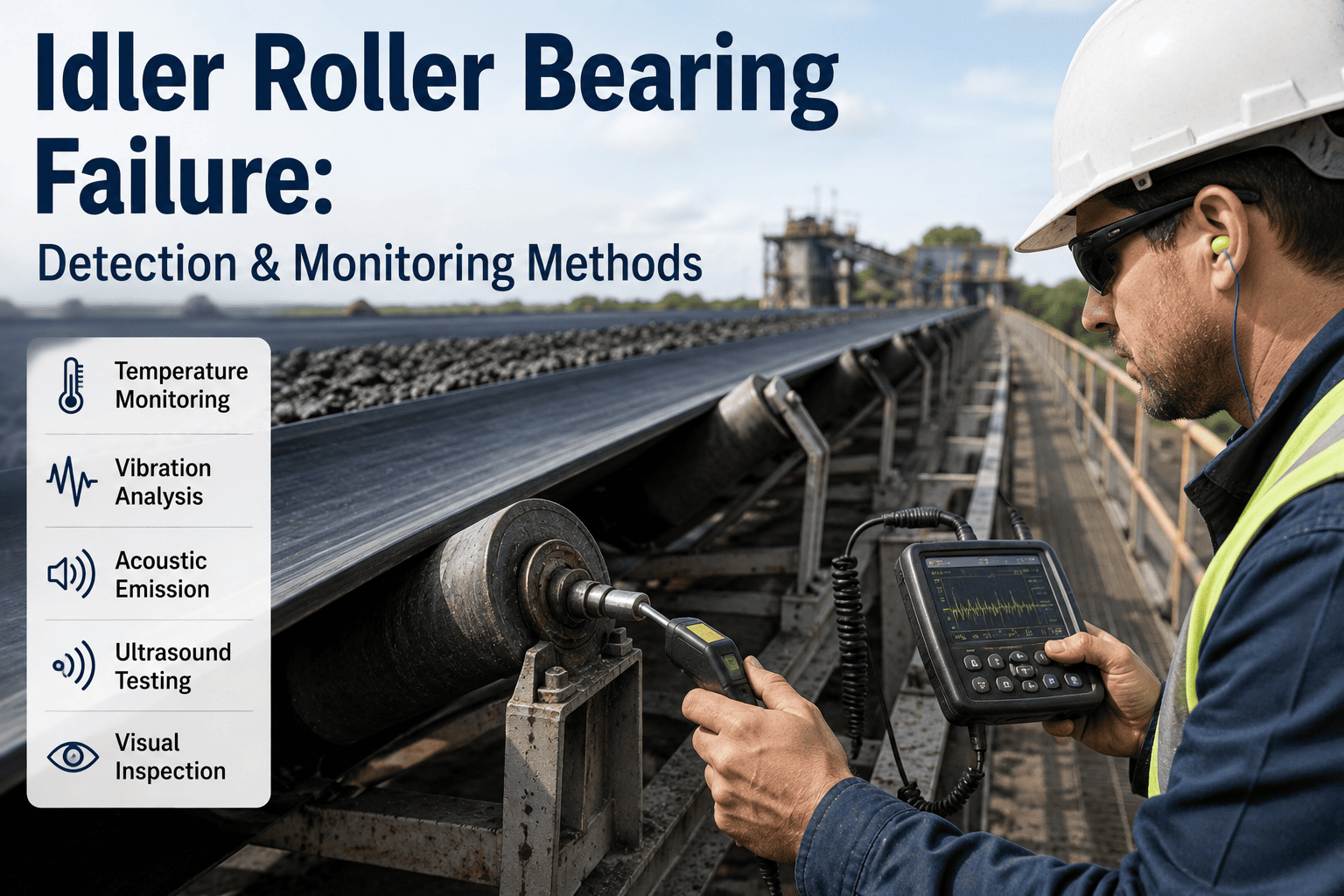
A coal conveyor can carry thousands of idler rollers along a single overland run, and every one of them is a candidate for bearing failure. Most of the time nobody notices a single seized idler until it's already scored a flat spot into the belt cover or, worse, generated enough friction heat to start a fire in a coal dust environment. The failure itself is small and cheap — a bearing costs a fraction of what a belt segment does — but the consequences of missing it are not, which is exactly why idler condition has become one of the higher-value targets for continuous monitoring on a coal handling line. This piece covers how idler bearings actually fail, which detection methods catch that failure early, and how to prioritize monitoring across a conveyor carrying more rollers than any inspection crew can realistically walk every shift. A demo can show how continuous idler monitoring fits your conveyor layout.
Coal Conveyor Reliability
Catch a Failing Idler Bearing Before It Becomes a Belt Fire Risk
Acoustic monitoring, thermal imaging, and vibration-based detection compared for identifying seized and failing idler rollers on coal conveyor systems.
Why a Single Idler Failure Is a Bigger Problem Than It Looks
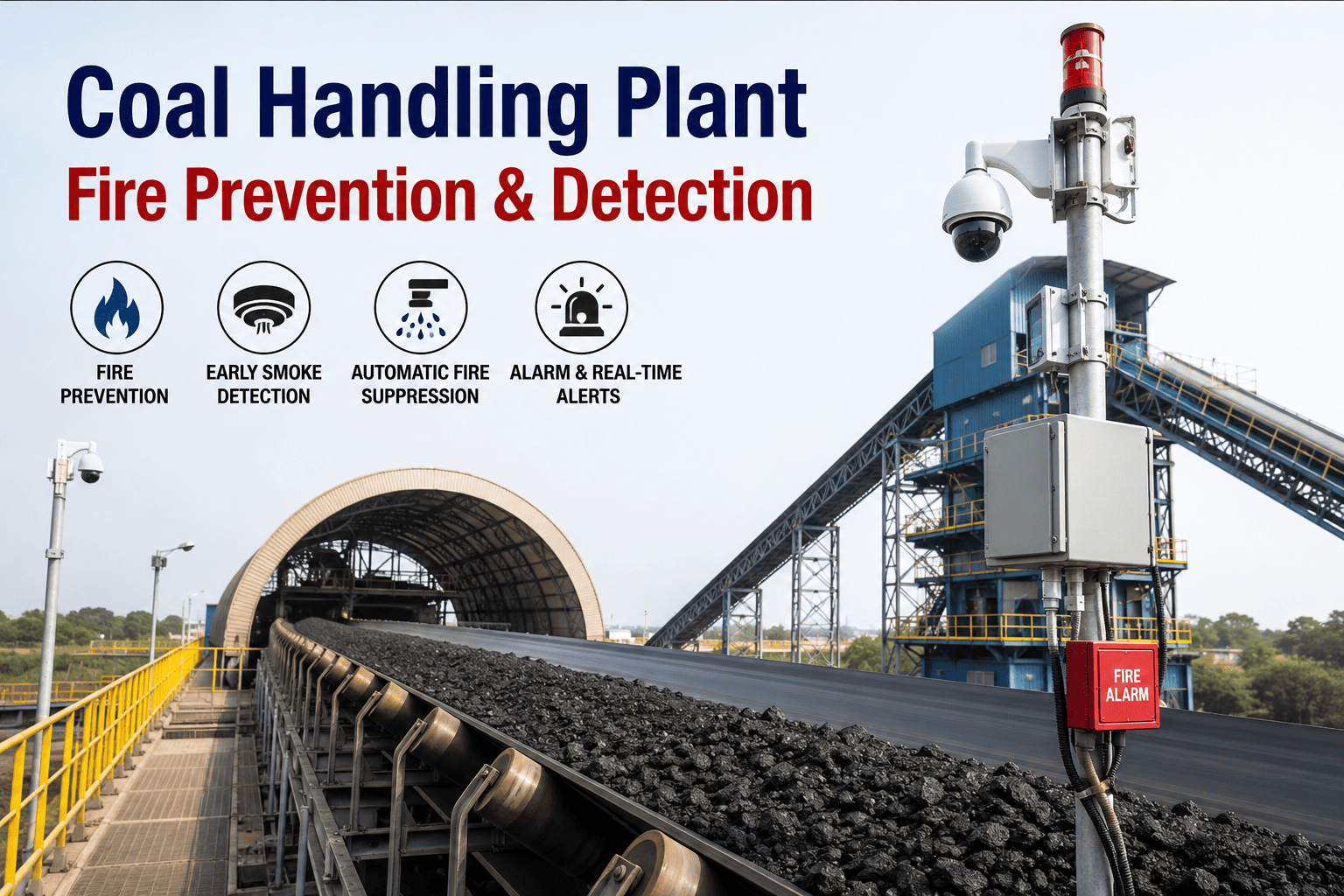
An idler roller's job is simple: support the belt and let it run freely with minimal friction. When the internal bearing degrades and seizes, the roller stops turning while the belt keeps moving across it, and that stationary point of contact becomes a source of friction heat and abrasive wear that grows worse the longer it goes unaddressed. On a clean, dry material this is primarily a belt-damage problem. On a coal conveyor, where fine coal dust is often present in the surrounding air and structure, a seized idler generating sustained friction heat is also a credible ignition source — which is why idler condition monitoring gets treated as a safety program on coal lines, not just a maintenance efficiency one.
Stage 1: Bearing Wear Begins
Early — vibration signature shifts, roller still turns freely
Stage 2: Increased Friction
Roller resistance increases, surface temperature begins rising
Stage 3: Partial Seizure
Intermittent sticking, audible noise, visible heat signature
Stage 4: Full Seizure
Roller stops turning entirely — belt drags across a fixed surface
Detection Methods Compared
No single detection method covers every idler on a long conveyor cost-effectively, which is why most reliability programs end up combining approaches — one for routine wide-area screening and another for confirming and prioritizing what that screening finds.
Acoustic Monitoring
Microphones or acoustic sensors positioned along the conveyor pick up the distinct sound signature of a bearing in distress — grinding, screeching, or an irregular rhythm — often before the failure is visible or measurable by temperature.
Thermal Imaging
Fixed or drone-mounted thermal cameras scan idler rows for heat signatures above the surrounding baseline, flagging rollers running hotter than their neighbors under the same load and belt speed conditions.
Vibration-Based Detection
Accelerometers or vibration sensors detect the characteristic frequency signatures of bearing wear stages, from early race pitting through to advanced degradation, often catching the earliest stage of failure of the three methods.
Symptoms, Root Causes, and Typical Lead Time
Understanding what a given symptom usually means — and how much runway it typically gives before failure — helps a maintenance team decide whether an idler needs attention this shift or can be scheduled into the next planned round.
| Symptom | Likely Root Cause | Typical Lead Time |
| Elevated vibration signature, roller still turns freely |
Early bearing race wear or contamination ingress |
Weeks to months |
| Localized heat signature above baseline |
Increased friction from developing bearing wear or lubrication loss |
Days to weeks |
| Audible grinding or irregular noise |
Advanced bearing race damage or debris intrusion |
Days |
| Visible smoke, scorching, or a stationary roller |
Full bearing seizure with active belt friction |
Immediate — stop and isolate |
The lead time column is the practical argument for layered detection. Vibration monitoring catches the earliest stage, giving a maintenance team the longest possible window to schedule a routine replacement. Thermal and acoustic methods tend to catch failures a stage or two later, which still beats discovering a seized roller from a scorch mark or smoke — but scheduling based on vibration data alone, where it's available, keeps repairs on a planned footing rather than a reactive one.
Prioritize Your Idler Rows
Find Out Which Idlers Need Attention First
A demo reviews your conveyor layout and load profile to identify the highest-risk idler zones on your specific belt network.
Prioritizing Idler Monitoring Across a Long Conveyor
A single overland coal conveyor can carry idlers numbering in the thousands, and instrumenting every one of them with the same monitoring density rarely makes economic sense. Prioritization usually follows load and access: the highest-load return and carry idlers closest to loading zones and transfer points see more mechanical stress and contamination exposure than idlers on a lightly loaded return run, and idlers in hard-to-access spans — over water, along elevated structure, in confined transfer towers — carry a higher consequence-of-failure weight simply because repair access is harder and slower.
High-Priority Zones
Idlers within the first few hundred feet of loading zones and transfer points, where impact loading and material contamination are highest, along with any idler in a hard-to-access or elevated span.
Standard-Priority Zones
Carry-side idlers on the main run of the conveyor, away from load points, where wear progresses more predictably and routine walk inspection combined with periodic scanning is generally sufficient.
Lower-Priority Zones
Return idlers on lightly loaded, easily accessible sections, where failure consequence is lower and repair access is straightforward enough to tolerate a longer detection lag.
Common Pitfalls in Idler Monitoring Programs
Relying only on scheduled walk inspections. A crew walking a conveyor once a shift or once a day can miss a bearing that progresses from early wear to full seizure between inspection rounds, particularly on long or hard-to-access spans.
Treating thermal scans as a standalone program. Heat signature alone can lag behind vibration-detectable wear by days or weeks, so a thermal-only program tends to catch failures later than a combined approach would.
Applying uniform monitoring density everywhere. Spreading a fixed monitoring budget evenly across a conveyor, instead of weighting it toward high-load and hard-to-access zones, leaves the highest-consequence idlers under-monitored.
Not connecting detection to a fire-risk protocol. On coal lines specifically, a confirmed seized idler with an active heat signature needs an immediate isolation response, not just a standard work order queued for the next maintenance window.
Sensor Placement and Monitoring Network Design
Getting value out of acoustic, thermal, or vibration monitoring depends as much on where the sensors sit as which technology is chosen. Fixed acoustic and vibration sensors need to be close enough to the idler rows they're monitoring to pick up a clear signal without picking up excessive ambient noise from the belt itself, adjacent machinery, or wind on an exposed overland run — which usually means a denser sensor spacing in high-priority zones and wider spacing on lower-risk return runs. Thermal cameras, whether fixed or drone-mounted, need a clear sightline to the idler row and enough resolution at the working distance to distinguish one roller's heat signature from its neighbors, which becomes a real constraint on tightly spaced idler configurations or heavily obstructed structure.
Network design also has to account for how the data actually reaches a decision-maker. A sensor generating useful readings that sit unreviewed in a standalone log until the next scheduled report is not meaningfully better than no sensor at all — the value comes from readings routing into an alerting system that flags a developing failure to the right person on the right timescale, whether that's an immediate stop-and-isolate alert for a confirmed seizure or a routine work order for an early-stage wear signature caught by vibration monitoring weeks out from failure.
Connecting Idler Data to Maintenance Planning
The real payoff of continuous idler monitoring shows up in how it changes maintenance scheduling, not just in catching individual failures. A program that tracks vibration trends across an idler population over time can start identifying which rows, which idler models, or which environmental conditions correlate with shorter bearing life — turning what used to be a reactive replace-on-failure pattern into a planned replacement schedule built around actual wear data rather than a generic time-based interval.
Failure clustering by zone. Idlers failing repeatedly in the same conveyor section often point to a load, alignment, or contamination issue at that location rather than random component variation, and that pattern only becomes visible with logged history across many failure events.
Vendor and model comparison. Tracking failure data by idler manufacturer and model over time gives procurement teams real evidence for spec changes, rather than relying on anecdotal impressions of which brand "seems to fail less."
Planned versus reactive replacement ratio. A rising share of idler replacements happening on a planned basis, driven by early vibration warnings, rather than as emergency reactive repairs is one of the clearest indicators that a monitoring program is delivering value.
Frequently Asked Questions
How many idler failures does a typical coal conveyor see per year?
The number varies enormously by conveyor length, load profile, environment, and idler quality, so there's no single figure that applies broadly across operations. What's more consistent across sites is the pattern of where failures concentrate — idlers near loading zones and transfer points see disproportionately more failures than idlers on lightly loaded return runs, simply due to higher mechanical stress and contamination exposure.
A demo can review your specific failure history to establish a baseline.
Can a seized idler actually start a fire on a coal conveyor?
Yes — a stationary roller under a continuously moving, loaded belt generates sustained friction heat at the contact point, and in an environment where coal dust is present in the air or has settled on nearby structure, that heat source is a credible ignition risk. This is a key reason coal handling operations treat idler condition monitoring as part of their fire prevention program rather than purely a mechanical maintenance concern, and why a confirmed seizure typically triggers an immediate stop-and-isolate response rather than a standard work order.
Which detection method gives the earliest warning of bearing failure?
Vibration-based detection generally identifies bearing wear at the earliest stage, since it can pick up on subtle changes in the bearing's vibration signature well before that wear generates a measurable heat difference or an audible noise change. Thermal imaging and acoustic monitoring tend to catch failures a stage or two further along, once friction has increased enough to produce a detectable heat signature or sound. Combining vibration data with thermal or acoustic confirmation gives both the earliest warning and a way to validate that a flagged reading is a genuine developing failure.
Support can help match detection methods to your specific idler inventory.
Is drone-based thermal inspection practical for routine idler monitoring?
Drone-based thermal inspection works well for periodic sweeps of long or hard-to-access conveyor spans, particularly elevated sections or overland runs where a walking inspection would take considerable time and still miss idlers on the underside or in confined structure. It's less suited to continuous, real-time monitoring compared to fixed sensors, so most programs use drone thermal sweeps as a scheduled supplement to fixed acoustic or vibration monitoring rather than a replacement for it.
How does idler bearing failure relate to belt rip risk?
The connection is indirect but real. A seized idler that goes undetected long enough can wear a flat spot or groove into the belt cover at the contact point, and a belt with existing cover damage is more vulnerable to a tramp metal object catching and initiating a longitudinal tear at that weakened spot than an undamaged section of belt would be. Programs that monitor both idler condition and belt integrity together tend to catch this compounding risk earlier than programs treating the two as unrelated maintenance items.
Ready When You Are
Bring Continuous Idler Monitoring to Your Conveyor Fleet
Book a session and see how acoustic, thermal, and vibration detection layer together across your specific belt network and idler count.