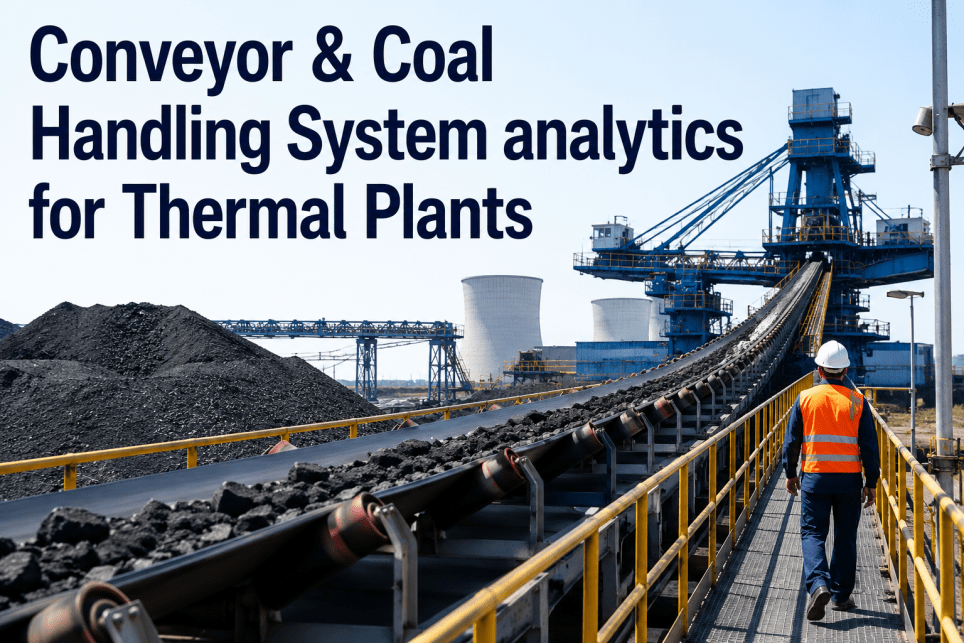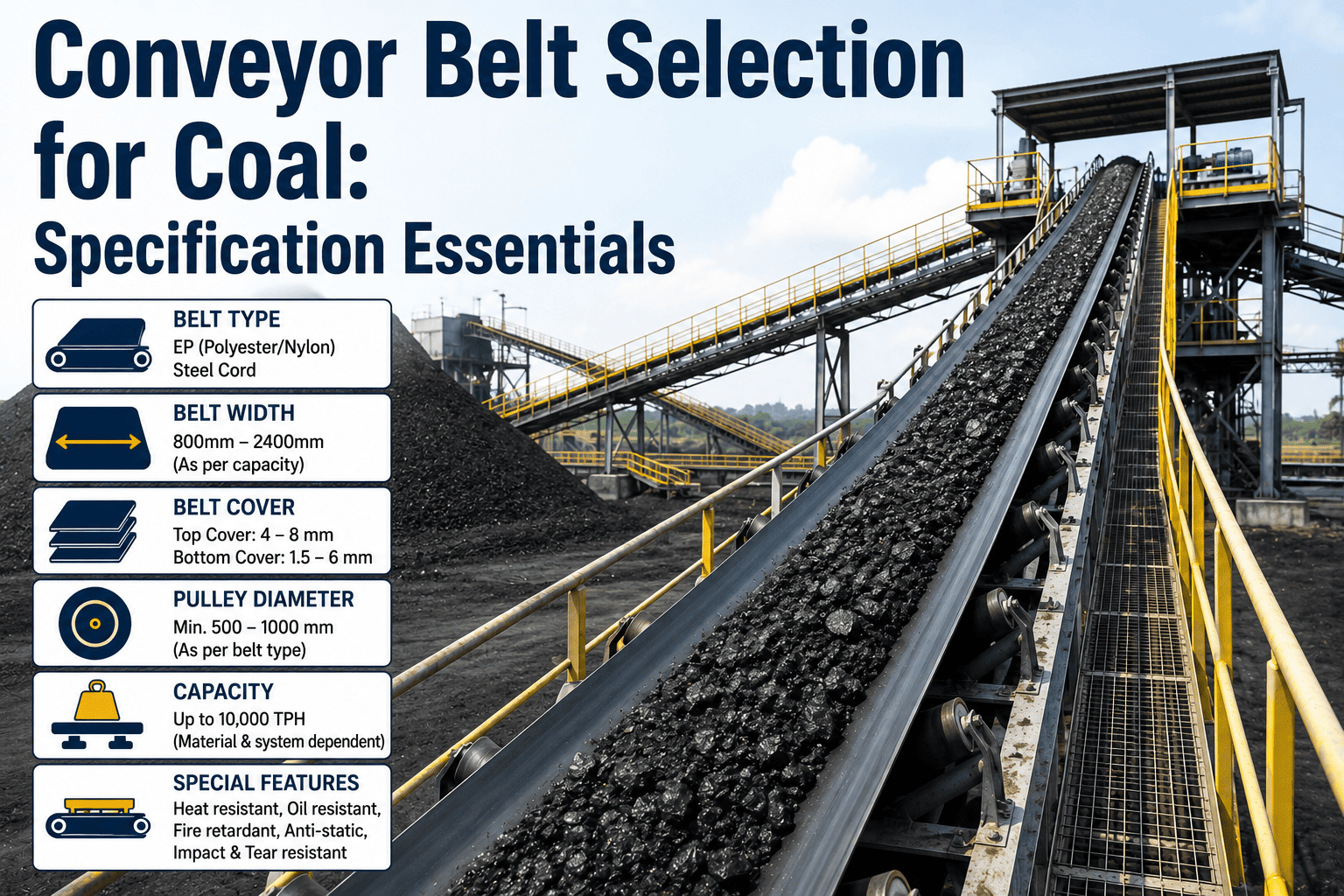
Specify the wrong conveyor belt for a coal handling application and the mistake rarely shows up on day one — it surfaces months later as edge cracking, cover gouging, cord fatigue at the splice, or in the worst case, a belt fire inside an enclosed transfer tower. Power plant coal conveyors run through some of the harshest conditions in industrial material handling: abrasive fines, embedded tramp metal, steep incline loading, high drop heights at crusher discharge, and strict fire-resistance codes for any run inside an enclosed structure. Getting belt grade, cover thickness, tensile strength, and fire rating right at the procurement stage is what separates a belt that runs its full design life from one that forces an emergency change six months in. This guide walks through the specification variables that actually determine coal conveyor belt performance, and where continuous condition monitoring fits once the right belt is on the pulleys — teams that want to see how monitoring data ties back into their next belt specification can Book a Demo.
What a Wrong Belt Specification Actually Costs
A conveyor belt that is under-specified for its duty rarely fails all at once. It fails slowly, in ways that are easy to write off as normal wear until the cost has already compounded past what the correctly rated belt would have cost up front. Four failure patterns account for most of the premature belt replacements on coal handling systems, and every one of them traces back to a specification decision made before the belt was ever ordered.
Premature Cover Wear
Coal fines are abrasive enough to cut through an undersized top cover well before the carcass itself is compromised. A general-purpose cover specified for a crusher discharge zone can lose usable thickness in a fraction of the belt's rated life, forcing a full replacement while the tensile members underneath are still sound.
Cord and Carcass Fatigue
Belts specified without enough margin against starting, braking, and incline-load tension stretch unevenly and fatigue at the splice long before the manufacturer's rated life is reached. Splice failure under load is one of the more disruptive events on a coal conveyor, since it typically takes the belt off line without warning.
Fire and Combustion Risk
A standard-grade belt run inside an enclosed gallery or underground transfer point is a code violation in most jurisdictions and a genuine fire propagation risk in coal service, where fugitive dust and belt friction combine as an ignition source. Fire-resistance rating is not an optional upgrade for enclosed runs — it is the baseline requirement.
Unplanned Downtime Cost
The price difference between a correctly rated belt and an under-specified one is usually a small fraction of what an emergency belt change costs once labor, lost production during the outage, and expedited freight on replacement belting are added up. Specification is the cheapest place to fix this problem.
Belt Grade Classification for Coal Service
Belt grade defines the cover compound the belt is built with, and it is the single specification decision that most directly determines how the belt holds up against the coal it is actually carrying. Five grade categories cover the overwhelming majority of coal handling applications, each aligned to a recognized standard and a specific duty profile.
| Grade / Class | Reference Standard | Best-Fit Application | Key Property |
|---|---|---|---|
| General Purpose (Fabric/EP) | ISO 14890 / RMA Grade II | Overland runs, low-abrasion coal streams | Balanced cost and moderate wear resistance |
| Abrasion Resistant (Grade A) | DIN 22102 Category W | Crusher discharge, high-fines transfer points | High abrasion-loss index rating |
| Heat Resistant | ISO 15236 / DIN 22102-T | Runs near dryers or hot material discharge | Sustained surface temperature tolerance |
| Fire Resistant (FR/MSHA 2G) | MSHA 30 CFR §18.65 / ISO 340 | Underground entries, enclosed galleries, transfer towers | Self-extinguishing, low smoke generation |
| Oil and Chemical Resistant | ISO 21181 | Runs near lubricant spill or chemical exposure zones | Resists cover swelling and degradation |
Tensile Strength: Matching Carcass Rating to Real Load
Tensile rating determines how much pulling force the belt carcass can carry before it stretches permanently or fails outright. Two carcass constructions dominate coal handling: fabric ply belts, built from layers of polyester and nylon reinforcement, and steel cord belts, built around longitudinal steel cables embedded in the core. The right choice depends almost entirely on conveyor length and lift height, not on habit or whatever the previous belt happened to be.
Fabric ply belting handles most short-to-medium overland coal conveyors economically and flexes well around smaller pulley diameters. Steel cord belting becomes necessary once conveyor length, lift height, or required capacity push total belt tension beyond what a fabric carcass can carry without excessive elongation — long overland coal conveyors and high-lift stacker-reclaimer feeds are typical steel cord applications.
Conveyor Length and Lift
Longer center-to-center distances and higher lift heights both raise the steady-state operating tension the belt has to carry across its full length.
Starting and Braking Tension
Peak tension during motor start-up or emergency braking typically exceeds steady-running tension by a wide margin, and the belt has to survive that peak repeatedly, not just once.
Splice Efficiency Derating
A splice never carries 100% of the rated carcass strength — mechanical splices typically run lower efficiency than vulcanized ones, and that derating has to be built into the specification, not discovered after installation.
Safety Factor Selection
DIN 22101 and comparable design standards typically call for safety factors between roughly 6.7:1 and 10:1 depending on splice type and duty severity — this is not a figure to shortcut on a coal conveyor carrying variable, abrasive load.
Cover Thickness Selection Matrix
Cover thickness is what actually stands between the coal and the tensile carcass underneath, and it needs to be matched to duty class rather than specified as a single default across an entire plant. A cover that is too thin wears through quickly at high-abrasion points; a cover that is too thick adds unnecessary weight and cost on runs where it was never needed.
| Duty Class | Top Cover | Bottom Cover | Typical Coal Service |
|---|---|---|---|
| Light Duty | 3–4.5 mm | 1.5 mm | Enclosed, low-fines transfer with short center distance |
| Medium Duty | 4.5–6 mm | 2 mm | Standard overland coal handling runs |
| Heavy Duty | 6–9 mm | 2–3 mm | Crusher discharge, high lump-and-fines mix |
| Extra Heavy / Impact | 9–12 mm | 3–4.5 mm | Primary crusher feed, high drop-height loading points |
Fire and Flame Resistance Standards for Enclosed Coal Belting
Any belt running through an enclosed structure, transfer tower, or underground entry is governed by fire-resistance requirements that go well beyond general cover grade. These are code requirements in most jurisdictions, not optional upgrades, and the certifying test methods differ by region and application.
MSHA 30 CFR §18.65 (2G)
The US requirement for belting used underground and in enclosed surface coal handling structures, combining a flame test with a drum-friction surface ignition test that the belt must pass before it is approved for the application.
NFPA 120
The Standard for Fire Prevention and Control in Coal Mines addresses belt entry ventilation, fire detection, and the mandate for fire-resistant belting on entries where a fire could obstruct escape or intake air.
ISO 340
The international flame and afterburn test method used to classify conveyor belting fire behavior outside the US regulatory framework, widely referenced in specifications for plants operating under ISO-aligned procurement standards.
DIN EN 12881-1
The European large-scale gallery fire test for belts intended for enclosed conveyor structures, evaluating full-scale fire propagation behavior rather than a small material sample alone.
Sample Specification Worksheet: Mid-Size Coal Handling Conveyor
The following worksheet reflects a representative mid-size coal-fired power plant conveyor run — a coal yard-to-bunker feed with a moderate incline and standard fines content. Actual values will vary with your plant's layout, capacity target, and coal characteristics, but the worksheet structure applies to any coal conveyor specification.
| Specification Parameter | Example Input | Consideration |
|---|---|---|
| Belt width | 1,200 mm | Set by required capacity and material lump size |
| Belt speed | 2.5 m/s | Balances capacity against material degradation and spillage risk |
| Design capacity | 800 tph | Should include margin above nameplate throughput |
| Incline angle | 12 degrees | Drives surcharge angle limits and cover friction requirements |
| Center-to-center length | 420 m | Primary driver of total operating tension |
| Required tensile rating | ST 1600 | Calculated from operating tension plus safety factor |
| Top / bottom cover | 6 mm / 3 mm | Heavy duty class for fines-heavy transfer conditions |
| Splice type | Vulcanized, step-splice | Higher efficiency than mechanical fastening for steel cord |
| Fire rating requirement | MSHA 2G / ISO 340 | Mandatory — enclosed transfer tower run |
Common Coal Belt Specification Mistakes
Most premature coal conveyor belt failures trace back to one of a small handful of recurring specification errors, and nearly all of them are avoidable with a more complete duty-condition review before the purchase order goes out.
Sizing Tensile Rating for Steady-State Only
Calculating required tensile strength from running tension alone, without accounting for the higher peak load during motor start-up or emergency stop, leaves no real margin against fatigue.
Using General Purpose Cover at Crusher Discharge
Specifying the same general-purpose cover grade used on overland runs for a high-impact, high-abrasion crusher discharge zone guarantees an early cover replacement.
Treating Fire Rating as Optional
Assuming a standard-grade belt is acceptable for an enclosed transfer tower because the run is short overlooks both the code requirement and the actual fire propagation risk in a confined coal handling structure.
Skipping Splice Efficiency Derating
Specifying carcass strength without derating for splice efficiency means the weakest point on the belt is under-rated from the day it's installed, regardless of how strong the base carcass is.
How Continuous Monitoring Protects the Belt You Specify
Correct specification gets a coal conveyor belt off to the right start, but belt condition still changes over time with load, tracking, and environmental exposure. Continuous, AI-based monitoring closes the loop between the belt you specified and the belt actually running on your conveyor today.
Vision-Based Rip and Tear Detection
Camera-based inspection watches the belt surface continuously for the early signs of longitudinal rips or gouges caused by embedded tramp metal, flagging damage long before it propagates into a full-width tear.
Mistracking and Alignment Monitoring
Persistent belt mistracking accelerates edge wear on exactly the cover you specified to resist it — continuous alignment monitoring catches drift before it turns into avoidable cover loss.
Cover and Splice Wear Tracking Over Time
Recording cover thickness and splice condition trends over months of operation shows whether the belt is wearing at the rate the specification assumed, or whether the duty conditions have shifted since it was ordered.
CMMS-Integrated Replacement Planning
Routing wear trend data into your CMMS turns belt replacement from a fixed calendar interval into a decision based on actual measured condition, so belts are changed when they need to be — not too early, and not after they've already failed.
Frequently Asked Questions: Coal Conveyor Belt Specification
What tensile strength does a coal conveyor belt need?
Required tensile strength is calculated from the maximum operating tension the belt will see — driven primarily by center-to-center length, lift height, and starting or braking peaks — multiplied by a safety factor typically in the 6.7:1 to 10:1 range under standards like DIN 22101, then divided by belt width to get the rated strength per unit width. Splice efficiency also has to be factored in, since a splice never carries the full rated strength of the base carcass. Getting this number wrong in either direction either leaves no safety margin or adds unnecessary cost to the belt. Teams unsure of their current belt's actual tension margin can Book a Demo to walk through the calculation against real conveyor data.
What cover thickness is right for coal handling?
Cover thickness should be set by duty class rather than applied as a plant-wide default. Light duty enclosed runs typically need only 3 to 4.5 mm top cover, while heavy impact zones like primary crusher feed points call for 9 mm or more. The deciding factors are abrasion exposure from coal fines, impact energy at loading and transfer points, and how much material drop height the belt absorbs on a routine basis. Matching cover thickness to the actual wear environment at each conveyor segment, rather than the system average, avoids both premature failure and unnecessary weight.
Is fire-resistant belting required for all coal conveyors?
Fire-resistant belting is generally mandatory for any run inside an enclosed structure, underground entry, or transfer tower under standards like MSHA 30 CFR §18.65 in the US or ISO 340 and DIN EN 12881-1 internationally, but it is not always required for fully open-air overland runs depending on local code. The determining factor is enclosure and ventilation, not simply whether the material being handled is coal. Plants should confirm applicable code requirements for each specific conveyor segment rather than assuming a single fire-resistance policy covers the entire system.
Steel cord versus fabric ply — which is right for coal service?
Fabric ply belting is the more economical choice for shorter, lower-tension overland coal conveyors and flexes more easily around smaller pulleys, making it common on in-plant feed and transfer runs. Steel cord belting becomes the better fit once conveyor length, lift height, or capacity push total operating tension past what a fabric carcass can carry without excessive stretch — long overland coal conveyors and high-lift stacker-reclaimer feeds typically fall into this category. The choice comes down to calculated tension requirements, not a default preference for one construction over the other.
How often should a coal conveyor belt be replaced?
Replacement interval depends far more on measured cover and carcass condition than on a fixed calendar schedule, since duty conditions and load can vary significantly even on belts with identical original specifications. Continuous condition monitoring — tracking cover thickness loss, splice integrity, and rip or tear indicators over time — gives a far more accurate picture of remaining service life than age alone. Support contact iFactory Support can walk through how condition-based tracking applies to an existing belt fleet.