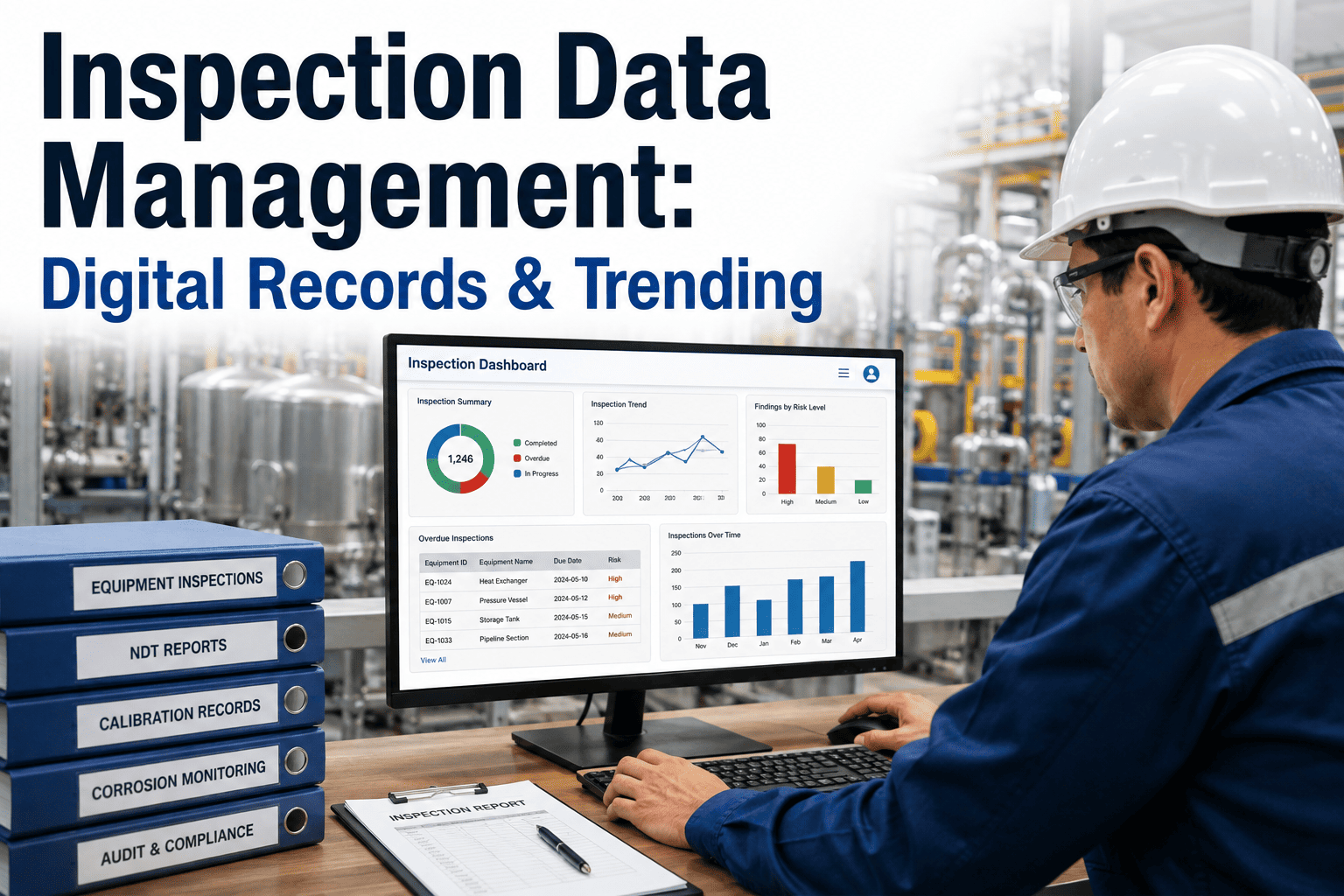
Decades of inspection history sitting in paper binders and scanned PDFs represent one of the largest untapped datasets a plant owns, thickness readings, defect locations, remaining-life calculations, all of it collected at real cost and most of it never actually trended against itself. Paper-based inspection was built for a slower production era with simpler regulatory requirements, and it still works well enough day to day that many plants never notice how much value is sitting locked in a format nobody can query. The gap shows up at the worst possible moment, during an audit that needs three years of history pulled by lot number, or during a root cause investigation that needs to know whether a defect has been trending for months. Plants digitizing that history can book a demo to see how monitoring supports the process.
MANUAL INSPECTION GAPS · DATA MANAGEMENT · 2026
Inspection Data Is Only as Useful as It Is Searchable
Digital records, consistent data quality, and historian or ERP integration turn thickness readings, defect logs, and remaining-life calculations from a filing obligation into a trend line that predicts failure before it happens.
What Paper-Based Inspection Actually Costs a Plant
A paper inspection record is not inherently inaccurate, an experienced inspector filling out a checklist by hand can be every bit as thorough as one working from a tablet. The cost shows up downstream, in how long it takes to find a record when it is needed and in how rarely anyone actually compares this month's reading against the last dozen readings for the same asset, because doing that comparison by hand across paper files is slow enough that most plants simply do not do it consistently.
Retrieval Time
Pulling a specific asset's inspection history from paper files can take hours instead of the seconds a searchable record allows.
Trend Visibility
A single handwritten reading rarely gets compared against its own history, which is exactly where a slow trend hides.
Audit Readiness
Regulated environments increasingly expect inspection data that is complete, traceable, and retrievable on demand, not reconstructed under deadline.
Transcription Risk
Every manual transfer from paper to a digital system is another point where a reading can be mistyped or lost.
The Data Quality Dimensions That Actually Matter
Digitizing inspection records is only half the job, a digital record with the same gaps as its paper predecessor, missing fields, inconsistent units, unclear asset identifiers, produces the same unreliable trend line in a nicer interface. The dimensions below are what separate a record that supports genuine trending from one that just looks organized.
CONTINUOUS INSPECTION DATA TRACKING
Stop Losing Inspection History to a Filing Cabinet
See how digital records, automatic trending, and historian integration support your inspection program.
Where Inspection Data Needs to Connect
Inspection data creates the most value when it stops living in its own silo and connects to the systems that already track the asset from other angles. A thickness reading means more next to the maintenance history for that vessel, and a defect log means more when it is linked back to the specific lot or production order it came from.
Process Historian
Links inspection readings to operating conditions at the time of inspection, useful for correlating wear with process upsets.
CMMS / Work Orders
Connects a defect finding directly to the corrective work order, closing the loop instead of leaving it for someone to remember.
ERP & Lot Records
Ties inspection results back to specific production orders and lot numbers, essential for PPAP and customer traceability requirements.
QMS & CAPA
Feeds non-conformance data directly into corrective action workflows rather than requiring manual re-entry.
From Handwritten Reading to Trended Record
STEP 1
Capture at the Point of Inspection
Readings are entered directly against a specific asset identifier, avoiding a separate transcription step later.
STEP 2
Validate Against Expected Ranges
Values outside a plausible range are flagged for review before they enter the permanent record, catching entry errors early.
STEP 3
Store Against the Asset's Full History
Every reading is stored in a searchable repository indexed by asset, location, and date, ready for immediate retrieval.
STEP 4
Trend & Alert on Drift
Readings are compared automatically against the asset's own trend line, flagging drift long before a single reading crosses an alarm.
What Inspection Program Leaders Are Saying
We could produce any single inspection report an auditor asked for, but pulling three years of thickness history for one vessel across a dozen binders took most of a day. Once the records were searchable, the same request took minutes, and we noticed a slow trend on a different vessel entirely while we were at it.
Inspection Program Lead, Process Manufacturing Facility
Frequently Asked Questions
Is digitizing inspection records worth it if the paper process already works?
A paper process that reliably captures accurate readings is doing its core job, but the value of digitizing lives almost entirely downstream of capture, in how fast a record can be retrieved and whether readings actually get compared against their own history. Most plants running paper-based inspection are not missing readings, they are missing the trend visibility that only comes from being able to instantly pull and plot years of history for a single asset. That gap tends to become expensive exactly when it matters most, during an audit or a failure investigation.
What makes an inspection record actually audit-ready?
An audit-ready record is complete, meaning every required field is populated rather than left blank under time pressure, and traceable, meaning it links cleanly to a specific asset, inspector, and date without ambiguity. Regulated environments in particular expect records that can be retrieved by lot number, part number, or asset identifier within seconds rather than reconstructed from scattered files under deadline. Teams preparing for an upcoming audit can review current practice through
support.
How does inspection data connect to a CMMS or maintenance program?
When inspection findings link directly to a CMMS, a defect identified during inspection can generate a corrective work order automatically rather than depending on someone remembering to log it separately after the fact. This connection also lets maintenance history and inspection history be viewed together for the same asset, which is often where a pattern becomes visible, a component that keeps needing the same repair after every inspection cycle is telling a different story than one repair viewed in isolation.
What is the biggest risk in migrating years of paper inspection records to digital?
The biggest risk is usually not the migration itself but inconsistent asset naming carried over from paper, where the same physical asset was recorded under several slightly different names across different inspectors and years, fragmenting its history across what should be one continuous trend line. Cleaning up asset identification before or during migration, rather than after, is what keeps the resulting digital record actually usable for trending instead of just digitally stored. Plants can
book a demo to see how this gets handled in practice.
Does moving to digital inspection records replace the need for a trained inspector?
No, digital records change how inspection data is captured, stored, and analyzed, not the judgment required to perform the inspection itself. A trained inspector's assessment of a defect or a reading is still the foundation of the record, digitizing simply makes that assessment retrievable, comparable across time, and connected to the other systems tracking the same asset. The value is additive, better data supporting the same expertise, rather than a substitute for it.
MANUAL INSPECTION GAPS · DATA MANAGEMENT
Move From Filed Paperwork to a Searchable Inspection Record
See how digital inspection records and trending fit into your plant's current inspection program.



.png)