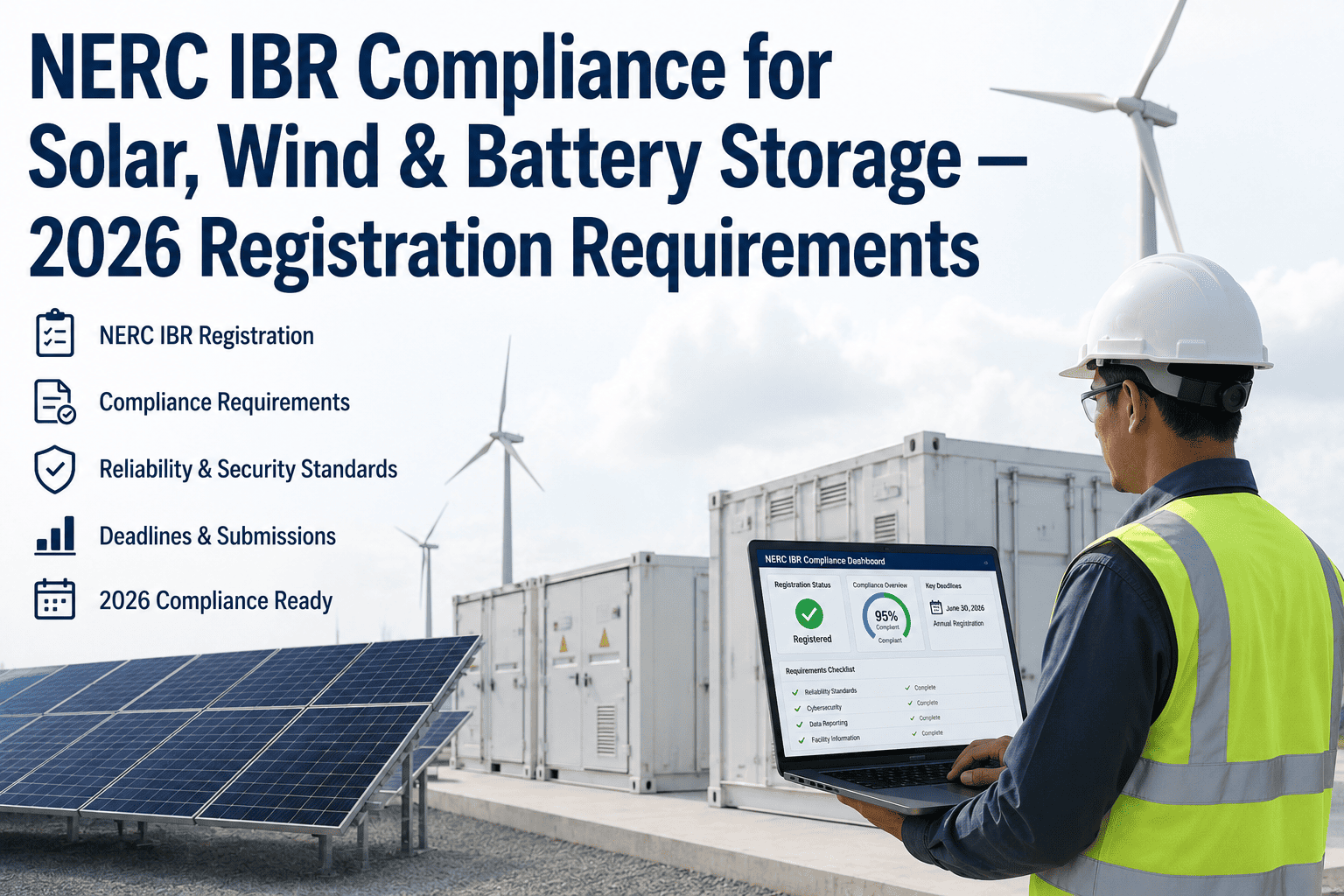
The May 15, 2026 effective date for NERC's Category 2 Generator Owner and Generator Operator registration has now passed, and solar, wind, and battery storage facilities that crossed the 20 MVA and 60 kV threshold are formally subject to mandatory Reliability Standards for the first time. Many operations directors spent the past year focused on the registration paperwork itself, only to discover that registration was the easy part. The harder work, building the modeling, data reporting, and event response processes these standards actually require, starts now that the Compliance Monitoring and Enforcement Program applies in full. See how AI-driven compliance operationalization helps by requesting a Book a Demo with the iFactory AI team.
Operationalizing NERC Category 2 IBR Compliance for Solar, Wind and Battery Storage
iFactory AI helps newly registered Category 2 generator owners and operators turn modeling, data reporting, and event analysis obligations into a continuously managed compliance program instead of a scramble triggered by every Regional Entity request.
Registration Was Only the First Obligation
For years, many solar, wind, and battery storage facilities operated entirely outside NERC's mandatory reliability framework. That changed with the Category 2 GO/GOP expansion, and now that the effective date has passed, the compliance clock does not pause for facilities still building out their internal processes.
Facilities meeting or exceeding this threshold at a common point of interconnection are captured, even when no single unit alone would qualify.
Registered Category 2 entities are now formally inside the Compliance Monitoring and Enforcement Program with no informal grace period.
Teams that have never built a compliance program face a compressed learning curve while already being subject to enforcement.
Beyond the underlying reliability standards, the registration and documentation process itself carries independent compliance exposure.
Are You a Category 2 GO/GOP?
Category 2 status is determined by a combination of two conditions rather than a single threshold, and aggregation rules mean facilities that look individually small can still be captured when connected assets are combined.
Non-BES inverter-based resource with an aggregate nameplate capacity of 20 MVA or greater, counting all resources sharing a common point of interconnection.
Connected to the grid through a system designed primarily to deliver that capacity to a point of connection at 60 kV or higher.
Both conditions met means registration and full applicable Reliability Standards compliance, even for facilities never previously registered with NERC. Planning coordinators and transmission operators may also nominate assets below this threshold if deemed material to reliability.
Standards Now Applicable to Registered Category 2 Entities
A defined set of Reliability Standards apply to Category 2 IBRs without requiring facility-specific modification, meaning compliance obligations begin immediately upon the registration effective date rather than phasing in gradually.
These standards cover real power balancing performance, reliability coordinator data submission, power system modeling data accuracy, and protection system documentation, all areas where evidence must now be produced on the same schedule as any long-registered generator owner.
Turning New Obligations Into a Managed Program
Facilities registering for the first time rarely have the internal infrastructure that longer-registered generator owners built over years. AI-driven compliance operationalization compresses that setup into a structured sequence rather than a prolonged trial and error process.
Model Data Validation
Generator model data submitted under MOD standards is checked against actual equipment performance to catch discrepancies before a Regional Entity review does.
Ride-Through and Response Monitoring
Frequency and voltage ride-through behavior is continuously monitored against required settings, flagging configuration drift before an actual grid event exposes it.
Automated Data Submission
Reliability coordinator data and protection system documentation are formatted and submitted on the required schedule without manual file preparation each cycle.
Event Response Documentation
When a reliability event occurs, performance data is automatically compiled into the documentation format Regional Entities expect for post-event analysis.
Ongoing Program Health Tracking
A single dashboard tracks compliance status across every applicable standard so gaps are visible continuously rather than discovered at the next audit. Operations teams can Book a Demo to see this applied to a real Category 2 facility.
Category 2 IBR Standards Reference Matrix
The table below summarizes the standards most relevant to newly registered Category 2 entities, what evidence each requires, and how AI-driven tracking keeps that evidence current.
| Standard | Focus Area | Typical Evidence | Submission Rhythm | AI Capability |
|---|---|---|---|---|
| BAL-001-TRE-2 | Real power balancing performance | Frequency response performance data | Continuous | Automated performance monitoring |
| IRO-010-5 | Reliability coordinator data | Requested operational data sets | On request and periodic | Automated data formatting and submission |
| MOD-032-1 | Power system modeling data | Steady-state and dynamic model data | Periodic update cycle | Model-to-performance validation |
| MOD-026-2 / MOD-027-1 | Generator model verification | EMT and dynamic model test data | Periodic verification cycle | Verification test scheduling and tracking |
| PRC-012-2 | Special protection system data | Protection system documentation | Event-driven and periodic | Documentation completeness checks |
Before AI vs After AI: A Newly Registered Facility's First Data Request
The first Regional Entity data request after registration is often the moment a newly registered facility discovers whether its compliance program is actually ready.
Without AI Operationalization
Data RequestThe team scrambles to locate model data, performance records, and documentation formats they have never had to produce before.
Internal CoordinationEngineering, operations, and compliance staff exchange emails trying to determine who owns which piece of evidence.
SubmissionData is submitted in an inconsistent format, raising questions from the Regional Entity that extend the review.
OutcomeA documentation-related finding is recorded even when the underlying operational performance was acceptable.
With AI Operationalization
Data RequestRequested model data and performance records are already validated and formatted to the expected submission structure.
Internal CoordinationOwnership for each standard is already assigned within the compliance dashboard, removing the need for ad hoc coordination.
SubmissionEvidence is submitted consistently and on schedule, matching the format Regional Entities expect from long-registered entities.
OutcomeThe first review closes cleanly, establishing a credible compliance track record from day one of registration.
Quantified Impact for Newly Registered Category 2 Entities
The metrics below reflect aggregated outcomes from solar, wind, and battery storage facilities that deployed AI-driven compliance operationalization following Category 2 registration.
Implementation Checklist for Category 2 Compliance Operationalization
Facilities that are newly registered or still finalizing registration should prioritize the following steps to move from paperwork compliance to an operational program.
Confirm Registration Status and Scope
Verify your registration effective date and the specific standards applicable to your registered function with your Regional Entity.
Validate Existing Model Data
Compare any previously submitted model data against actual equipment performance to identify discrepancies before a Regional Entity does.
Establish Data Submission Pipelines
Build automated formatting and submission processes for reliability coordinator data and protection system documentation.
Configure Ride-Through Monitoring
Deploy continuous monitoring of frequency and voltage ride-through settings against required performance parameters.
Assign Standard-Level Ownership
Designate a clear internal owner for each applicable standard so evidence gaps have an accountable person before an audit surfaces them.
Run a Mock Data Request
Simulate a Regional Entity data request internally to confirm the program can produce compliant evidence under real time pressure.
NERC Category 2 IBR Compliance — FAQs for Operations Directors
The May 15, 2026 effective date has already passed. Is it too late to get compliance right?
No, but the priority shifts from registration paperwork to demonstrating an operating compliance program, since the Compliance Monitoring and Enforcement Program applies from the effective date forward regardless of how prepared an entity was on that day. Facilities that are still building their internal processes should focus on closing the gap quickly rather than treating the passed deadline as a reason to deprioritize the work. For an assessment of where your program currently stands, Book a Demo with our team.
Our individual sites are each under 20 MVA. Are we still at risk of being captured?
Yes, the aggregation rule means multiple facilities sharing a common point of interconnection are evaluated together, so a group of smaller sites can collectively cross the 20 MVA threshold even though no individual site would qualify alone. Planning coordinators and transmission operators also have authority to nominate assets below the threshold if they consider a facility material to reliability, so proximity to the threshold is worth reviewing even for sites that appear clearly exempt.
What happens if our model data does not match actual equipment performance?
A mismatch between submitted model data and actual performance is a common finding for newly registered facilities, particularly where original equipment manufacturers no longer support model updates for older equipment. Identifying and correcting these discrepancies proactively, before a Regional Entity's own review surfaces them, is generally viewed more favorably than having the gap discovered externally.
Do we need dedicated compliance staff, or can this be managed alongside existing operations roles?
Many newly registered Category 2 entities start by assigning compliance responsibilities to existing operations or engineering staff rather than hiring a dedicated team immediately. This is workable if the underlying data collection, formatting, and submission processes are automated, since the remaining workload becomes reviewing exceptions rather than manually assembling evidence each cycle. Support for structuring this internally is available through iFactory Support.
How quickly can a newly registered facility reach a stable compliance posture?
Facilities that prioritize model data validation and automated submission pipelines in the first few months after registration typically reach a stable, audit-ready posture well before their first full Regional Entity review cycle. The facilities that struggle most are usually the ones that treat the registration date as the finish line rather than the starting point of an ongoing compliance obligation.
Move From Registered to Ready
Connect with iFactory AI to validate your model data, automate your reliability data submissions, and build a compliance program that holds up under your first Regional Entity review as a Category 2 entity.






.png)