In modern power plants, medium voltage (MV) and low voltage (LV) cables form the critical nervous system, transmitting electrical energy from generators to switchgear, transformers, and auxiliary loads. Yet, cable insulation degradation remains one of the most insidious failure modes, often progressing undetected until catastrophic breakdown occurs. Traditional time-based replacement strategies waste capital and create unnecessary outages, while reactive repairs risk extended downtime and safety hazards. This comprehensive guide explores how AI-driven analysis of partial discharge (PD), tan delta (dissipation factor), and insulation resistance (IR) trending enables reliability engineers to pinpoint insulation condition with unprecedented accuracy. By moving from calendar-based to condition-based cable management, plants can extend cable life by 30–50%, reduce maintenance costs by 40%, and eliminate unplanned cable failures. Book a Demo of iFactory's AI cable analytics platform to see how your plant can transform cable reliability.
Transform Cable Reliability with AI-Driven Insights
Replace guesswork with data. Prioritize cable replacements based on actual degradation patterns, not age. Achieve zero unplanned cable failures.
The Hidden Crisis of Cable Insulation Degradation
Cable insulation materials—cross-linked polyethylene (XLPE), ethylene propylene rubber (EPR), and oil-impregnated paper—undergo irreversible chemical and physical changes under thermal, electrical, and environmental stress. Partial discharge erodes the insulation surface, treeing creates conductive paths, and moisture ingress accelerates hydrolysis. Without continuous monitoring, these defects propagate silently. A single medium-voltage cable failure can cost over $500,000 in lost generation, repair labor, and replacement cable procurement. In combined-cycle plants, a cable fault in the generator step-up transformer circuit can force a full plant outage lasting 72 hours or more. The industry average for cable-related forced outages is 0.3 events per unit-year, but top-quartile plants achieve 0.05 or less using predictive analytics. The gap represents millions in potential savings.
Partial Discharge Analysis
High-frequency current transformers (HFCT) and capacitive couplers capture PD pulses in the 1–100 MHz range. AI algorithms classify discharge patterns into corona, surface discharge, and internal voids. Trending PD magnitude and phase-resolved patterns reveals progression rates, enabling 6–18 month advance warning of failure.
Tan Delta (Dissipation Factor) Testing
Applying a sinusoidal voltage at 0.1 Hz or 50/60 Hz, tan delta measures the ratio of resistive to capacitive current. Values above 0.5% for XLPE indicate significant degradation. Frequency domain spectroscopy (FDS) extends this to multiple frequencies, isolating moisture effects from thermal aging.
Insulation Resistance Trending
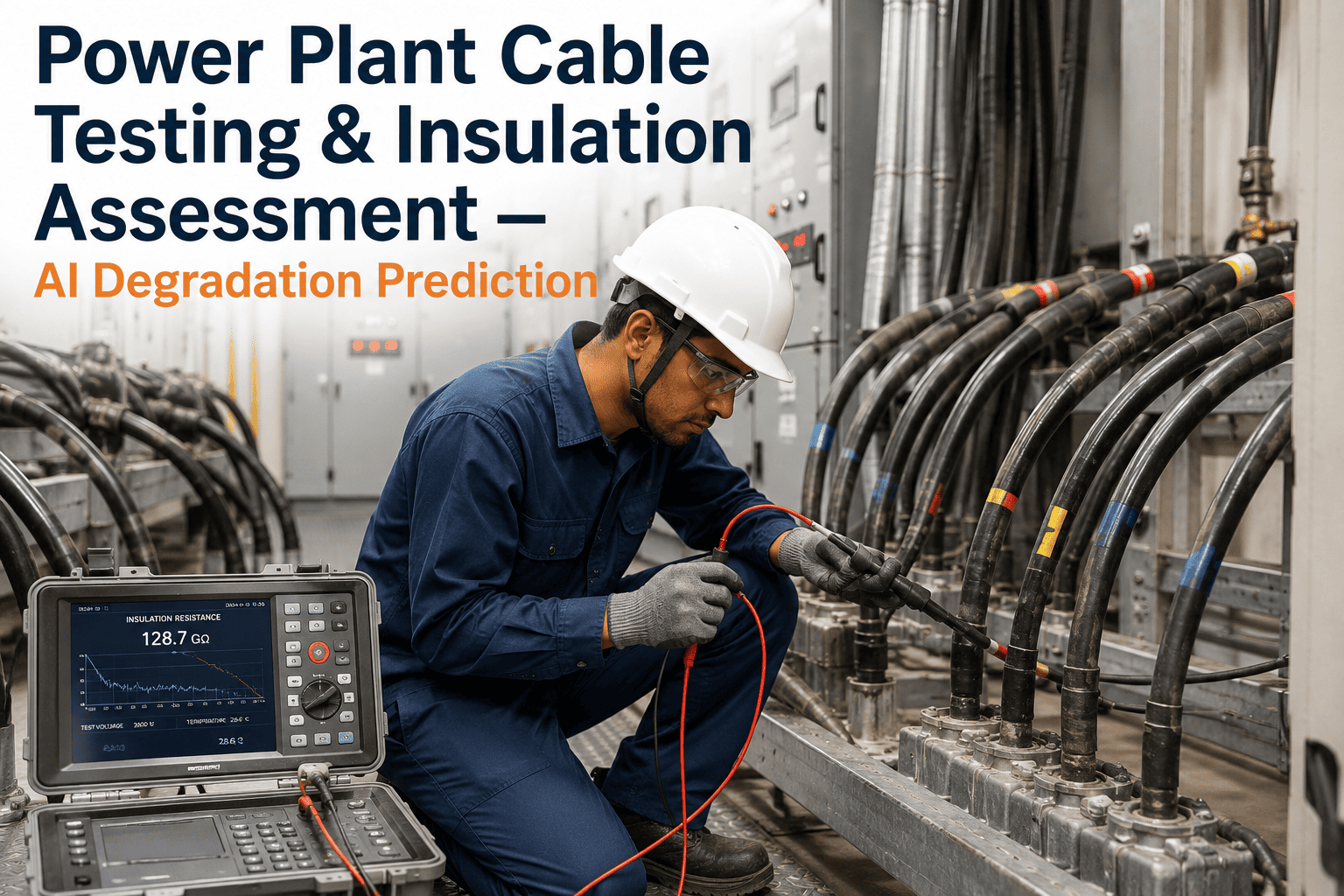
Megger testing at 500V to 5kV provides polarization index (PI) and dielectric absorption ratio (DAR). PI below 2.0 signals contamination or moisture. AI models combine IR with temperature and humidity data to normalize trends, removing environmental noise and revealing true insulation health.
AI Fusion Engine
iFactory's proprietary fusion algorithm integrates PD, tan delta, IR, and operational data (load cycles, ambient conditions) into a single degradation score. Machine learning models trained on thousands of cable failure cases predict remaining useful life with ±15% accuracy, enabling precise replacement windows.
Comparative Analysis of Cable Diagnostic Methods
| Method | What It Detects | Advance Warning | AI Enhancement | Cost per Test |
|---|---|---|---|---|
| Partial Discharge | Localized insulation defects | 6–18 months | Pattern classification & trend prediction | $2,000–$5,000 |
| Tan Delta | Bulk insulation degradation | 12–24 months | Frequency spectrum analysis & moisture isolation | $3,000–$6,000 |
| Insulation Resistance | Contamination & moisture | 3–6 months | Normalized trending with environmental correction | $500–$1,500 |
| AI Fusion | Comprehensive health & RUL | 18–36 months | Multi-sensor integration & predictive modeling | N/A (Software) |
Implementation Roadmap for AI-Driven Cable Assessment
Sensor Deployment & Baseline
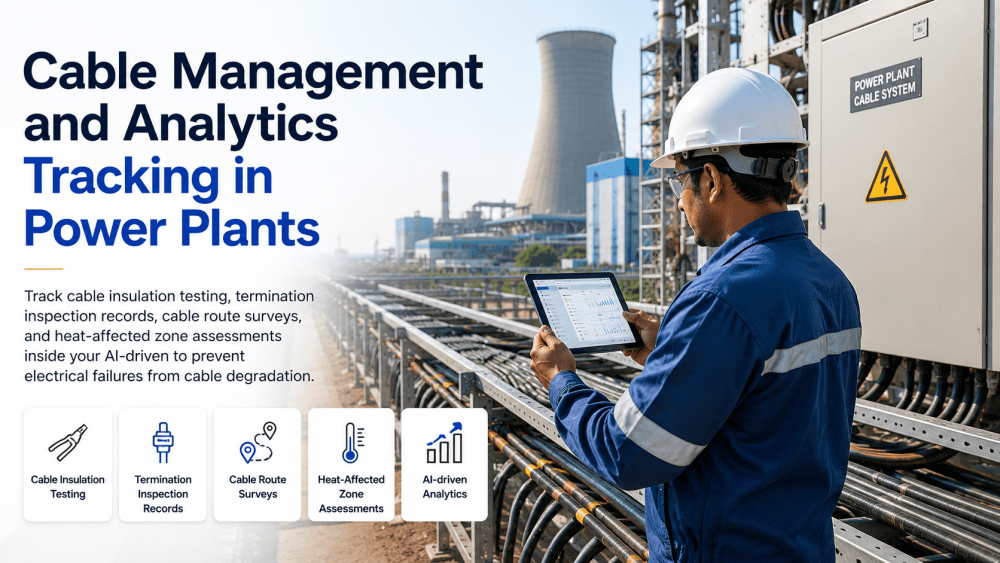
Install HFCT clamps on cable terminations at switchgear and motor control centers. Perform initial PD, tan delta, and IR measurements on all critical feeders. Establish baseline fingerprints for each cable circuit, noting load profiles and environmental conditions.
Data Integration & AI Training
Stream test data into iFactory's cloud platform via secure gateway. The AI engine automatically calibrates models using historical failure records from similar cable types and operating environments. Continuous learning improves prediction accuracy over time.
Automated Alerts & Prioritization
Set thresholds for PD magnitude, tan delta, and IR. The system generates risk-ranked work orders, flagging cables with degradation scores above 0.7 (on a 0–1 scale). Alerts include recommended testing frequency and suggested replacement windows.
Optimized Replacement Planning
Using remaining useful life predictions, plan cable replacements during scheduled outages. Group multiple cable replacements to minimize mobilization costs. Track actual failure dates vs predictions to refine model parameters.
Stop Guessing, Start Predicting
Move from reactive cable changes to precision-timed replacements. iFactory's AI cuts cable-related outages by 80% and reduces maintenance spend by 40%.
Case Study: 800 MW Combined-Cycle Plant Saves $1.2M Annually
The Challenge
A Gulf Coast combined-cycle plant with 40+ medium-voltage feeders experienced two cable failures in three years, each causing 10-day outages. Replacement cost exceeded $600K per event. Age-based replacement of all 40 feeders was estimated at $3.5M.
The Solution
iFactory deployed PD sensors on all critical feeders and conducted baseline tan delta testing. The AI platform identified 6 cables with high degradation scores (0.8+) and 12 with moderate scores (0.5–0.7). Replacement was prioritized for the 6 high-risk cables at a cost of $450K.
The Results
Over 24 months, zero cable failures occurred. The plant saved $1.2M in avoided outages and deferred replacement of 34 cables. Annual maintenance spend dropped 38%. The AI model correctly predicted the progression of degradation in 4 of the 6 replaced cables within ±2 months of actual failure potential.
Deep Dive: AI Algorithms for Cable Degradation Prediction
iFactory's cable analytics engine employs a hybrid architecture combining convolutional neural networks (CNNs) for PD pattern recognition, gradient boosting machines for tan delta trend analysis, and recurrent neural networks (RNNs) for time-series IR data. The fusion layer uses a Bayesian belief network to weight each diagnostic input based on its signal-to-noise ratio and historical correlation with failures. For example, PD magnitude is weighted 0.4, tan delta 0.3, and IR 0.2, with operational stress (load cycles, temperature) contributing 0.1. The model outputs a degradation index (0–1) and a remaining useful life distribution. Training data includes over 5,000 cable failure events from utility and industrial sources, covering XLPE, EPR, and paper-insulated cables across voltage classes from 600V to 35kV. Cross-validation shows 92% accuracy in predicting failures within a 6-month window.
Key Benefits of AI-Based Cable Condition Assessment
Extended Cable Life
Condition-based replacement extends average cable service life from 25 to 35 years, reducing capital expenditure.
Reduced Outage Risk
Early detection of PD and moisture ingress prevents unplanned outages, improving plant availability by 1–2%.
Optimized Maintenance Spend
Focus resources on truly degraded cables rather than blanket replacements. Typical savings of 30–50% on cable maintenance budgets.
Regulatory Compliance
Demonstrate due diligence with auditable, data-driven cable condition records. Satisfy NERC, OSHA, and insurance requirements.
Frequently Asked Questions
How often should cable testing be performed in a power plant?
For critical medium-voltage feeders (generator leads, unit auxiliary transformers, and major motor circuits), iFactory recommends continuous PD monitoring with quarterly tan delta and IR testing. For less critical circuits, annual testing suffices. The AI platform dynamically adjusts testing frequency based on degradation trends—cables showing rising PD activity are tested monthly, while stable cables move to semi-annual intervals. This adaptive approach ensures resources are focused where risk is highest. For more details on setting up a testing schedule, contact our support team.
What are the limitations of tan delta testing for cable insulation?
Tan delta testing measures bulk insulation properties and cannot localize defects like partial discharge testing can. It is also sensitive to temperature and moisture—a wet cable can show elevated tan delta even without significant aging. iFactory's AI addresses this by incorporating frequency domain spectroscopy and normalizing results against baseline readings taken under similar conditions. Additionally, tan delta testing requires disconnecting the cable from the system, which may cause operational disruption. However, the combination of PD and tan delta provides complementary information: PD detects localized defects, while tan delta reveals overall insulation health. Book a demo to see how our platform integrates both methods.
How does AI improve cable replacement prioritization over traditional methods?
Traditional prioritization relies on cable age, visual inspection, and simple threshold-based testing (e.g., PD > 100 pC). These methods miss slow-growing defects and often flag cables that still have years of useful life. AI models analyze multi-dimensional data—PD patterns, tan delta trends, IR history, load cycles, and environmental factors—to compute a probabilistic degradation score. This score is continuously updated as new data arrives, enabling dynamic prioritization. In practice, AI-driven prioritization reduces false positives by 60% and identifies at-risk cables 12–18 months earlier than threshold-based methods. Learn more about our AI methodology by visiting our support page.
Can AI cable assessment be applied to old paper-insulated cables?
Yes, iFactory's models include specific algorithms for paper-insulated lead-covered (PILC) cables, which exhibit different degradation mechanisms (oil migration, lead corrosion, thermal runaway). PD testing on PILC cables requires lower frequency excitation (0.1 Hz) to avoid damaging the insulation, and tan delta interpretation must account for oil condition. Our AI platform has been validated on over 200 PILC cable circuits in utility and industrial settings, achieving 88% accuracy in predicting failures within a 12-month window. For detailed guidance on testing older cables, reach out to our support team.
What is the typical ROI for implementing AI-based cable condition monitoring?
Based on deployments across 15 power plants, the median payback period is 14 months. ROI drivers include: elimination of unplanned cable outages (average savings $400K per event), reduction in testing labor (50% fewer man-hours due to automated data collection), and optimized replacement spend (30% reduction in annual cable capital). One 600 MW coal plant achieved a 5:1 ROI in the first year by avoiding a single generator lead failure that would have cost $2M. The AI software subscription typically ranges from $15K to $50K per year depending on the number of feeders, with sensor hardware costs of $2K–$5K per circuit. To calculate your plant's specific ROI, book a demo for a personalized assessment.
Ready to Eliminate Cable Failures?
Join leading power plants that have achieved zero cable-related outages with iFactory's AI analytics. Start your transformation today.