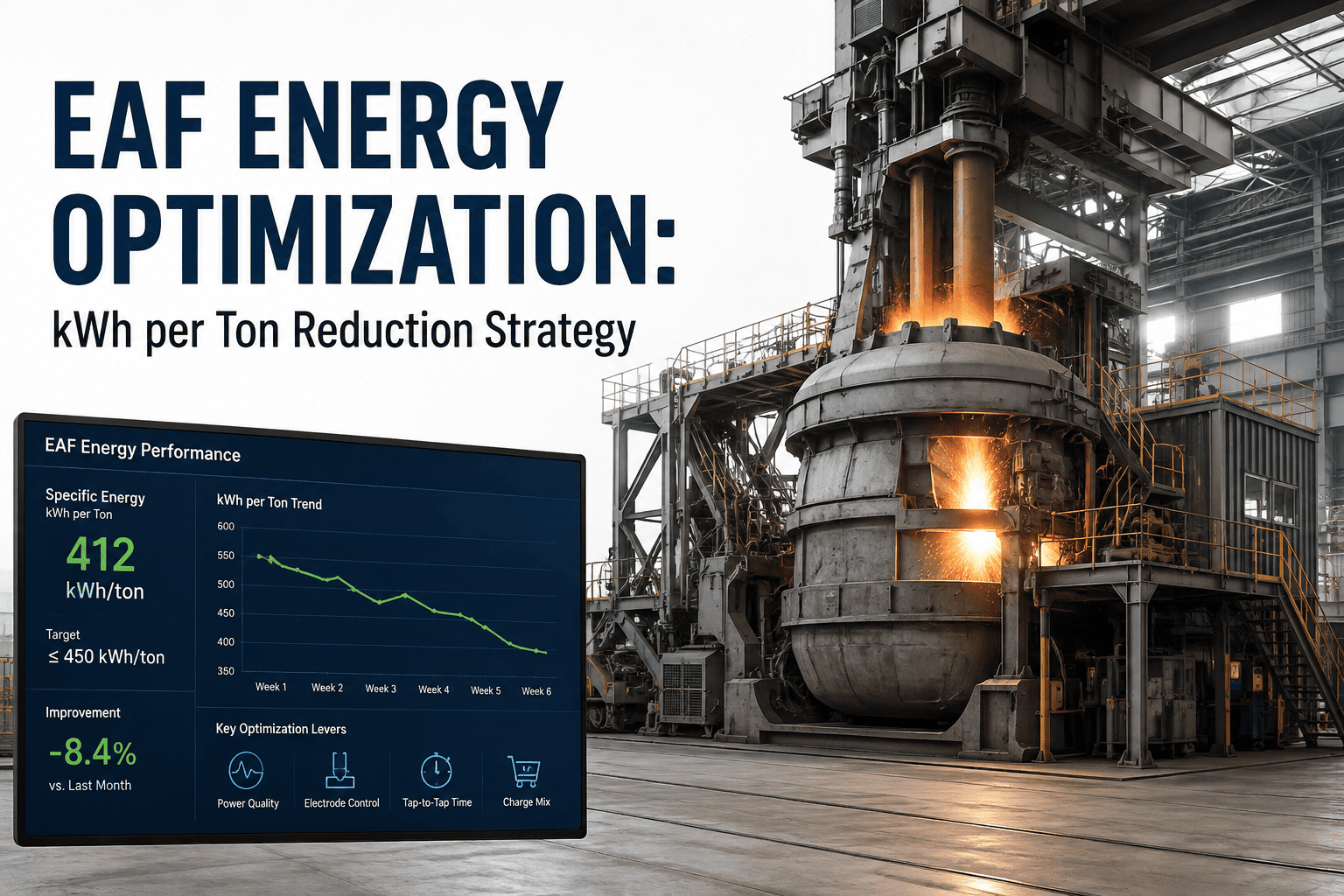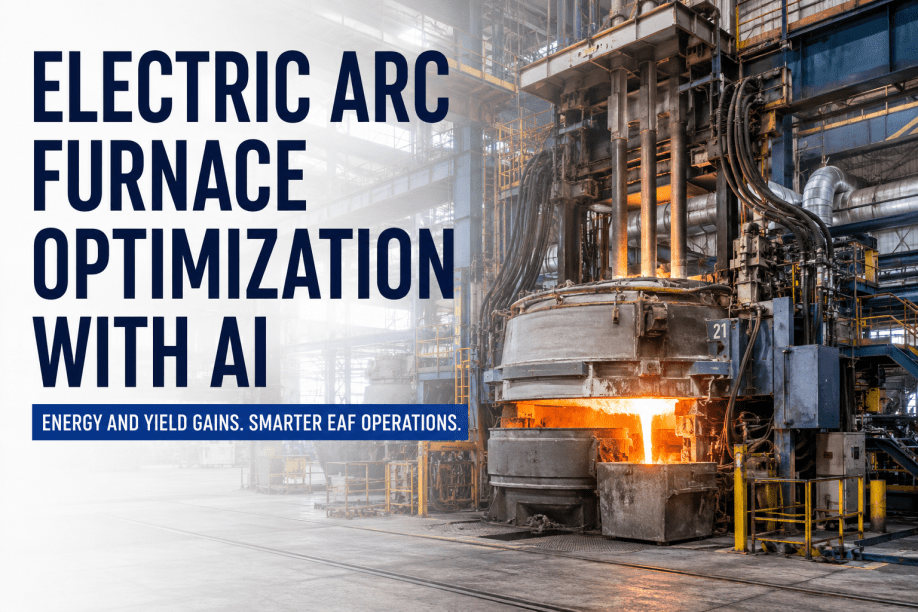
The electric arc furnace (EAF) transforms scrap steel, direct reduced iron (DRI), and hot briquetted iron (HBI) into liquid steel using electrical energy delivered through graphite electrodes that generate arc temperatures exceeding 3,000°C. Specific electrical energy consumption ranges from 350 to 550 kWh per ton of liquid steel depending on scrap quality, DRI metallization, electrode management, and the effectiveness of chemical energy input from oxy-fuel burners and post-combustion lances. Every 10 kWh per ton reduction in specific energy saves $0.60 to $0.90 per ton at typical U.S. industrial electricity rates, and every minute saved on tap-to-tap time increases annual furnace capacity by 1.5 to 2.5% at a constant power input. Traditional EAF optimization relies on operator experience for scrap bucket management, electrode regulation, and slag foaming practice — with substantial variation between shifts, furnace conditions, and scrap quality. iFactory's EAF Optimization Suite integrates electrode control AI, scrap mix optimization, post-combustion modeling, foamy slag management, and tap-to-tap scheduling into a single on-premise platform that reduces specific energy by 5 to 12%, increases yield by 1.5 to 3%, and cuts tap-to-tap time by 4 to 8 minutes. Book a Demo to discuss EAF optimization for your furnace size, scrap portfolio, and steel grade mix.
Can Your EAF Consistently Hit 380 kWh per Ton Across Every Scrap Mix and Steel Grade?
iFactory's EAF Optimization Suite predicts optimal scrap mix, electrode current profile, post-combustion oxygen rate, and foamy slag conditions in real time — processed on an on-premise NVIDIA edge server with zero cloud dependency, read-only PLC connectivity, and no modifications to your existing electrode regulation or furnace control system.
The Operational Case for AI-Driven Electric Arc Furnace Optimization
Electric arc furnace steelmakers face a persistent economic tension: maximize electrical energy input for fast melting while minimizing specific energy consumption, electrode consumption, and refractory wear. A typical 100-ton EAF producing 250,000 tons per year spends $3 million to $5 million annually on electrical energy, $400,000 to $800,000 on graphite electrodes, and $300,000 to $600,000 on refractory maintenance. Operator experience determines how well each heat balances these competing objectives, but experience varies across shifts, scrap quality shifts unpredictably between buckets, and the multivariate interactions between power input, chemical energy, slag chemistry, and bath temperature exceed human cognitive capacity to optimize continuously. AI models trained on 12 to 24 months of furnace operating data have demonstrated 5 to 12% reduction in specific electrical energy, 8 to 15% reduction in electrode consumption, and 4 to 8 minute reduction in tap-to-tap time — improvements that together deliver $800,000 to $2.5 million in annual savings per furnace at a typical 250,000 ton-per-year EAF shop.
Five AI Applications Transforming Electric Arc Furnace Optimization
AI deployment across EAF steelmaking spans five primary application domains. Each addresses a specific operating cost driver and generates measurable financial return through reduced energy consumption, improved yield, or increased productivity. The following tabbed overview details each application with its technology stack and documented outcomes from iFactory's EAF optimization deployments at U.S. mini-mills and integrated producers.
AI Electrode Control for Arc Stability and Energy Efficiency
Electrode control systems regulate the electrode arm position to maintain target arc current and voltage throughout the melting cycle. Conventional electrode regulators use PID controllers with fixed gain parameters tuned for average furnace conditions, but arc behavior varies dramatically across the melting cycle: long arcs during scrap bore-in, short arcs during flat bath melting, and unstable arcs during slag foaming transitions. AI electrode control models ingest real-time electrode current and voltage waveforms, hydraulic servo position feedback, and furnace impedance data at millisecond resolution, predicting arc instability 100 to 300 milliseconds before conventional regulators detect the deviation. The AI model dynamically adjusts gain parameters and position setpoints for each phase of the melting cycle, reducing arc flicker by 30 to 45%, electrode consumption by 8 to 15%, and specific energy by 3 to 6% compared to conventional PID-based electrode regulation. At a 120-ton EAF producing 280,000 tons per year in the southeastern United States, iFactory's electrode control AI reduced annual electrode consumption by 52 tons, saving $390,000 per year at $7,500 per ton electrode cost.
- Millisecond-resolution arc current and voltage waveform analysis for instability prediction 100–300 ms ahead of conventional PID detection
- Dynamic gain adaptation per melting phase — bore-in, flat bath, foaming slag, and temperature hold
- 30–45% reduction in arc flicker, 8–15% reduction in electrode consumption, 3–6% reduction in specific energy
- 52 tons annual electrode savings documented at 120-ton southeastern U.S. EAF shop
AI Scrap Mix Optimization for Lowest-Cost Charge Design
Scrap mix design — the selection and proportioning of scrap grades, DRI, HBI, pig iron, and other metallic inputs — determines the EAF charge cost, energy requirement, yield, and steel chemistry. A typical EAF shop purchases 15 to 30 scrap grades with prices that fluctuate weekly, availability that varies seasonally, and quality parameters including copper, chromium, nickel, tin, and residual element content that must be managed within steel grade specifications. Traditional scrap mix optimization uses spreadsheet models updated weekly and relies on the scrap buyer's experience to balance cost-versus-quality tradeoffs. AI scrap mix optimization engines ingest real-time scrap pricing feeds, yard inventory data, furnace operating data, and steel grade schedules to calculate the lowest-cost charge design for each individual heat. The AI model considers the melting energy requirements of each scrap type, the yield loss from oxidation and slag carryover, and the residual element constraints of the target steel grade. At a 90-ton EAF mini-mill in the Midwest, iFactory's scrap mix AI reduced charge material cost by $5.20 per ton over a 12-month period by identifying substitution opportunities between premium and industrial scrap grades that maintained steel quality while lowering purchased scrap cost by $1.3 million annually.
- Real-time scrap pricing and inventory integration — lowest-cost charge design per heat using current market prices
- Multi-variable constraint optimization — chemistry limits, melting energy, yield loss, and residual element management
- $5.20 per ton charge cost reduction documented at 90-ton Midwest U.S. mini-mill
- Automated scrap yard inventory management — aging cost minimization and grade substitution recommendations
AI Post-Combustion Optimization for Chemical Energy Utilization
Post-combustion lances inject oxygen above the slag layer to combust CO generated by decarburization into CO2, releasing chemical energy that typically provides 25 to 35% of the total energy input to an EAF heat. The effectiveness of post-combustion depends on the oxygen flow rate, lance position relative to the slag surface, and the slag foaming condition — parameters that operators adjust manually based on flame appearance and offgas temperature readings. AI post-combustion models ingest offgas CO and CO2 concentration data, lance position feedback, oxygen flow rate, and slag height measurements to calculate the real-time post-combustion ratio (CO2 / [CO + CO2]) and recommend oxygen flow rate and lance position adjustments that maximize chemical energy transfer to the bath. At a 150-ton EAF producing 350,000 tons per year, iFactory's post-combustion AI increased the average post-combustion ratio from 0.55 to 0.72, recovering an additional 4.8 kWh per ton of chemical energy that reduced specific electrical energy by 4.2% and saved $210,000 annually at $0.07 per kWh.
- Real-time post-combustion ratio calculation from offgas CO and CO2 concentration, oxygen flow rate, and slag height
- AI lance position and oxygen flow rate recommendations to maximize chemical energy transfer to the bath
- 4.2% specific electrical energy reduction from improved post-combustion efficiency
- Post-combustion ratio improvement from 0.55 to 0.72 documented at 150-ton U.S. EAF
AI Foamy Slag Management for Arc Shielding and Energy Retention
Foamy slag practice — injecting carbon and oxygen into the slag layer to generate CO bubbles that create a foam blanket covering the arc — is critical for EAF energy efficiency and refractory life. A well-developed foamy slag blanket reduces radiant heat loss to the water-cooled panels by 15 to 25%, decreases electrode consumption by reducing arc exposure, and improves arc stability by dampening current fluctuations. Conventional foamy slag management relies on operator judgment of slag appearance through the slag door, periodic slag sampling, and fixed carbon and oxygen injection ratios per grade. AI foamy slag models analyze electrode current and voltage harmonic signatures, furnace vibration patterns, and acoustic signals to estimate slag foaming height in real time, then recommend carbon injection rate, oxygen lance position, and slag conditioning flux additions to maintain an optimal foam blanket throughout the flat bath period. At a 100-ton EAF producing 220,000 tons per year, iFactory's foamy slag AI reduced specific electrical energy by 3.8% and decreased refractory consumption by 12% through consistent foamy slag coverage that reduced thermal loading on the refractory lining.
- Real-time slag foaming height estimation from electrode harmonic signatures, vibration patterns, and acoustic data
- AI recommendations for carbon injection rate, oxygen lance position, and flux additions to optimize foam blanket
- 3.8% specific energy reduction and 12% refractory consumption reduction documented
- Consistent foam blanket coverage across all operators and shifts regardless of individual experience
AI Tap-to-Tap Optimization for Productivity and Scheduling
Tap-to-tap time — the total duration from charge to tap — determines EAF productivity and is the primary constraint on annual steel production capacity. A typical EAF operates with a target tap-to-tap time of 45 to 60 minutes, but actual times vary by 8 to 15 minutes per heat depending on scrap density, energy input rate, slag practice, and operator decisions on when to sample, temperature-check, and tap. AI tap-to-tap optimization models ingest real-time furnace data throughout the heat, predicting the remaining time to target temperature and chemistry, and providing the operator with a continuous time-to-tap countdown that accounts for current energy input rate, scrap melting progress, and slag conditioning status. The AI model recommends actions — including power input adjustment, oxygen flow rate changes, and flux timing — that keep each heat on schedule toward the target tap time. At a 120-ton EAF producing 300,000 tons per year, iFactory's tap-to-tap AI reduced average heat time by 6.2 minutes, increasing annual production capacity by 25,000 tons without capital investment in transformer upgrades or furnace modifications.
- Continuous time-to-tap prediction updated every 30 seconds using current energy input, scrap melting rate, and slag conditions
- AI recommendations for power input, oxygen rate, and flux timing to maintain tap-to-tap schedule
- 6.2-minute average tap-to-tap reduction documented at 120-ton U.S. EAF
- 25,000 tons incremental annual capacity without transformer or furnace capital modifications
Manual EAF Operation vs. AI-Driven Optimization — The Performance Gap
EAF operators have optimized manual control over decades of experience, but the performance ceiling of conventional operations has structural limitations: electrode current regulation is bounded by PID controller response times, scrap mix optimization is constrained by weekly spreadsheet update cycles, and foamy slag management depends on operator visual observation of slag appearance through the slag door. AI systems operating on millisecond-resolution sensor data and continuous model optimization achieve measured performance improvements that manual and conventional SCADA-only operations cannot reach regardless of operator experience or staffing levels.
| Operation Domain | Conventional Manual Method | AI-Driven Method | Measured Improvement |
|---|---|---|---|
| Electrode Control | PID-based electrode regulation with fixed gain parameters tuned for average furnace conditions; operator intervention for arc instability events | AI electrode control with millisecond-resolution arc waveform analysis and dynamic gain adaptation per melting phase; arc instability prediction 100–300 ms before conventional detection | 8–15% electrode consumption reduction; 30–45% arc flicker reduction; 3–6% specific energy reduction |
| Scrap Mix Design | Weekly spreadsheet-based scrap mix optimization; scrap buyer experience determines grade substitution and cost-quality tradeoffs | AI real-time scrap mix optimization per heat using live pricing, yard inventory, and chemistry constraint data; automated grade substitution with cost minimization | $5.20 per ton charge cost reduction; $1.3 million annual scrap cost savings at 90-ton EAF |
| Post-Combustion Control | Operator-adjustable oxygen lance position and flow rate based on offgas temperature and flame appearance through the slag door | AI real-time post-combustion ratio calculation from offgas CO/CO2 data; automated lance position and oxygen flow recommendations maximizing chemical energy transfer | Post-combustion ratio improvement from 0.55 to 0.72; 4.2% specific energy reduction |
| Foamy Slag Management | Operator visual assessment of slag foam height through slag door; fixed carbon and oxygen injection ratios per steel grade | AI real-time slag foaming height estimation from electrode harmonics and acoustic data; dynamic carbon, oxygen, and flux recommendations to maintain optimal foam blanket | 3.8% specific energy reduction; 12% refractory consumption reduction |
| Tap-to-Tap Scheduling | Operator judgment on sample timing, temperature check timing, and tap decision based on experience and visual furnace condition assessment | AI continuous time-to-tap prediction with 30-second updates; real-time recommendations for power, oxygen, and flux adjustments to maintain schedule | 6.2-minute average tap-to-tap reduction; 25,000 tons incremental annual capacity |
A Phased Approach to AI Deployment at Your EAF Shop
Deploying AI-driven optimization across an EAF shop does not require a greenfield control system replacement or a production shutdown schedule. iFactory's platform is designed for brownfield retrofit on live furnace operations, with read-only data integration into existing electrode regulation systems, scrap management systems, and secondary metallurgy control systems. The deployment sequence reflects lessons learned from multi-facility AI installations across U.S. mini-mills and integrated EAF shops.
Furnace Data Audit & AI Platform Sizing
iFactory engineering teams conduct an on-site audit of furnace instrumentation, electrode regulation system architecture, scrap yard management workflows, and existing data infrastructure. Priority AI modules — electrode control, scrap mix optimization, post-combustion control, foamy slag management, and tap-to-tap scheduling — are sized and specified for the furnace's transformer rating, electrode diameter, scrap portfolio, and steel grade mix. Book a Demo to discuss your EAF shop's specific configuration and deployment timeline.
AI Model Training & Site-Specific Calibration
AI models are trained on facility-specific historical data covering 12 to 24 months of furnace operating data, scrap purchases, and metallurgical outcomes. Electrode control models are calibrated on the furnace's specific transformer tap settings, electrode regulation system response characteristics, and scrap melting patterns. Scrap mix optimization models are trained on the shop's specific scrap grade chemistry profiles, pricing history, and steel grade chemistry targets. Post-combustion, foamy slag, and tap-to-tap models are calibrated on furnace-specific sensor data. All AI-generated recommendations are reviewed by operations, metallurgy, and maintenance teams during this validation period before production deployment. Each model must achieve minimum 85% prediction accuracy before entering full production mode.
Full Production Deployment & Operator Adoption
All AI modules operate in full production mode across the EAF shop. Electrode control AI runs on millisecond-resolution arc data, providing continuous electrode position recommendations. Scrap mix AI generates per-heat charge designs. Post-combustion, foamy slag, and tap-to-tap AIs provide real-time recommendations to furnace operators through a dedicated console. A 4-to-6-week parallel operation phase builds operator trust by displaying AI predictions alongside traditional control displays, allowing each operator to compare AI recommendations with their own judgment. All systems integrate through iFactory's EAF operations intelligence layer, feeding energy dashboards, scrap cost reports, electrode consumption tracking, and productivity analytics to operations and management teams.
Continuous Benchmarking & ROI Verification
With 8-plus weeks of production AI deployment data, iFactory generates monthly KPI benchmark reports comparing pre-deployment baselines against current performance across all tracked dimensions: specific electrical energy consumption, electrode consumption rate, scrap cost per ton, post-combustion efficiency, foamy slag coverage duration, tap-to-tap time distribution, and overall yield. These benchmarks quantify the commercial return on the AI deployment and guide continuous improvement priorities for the subsequent quarter. Model retraining occurs automatically as scrap quality patterns shift, electrode regulation system components age, and steel grade mix evolves.
See iFactory's EAF Optimization Suite — Deployed on Operating Furnaces.
iFactory integrates electrode control AI, scrap mix optimization, post-combustion modeling, foamy slag management, and tap-to-tap scheduling into a single platform purpose-built for the operational demands of electric arc furnace steelmaking.
Expert Perspective: What Changes When AI Drives Electric Arc Furnace Operations
The most significant operational shift that AI deployment creates at an EAF shop is not any single application improvement — it is the system-level effect of connecting electrode control data to scrap mix decisions, post-combustion conditions, and tap-to-tap scheduling in real time. In a conventional EAF shop, electrode regulation, scrap management, and furnace operations are managed by separate teams working from different data sources on different time cycles.
We operate a 120-ton EAF producing approximately 280,000 tons per year of structural and SBQ grades in the southeastern United States. Before deploying iFactory's EAF Optimization Suite, we managed electrode control with a 15-year-old PID regulation system, designed scrap mixes with weekly spreadsheet updates, and relied entirely on operator experience for post-combustion and foamy slag practice. The AI system changed our operating paradigm within the first 90 days. The electrode control AI detected an arc instability pattern that was developing as our electrode column guide bushings wore — the PID system had been compensating with increasing gain that was masking the degradation while consuming 8% more electrode than the first half of the campaign. The AI identified the pattern in the arc waveform harmonics and recommended a bushing inspection that caught the wear before it caused a column seizure event that would have cost 36 hours of unplanned downtime.
The scrap mix optimization engine has been equally transformative for our charge material cost. The AI identified that we were over-using premium low-residual scrap grades for commodity-grade structural steel heats. By substituting industrial scrap grades in 40% of our structural tonnage while maintaining chemistry constraints, the AI reduced our annual scrap cost by $1.3 million without a single chemistry-related downgrade. On the energy side, the integrated effect of electrode control AI, post-combustion optimization, and foamy slag management reduced our specific electrical energy by 9.7% over the first six months — from 418 kWh per ton to 378 kWh per ton. At $0.065 per kWh, that is $680,000 in annual electrical energy savings from a single furnace. The tap-to-tap AI added another 6.2 minutes per heat reduction, which gave us 25,000 tons of incremental annual capacity that we monetized through increased production of higher-margin SBQ grades.
The Case for AI-Driven EAF Optimization Is Measurable, Repeatable, and Available Now
The operational case for AI optimization at electric arc furnace shops is documented and commercially significant: electrode control AI delivers 8 to 15% reduction in electrode consumption and 3 to 6% reduction in specific energy, scrap mix AI reduces charge cost by $4 to $8 per ton through real-time pricing and quality optimization, post-combustion AI recovers 4 to 6 kWh per ton of additional chemical energy, foamy slag AI reduces refractory consumption by 10 to 15%, and tap-to-tap AI reduces heat time by 5 to 8 minutes, increasing annual capacity by 8 to 12% without transformer or furnace capital modifications. The combined effect of these five AI modules — deployed as an integrated suite — delivers $800,000 to $2.5 million in documented annual savings per furnace at a typical 250,000 ton-per-year EAF shop.
iFactory's EAF Optimization Suite is deployable as a brownfield retrofit on live furnace operations without production shutdown, electrode regulation system replacement, or modification of existing scrap handling or secondary metallurgy infrastructure. The documented ROI from energy reduction, electrode savings, scrap cost reduction, and productivity improvement typically delivers full platform payback within 6 to 10 months at a 250,000 ton-per-year EAF shop. Book a Demo with iFactory's EAF team to build a site-specific deployment plan and begin the path to AI-driven optimization at your electric arc furnace shop.
Deploy AI-Driven Optimization Across Your Electric Arc Furnace Shop
iFactory's EAF Optimization Suite delivers electrode control AI, scrap mix optimization, post-combustion modeling, foamy slag management, and tap-to-tap scheduling in one platform purpose-built for the operational demands of electric arc furnace steelmaking. Deployed on a pre-configured NVIDIA edge server with read-only PLC connectivity, no control system modifications required, and a 12 to 20 week deployment timeline.
EAF AI Optimization — Frequently Asked Questions
Does AI deployment require replacement of the existing electrode regulation system or furnace control system?
No. iFactory's platform integrates via read-only connections to existing electrode regulation systems, PLCs, scrap management databases, and secondary metallurgy control systems. No furnace shutdown, control system replacement, or re-instrumentation is required. The AI layer operates alongside existing control systems, providing optimization recommendations through a dedicated operator console that does not write back to any control system component. Operators retain full control over electrode position, power input, oxygen flow, and all other furnace parameters through the existing control interface. Book a Demo to review your EAF shop's data architecture with iFactory's engineering team.
How does the AI scrap mix optimizer handle fluctuating scrap prices and variable scrap quality?
The scrap mix optimization engine integrates with your scrap management system through read-only data links to receive real-time scrap inventory levels, pricing feeds, and quality certificates. The AI model recalculates the optimal charge design for each individual heat as prices change, scrap inventory levels shift, and steel grade scheduling updates occur. The model maintains a chemistry constraint database per steel grade, ensuring that residual element limits for copper, chromium, nickel, tin, and other elements are satisfied regardless of scrap grade substitutions. The scrap buyer and melt shop metallurgist receive alerts when the model identifies a significant cost-saving substitution opportunity.
What is the typical timeline and payback period for EAF AI deployment?
iFactory's documented deployments show full platform payback within 6 to 10 months at a typical 250,000 ton-per-year EAF shop. The deployment timeline from initial data audit to full production operation is approximately 20 weeks across four phases. Primary ROI drivers are specific electrical energy reduction of 5 to 12% ($300,000 to $900,000 annual savings), electrode consumption reduction of 8 to 15% ($150,000 to $500,000 annual savings), scrap cost reduction of $4 to $8 per ton ($1 to $2 million annual savings), and tap-to-tap time reduction adding 8 to 12% incremental capacity monetized through increased higher-margin production.
Can the platform handle different furnace sizes, transformer ratings, and steel grade mixes?
Yes. The AI platform architecture is furnace-agnostic by design. Electrode control models calibrate to the furnace's specific transformer tap configuration, electrode column geometry, and hydraulic regulation system response characteristics. Scrap mix models adapt to the shop's specific scrap grade portfolio, chemistry profiles, and steel grade targets. Post-combustion, foamy slag, and tap-to-tap models train on furnace-specific sensor data and operating practices. The platform has been deployed on furnaces ranging from 50 to 200 tons with transformer ratings from 40 MVA to 120 MVA, producing steel grades from commodity rebar through high-value SBQ and specialty plate grades.
How does the AI foamy slag model work without continuous slag height measurement instrumentation?
The foamy slag AI model estimates slag foaming height indirectly from signals that correlate strongly with foam blanket condition. Electrode current and voltage harmonic signatures change characteristically as the foam blanket covers the arc — reducing high-frequency current harmonics and stabilizing the arc impedance. Furnace shell vibration sensors detect the damping effect of the foam blanket on mechanical vibrations from arc activity. Acoustic microphones on the furnace roof detect the sound attenuation characteristic of a well-developed foam blanket. The model is trained on periods where operators made visual foam height observations, correlating these indirect signals with actual foam condition. Once trained, the model provides reliable foam height estimates that enable AI-driven carbon injection, oxygen lance, and flux addition recommendations.
Deploy EAF Optimization with iFactory
EAF plant managers at U.S. mini-mills and integrated producers trust iFactory's on-premise AI platform to reduce specific energy by 5 to 12%, cut electrode consumption by 8 to 15%, optimize scrap costs, improve yield, and increase annual capacity — all on a turnkey NVIDIA edge server with read-only PLC connectivity and zero modifications to existing furnace control systems.