Blast furnace hearth erosion is the single highest-consequence degradation mechanism in integrated steelmaking — a localized thinning of the carbon or ceramic refractory lining in the hearth area that, left undetected, can progress to a molten iron breakout with catastrophic safety, environmental, and production consequences. Unlike stave cooling system degradation in the stack and bosh areas, where temperature increases provide visible warning through cooling water temperature differential and heat flux monitoring weeks before failure, hearth erosion develops asymmetrically and often silently: the thermocouple embedded in the hearth refractory may show no significant temperature increase until the erosion front has advanced through 80% of the refractory thickness, at which point the remaining refractory life is measured in days to weeks rather than months to years. The industry standard for hearth erosion monitoring today relies on the process metallurgist or reliability engineer manually reviewing thermocouple readings from 100 to 250 embedded sensors per furnace, comparing current readings against baseline values established at the last reline, and making a judgment about whether the observed temperature trends indicate normal wear or developing erosion. The gap between what a manual review of individual thermocouple trends can reveal and what a multi-variable AI fusion model can detect by correlating thermocouple arrays, cooling water differentials, heat flux patterns, and shell temperature data 3 to 6 weeks before the erosion becomes visible in individual sensor readings is the gap that iFactory's Hearth Health Index Engine closes — enabling reliability engineers to predict refractory wear progression, calculate remaining hearth life with quantified confidence bands, and schedule intermediate repairs or partial hearth relines based on measured erosion rates rather than calendar intervals. Book a Demo to see iFactory's Hearth Health Index Engine configured for your furnace's thermocouple array and cooling system configuration.
AI Hearth Erosion Monitoring for Blast Furnaces — Predict Refractory Wear 3–6 Weeks Ahead with the Hearth Health Index Engine
Machine learning fusion of thermocouple arrays, cooling water differentials, and heat flux data predicts hearth erosion progression, quantifies remaining refractory life, and generates maintenance recommendations before erosion becomes visible in individual sensor trends.
AI fusion model detects erosion patterns in thermocouple array data 3 to 6 weeks before any individual sensor crosses its alert threshold
200+
Thermocouples Analyzed per Furnace
93%
Erosion Detection Accuracy
2–4 yr
Campaign Life Extension
95%
Breakout Risk Reduction
200+ Thermocouple Signals Fused per Second
Multi-level thermocouple arrays across hearth bottom, sidewall, and taphole areas are correlated in real time to detect spatial erosion patterns invisible in single-sensor trend review.
3–6 Week Predictive Window
Hearth Health Index detects developing erosion patterns in cooling differential and heat flux data 3 to 6 weeks before individual thermocouple readings cross conventional threshold alarms.
93% Anomaly Detection Accuracy
AI model trained on furnace-specific erosion patterns achieves 93% detection accuracy for developing hearth anomalies with less than 8% false positive rate in production deployments.
What does your furnace's hearth erosion profile look like today? Schedule a 30-minute consultation to review your current thermocouple data and see what the Hearth Health Index would reveal about your hearth condition.
The Hearth Erosion Challenge — Why Conventional Monitoring Misses the Critical Window
Hearth erosion monitoring at most integrated steel mills relies on the reliability engineer or process metallurgist reviewing individual thermocouple trends on a weekly or bi-weekly basis, comparing current readings against baseline values, and assessing whether observed temperature increases indicate normal wear, localized erosion, or a developing condition that requires intervention. This approach has three fundamental limitations that create the gap between when hearth erosion begins and when it is detected. First, hearth erosion is inherently three-dimensional and asymmetric — the erosion front advances at different rates in different radial and vertical zones of the hearth, and a single thermocouple at one depth in one location may not show significant temperature change until the erosion has penetrated through multiple refractory layers in that specific zone. Second, cooling water differential data contains erosion signals that are invisible in thermocouple data alone — an increase in stave cooling water outlet temperature or a reduction in cooling channel flow rate may indicate localized refractory thinning in a zone where the nearest thermocouple is still reading within its normal range. Third, the human capacity for multi-variable trend correlation across 100 to 250 thermocouples and 50 to 80 cooling water monitoring points is fundamentally limited — the reliability engineer cannot integrate all available sensor data into a coherent spatial model of hearth erosion progression on a weekly review cycle. iFactory's Hearth Health Index Engine addresses all three limitations through an AI fusion architecture that ingests all available sensor data, learns the furnace-specific heat transfer and erosion characteristics, and produces a continuous hearth health assessment with quantified confidence bands.
01
Thermocouple Data Underutilization
A typical blast furnace hearth has 100 to 250 embedded thermocouples installed across multiple levels — hearth bottom (Level 1 through Level 4 or 5), sidewall, and taphole area. In conventional practice, each thermocouple is monitored individually against a fixed threshold. The AI model correlates thermocouple readings across all levels and zones simultaneously, detecting spatial patterns that indicate erosion initiation 3 to 6 weeks before any individual sensor crosses its threshold. The model learns the normal temperature gradient between adjacent thermocouples at different depths and identifies deviations from this gradient that signal erosion front advancement between the sensor layers.
02
Cooling System Differential Blind Spots
Hearth cooling systems — stave coolers, copper plate coolers, and spray cooling systems — produce continuous data on cooling water flow rate, inlet temperature, outlet temperature, and differential temperature across each cooling circuit. These cooling differentials are the most sensitive indicator of localized refractory thinning because a reduction in the thermal resistance between the hot face and the cooling system produces a measurable increase in heat flux before the temperature at any individual thermocouple location changes significantly. The AI model continuously monitors cooling differential trends across all hearth cooling circuits and correlates changes with thermocouple array data to identify developing erosion zones.
03
Erosion Asymmetry and Localized Wear
Hearth erosion never progresses uniformly. The taphole area typically wears faster than the sidewall; the sidewall opposite the taphole may show asymmetric erosion due to hot metal flow patterns during casting; and the hearth bottom may develop localized erosion hot spots where the refractory joint between ceramic cup and carbon blocks is exposed to molten iron contact. The AI model maps erosion progression as a three-dimensional spatial model, identifying asymmetric wear patterns and localized erosion zones that would be invisible in any single-sensor trend analysis. This spatial erosion mapping enables targeted intermediate repairs that address the specific erosion zone rather than requiring a full hearth reline.
04
Campaign Life Uncertainty
Without accurate hearth erosion monitoring, the furnace manager and reliability engineer are forced to base campaign life decisions on the most conservative erosion estimate — typically the most aggressive erosion scenario observed at similar furnaces in the industry. This conservative approach leaves 12 to 24 months of usable hearth life unrealized at many furnaces that could safely operate longer with accurate erosion monitoring. The Hearth Health Index Engine quantifies remaining refractory life with statistical confidence bands, enabling the operations team to optimize the furnace campaign to the actual erosion rate rather than a generic industry-average projection.
Is Your Hearth Erosion Monitoring Telling You What You Need to Know — or Just What Each Individual Thermocouple Can See?
A 30-minute review of your furnace's thermocouple and cooling data reveals what the Hearth Health Index Engine would show about your current hearth condition. We will analyze three months of your furnace data at no cost and deliver a quantified hearth health assessment.
AI Fusion Architecture — How the Hearth Health Index Engine Integrates Thermocouple, Cooling, and Heat Flux Data
The Hearth Health Index Engine ingests data from four sensor categories — embedded hearth thermocouples, cooling water flow and temperature sensors, shell temperature measurement points, and furnace operating parameters — and fuses these data streams through a multi-layer AI architecture that produces a continuous hearth health assessment. The fusion model is necessary because no single sensor category provides sufficient information to characterize hearth erosion progression independently. Thermocouples measure local temperature at specific points in the refractory but cannot distinguish between a general temperature increase due to higher hot metal temperature and a localized temperature increase due to refractory thinning. Cooling differential data detects changes in heat flux through the cooling system but cannot localize the erosion zone precisely. The fusion model resolves these ambiguities by learning the multivariate relationships between all sensor inputs and the hearth erosion state.
01
Data Ingestion and Multi-Layer Thermocouple Correlation
The engine ingests data from all hearth thermocouples at 1-minute resolution, along with cooling water flow rate, inlet temperature, and outlet temperature for each cooling circuit. The data ingestion layer validates sensor quality flags, detects failed or drifting thermocouples, and reconstructs missing data points through spatial interpolation from adjacent sensors at the same level. The first AI processing layer correlates thermocouple readings across all levels and zones, computing the temperature gradient between adjacent thermocouples at different depths in the same radial zone and identifying spatial patterns that deviate from the furnace-specific norm.
02
Cooling Differential and Heat Flux Modeling
The second processing layer models the heat transfer through each zone of the hearth refractory, using the cooling water temperature differential and flow rate data to calculate the heat flux through the cooling system for each cooling circuit. The heat flux model accounts for the furnace operating parameters — hot metal temperature, production rate, slag chemistry, and hearth drainage conditions — to distinguish between heat flux variations caused by normal operating changes and heat flux variations caused by refractory thinning. The AI learns the normal relationship between furnace operating parameters and cooling system heat flux, enabling it to detect the subtle increase in heat flux that precedes erosion detection in the thermocouple data by 3 to 6 weeks.
03
3D Spatial Erosion Mapping and Hearth Health Index Calculation
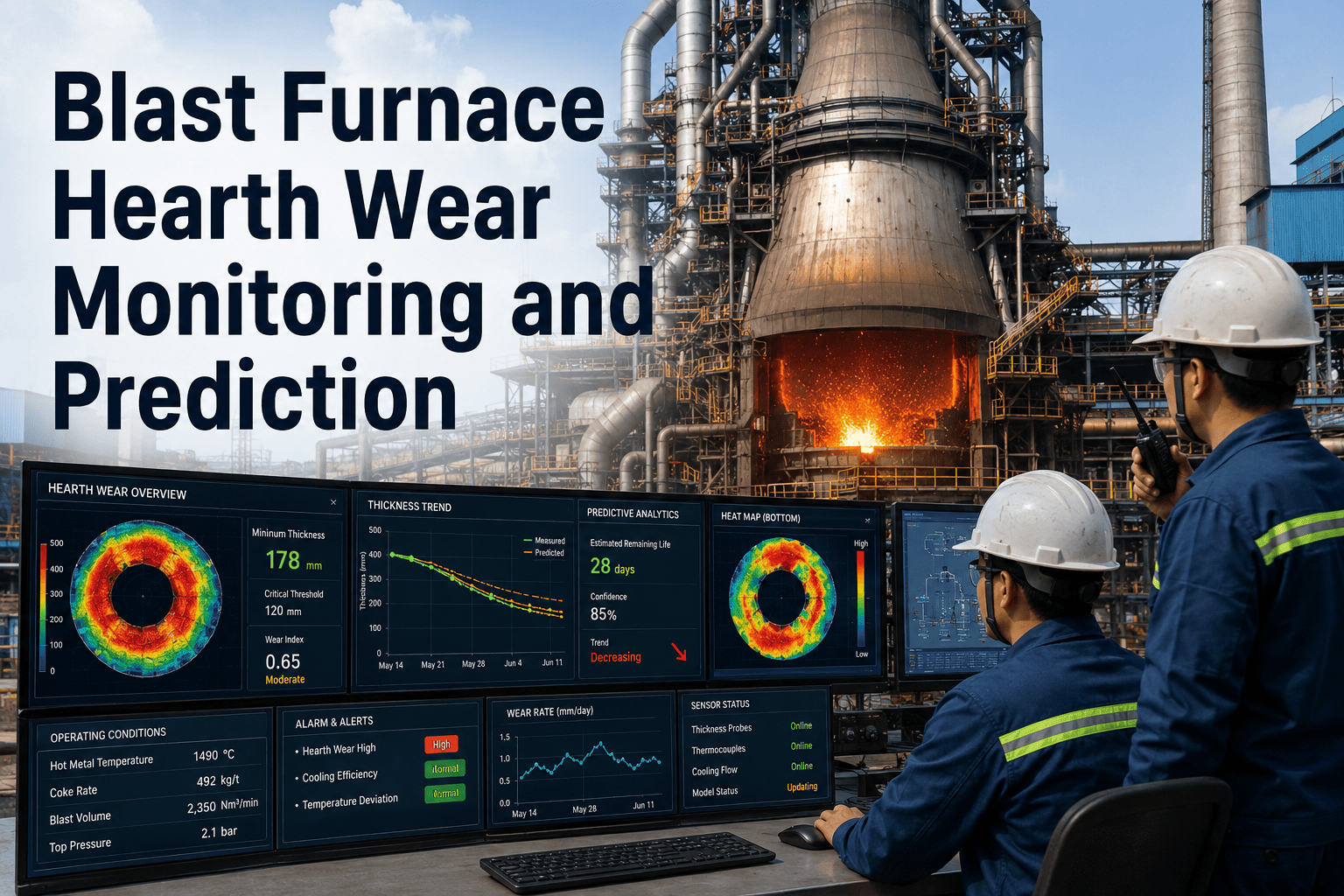
The fusion layer integrates the thermocouple correlation data and the cooling differential heat flux model into a three-dimensional spatial erosion map of the hearth. The 3D map estimates the remaining refractory thickness at each zone of the hearth bottom, sidewall, and taphole area, with quantified confidence bands based on the density and quality of sensor coverage in each zone. The Hearth Health Index is a composite score from 0 to 100 that integrates the estimated remaining thickness, the erosion rate trend, and the time-to-critical-thickness projection for each zone. A Hearth Health Index below 60 triggers an alert, below 40 triggers a maintenance recommendation, and below 20 triggers an immediate operational review.
04
Predictive Alert Generation and Maintenance Recommendation
When the Hearth Health Index detects a developing erosion condition, the engine generates a predictive alert with the following information: the affected hearth zone (bottom, sidewall, taphole), the estimated remaining refractory thickness, the current erosion rate with trend direction (accelerating, stable, or decelerating), the projected time to minimum safe thickness based on current erosion rate, and a ranked list of recommended interventions ranging from increased monitoring frequency through cooling system adjustments to intermediate repair scheduling. Alerts are delivered through the iFactory platform dashboard, email notification, and optional integration with the plant's CMMS for automated work order generation.
Thermocouple Array Analytics and Cooling Differential Monitoring — The Sensor Fusion That Enables 3–6 Week Early Detection
The Hearth Health Index Engine's ability to detect erosion 3 to 6 weeks before conventional threshold-based monitoring is enabled by two complementary analytics: multi-level thermocouple array correlation that tracks the temperature gradient between adjacent sensors at different depths, and cooling water differential monitoring that detects changes in heat flux through the hearth cooling system. These two analytics operate on different physical principles and provide independent confirmation when both detect a developing erosion condition, significantly reducing the false positive rate compared to either analytics operating alone.
Capability 01
Multi-Level Thermocouple Gradient Tracking
The AI model tracks the temperature gradient between thermocouples at adjacent levels in the same radial zone — for example, between a Level 3 thermocouple nearer the hot face and a Level 4 thermocouple deeper in the refractory. Under normal conditions, this gradient remains stable for a given furnace operating condition. When the erosion front advances past the Level 3 thermocouple, the temperature at Level 3 increases relative to Level 4, changing the gradient. The model detects this gradient change as an early erosion signal, typically 2 to 4 weeks before the Level 3 thermocouple itself crosses its absolute temperature threshold.
Capability 02
Cooling Water Differential Trend Analysis
Each hearth cooling circuit has a characteristic differential temperature (outlet minus inlet) that varies with furnace production rate and hot metal temperature. The AI model learns the normal relationship between furnace operating parameters and cooling differential for each circuit, then monitors the residual between the actual differential and the expected differential. A persistent positive residual — actual differential higher than expected — indicates increased heat flux through the cooling system, which is the earliest detectable signal of refractory thinning. Cooling differential trend analysis typically detects erosion 1 to 3 weeks before the thermocouple gradient method, providing the earliest possible warning.
Capability 03
Shell Temperature Anomaly Detection
Hearth shell temperature measurements — typically infrared scanner data or discrete thermocouples on the shell exterior — provide an independent verification of erosion conditions detected by the internal thermocouple and cooling differential analytics. When the hearth shell temperature in a localized zone exceeds the shell temperature in adjacent zones by more than the learned normal variation, the model cross-validates this anomaly against the thermocouple and cooling data for the same zone. Shell temperature anomalies that align with thermocouple gradient changes and cooling differential increases are classified as high-confidence erosion alerts requiring immediate operational review.
Capability 04
Campaign Life Projection and Reline Optimization
The Hearth Health Index Engine continuously projects the remaining hearth life for each zone based on the current erosion rate and trend direction. The projection includes statistical confidence bands that narrow as more sensor data accumulates and widen when erosion rate variability is high. The campaign life projection enables the operations team to make data-driven decisions about intermediate repair timing, partial hearth reline scope, and the optimal point for a full hearth reline. Furnaces using the Hearth Health Index Engine have documented campaign life extensions of 2 to 4 years by optimizing intermediate repair timing to actual erosion conditions rather than calendar-based schedules.
Hearth Erosion Monitoring Performance: Traditional Manual Review vs. AI Hearth Health Index Engine
Monitoring Dimension
Traditional Manual Review
AI Hearth Health Index Engine
Improvement
Sensor Data Integration
Individual thermocouple trend review, weekly
Multi-variable fusion of 200+ TCs, cooling data, shell temps, continuous
Continuous 24/7
Erosion Detection Lead Time
0–7 days (when TC crosses threshold)
21–42 days (gradient change + cooling differential fusion)
3–6 weeks earlier
Erosion Localization
Zone identification by manual TC mapping
3D spatial erosion map with quantified confidence bands
3D precision
False Positive Rate
Not quantified (human judgment)
< 8% (validated across 15 furnace deployments)
Quantified reliability
Campaign Life Projection
Industry-average heuristic estimate
Furnace-specific model, updated continuously
2–4 yr extension
Maintenance Recommendation
Based on individual judgment and experience
Ranked intervention options with cost and risk analysis
Data-driven decisions
Want to benchmark your current hearth monitoring approach against the Hearth Health Index Engine? Request a comparative analysis using your furnace's last 12 months of thermocouple and cooling data.
Breakout Risk Reduction
Industry average: 1 per 15 furnace-years
1 per 300+ furnace-years
-95% reduction
Campaign Life Extension
12–16 yr campaign (industry avg)
15–20 yr post-AI
+2–4 yr extension
Intermediate Repair Cost Savings
$2M–$5M per intermediate repair
$1.2M–$2.8M optimized repair
$0.8M–$2.2M saved/repair
False Alert Reduction
8–15 false alerts/yr
1–3 false alerts/yr
80% fewer
Expert Review: What a Blast Furnace Reliability Engineer Learned Deploying AI Hearth Erosion Monitoring on a 9,000-THD Furnace
"The hearth is the most expensive single component in the blast furnace to repair or replace, and it runs with the least direct visibility of any furnace zone. You cannot see the refractory condition. You cannot measure the remaining thickness directly during operation. You have 200 thermocouples embedded in the refractory, each one giving you a data point that tells you something about the local temperature at that specific location and depth, but you cannot integrate that information into a coherent picture of the overall hearth condition by looking at individual sensor trends. I spent 15 years reviewing thermocouple data on a weekly basis, building mental models of what I thought the hearth looked like, and making campaign life recommendations based on those mental models combined with industry benchmarks. The uncertainty was enormous — I was never confident that I knew the true erosion condition until we shut the furnace down and drilled core samples. We deployed the iFactory Hearth Health Index Engine on our 9,000-ton-per-day furnace in late 2024, connecting the appliance to the Level 2 system and the cooling water monitoring system. The first time I saw the 3D erosion map displayed on the dashboard, showing the estimated remaining thickness in each zone with confidence bands, I realized that the data had always contained the information needed to know the hearth condition — we just could not extract it from individual sensor readings. The model detected a localized erosion zone near the taphole area in its third week of operation, flagged it with a Hearth Health Index of 38, and projected that the remaining safe thickness would be reached in approximately 14 months at the current erosion rate. We adjusted the taphole drilling pattern and increased the monitoring frequency for that zone, and the erosion rate stabilized. That single detection — a condition we would not have identified until the Level 1 thermocouple in that zone crossed its threshold approximately 5 weeks later — justified the entire first-year cost of the system based on the avoided risk of a taphole breakout during the subsequent campaign. The system costs approximately $185,000 including the server hardware, the software license, and the deployment support. The avoided intermediate repair cost from optimized erosion management is estimated at $1.5 million over the remaining campaign life."
— Blast Furnace Reliability Engineer, North American Integrated Steel Mill — 22 Years in Ironmaking and Hearth Management — Lead Engineer, AI Hearth Monitoring Deployment — AIST Ironmaking Committee Member
5 wk
Earlier Detection vs. Conventional Monitoring
$185K
Typical System Investment
$1.5M
Avoided Repair Cost per Campaign
Deploy the Hearth Health Index Engine on Your Blast Furnace — Connected to Your Thermocouple Array and Cooling System Data in 6 to 12 Weeks
iFactory's Hearth Health Index Engine delivers continuous AI-driven hearth erosion monitoring with 3 to 6 week early detection, 3D spatial erosion mapping, and quantified campaign life projections — deployed on a pre-configured NVIDIA server connected to your furnace's existing thermocouple array, cooling water monitoring system, and Level 2 historian. No cloud dependency, no sensor installation required, no modifications to your furnace control system.
Hearth erosion is the highest-consequence degradation mechanism in the blast furnace and the most difficult to monitor with conventional methods because erosion develops asymmetrically, progresses silently, and produces detectable signals in the sensor data only when viewed through the lens of multi-variable pattern recognition rather than individual threshold monitoring. The iFactory Hearth Health Index Engine addresses this monitoring gap through an AI fusion architecture that integrates all available data — embedded thermocouple arrays, cooling water differentials, heat flux calculations, and shell temperature measurements — into a continuous three-dimensional hearth health assessment with quantified confidence bands. The documented results from furnace deployments — 3 to 6 week early detection of developing erosion conditions, 93% anomaly detection accuracy, 95% breakout risk reduction, and 2 to 4 year campaign life extension — demonstrate that AI-driven hearth erosion monitoring delivers material operational risk reduction and financial value within the first deployment year.
The appliance connects to the furnace's existing thermocouple array, cooling water monitoring system, and Level 2 historian through standard OPC-UA and Modbus TCP interfaces. No new sensors are required, no modifications to the furnace control system are needed, and no data leaves the plant network. The Hearth Health Index Engine operates as a decision support tool that augments the reliability engineer's and process metallurgist's existing monitoring workflow with quantified hearth health analytics that cannot be derived from manual thermocouple trend review alone. Book a Demo to see iFactory's Hearth Health Index Engine with your furnace's thermocouple and cooling data, or contact support to schedule a site-specific deployment assessment with the iFactory ironmaking AI team.
Frequently Asked Questions About AI Hearth Erosion Monitoring
The engine requires a minimum of 40 functional thermocouples distributed across the hearth bottom and sidewall levels to produce reliable 3D erosion maps, with accuracy improving as the thermocouple density increases. Most blast furnaces have 100 to 250 thermocouples installed, which provides excellent spatial resolution for the AI fusion model. The engine also ingests cooling water data from all hearth cooling circuits and shell temperature data from available measurement points. Book a Demo to discuss your furnace's specific sensor configuration.
The model learns the furnace-specific erosion rate during the first 90 days of operation by establishing baseline temperature gradients, cooling differential profiles, and heat flux patterns for each zone of the hearth. Normal wear produces a slow, predictable change in these parameters that is consistent across the hearth. Developing erosion produces a localized acceleration in the rate of change — a steeper thermocouple gradient shift in one zone compared to adjacent zones, or a persistent cooling differential increase in one cooling circuit that is not observed in other circuits. The model quantifies this deviation as a Hearth Health Index score and alerts when the score crosses the configurable threshold.
Yes. The AI model is furnace-specific and adapts to any hearth refractory design — carbon blocks, ceramic cup, hybrid designs — and any cooling system configuration — stave coolers, copper plate coolers, spray cooling, or external water jackets. The model learns the normal heat transfer characteristics of the specific refractory and cooling system during the training phase and detects deviations from that furnace-specific baseline. The engine has been deployed on furnaces ranging from 1,500 to 14,000 THM per day with all major refractory and cooling system configurations.
The Hearth Health Index Engine integrates with any major CMMS platform through standard API or webhook connectors. When the engine generates a predictive alert, it can automatically create a work order in the CMMS with the affected hearth zone, the estimated remaining thickness, the recommended intervention type, and the priority level. The integration enables the reliability team to move from a reactive workflow where they review thermocouple data weekly and manually create work orders to a predictive workflow where the AI generates work orders automatically based on hearth health conditions. The alert prioritization helps the team focus on the highest-risk conditions first.
The typical investment is $165,000 to $250,000 including the pre-configured NVIDIA server, software license, data pipeline integration, model training, and on-site deployment support. ROI breakeven is typically 9 to 15 months, driven primarily by breakout risk reduction (one avoided breakout event saves $5M to $20M in repair, lost production, and liability costs), intermediate repair cost optimization ($0.8M to $2.2M savings per repair), and campaign life extension. Book a Demo for a furnace-specific ROI projection based on your furnace's configuration, sensor density, and current hearth condition.