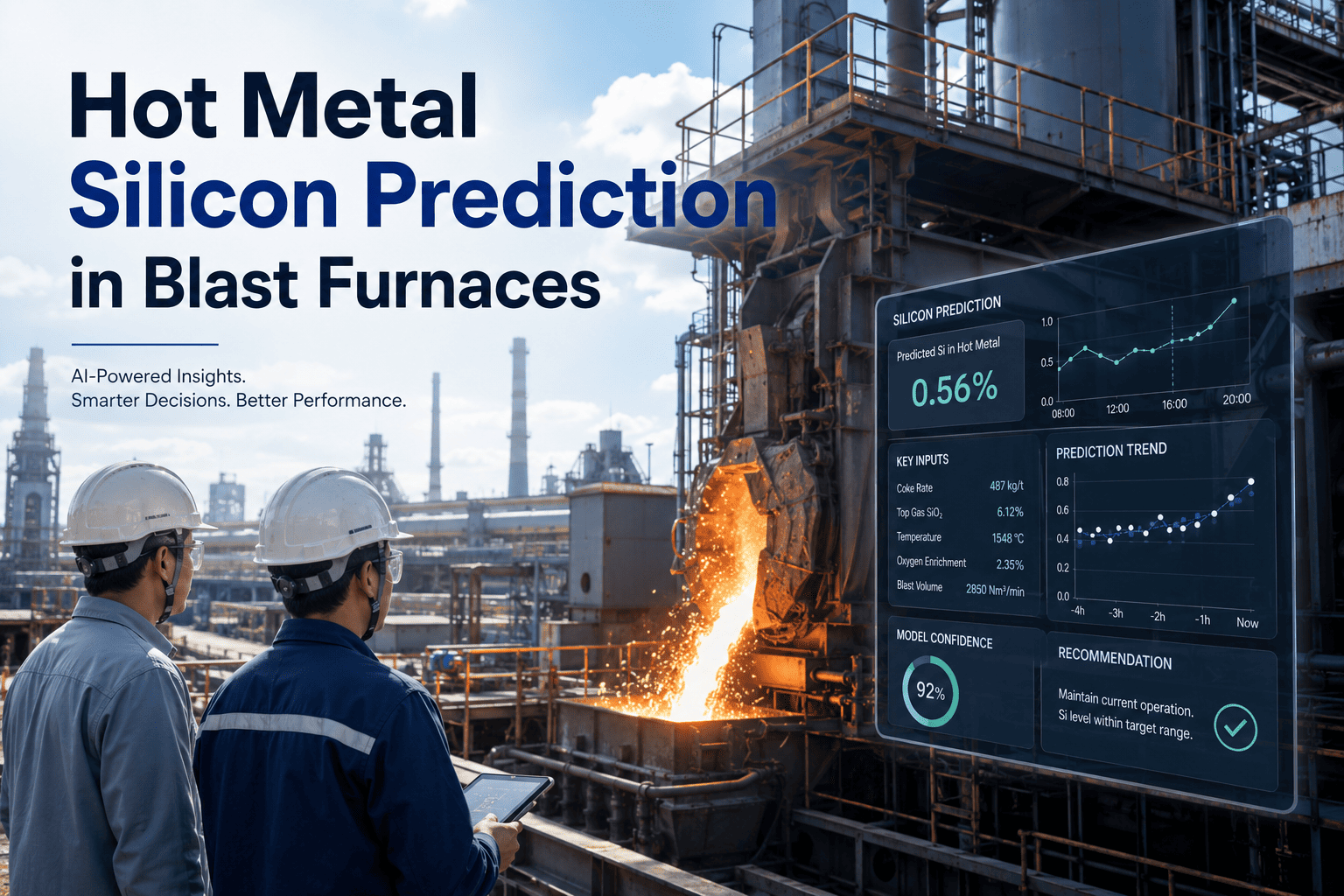
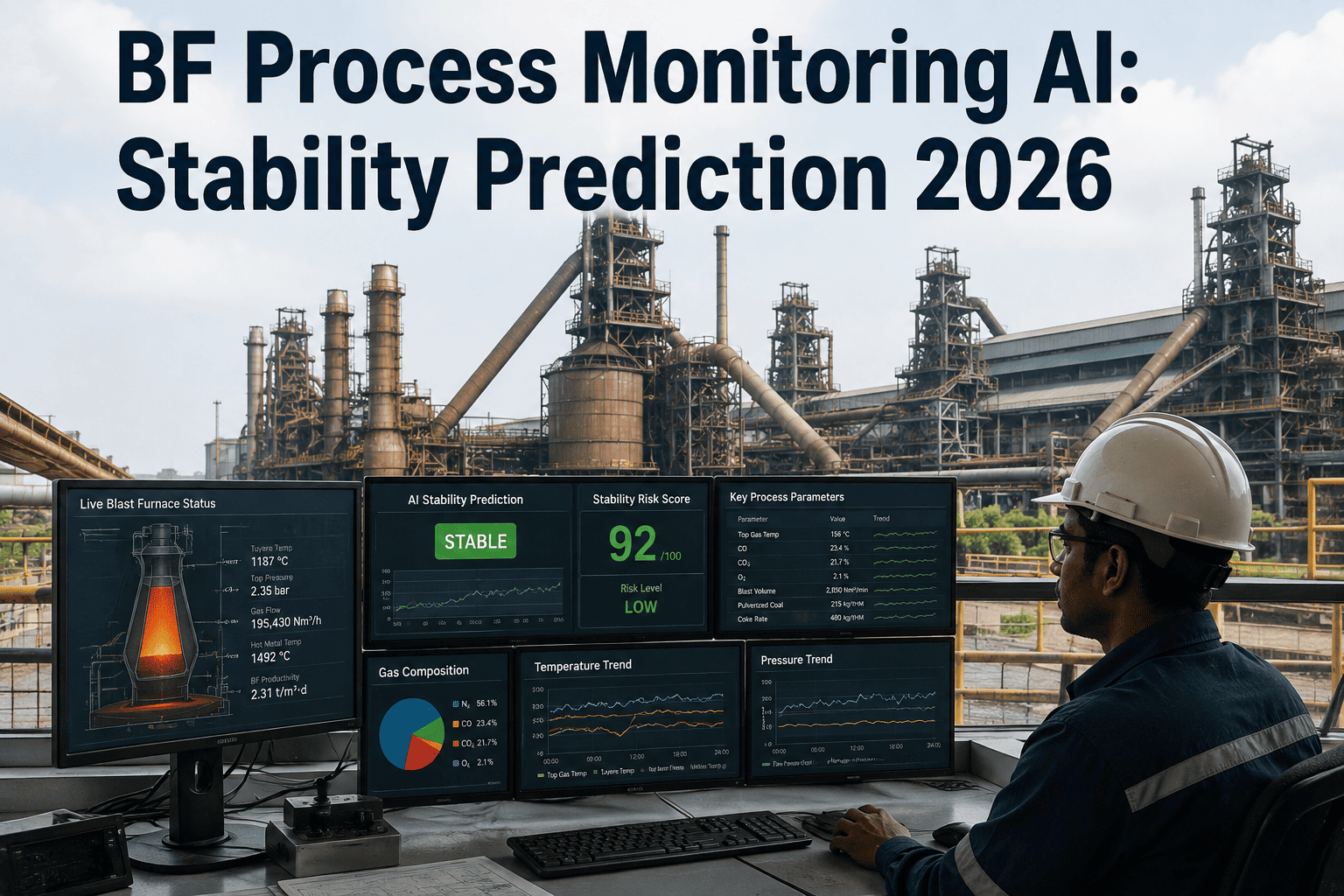
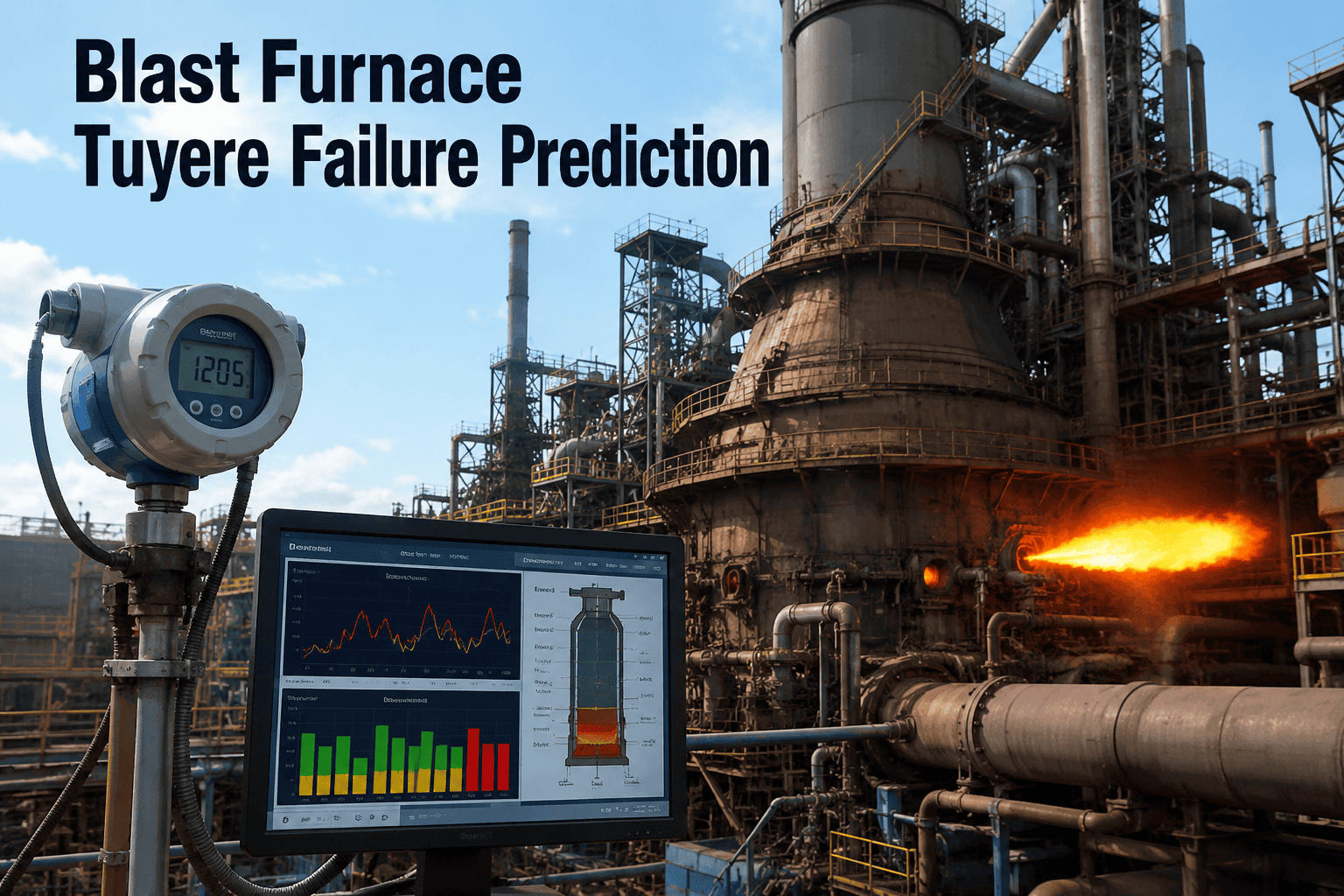
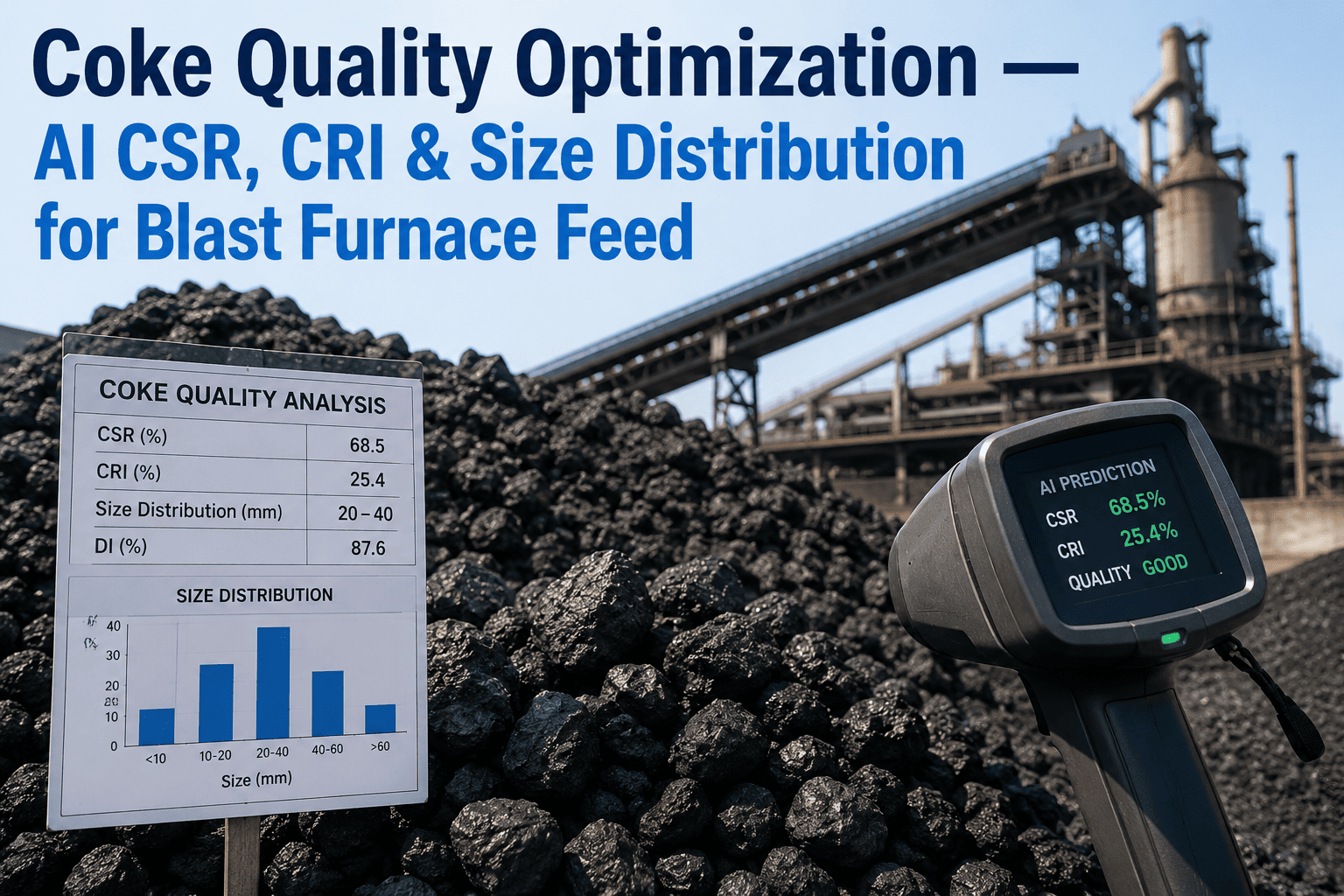
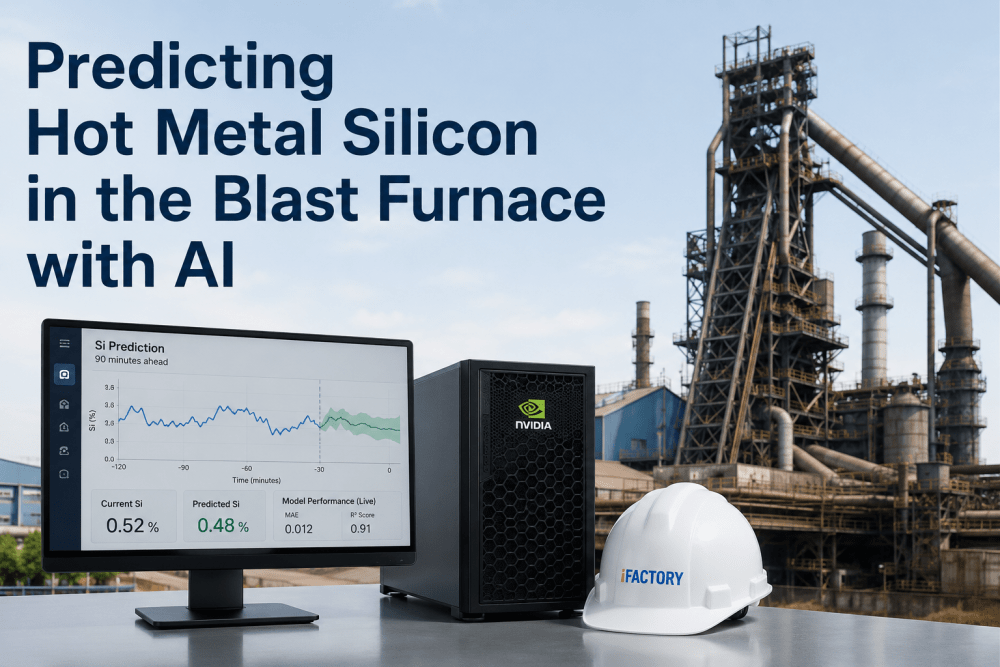
In blast furnace ironmaking, hot metal silicon content is the single most critical indicator of thermal state and chemistry stability. A 0.1% swing in Si can cascade into BOF rework, desulfurization delays, and yield losses exceeding thousands of dollars per cast. Traditional models rely on offline lab analysis that arrives too late for corrective action. This article presents an AI-driven approach that predicts hot metal Si 2 to 4 hours ahead using real-time BF parameters such as blast temperature, oxygen enrichment, burden distribution, and top gas composition. By transforming delayed reactive control into proactive predictive adjustment, the model empowers operators to stabilize chemistry, reduce rework, and achieve consistent hot metal quality. Explore how machine learning on historical and live furnace data delivers actionable forecasts with 90%+ accuracy, directly from the control room to the cash register. The solution is now available for deployment and can be integrated with existing Level 2 systems. Book a demo to see it in action on your furnace data.
Blast Furnace AI
Predict Hot Metal Si 2-4 Hours Ahead
Reduce BOF rework, improve yield, and stabilize chemistry with operator-ready AI forecasts.
Why Hot Metal Silicon Matters
Silicon content directly reflects the thermal state of the hearth and the degree of direct reduction. High Si indicates excessive coke consumption and high slag basicity. Low Si risks cold iron, sulfur pickup, and tap hole issues. For every 0.1% deviation from target, downstream BOF oxygen blowing time increases by 2 minutes, and desulfurization agent consumption rises by 5%. In a typical 2 MTPA furnace, this translates to over $1.5M in annual avoidable costs. Accurate Si prediction enables operators to adjust burden, blast parameters, and fuel injection proactively.
2-4 Hrs
Prediction Horizon
$1.5M
Annual Savings Potential
Silicon Prediction Model Composition
The AI model uses a hybrid ensemble of gradient boosting and LSTM networks to capture both linear and temporal dependencies. The input feature set includes blast temperature, oxygen enrichment, blast moisture, pulverized coal injection rate, burden Fe%, top gas CO/CO2 ratio, and hot metal temperature. The output is a continuous Si value with a confidence interval. Below is a typical composition of prediction contributions.
Thermal & chemical parameters (blast temp, O2, PCI) contribute 60% of prediction power.
Burden & top gas composition contribute 25%.
Lagging indicators (hot metal temp, previous Si) contribute 15%.
Three Core Prediction Methods
We evaluated three modeling approaches on 18 months of furnace data. Each offers a different trade-off between interpretability and accuracy.
Gradient Boosting
Best for interpretability. Provides feature importance rankings. Achieves RMSE of 0.08% Si. Ideal for operators who need to explain predictions to management.
Interpretable
LSTM Neural Network
Captures temporal patterns like hearth thermal inertia. Requires 6-8 hour lookback. RMSE of 0.06% Si. Best for dynamic furnace conditions.
Accurate
Hybrid Ensemble
Combines boosting and LSTM using a meta-learner. Achieves RMSE of 0.05% Si. Provides confidence intervals. Production-ready for real-time deployment.
Production Grade
Ready to stabilize your hot metal chemistry?
Book a demo to see our hybrid ensemble model applied to your furnace data.
Deployment Workflow
Integrating the Si prediction model into your existing Level 2 or PI system follows a structured four-step process. Each step is designed for minimal disruption and maximum operator trust.
1
Data Ingestion
Connect to your process historian (OSIsoft PI, Aspen InfoPlus, etc.) to pull 12+ months of furnace parameters and lab Si results. Data is cleaned and normalized automatically.
2
Model Training
Our AI engine trains the hybrid ensemble on your data, using 80% for training and 20% for validation. Feature selection and hyperparameter tuning are automated. Model accuracy is reported within 24 hours.
3
Operator Dashboard
The prediction output is displayed on a real-time dashboard with trend lines, confidence bands, and alert thresholds. Operators can see predicted Si for the next 4 hours and recommended actions.
4
Continuous Improvement
The model retrains weekly on new data. Operator feedback on prediction accuracy is captured via a thumbs-up/thumbs-down button. Drift detection triggers automatic retraining.
Ready to Predict Si with Confidence?
Deploy in weeks, not months. See results on your data.
Common Pitfalls in Si Prediction
Implementing a silicon prediction model without addressing these common mistakes can lead to poor accuracy and operator distrust. Avoid them for a successful deployment.
Ignoring Hearth Drainage
Si prediction accuracy drops by 30% if the model does not account for tap-to-tap variability and residual iron in the hearth. Always include tap cycle time and iron weight as features.
Using Lab Data Only
Lab analysis has a 1-2 hour lag. Relying solely on historical Si values for prediction leads to stale forecasts. Always combine with real-time process parameters.
Overfitting to Steady State
Models trained only on steady-state data fail during disturbances like burden slips or tuyere leaks. Use data augmentation and include anomaly samples in training.
No Confidence Intervals
Operators need to know when to trust the prediction. Models without uncertainty estimates cause overreliance or rejection. Always output a prediction interval.
Frequently Asked Questions
How accurate is the AI silicon prediction model?
The hybrid ensemble model achieves a root mean square error (RMSE) of 0.05% Si on validation datasets from multiple furnaces. This means that for a typical hot metal target of 0.40% Si, the prediction will be within 0.05% approximately 90% of the time. Accuracy depends on data quality, sensor reliability, and furnace condition. In cases of extreme disturbances like a slipped burden or power outage, the model automatically widens its confidence interval to alert operators of reduced reliability. Continuous retraining ensures that accuracy improves over time as more data becomes available. We recommend a minimum of 6 months of historical data to achieve production-grade performance.
Book a demo to see accuracy benchmarks on your specific furnace data.
What data is needed to deploy the model?
The model requires a minimum of 12 input parameters collected at 1-minute intervals: blast temperature, blast pressure, oxygen enrichment, blast moisture, pulverized coal injection rate, burden Fe content, burden basicity, top gas CO/CO2 ratio, top gas temperature, hot metal temperature, iron weight per tap, and tap cycle time. Additionally, at least 6 months of historical lab Si analyses are needed for training. The data can be ingested from any standard process historian such as OSIsoft PI, Aspen InfoPlus, or Siemens XHQ. If some parameters are missing, the model can still function with reduced accuracy using feature imputation. Our team provides a data readiness assessment within one week.
Contact support to schedule the assessment.
How long does deployment take?
A typical deployment takes 4 to 6 weeks from data connection to operator dashboard. Week 1 involves data ingestion and quality checks. Week 2 focuses on model training and validation. Week 3 is for dashboard configuration and user acceptance testing. Weeks 4-6 are for parallel run, operator training, and fine-tuning. The model is designed to run on a standard server or cloud instance and does not require changes to your Level 2 system. We provide full documentation and on-site support during the go-live phase. For urgent needs, an accelerated 3-week deployment is available.
Book a demo to discuss your timeline.
Can the model handle multiple furnaces?
Yes, the platform supports multi-furnace deployments with a unified dashboard. Each furnace has its own dedicated model instance trained on its specific data. The dashboard allows operators to view predictions for all furnaces on a single screen, with color-coded alerts for deviations. The system can manage up to 10 furnaces on a single server. For more than 10 furnaces, a distributed architecture is recommended. The cost per additional furnace is significantly reduced after the first deployment. Multi-furnace customers typically see a 20% reduction in total cost of ownership compared to deploying separate solutions.
Talk to support for a custom quote for your fleet.
What is the ROI of implementing Si prediction?
Customers typically achieve a return on investment within 3 to 6 months. The primary savings come from reduced BOF rework (average 15% reduction), lower desulfurization agent consumption (up to 20% reduction), and increased yield (0.5% improvement). For a typical 2 MTPA blast furnace, this translates to annual savings of $1.2M to $1.8M. Additional benefits include extended refractory life due to reduced thermal cycling and fewer tap hole issues. The model also reduces operator cognitive load by providing clear, actionable recommendations. We provide a detailed ROI calculator during the demo.
Book a demo to see the potential savings for your specific operation.
Take Control of Hot Metal Chemistry
Stop reacting to Si swings. Predict and prevent them with AI.