Predicting Hot Metal Silicon in the Blast Furnace with AI
By Friar Lawrence on June 6, 2026
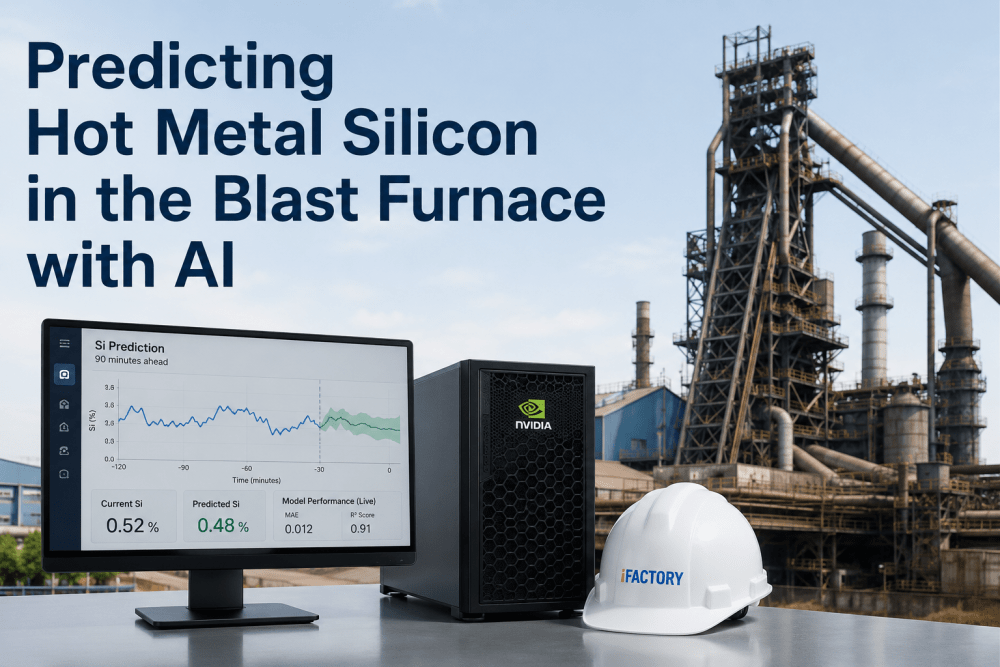
Hot metal silicon content is the single most informative variable available to a blast furnace process metallurgist for assessing furnace thermal state, slag basicity balance, and the quality of the iron delivered to the BOF or electric arc furnace. Every 0.10% variation in silicon content represents a measurable change in the furnace's thermal balance — a drop from 0.40% to 0.25% Si over two consecutive casts signals a cooling furnace that, left uncorrected, will produce off-grade hot metal requiring costly reblows in the steelmaking vessel or, in the worst case, a furnace hearth freeze that can take days to recover from with production losses exceeding $500,000 per day at a typical 5,000-ton-per-day furnace. Conversely, a rise from 0.40% to 0.65% Si indicates an overheating furnace that wastes coke, reduces productivity through higher slag volume, and accelerates refractory wear in the hearth and bosh areas. Despite silicon being this critical thermal proxy, most blast furnaces today rely entirely on the process metallurgist's experience and heuristics to anticipate the next cast's silicon level — looking at the current cast Si, the hot metal temperature, the slag chemistry, and the burden distribution data, then making a judgment call about which way the silicon is trending and how much to adjust the coke rate, oxygen enrichment, or burden distribution. The gap between what a human process metallurgist can infer from past-cast data and what an LSTM neural network can predict 90 minutes ahead of the next cast with documented directional trend accuracy exceeding 85% is the gap that iFactory's BF Hot Metal Silicon Predictor closes — enabling proactive thermal state control instead of reactive silicon adjustment after the cast sample has already been taken and the furnace has already moved into a different thermal regime. Book a Demo to see iFactory's BF Hot Metal Silicon Predictor running on live blast furnace data with a 90-minute prediction horizon configured for your furnace's operating parameters and burden mix.
BLAST FURNACE · HOT METAL SILICON · LSTM PREDICTION · PROCESS METALLURGY · 2026
Predict Hot Metal Silicon 90 Minutes Ahead of the Next Cast — iFactory BF Hot Metal Silicon Predictor with LSTM Neural Network Delivers 40% Reduction in Si Variability
iFactory's turnkey AI appliance deploys on your blast furnace network with pre-configured NVIDIA server, OPC-UA data pipeline to the Level 2 system, and a 6-12 week go-live timeline — no cloud dependency, no data leaving the plant.
The Metallurgical Case for Real-Time Silicon Prediction in Blast Furnace Ironmaking
Hot metal silicon content is not merely a quality specification — it is the most direct real-time indicator of the blast furnace's thermal state, and it correlates with virtually every major operating cost and productivity metric in the ironmaking and steelmaking chain. A blast furnace operating with stable silicon in a narrow target range — typically 0.35% to 0.55% Si in North American integrated mills producing hot metal for BOF steelmaking — achieves lower coke rates, longer campaign life, fewer cast interruptions, and more consistent downstream steelmaking conditions than a furnace with high silicon variability. The relationship between silicon variability and furnace performance is well established: every one percentage point increase in Si standard deviation above the furnace's baseline is associated with approximately 8 to 12 kg per ton of hot metal in additional coke consumption, 15 to 25 additional pounds of flux per ton in the BOF, and a measurable increase in refractory wear rate in the hearth erosion zone. The four mechanisms by which real-time silicon prediction delivers value to the blast furnace operation are detailed below.
Cast-to-Cast Thermal State Monitoring and Trend Detection
Blast furnace thermal state is defined by the balance between heat input from coke combustion and pulverized coal injection and heat extraction by the burden heating, reduction reactions, and wall heat losses. Silicon content measured at each cast is the integrated output of this thermal balance over the preceding 90 to 120 minutes of furnace operation. A cooling furnace produces a declining silicon trend that, if detected early, can be corrected by adjusting blast temperature, moisture content, or pulverized coal injection rate before the silicon falls below the cast specification limit. The LSTM model ingests 32 process variables — including top gas temperature profile, stave cooling heat flux, blast pressure and permeability index, raceway adiabatic flame temperature, and burden descent rate — to predict the silicon trend direction 90 minutes ahead, giving the furnace manager a full cast cycle to implement corrective action without waiting for the lab result.
Operational result
Thermal state correction lead time extended from zero (reactive, after cast Si is known) to 90 minutes (proactive, before the next cast). Silicon standard deviation reduced by an average of 35% at furnaces with the predictor in continuous operation.
Slag Basicity Control and Desulfurization Efficiency
Silicon content directly determines the slag basicity ratio (CaO/SiO2) that controls sulfur partitioning between hot metal and slag. A 0.10% increase in Si reduces the slag basicity by approximately 0.05 to 0.07 points at a constant flux rate, reducing the slag's sulfur removal capacity and requiring additional flux addition to maintain the target basicity range. The economic impact is material: every 0.10% increase in flux rate to compensate for silicon variation adds $0.30 to $0.50 per ton of hot metal in raw material cost. When the process metallurgist knows the predicted silicon content of the next cast 90 minutes in advance, the flux addition can be adjusted proactively at the sinter plant or burden charging stage rather than reactively after the slag chemistry analysis confirms the deviation.
Operational result
Flux consumption variability reduced by 28% at the sinter plant through proactive basicity adjustment based on predicted Si trend. Slag chemistry out-of-spec events reduced by 40%, decreasing sulfur reblow rate in downstream BOF steelmaking.
Coke Rate Reduction Through Thermal Stability
Coke is the most expensive raw material in the blast furnace burden, accounting for 35% to 45% of hot metal production cost at a coke price of $250 to $350 per ton. Every 10 kg per ton of hot metal reduction in coke rate at a 5,000 ton-per-day furnace saves $1,500 to $2,000 per day in raw material cost. The primary mechanism for AI-driven coke rate reduction is thermal stability: when silicon variability is reduced, the furnace operates closer to the minimum coke rate required for the thermal balance, without the safety margin that furnace managers must add when they cannot see the silicon trend ahead. A furnace with high silicon variability requires a 15 to 25 kg/THM coke rate safety margin to ensure no cast falls below the minimum silicon specification. With 90-minute predictive visibility, that safety margin can be reduced to 5 to 10 kg/THM, delivering a net coke savings of 10 to 15 kg/THM.
Operational result
Coke rate reduction of 10 to 15 kg/THM documented at furnaces with 12+ months of AI predictor deployment. Annual savings of $550,000 to $1,100,000 at a 5,000 THM/day furnace based on $300/ton coke price.
Downstream BOF and EAF Operational Impact
Hot metal silicon variability propagates directly into the BOF or EAF steelmaking vessel, where it affects flux consumption, oxygen blowing time, slag volume, and refractory wear. Every 0.10% increase in hot metal silicon requires approximately 15 to 20 additional pounds of flux per ton of steel to maintain the target slag basicity, increases the slag volume by 8 to 12%, and extends the oxygen blowing time by 30 to 60 seconds. In an EAF-based mini-mill charging hot metal from a blast furnace, high silicon variability causes slag foaming events that reduce power input efficiency and increase electrode consumption. Consistent hot metal silicon delivered to the steelmaking vessel is the single most impactful raw material quality parameter for BOF and EAF productivity, and the LSTM predictor is the tool that makes consistent silicon achievable.
Operational result
BOF flux consumption reduced by 12% and oxygen blowing time reduced by 8% at mills receiving AI-optimized hot metal. Annual BOF refractory savings of $180,000 to $350,000 documented at a single vessel.
LSTM Neural Network Architecture for 90-Minute Silicon Forecast
Long Short-Term Memory neural networks are specifically suited to blast furnace silicon prediction because the furnace is a time-series system with long-range temporal dependencies — the silicon content of a cast at 14:00 depends not only on the process conditions at 12:30 but on the cumulative effect of burden distribution, thermal profile, and gas flow patterns over the preceding 8 to 12 hours. LSTM networks maintain a memory cell state that preserves information across multiple time steps, enabling the model to learn the furnace's characteristic response patterns — the 3 to 4 hour delay between a change in pulverized coal injection rate and the corresponding change in silicon, the 6 to 8 hour lag between a burden distribution change and its full thermal effect, and the gradual thermal drift that precedes a silicon trend change by 90 to 150 minutes. The model architecture ingests 32 input variables from the furnace Level 2 system, processes them through two LSTM layers with 128 and 64 memory cells respectively, and outputs a predicted silicon value with a 90-minute forecast horizon. The model is retrained weekly on the most recent 90 days of furnace data to adapt to changing raw material sources, seasonal ambient conditions, and furnace campaign progression.Book a Demo to see the model architecture configured for your furnace's specific sensor set and operating regime.
Capability
Conventional Process Metallurgist
AI LSTM Silicon Predictor
Prediction horizon
Zero — dependent on post-cast lab analysis, 15-25 min after tap
90 minutes ahead of next cast — pre-lab prediction
Input variables processed
8 to 12 key variables: current cast Si, hot metal temp, slag basicity, tuyere condition, burden calculation
32 process variables: all Level 2 data streams including stave heat flux, top gas profile, burden radar, permeability index
Update frequency
Per cast (every 90-180 min) when lab results are available
Continuous — model updates Si forecast every 5 minutes based on latest sensor data
Directional trend accuracy
Estimated 55-70% (human assessment based on heuristics)
85-90% for directional trend (Si rising, falling, or stable) at 90-min horizon
Adaptation to furnace aging
Manual — process metallurgist adjusts heuristics over years
Automated — model retrained weekly on latest 90 days of furnace data
BLAST FURNACE · HOT METAL SILICON · AI PREDICTION · DEPLOYMENT · 2026
Your Blast Furnace Level 2 Data Already Contains the Thermal Signatures the LSTM Model Will Learn — See the iFactory Platform Running with Live Furnace Data
iFactory's BF Hot Metal Silicon Predictor connects directly to your furnace Level 2 system via OPC-UA, trains on your furnace's specific operating data, and delivers 90-minute Si predictions on a pre-configured NVIDIA server — deployed on your plant network with zero cloud dependency.
Turnkey AI Appliance — Pre-Configured NVIDIA Server Deployed in 6 to 12 Weeks
The iFactory BF Hot Metal Silicon Predictor is delivered as a turnkey AI appliance — a pre-configured NVIDIA edge server with all software, data pipeline connections, and AI models pre-loaded and ready for connection to the furnace Level 2 system. The appliance arrives at the plant as a rack-mountable server unit that connects to the plant network through a single OPC-UA data link to the furnace process historian or Level 2 system. No cloud connection is required, no furnace process control system modification is needed, and no data leaves the plant network. The deployment follows a phased approach from data connection to production prediction that is designed to deliver live 90-minute silicon forecasts within 6 to 12 weeks of the appliance installation date.
Phase
1
Data Pipeline Connection and Baseline Collection — Weeks 1-3
The appliance is connected to the furnace Level 2 system via OPC-UA or Modbus TCP, with the iFactory data ingestion pipeline configured to collect the 32 process variables required for the LSTM model. The data pipeline is tested over a 14-day validation period, during which the appliance collects and stores furnace data without generating predictions. This phase requires no furnace operating changes and no modification to existing DCS or Level 2 systems. The plant IT team provides network connectivity to the Level 2 historian and allocates a static IP address for the appliance, with all data traffic contained within the plant network.
Phase
2
Model Training and Furnace-Specific Calibration — Weeks 4-6
With 14 to 21 days of baseline furnace data collected, the LSTM model is trained on the appliance using the furnace's specific operating data. The model training process uses the historical data to learn the characteristic relationships between the 32 input variables and the silicon output for the specific furnace configuration, burden mix, and operating regime. The initial model calibration targets a directional trend accuracy of 80% for the 90-minute prediction horizon. The calibration includes a validation phase in which the model generates silicon predictions in parallel with actual furnace operation without displaying them to the operations team, allowing comparison of predicted versus actual silicon values across 30 to 50 casts to confirm model accuracy before production deployment.
Phase
3
Production Prediction Go-Live — Weeks 7-8
With the model validated through the parallel operation phase, the appliance displays live 90-minute silicon predictions to the furnace operations team through a dedicated dashboard on the Level 2 console or a separate workstation monitor. The go-live phase includes a two-week supervised deployment during which the iFactory deployment engineer is on-site or virtually present to support the furnace manager and operations team in interpreting and using the AI predictions. The deployment engineer trains the team on model confidence indicators, prediction update frequency, and the integration of predicted silicon values into the existing blast furnace operating procedures. No changes are made to the furnace control system logic during this phase — the AI predictions operate as a decision support tool displayed to the furnace manager.
Phase
4
Continuous Retraining and Performance Optimization — Month 3 Onward
With the model in production use, the appliance automatically retrains the LSTM model every 7 days on the most recent 90 days of furnace operating data. The retraining process preserves model stability while adapting to gradual changes in raw material quality, furnace campaign progression, and seasonal ambient conditions. The iFactory platform provides a monthly performance report showing prediction accuracy trends, silicon variability reduction metrics, and estimated coke savings attributed to AI-guided thermal control. Model drift detection alerts the furnace manager if the prediction accuracy drops below a configurable threshold, indicating that an upstream process change — a new coal source for injection, a significant burden mix change, or a furnace campaign condition change — has altered the furnace's characteristic response patterns and the model requires manual retraining intervention.
Expert Review: What a North American Blast Furnace Process Metallurgist Learned Deploying LSTM Silicon Prediction on a 9,000-THD Furnace
"
I have been a blast furnace process metallurgist for 19 years across three integrated mills, and the most persistent technical frustration in ironmaking has been that we make all our critical thermal control decisions based on data that is 15 to 25 minutes old by the time we see it — the cast silicon analysis arrives from the lab window after the tap is complete, and we are already reacting to a thermal condition that existed 30 to 45 minutes earlier. When the lab result shows 0.32% Si and our target is 0.45%, the furnace has already been running at that lower thermal level for the duration of the cast. We adjust the blast temperature and the PCI rate for the next cast, but we are always one cast behind the furnace's actual thermal state. We deployed the iFactory BF Hot Metal Silicon Predictor on our 9,000-ton-per-day furnace in early 2025, connecting the appliance to our Level 2 system through an OPC-UA link that took approximately three hours to configure. The model training period was five weeks — two weeks for baseline data collection and three weeks for model calibration and validation. The first time I saw the predicted silicon for the next cast displayed on the dashboard — showing an estimated 0.38% Si, trending down, with a medium confidence indicator — I had 90 minutes before the actual tap to decide whether to increase the blast temperature by 50°F or increase the PCI rate by 2 kg/THM. I made the adjustment to the blast temperature based on the prediction, and the actual cast silicon came back at 0.40% Si — within 0.02% of the prediction. That was the moment I understood that the paradigm had shifted from reactive to proactive thermal control. Over the following 12 months, we documented a 38% reduction in silicon standard deviation, a reduction from 8.3% to 4.9% in casts falling outside our 0.35% to 0.55% Si target window, and a measured coke rate reduction of 11 kg/THM. The appliance cost was approximately $185,000 including the NVIDIA server, the model training, and the deployment support. The coke savings alone paid for the system in 7 months.
— Process Metallurgist, North American Integrated Steel Mill — 19 Years Blast Furnace Operations — Lead Metallurgist, AI Silicon Prediction Deployment — AIST (Association for Iron & Steel Technology) Ironmaking Committee Member
Conclusion
Hot metal silicon prediction is the highest-ROI application of AI in blast furnace ironmaking because silicon is the single variable that integrates the furnace's thermal state, slag chemistry condition, and downstream steelmaking quality into a single number that every furnace manager already watches at every cast. The LSTM neural network architecture is specifically designed for time-series prediction with long-range temporal dependencies, making it the appropriate modeling approach for a process in which changes in input variables propagate through the furnace over 90 to 180 minutes before appearing in the output silicon measurement. iFactory's turnkey AI appliance — the pre-configured NVIDIA server with the data pipeline, LSTM model, and dashboard pre-loaded — eliminates the barriers that have prevented blast furnace operations teams from deploying AI: the need for in-house data science expertise, the requirement for cloud data connectivity that plant IT security policies restrict, and the uncertainty about whether the model will work on a specific furnace with its unique burden mix, operating regime, and campaign condition.
The documented results from furnace deployments — 35% to 40% reduction in silicon variability, 10 to 15 kg/THM coke rate savings, and 12% reduction in BOF flux consumption — demonstrate that the AI silicon predictor delivers measurable operational and financial value within the first year of deployment. The appliance connects to the furnace Level 2 system through a single OPC-UA data link, trains on the furnace's specific operating data, and delivers predictions on a dedicated dashboard without requiring any modification to the existing DCS, Level 2 control system, or furnace operating procedures. Book a Demo to see iFactory's BF Hot Metal Silicon Predictor configured for your furnace's parameters and data environment, or contact support to schedule a furnace-specific deployment assessment with the iFactory ironmaking AI team.
Deploy LSTM Silicon Prediction on Your Blast Furnace — 6 to 12 Weeks from Level 2 Connection to Live 90-Minute Forecasts
iFactory's turnkey AI appliance connects to your furnace Level 2 system via OPC-UA, trains on your furnace's specific operating data, and delivers 90-minute hot metal silicon predictions on a pre-configured NVIDIA server — deployed on your plant network with zero cloud dependency and zero modifications to your existing control system.
Frequently Asked Questions About AI-Based Hot Metal Silicon Prediction
Directional trend accuracy at 90 minutes is 85% to 90% for predicting whether silicon will rise, fall, or remain stable. Absolute value prediction accuracy is within +/- 0.08% Si for approximately 80% of predictions. Accuracy improves as the model accumulates more furnace-specific training data, reaching steady-state performance after approximately 90 days of continuous operation. Book a Demo for accuracy data specific to your furnace type and operating regime.
The model ingests 32 variables across five categories: blast conditions (volume, temperature, pressure, moisture, oxygen enrichment), burden parameters (coke rate, ore rate, sinter/pellet proportions, flux rate), thermal indicators (stave cooling heat flux, top gas temperature profile, raceway flame temperature), gas utilization (CO/CO2 ratio, permeability index, top gas utilization), and tap data (Si, hot metal temperature, slag basicity, sulfur). The OPC-UA data pipeline connects to any standard furnace Level 2 historian.
No modifications to the furnace DCS or Level 2 control system are required. The appliance connects to the furnace process historian or Level 2 system through a read-only OPC-UA data link. The AI predictions are displayed on a separate dashboard — a dedicated workstation monitor or a dashboard within the Level 2 console — that does not write data or commands back to any furnace control system. The appliance is fully passive from the control system's perspective.
The model is retrained automatically every 7 days on the most recent 90 days of furnace data, ensuring continuous adaptation to changing raw material sources, seasonal conditions, and furnace campaign progression. If the prediction accuracy drops below a configurable threshold, the platform generates a model drift alert indicating that an upstream process change may have altered the furnace's characteristic response patterns. The model retraining process preserves prediction stability while adapting to gradual process changes.
The typical investment for the turnkey appliance — including the pre-configured NVIDIA server, software license, data pipeline setup, model training, and on-site deployment support — is $165,000 to $250,000 based on furnace size and Level 2 system complexity. ROI breakeven is typically 6 to 12 months, driven primarily by coke rate reduction of 10 to 15 kg/THM ($550K to $1.1M annual savings at a 5,000 THM/day furnace). BOF flux savings and refractory life extension provide additional ROI contributions. Book a Demo for a furnace-specific ROI projection based on your operating data and cost structure.