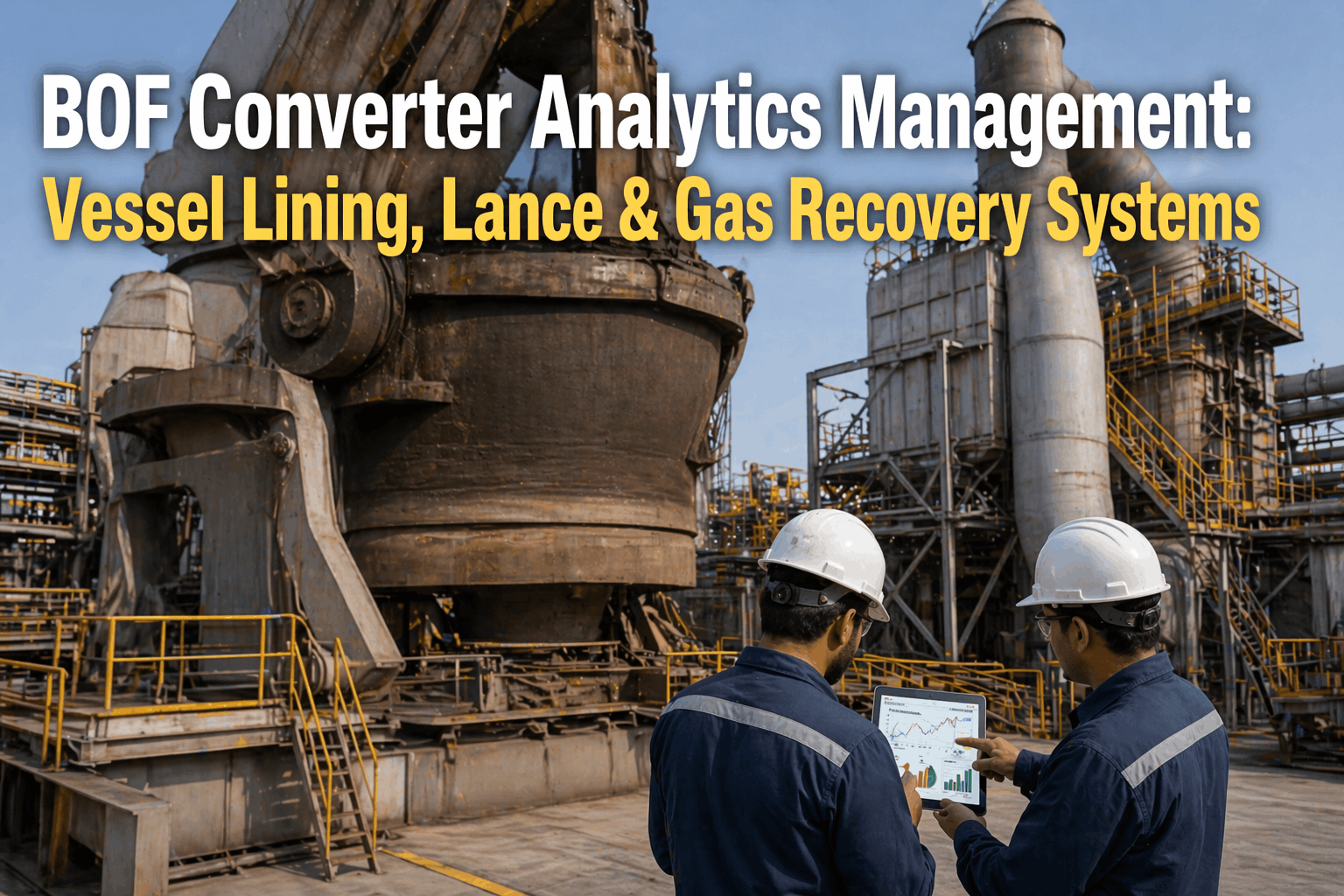
The Basic Oxygen Furnace converter is the most capital-intensive vessel in an integrated steel plant's liquid steel production chain — and the one where the difference between a well-managed lining campaign and a poorly monitored one translates most directly into the plant's cost-per-tonne of liquid steel. A converter lining represents a $2 to $6 million capital investment in refractory bricks, with a campaign life of 3,000 to 10,000 heats depending on vessel size, lining design, and the quality of the slag splashing and maintenance program applied over the campaign. When that campaign is managed reactively — relining scheduled when the lining fails rather than when the analytics say it will — the mill absorbs 8 to 15 emergency heats of reduced productivity, accelerated wear in the final campaign period, and unplanned reline downtime that disrupts downstream caster schedules by 5 to 7 days. BOF converter analytics and vessel lining life management converts this reactive pattern into a planned discipline: lining wear modeled heat by heat, slag splashing schedules optimized continuously, oxygen lance condition tracked per blow, and the reline decision made from data 30 to 60 days before the emergency forces it. Operations that have deployed iFactory's BOF analytics platform report campaign life extensions averaging 18% and refractory cost reductions of 15 to 22% within the first full converter campaign.
Why BOF Converter Lining Management Is the Highest-ROI Refractory Analytics Program in Steelmaking
The BOF converter is unique among steelmaking vessels in both the severity of its operating conditions and the economic leverage of its campaign life. While a ladle lining campaign runs 50 to 150 heats and an EAF lining runs 300 to 800 heats, the BOF converter is designed for campaigns of 3,000 to 10,000 heats — meaning that every additional 100 heats of campaign life extracted through better lining management is worth $400,000 to $1.2 million in deferred reline capital and avoided downtime at a typical U.S. integrated mill. No other refractory analytics program offers this return per heat of campaign extension.
The challenge is that BOF lining wear is not uniform, not linear, and not predictable from heat count alone. The critical wear zones — the trunnion zone, charge impact zone, tapping side slag line, and tuyere zone in bottom-blown vessels — wear at rates that depend on scrap mix, hot metal chemistry, slag basicity, blow practice, and the consistency of the slag splashing program applied after each heat. A lining that is managed identically heat by heat will still exhibit dramatically different wear rates in different zones, depending on whether the slag splashing coating is being applied where the lining actually needs it rather than where the standard practice prescribes it. iFactory's BOF analytics platform closes the gap between where the slag is going and where the lining needs it.
- Lining wear estimated from heat count and visual gunning inspection only
- Slag splashing applied on fixed schedule regardless of zone-specific wear condition
- Reline decision made when wall thickness measurements confirm emergency condition
- Oxygen lance condition assessed visually — replacements reactive to performance loss
- Campaign end surprises create 5–7 day caster supply gaps and emergency contractor mobilization
- Refractory materials ordered on fixed volume schedules regardless of actual consumption rate
- Zone-level wear model updated every heat from process data and thermal signals
- Slag splashing schedule optimized per heat based on zone wear condition map
- Reline date projected 30–60 days in advance from wear rate trending
- Oxygen lance consumption tracked per blow — replacement timing planned weeks ahead
- Planned reline scheduled with downstream caster — zero supply gap, contractor pre-mobilized
- Refractory material consumption modeled against wear rate — procurement optimized per campaign
Converter Lining Wear Analytics: Zone-Level Modeling from Blow Data
The BOF converter lining wear model is iFactory's most technically distinctive capability for BOF operations — and the one that delivers the largest portion of the campaign life extension value. The model connects per-heat blow data (oxygen volume, blow time, lance position profile, hot metal and scrap weights, flux additions) to zone-specific wear indicators (thermal lance readings, sublance temperature profiles, and periodic thickness measurements) to produce a continuously updated wear map across all critical lining zones. This is fundamentally different from a heat-count-based lining model — it accounts for the fact that a heat with high-scrap charge, aggressive lance practice, and low slag basicity consumes 40 to 60% more refractory life per heat in the charge impact zone than a standard hot metal-dominant heat. Book a Demo to see the converter lining wear map.
Slag Splashing Analytics: From Fixed Schedule to Wear-Map-Driven Optimization
Slag splashing is the single most operationally controllable variable in BOF converter lining management — and the one where the transition from a fixed practice to an analytics-driven practice delivers the most immediate and measurable impact on campaign life. In most U.S. integrated BOF shops, slag splashing is performed after each heat using a standard nitrogen volume, splash duration, and lance height profile that was established at the beginning of the campaign and is applied identically regardless of the current lining condition or the process conditions of the just-completed heat. This approach provides consistent baseline protection but misses the opportunity to concentrate protective coating where the lining actually needs it most.
Oxygen Lance Analytics: Tracking the Asset That Controls Heat Chemistry
The oxygen lance is the process control instrument that determines carbon removal rate, heat temperature trajectory, and slag formation in every BOF blow — and its condition directly affects both steel quality and lining wear rate. A lance with a damaged or partially blocked nozzle delivers oxygen asymmetrically, creating hotspots on the slag line and reducing post-combustion efficiency. Lance degradation in most BOF shops is managed by visual inspection at change-out and by fixed-use-cycle replacement schedules that neither account for actual nozzle condition nor connect lance performance to heat quality outcomes.
| Lance Monitoring Parameter | Measurement Method | Normal Range | Degradation Signal | Impact on Lining and Quality |
|---|---|---|---|---|
| Oxygen Flow Consistency | Flow meter at lance supply — per-blow profile | ±2% of setpoint at rated pressure | Flow variation >5% or step change at constant pressure | Asymmetric slag agitation; uneven lining thermal load |
| Nozzle Exit Pressure Distribution | Pressure differential across lance body | Balanced across all nozzle holes ±3% | Pressure imbalance >8% indicating partial blockage | Off-center combustion; localized slag line erosion |
| Lance Cooling Water Delta-T | Inlet/outlet temperature — continuous monitoring | Design ΔT ±10% at rated oxygen flow | ΔT rising >15% above baseline at same flow | Lance body damage developing; burnthrough risk increasing |
| Off-Gas CO/CO₂ Ratio Profile | Off-gas analyzer — blow duration profile | Grade-specific profile ±5% at each blow phase | Profile deviation >10% from grade baseline | Post-combustion efficiency loss; excess heat to lining |
| Lance Heats Accumulated | Heat counter linked to lance ID in CMMS | Per OEM design life specification | Approach to 90% of design heat count | Systematic degradation risk; pre-scheduled replacement trigger |
| Sublance Calibration Drift | Cross-check sublance vs. ladle sample on 10-heat intervals | Within ±10°C and ±0.02% C of ladle sample | Systematic deviation >15°C or 0.03% C | Incorrect tap temperature practice; off-spec steel risk |
Vessel Reline Planning: Converting Analytics into a Coordinated Shutdown
The vessel reline is the highest-cost and highest-impact planned maintenance event in an integrated steel plant — typically $2 to $6 million in direct refractory and contractor cost, with 5 to 8 days of planned vessel downtime that must be coordinated with continuous casting schedules, hot metal supply from the blast furnace, and ladle and tundish lining availability. When this event is planned 30 to 60 days in advance from accurate wear rate data, it is a manageable logistics challenge. When it is forced by emergency wear condition discovery, it becomes a supply chain disruption that affects downstream customers and costs $400,000 to $1.2 million in additional production impact beyond the direct reline cost.
The commercial value of this coordination workflow is straightforward: the difference between a planned 7-day reline window coordinated 8 weeks in advance and an emergency reline forced by unexpected wear condition is $600,000 to $1.8 million in avoided production disruption, premium freight, and secondary steelmaking capacity constraints. iFactory's reline planning module has eliminated emergency reline events entirely at three U.S. BOF operations in the two years following platform deployment.
Expert Perspective: What Analytics Changes in BOF Converter Management
We managed our BOF converters on heat count and visual gunning inspections for twenty-two years. The practice worked — we rarely had a reline emergency — but we were also almost certainly ending campaigns 200 to 400 heats earlier than the lining actually required, because our visual assessment was conservative and we had no way to quantify the protective effect of each slag splashing event. When we deployed iFactory's wear modeling, the first campaign we ran with it extended 340 heats beyond our previous average for the same vessel with the same lining design. That's $1.4 million in deferred reline cost from one campaign extension on one vessel. The more important change was in how we manage the slag splashing program. We had been applying the same splash practice after every heat for a decade. The analytics showed us that in our operation, three to four heat types — specific scrap mixes with high limestone additions — were consuming three times the charge impact zone life per heat of our standard practice heats. We changed the splash parameters for just those heat types, concentrating nitrogen volume in the upper vessel for an additional 90 seconds after those specific heats. Charge impact zone wear rate dropped 34% in the following 500 heats. That one practice change extended our next campaign by an estimated 280 heats on its own. The lesson is not that we had been managing badly — the lesson is that without heat-level analytics connecting blow practice to zone-specific wear, these kinds of improvements are invisible until you have the data to surface them.
Frequently Asked Questions: BOF Converter Analytics and Vessel Lining Management
iFactory's wear model operates as a physics-informed machine learning model that estimates zone-specific lining condition from the combination of per-heat process data (oxygen volume, blow time, lance height profile, hot metal silicon, slag basicity, tap temperature) and periodic calibration measurements (thickness readings from thermal lance or physical measurement at vessel inspection, typically every 50 to 100 heats). Between calibration measurements, the model accumulates wear increments for each zone based on the process parameters of each heat and their known relationships to wear rate in that zone — for example, the relationship between hot metal silicon content and slag volume, and between slag volume and slag line wear rate, is well-quantified in published BOF metallurgical literature and validated against the plant's own historical data during the initial model training period. At each calibration measurement, the model updates its zone wear estimates to the measured values and recalibrates the wear rate coefficients for the recent heat mix. Most BOF operations running iFactory achieve model accuracy of ±15% of actual measured thickness between calibration events, which is sufficient for reliable 30- to 60-day reline projection in operations with normal campaign profiles. For high-wear-rate situations — unusual scrap mix, extended periods of aggressive blow practice, or suspected refractory material quality deviation — the model flags an earlier calibration measurement trigger to maintain prediction accuracy at the critical campaign end period.
iFactory optimizes three slag splashing parameters for each post-heat splash event: nitrogen volume (total Nm³ for the splash cycle), splash duration (total seconds of nitrogen injection), and lance height profile (the trajectory of lance height through the splash cycle, which controls the distribution of splashed slag between the lower vessel, slag line, and upper vessel zones). These three parameters together determine both how much slag is displaced and where it coats the lining surface — the lance height profile is the most operationally controllable of the three and the one that iFactory adjusts most frequently based on zone wear condition. Recommendations are delivered in two ways depending on the plant's automation infrastructure. In operations with automated slag splashing control, iFactory writes the recommended parameters directly to the splashing control system via OPC-UA or Modbus interface — the operator sees the recommendation in the HMI and confirms or overrides before the splash cycle begins. In operations with manual splashing control, iFactory presents the recommended parameters in the operator workstation interface, formatted as a simple instruction set (nitrogen flow setpoint, lance height at each phase, total duration) that the operator implements directly at the lance control. In both cases, the operator retains override authority — iFactory makes the recommendation, the operator executes it, and the actual parameters applied are recorded against the recommendation for effectiveness tracking.
Yes — gunning material tracking is one of the highest-value secondary analytics capabilities in the BOF module, and it provides a direct material cost reduction opportunity alongside the campaign life extension from slag splashing optimization. iFactory connects gunning material consumption per zone per application event to the zone wear rate data in the lining model, creating a per-zone gunning effectiveness metric that measures how many heats of wear protection each kilogram of gunning mass provides in each zone. This metric — gunning efficiency, expressed as heats per kg of gunning material — varies significantly between zones, between application methods (hot gunning vs. cold gunning), and between gunning material batches. Operations tracking this metric discover that a significant fraction of their gunning material is applied to zones that are within their target thickness range and do not need it — driven by fixed gunning schedules that apply material by zone rotation rather than by zone condition. Redirecting that material to zones with above-average wear rate simultaneously reduces total gunning consumption and extends the campaign life of the most worn zones. Most BOF operations implementing iFactory's gunning analytics find 15 to 25% reduction in total gunning material consumption per campaign while improving the condition of the critical wear zones at campaign end.
iFactory maintains independent wear models and campaign management records for each vessel in the shop, with a cross-vessel scheduling view that allows the steelmaking planning team to see the projected campaign end dates for all active vessels simultaneously. In a two-vessel shop running a swing vessel configuration, this cross-vessel visibility is essential for reline coordination — the swing vessel maintenance schedule must align with the production vessel campaign end projection to ensure continuous steelmaking capacity during the reline period. iFactory's multi-vessel view updates all campaign projections simultaneously after each heat, so that the planning team always has the most current picture of when each vessel will require a planned shutdown. For vessels returning from scheduled maintenance stops — such as tapping hole repair or trunnion inspection outages — iFactory applies a post-maintenance baseline reset for the affected vessel zones and recalibrates the wear model against the post-maintenance thickness measurements before the next heat campaign begins. This reset prevents the pre-maintenance wear history from distorting the post-maintenance wear projection, which is a systematic error in heat-count-based models that do not account for partial reline events.
For a U.S. integrated BOF shop operating two to three 200- to 300-tonne converters with an annual production of 2 to 4 million tonnes of liquid steel, iFactory's BOF analytics platform deployment runs $85,000 to $190,000 in total investment over a 6 to 10 week implementation timeline. The ROI timeline depends on which value stream reaches measurable impact first. In most deployments, gunning consumption optimization shows measurable cost reduction within the first 60 to 90 days — typically $80,000 to $200,000 per campaign in material savings from redirecting gunning mass to high-wear zones. Slag splashing optimization delivers its value over the first full campaign — typically 3,000 to 6,000 heats — with the campaign life extension versus the plant's historical average quantifiable at campaign end. For a 250-tonne converter with a $3.5 million reline cost and a baseline campaign of 4,500 heats, a 15% campaign extension (675 additional heats at approximately $400,000 per 100-heat increment) represents $2.7 million in deferred reline capital — an ROI of 14× to 32× the platform investment per campaign, recovered over the campaign life of 18 to 30 months. The first year typically delivers 3× to 5× ROI from the combination of gunning savings, oxygen lance consumption optimization, and emergency reline avoidance — with the full campaign life extension value recognized at the planned reline event. An ROI modeling session using your specific converter size, refractory cost, and campaign history is available at no cost through iFactory's technical team.
Conclusion: The Campaign That Doesn't End in an Emergency
BOF converter lining management has been practiced in U.S. integrated steelmaking for more than 60 years — and for most of that time, it has been practiced reactively. Heat count, visual inspection, and conservative campaign end decisions based on the last emergency rather than the current data have defined the standard. The mills absorbing $400,000 to $1.8 million in production disruption per unplanned reline event are not failing at metallurgy or maintenance — they are failing at data utilization, because the information to predict and prevent those events exists in the per-heat blow data, the slag basicity records, the thermal lance readings, and the gunning consumption logs that every BOF shop is already generating.
iFactory's BOF analytics platform connects that data into the continuous, heat-by-heat campaign management picture that converts campaign-ending emergencies into routine planned events. The result is a melt shop that plans its relines 60 days out, extends campaign life by 15 to 22%, reduces refractory material cost by 15 to 22%, and eliminates the production disruption that currently defines the transition from one campaign to the next. The data is already there. The analytics just needs to be applied to it.