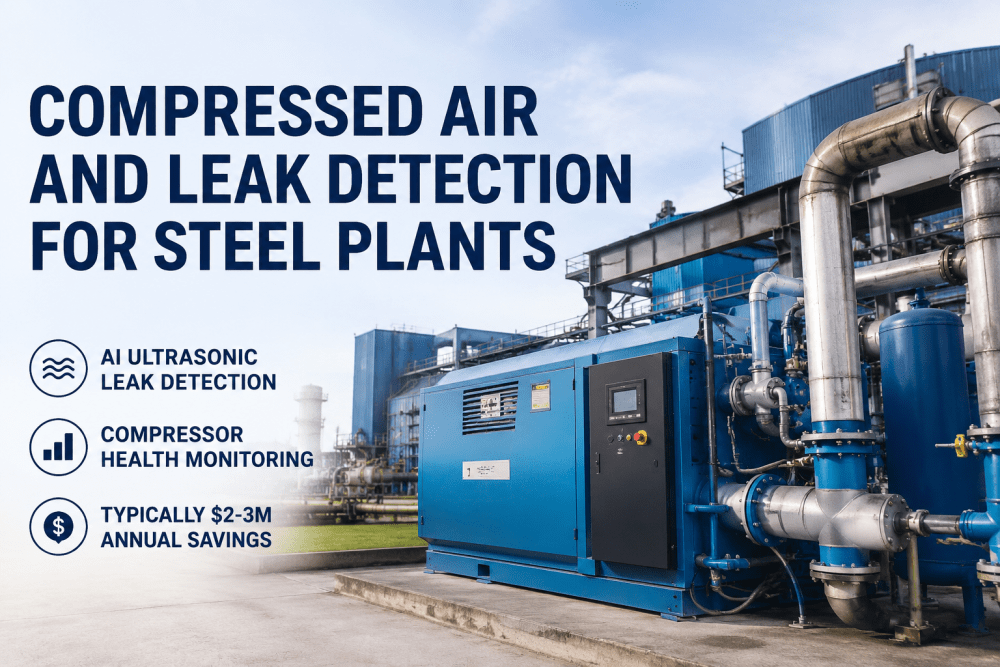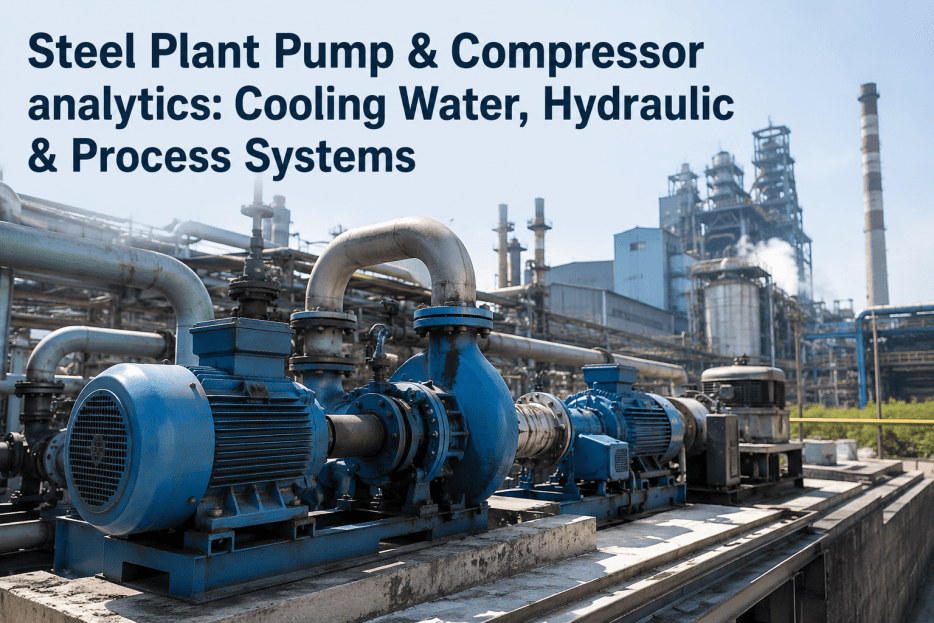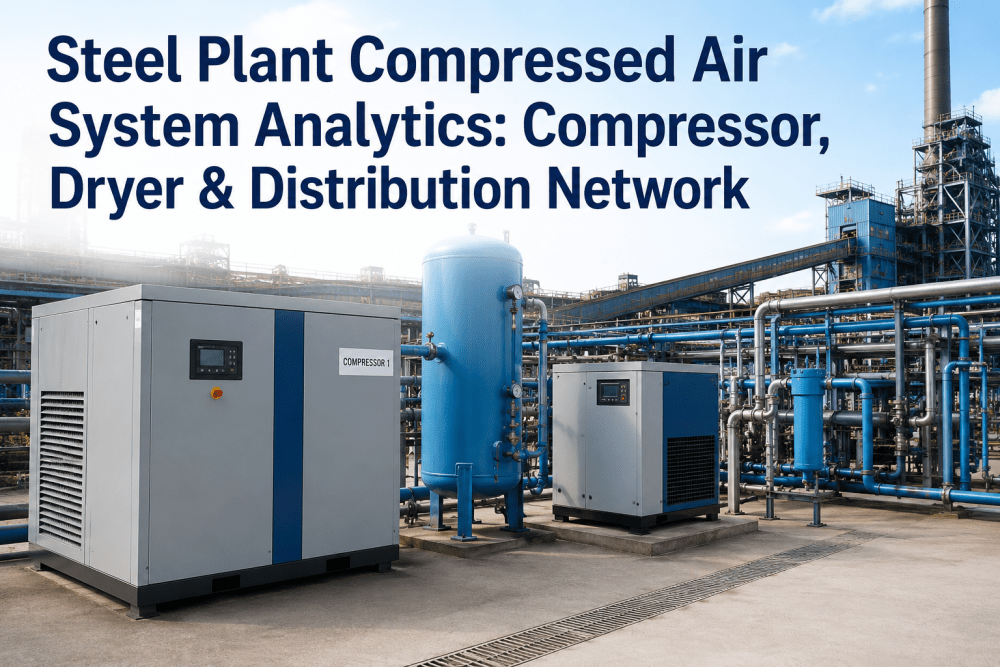
Compressed air is the fourth utility of the steel plant — behind electricity, natural gas, and water — and the most reliably mismanaged one. Unlike the other three, compressed air system failures rarely trigger a single dramatic event; they accumulate silently in the form of leaks, fouled dryers, degraded compressor efficiency, and pressure drops that force upstream production adjustments that nobody connects back to the air system. Steel Plant Compressed Air System analytics gives maintenance organizations the visibility to break that cycle: instrument air quality failures traced back to desiccant dryer saturation cycles, process air pressure drops correlated with distribution network leak rates, and compressor motor current trending ahead of bearing degradation events. This guide covers compressor analytics strategy, air dryer servicing workflows, distribution network leak detection, and energy cost reduction frameworks for integrated steel plant and EAF shop environments. Book a Compressed Air Analytics Review.
Why Compressed Air Analytics Is the Highest-ROI Utility Program in a Steel Plant
Compressed air in a steel plant serves two fundamentally different purposes that the analytics program must address separately: instrument air, which powers pneumatic control valves and instrumentation across the entire plant and requires oil-free, dry, contaminant-free air to a dew point of -40°F or better; and process air, which drives pneumatic tooling, material handling, scale washing, and bag filter cleaning operations and tolerates broader quality specifications. A single compressed air system often serves both loads from a common header, which means instrument air quality degradation — caused by a saturated desiccant dryer or a failed coalescing filter — affects control system reliability across the entire facility, not just the local application. Most steel plants cannot directly trace a valve positioner failure or a pneumatic actuator fault back to a compressed air quality event because there is no analytics connection between the instrument air system and the control maintenance program.
The energy dimension amplifies the ROI case. Compressed air is the most expensive utility per unit of delivered energy in the plant — typically 7–8 times more expensive per unit of work output than electricity used directly. Studies across U.S. industrial operations consistently find that 20–30% of compressed air generated is lost to distribution leaks, and that compressor systems running without demand-side analytics operate 15–25% above the load actually required by the process. For a mid-size steel plant with a compressed air system drawing 3,000–8,000 kW at full load, a 20% efficiency improvement from analytics-driven management represents $180,000–$650,000 in annual energy cost reduction at typical industrial electricity rates.
Compressor Analytics, Dryer Servicing, and Distribution Monitoring Frameworks
The analytics architecture for a steel plant compressed air system must cover three distinct asset classes — generation (compressors), treatment (dryers, filters, receivers), and distribution (headers, drops, regulators) — each with different failure modes, monitoring parameters, and maintenance cadences. The framework below addresses each class through the lens of what data to collect, what it indicates, and what maintenance action it triggers.
Compressor Analytics: Key Parameters and Degradation Signatures
Rotary screw compressors — the dominant type in steel plant applications — generate a rich set of condition indicators that are available from the local controller but rarely connected to the maintenance management system. Discharge temperature, oil temperature, differential pressure across oil and air filters, motor current draw, and vibration at the drive-end and non-drive-end bearings all trend predictably ahead of the failure modes that cause unplanned downtime. The analytics program connects these parameters to asset-specific baselines and generates condition scores that drive maintenance planning rather than hour-based PM schedules that neither account for actual operating load nor detect developing faults between scheduled service intervals.
| Parameter | Normal Range | Degradation Indicator | Failure Mode | Maintenance Action |
|---|---|---|---|---|
| Discharge Temperature | 180–200°F (air-cooled) | >220°F sustained | Oil cooler fouling / low oil level | Cooler cleaning, oil check |
| Oil Filter Differential Pressure | <15 psi at operating temp | >25 psi | Oil filter element plugged | Filter element replacement |
| Air/Oil Separator Differential | <8 psi new, <12 psi service | >15 psi | Separator element restriction | Separator replacement |
| Motor Current Draw | Nameplate FLA ± 5% | >110% FLA at rated pressure | Mechanical drag / bearing wear | Bearing inspection, drive check |
| Vibration (Drive End) | <0.10 in/s RMS | >0.20 in/s RMS | Bearing degradation / misalignment | Vibration analysis, alignment check |
| Inlet Valve Response | Opens/closes within 0.5 sec | Slow response or hunting | Inlet valve wear / solenoid fault | Inlet valve rebuild or replacement |
Air Dryer Servicing: Desiccant Cycles, Dew Point Trending, and Failure Prevention
Desiccant dryers serving instrument air systems in steel plants are among the most maintenance-neglected assets in the facility, because they operate continuously and quietly until they fail — at which point the contamination event has already reached the control valve network. The analytics program monitors dew point at the dryer outlet continuously (not on a quarterly manual check basis) and correlates dew point degradation with desiccant bed cycle counts, purge flow efficiency, and inlet air temperature to identify whether the root cause is desiccant exhaustion, purge valve failure, or an upstream separator issue that is sending liquid water to the desiccant bed.
Distribution Network Monitoring: Pressure Mapping, Leak Detection, and Drop Performance
The compressed air distribution network in a steel plant is typically a mix of main headers, sub-headers, and individual drops installed over decades — sections added as production expanded, older sections never decommissioned, and isolation valves that have not been operated in years. Leak rates compound as the network ages: a 1/8-inch leak at 100 psi costs approximately $1,200 per year in wasted compressed air energy. A plant with 200 such leaks — not unusual in a 20-year-old distribution system — is wasting $240,000 annually before any compressor inefficiency is considered. Analytics-driven distribution monitoring uses differential pressure mapping across header segments, flow balance analysis between generation and consumption, and ultrasonic leak survey data integrated into the CMMS to create a prioritized leak repair backlog ranked by dollar value of energy waste.
| Leak Size | Pressure (psi) | Flow Loss (CFM) | Annual Energy Cost | Detection Method |
|---|---|---|---|---|
| 1/16 inch orifice | 100 psi | ~3.5 CFM | ~$300/year | Ultrasonic detector |
| 1/8 inch orifice | 100 psi | ~14 CFM | ~$1,200/year | Ultrasonic detector |
| 1/4 inch orifice | 100 psi | ~55 CFM | ~$4,700/year | Ultrasonic / pressure drop |
| 1/2 inch orifice | 100 psi | ~220 CFM | ~$18,800/year | Pressure drop mapping |
| Open 1/2 inch line | 100 psi | ~300 CFM | ~$25,600/year | Flow balance analysis |
Compressed Air Energy Analytics: Demand Profiling and Load Management
Energy analytics for compressed air starts with demand profiling — understanding exactly how much air the process actually requires at each hour of the operating cycle, compared to what the compressor system is generating. Most steel plant compressor systems are sized for peak demand plus a design margin, but they run at or near full load continuously because there is no demand-side management connecting production schedules to compressor staging logic. An analytics program that connects production schedule data to compressor control creates the opportunity to stage compressors down during planned low-demand periods (furnace tapping windows, roll change sequences, shift breaks) and capture the energy savings without affecting process availability.
Compressed Air Maintenance Workflow: From Condition Alert to Closed Work Order
The maintenance workflow for compressed air system analytics follows the same alarm-to-work-order logic that governs all AI-driven maintenance programs — but with additional steps specific to the safety and quality implications of compressed air system failures in a steel plant environment. Instrument air system failures can affect safety interlocks and emergency shutdown systems, which means the escalation logic must account for the criticality tier of the affected loads, not just the severity of the compressor or dryer fault itself.
Continuous Parameter Monitoring and Condition Scoring
All compressor, dryer, and distribution monitoring parameters are read at the configured scan rate — typically 1–5 minute intervals for compressor condition parameters and 15-minute intervals for distribution pressure mapping — and converted into individual condition scores using asset-specific baselines. The overall compressed air system health score integrates generation, treatment, and distribution sub-scores into a single number that reflects system-wide readiness. A score below 75 triggers a planned inspection work order. Below 55 triggers a priority work order with a 48-hour completion requirement. Below 35 escalates to immediate notification for the maintenance supervisor and reliability engineer.
Instrument Air Criticality Classification
Before any compressed air maintenance work order is executed that requires system pressure reduction or a compressor shutdown, the analytics platform checks the instrument air criticality register — a database that maps every pneumatic control valve and actuator in the plant to its instrument air supply header and documents the safety function class (SIL-rated safety valve, process control only, or non-critical utility). Work orders that require instrument air system isolation are automatically tagged with the list of affected safety functions, and the work order approval workflow requires sign-off from the process engineer responsible for the affected area before the maintenance window is scheduled. This step prevents maintenance-induced safety incidents that are disproportionately common in compressed air system work.
Work Order Generation with Parts and Procedure Pre-Population
Condition-triggered work orders for compressed air equipment include pre-populated failure mode classification, the recommended inspection procedure from the equipment library, and the parts list from the last three similar work orders for that compressor model. For common high-frequency tasks — oil filter replacement, separator element change, desiccant bead replacement — the work order includes the manufacturer's step-by-step procedure and the torque specifications, eliminating the need for the technician to locate the service manual before starting the job. Work order pre-population reduces diagnostic time at the equipment by 25–40% and reduces the rate of incorrect part orders that delay completion.
Post-Repair Verification and Baseline Reset
After a compressor or dryer repair is completed and the work order is closed, the analytics platform enters a 24–72 hour post-repair verification window during which the condition parameters are monitored against the expected post-service baseline rather than the degraded pre-service baseline. If the repair was effective — oil filter replaced, discharge temperature returns to 185–195°F within two operating hours — the new reading automatically becomes the post-service reference point and the condition score resets. If the parameter does not return to the expected range within the verification window, the system generates a follow-up work order flagged as "repair verification failed" with the pre- and post-repair trend data attached, prompting a root-cause investigation before the anomaly is accepted as a new normal.
Leak Repair Prioritization and Energy Recovery Tracking
Compressed air leaks identified through ultrasonic survey or pressure balance analysis are entered into the CMMS as work orders with the estimated annual energy cost of the leak attached as the priority field. The maintenance planner's queue sorts leak repair work orders by dollar value of energy waste, ensuring that the highest-cost leaks are addressed first. After each leak repair, the distribution flow balance is re-measured to confirm the leak volume was eliminated and the energy saving is recorded. This creates an auditable record of energy cost avoidance from the leak management program that feeds directly into the annual maintenance ROI reporting and supports the capital case for future compressed air system investments.
Process Area Analytics: Compressed Air Performance by Steel Plant Zone
Compressed air demand and quality requirements vary significantly across the process areas of an integrated steel plant. The analytics framework must apply zone-specific quality standards and demand profiles — instrument air to the BOF/EAF controls requires different treatment than process air to the bag filter cleaning system — and generate maintenance priorities that reflect the consequence of failure for each zone's production function.
| Process Zone | Air Type / Quality | Pressure Requirement | Key Analytics Parameters | Failure Consequence |
|---|---|---|---|---|
| EAF / BOF Controls | Instrument air, oil-free, -40°F dew point | 90–110 psi | Dew point, oil carryover (PPM), pressure at panel | Control valve failure, safety system impairment |
| Continuous Caster | Instrument air + process air | 85–100 psi (instrument), 60–80 psi (process) | Mold oscillation actuator response, segment clamp pressure | Strand breakout risk, casting speed loss |
| Rolling Mill | Process air (scale washing, pneumatic tooling) | 80–100 psi | Scale washer flow, press-room header pressure | Surface quality defects, tooling downtime |
| Bag Filter / Dust Collection | Process air (pulse cleaning) | 60–90 psi | Pulse pressure, cleaning cycle interval, differential pressure across bags | Emission compliance failure, bag blinding |
| Reheat Furnace | Instrument air (combustion controls) | 80–100 psi | Burner valve response, combustion air ratio | Combustion upset, emission exceedance |
| Maintenance Shops | Process air (tools, general use) | 90–100 psi | Header pressure, outlet pressure at drops | Tool performance degradation (low-consequence) |
Not all compressed air quality failures are equal in a steel plant. An instrument air dew point rising from -40°F to -20°F is a critical condition that can cause pneumatic actuator freezing in cold ambient conditions and accelerates valve packing degradation across the entire instrument air network. The same dew point value in a process air header serving bag filter pulse cleaning is a non-critical quality deviation that has no immediate effect on equipment reliability. The analytics program must apply zone-specific quality standards and consequence classifications — treating an instrument air quality event with the same urgency as a process air pressure drop creates false priority inflation that desensitizes the maintenance team to genuine instrument air risk. Build the criticality register first, before configuring the analytics thresholds. See the compressed air analytics module.
Compressor Efficiency Trending
Specific power (kW/100 CFM) is calculated continuously for each compressor and trended against the manufacturer's rated specific power at the operating pressure. A 5% rise in specific power at constant load indicates internal mechanical degradation — typically air-end wear, valve deterioration in reciprocating units, or increased internal leakage past rotor seals in screw compressors. Trending specific power monthly allows the maintenance team to project the crossover point at which the compressor requires rebuild versus replacement before the degradation reaches the failure threshold, converting an emergency rebuild decision into a planned capital decision.
Receiver and Storage Utilization Analysis
Air receiver vessels serve as the buffer between compressor cycling and demand variability, and their utilization pattern reveals demand-side characteristics that are invisible from compressor monitoring alone. A receiver that cycles between high and low pressure more than 8–10 times per hour indicates that the compressor staging logic is not matched to the demand profile — either the compressor is undersized for peak demand, the receiver volume is insufficient for the demand swing rate, or there are large intermittent loads (bag filter pulse sequences, pneumatic shears) that could be scheduled to flatten the demand curve. Analytics-driven receiver monitoring identifies which of these conditions applies and generates specific recommendations for each.
Condensate Drain Performance Monitoring
Automatic condensate drains — zero-loss electronic demand drains or timer-based float drains — are among the most frequently failed components in the compressed air treatment system and among the least monitored. A failed-open drain wastes compressed air continuously; a failed-closed drain allows condensate to carry downstream into the distribution network and the instrument air system, causing exactly the kind of corrosion and water contamination damage to control valves that the desiccant dryer was installed to prevent. Analytics-driven drain monitoring tracks drain cycle frequency against expected condensate production (a function of inlet air conditions and flow rate) and flags drains that cycle outside the expected range — indicating either a failed-open or failed-closed condition.
Pressure Regulator and Point-of-Use Performance
Point-of-use pressure regulators that maintain local air pressure at pneumatic tooling stations and control panel headers are installed-and-forgotten in most steel plant maintenance programs. A regulator that has drifted 10 psi above setpoint is wasting energy at every downstream use point and may be over-pressuring pneumatic components beyond their design rating. A regulator that cannot maintain setpoint under peak demand indicates either a degraded regulator diaphragm or an undersized supply line. Analytics-driven regulator monitoring trends downstream pressure at instrumented points against the regulator setpoint and flags deviations that indicate regulator drift or capacity failure before the downstream equipment is affected.
Implementation Roadmap: Compressed Air Analytics in Three Phases
The implementation sequence for compressed air analytics in a steel plant follows a logical progression from generation to treatment to distribution — the same order in which compressed air flows through the system, and the same order in which data quality and completeness build on each phase's foundation. Attempting to implement distribution analytics before generation monitoring is established creates a common failure mode: pressure drop alerts that cannot be traced to their source because compressor staging data is not available to distinguish a generation shortfall from a distribution leak.
| Phase | Scope | Duration | Key Deliverables | Investment Range |
|---|---|---|---|---|
| Phase 1: Generation Analytics | Compressor monitoring — discharge temp, oil temp, filter DP, motor current, vibration, specific power calculation | 6–10 weeks | Compressor condition scores, PM interval optimization, first avoided failure baseline | $25,000–$55,000 |
| Phase 2: Treatment Analytics | Dryer dew point monitoring, filter differential pressure, condensate drain monitoring, oil carryover testing integration | 4–8 weeks | Instrument air quality assurance, desiccant condition-based replacement, drain performance dashboard | $18,000–$40,000 |
| Phase 3: Distribution Analytics | Header pressure mapping, flow balance analysis, leak survey integration, point-of-use pressure trending | 8–14 weeks | Prioritized leak repair backlog, energy waste quantification, zone pressure compliance report | $30,000–$70,000 |
| Phase 4: Energy Optimization | Demand profiling, compressor staging automation, VFD trim assessment, production schedule integration | 6–10 weeks | Demand-matched compressor staging, annual energy savings calculation, capital case for VFD if applicable | $20,000–$45,000 |
Expert Review: What Separates Effective Compressed Air Analytics Programs from Expensive Dashboards
The compressed air analytics programs that deliver sustained ROI in U.S. steel plants share one characteristic that distinguishes them from the ones that produce impressive dashboards and no behavior change: they connect air system condition data to maintenance execution, not just to reporting. I have reviewed compressed air programs where the plant had continuous dew point monitoring, flow metering on every header, and a real-time leak rate dashboard — and a desiccant dryer that had been running with a failed purge valve for four months because the dashboard alert never generated a work order that anyone was accountable for completing. The technology was right. The integration to the maintenance management workflow was missing. Effective programs are built backwards from the work order: what is the condition alert, what is the threshold, who receives the work order, what is the completion standard, and how does the closed work order feed back to the analytics baseline. Plants that build the workflow first and add monitoring instrumentation to support it outperform plants that instrument first and figure out the workflow later — every time, without exception.
— Compressed Air System Reliability Benchmark Review, U.S. Steel & Metals Operations, iFactory Analytics Reference 2026Conclusion
Compressed air analytics in a steel plant is a maintenance and energy management program — not a monitoring project. The monitoring instrumentation (compressor condition sensors, online dew point analyzers, header pressure transmitters, flow meters) is the data collection layer. The analytics platform is the intelligence layer. But neither creates value until the maintenance workflow layer is in place: work orders generated automatically from condition alerts, assigned to accountable craft personnel, completed against defined standards, and closed with data that feeds back to the AI model. Plants that invest in the monitoring layer without building the workflow layer create expensive dashboards. Plants that build the workflow first and add instrumentation to support specific decision points create measurable maintenance and energy cost improvements.
The three-phase implementation framework in this guide — generation analytics, then treatment analytics, then distribution analytics — reflects the sequence in which data quality and maintenance value compound. Each phase delivers standalone ROI while building the data foundation for the next phase. For U.S. steel operations where compressed air system failures contribute to instrument air quality events, control valve degradation, and energy costs that nobody has quantified because the data has never been connected to a cost center, the analytics frameworks described here represent a direct path to a program where every dollar of compressed air system maintenance spend is justified by condition data and every significant equipment failure is preceded by a work order rather than followed by one.
Frequently Asked Questions
Instrument air and process air are functionally different products that happen to be delivered by the same compression equipment in most steel plants. Instrument air serves pneumatic control valves, positioners, actuators, and safety instrumentation systems — it must be oil-free (Class 0 per ISO 8573-1), dry to a minimum dew point of -40°F at line pressure, and particle-free to 0.1 micron. These specifications are driven by the sensitivity of control valve internals and seals to contamination, and by the requirement that pneumatic safety systems function reliably in cold ambient conditions. Process air serves bag filter pulse cleaning, scale washing, pneumatic material handling, and general tool air — it tolerates oil carryover up to 0.5 PPM, dew points of +35°F or better, and particle filtration to 1–5 microns. The distinction matters for analytics because the consequence of quality failure is radically different. An instrument air quality exceedance affects control system reliability across the entire plant and can impair safety interlock functions. A process air quality exceedance in a bag filter system may accelerate bag fabric degradation over weeks but causes no immediate safety or production impact. The analytics program must apply separate quality thresholds, separate alert priorities, and separate escalation workflows to the two air types — treating them identically either over-responds to process air quality variations or under-responds to instrument air quality degradation, both of which are failure modes of the analytics program design.
The dollar value of a compressed air leak is calculated from four inputs: the leak flow rate (CFM), the system operating pressure, the compressor specific power (kW per 100 CFM), and the facility electricity cost ($/kWh). The standard leak flow calculation for a sharp-edged orifice at pressures above 15 psig uses the formula: CFM = 0.33 × (orifice area in square inches) × (absolute pressure in psia). For a 1/8-inch round orifice at 100 psi, this yields approximately 14 CFM of continuous leak flow. If the compressor system has a specific power of 20 kW per 100 CFM (typical for a well-maintained rotary screw compressor), that 14 CFM leak consumes 2.8 kW continuously. At an industrial electricity rate of $0.09 per kWh and 8,760 hours per year of operation, the annual energy cost of that leak is approximately $2.21/day × 365 = $807 per year. Adding a 20% overhead factor for compressor part-load inefficiency (the compressor must run slightly harder to compensate for the leak loss) brings the true cost to approximately $1,000–$1,200 per year for a single 1/8-inch leak at 100 psi. For work order prioritization, calculate the leak cost at detection and attach it as the financial priority field. Sort the leak repair queue by annual leak cost descending, and require that any leak costing more than $5,000 per year be repaired within 30 days as a standing program standard. Leaks costing less than $500 per year can be batched into quarterly repair windows to minimize the labor mobilization cost per repair.
Specific power is the ratio of compressor input power (kilowatts) to useful compressed air output (100 CFM at the discharge pressure), and it is the single most useful efficiency and condition indicator for a rotary screw compressor in an analytics program. The manufacturer's nameplate specific power at rated conditions — typically 16–22 kW per 100 CFM for oil-flooded rotary screw compressors at 100 psi discharge — represents the design efficiency baseline. As the compressor accumulates operating hours, specific power rises due to air-end internal clearance increase, degraded inlet valve performance, increased internal leakage past rotor seals, or drive belt slippage in belt-driven units. A specific power increase of 5% above the post-overhaul baseline indicates early degradation that warrants inspection. An increase of 10% indicates significant internal wear that is reducing air delivery volume and increasing energy cost simultaneously. An increase of 15% typically justifies an air-end rebuild or replacement on economic grounds — the energy cost penalty at that efficiency level exceeds the capital cost of rebuild within 12–18 months. To use specific power as an analytics parameter, you need two measurements: compressor input power (available from the motor control center power meter or a dedicated power transducer) and actual air flow output (from a flow meter at the compressor discharge). Divide power by flow and normalize to 100 CFM at the current discharge pressure. Calculate this daily, trend it weekly, and alert at the 5% and 10% threshold crossings. This is a more precise and actionable maintenance indicator than discharge temperature alone, which can be masked by variations in cooling air temperature and oil condition.
The manufacturer's recommended desiccant replacement interval for heatless desiccant dryers is typically 3–5 years under design inlet conditions — compressed air at 100°F maximum inlet temperature, 100% relative humidity at saturation, with a properly functioning upstream coalescing filter removing all liquid water and oil aerosol before the desiccant bed. In a steel plant, those design conditions are rarely maintained continuously. Seasonal ambient temperature swings change the condensate loading on the desiccant bed. A failed upstream coalescing filter element that goes undetected for weeks can deliver oil-saturated air to the desiccant bed, which permanently degrades the desiccant's adsorption capacity through oil contamination. A purge valve that sticks partially closed reduces the regeneration efficiency and causes the bed to carry over moisture load from one cycle to the next. Any of these conditions can exhaust desiccant in 12–18 months rather than the rated 3–5 years. Analytics changes the replacement decision from a calendar interval to a condition trigger. An online dew point transmitter at the dryer outlet measures actual desiccant performance continuously. When the outlet dew point begins trending upward — typically starting 30–60 days before it reaches the -40°F specification limit in a normally degrading bed — the analytics system generates a planned desiccant replacement work order with enough lead time to procure the desiccant charge and schedule the 6–8 hour replacement window. This eliminates both the waste of replacing good desiccant on a fixed calendar (which happens roughly 40% of the time in plants that follow the 3-year interval regardless of condition) and the risk of running degraded desiccant until an instrument air quality event triggers an emergency response.
For a mid-size U.S. integrated steel facility with a compressed air system drawing 3,000–5,000 kW across 4–8 compressors, with an existing but unmanaged distribution network, a full four-phase compressed air analytics program typically delivers payback in 12–18 months from three value streams: energy cost reduction from leak elimination and compressor staging optimization (typically $120,000–$280,000 per year), avoided compressor failure costs including emergency repair labor, expedited parts, and production downtime during unplanned outages (typically $80,000–$200,000 per year at one to two avoided major failures), and instrument air quality events eliminated — valve and actuator damage from moisture or oil contamination events costs $30,000–$120,000 per event when downstream repair costs and production delays are included. The fastest ROI path is Phase 1 (generation analytics) combined with a compressed air leak survey conducted in the first 30 days. Most plants that have never done a formal ultrasonic leak survey find 150–300 leaks representing 15–25% of total compressed air generation, with a repair backlog valued at $200,000–$600,000 in annual energy waste. Completing the top-tier leaks (those above $2,000 per year each) within 90 days of the survey typically returns $80,000–$200,000 in annual energy savings with a repair cost of $15,000–$40,000 in labor and materials — a 3–6 month payback on that work stream alone, before any compressor condition monitoring value is counted.