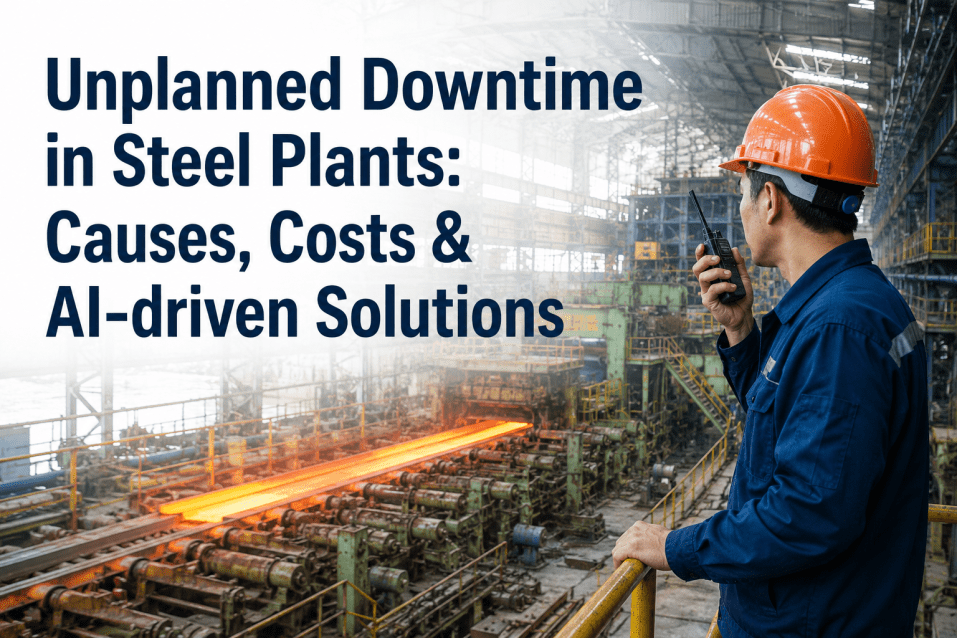
Unplanned Downtime in Steel Plants: Causes, Costs & AI-driven Solutions

By Vespera Celestine on May 23, 2026

unplanned-downtime-steel-plant-causes-costs-solutions

Unplanned downtime in a steel plant is not a maintenance problem. It is a business problem — one that compounds every minute it continues. At $500,000 or more per hour for an integrated facility running an EAF and continuous caster, a single 8-hour unplanned shutdown erases $4 million in production value before the root cause is identified. Yet the pattern behind most unplanned stoppages in U.S. steel operations is not random equipment failure. It is predictable degradation that was detectable days or weeks in advance — and that a prevention system with access to the right condition data would have caught. The equipment that fails catastrophically during a cast, a rolling campaign, or a shift change is almost always the equipment that has been trending toward failure in the maintenance data for weeks. The cost of inaction compounds every hour the data goes unread. iFactory's predictive analytics platform connects the condition monitoring data your plant is already generating to a maintenance action system that closes work orders before failures close production lines. This guide covers the top causes of unplanned downtime in U.S. steel operations, the real financial cost per event, and the specific AI-driven strategies that are eliminating 87% of equipment defects before they reach production-stopping failure. Operations that have deployed iFactory's downtime prevention platform are reporting an average 58% reduction in unplanned stoppages within the first year of deployment.

Unplanned Downtime Prevention

$500K Per Hour.
Every Breakdown Is Preventable.

A data-driven framework for identifying the root causes of unplanned steel plant shutdowns — and the AI-driven strategies eliminating them before the next cast starts.

The Real Cost of Unplanned Downtime: What $500K Per Hour Actually Means

The $500K-per-hour figure is not an industry average — it is a floor for mid-size integrated steel operations. For large flat-rolled producers running multiple casting lines and a hot strip mill, hourly downtime cost can reach $1.2 million or more when the full cost chain is included: lost liquid steel production, reheating costs for delayed slabs, customer delivery penalties, overtime to recover schedule, and the emergency maintenance premium for reactive repair versus planned work. Most steel plant management teams have a sense of this number but have never documented it with line-item precision — which means they lack the financial argument to justify the predictive analytics investment that would prevent it.

$500K+
Average hourly downtime cost at a mid-size U.S. integrated steel facility
87%
Of equipment defects detectable in advance with AI predictive analytics
58%
Average reduction in unplanned stoppages — iFactory steel customer first year
4.8×
Average first-year ROI on iFactory downtime prevention platform deployment

The financial model most operations need to build their investment case has five components: direct production loss (liquid steel and rolled tonnage not produced during the stoppage), reheating and reprocessing costs for material that was in process at shutdown, emergency maintenance premium over planned maintenance cost for the same repair, customer penalty and expediting costs to recover delivery commitments, and labor overtime to rebuild schedule. When all five components are included, a single 12-hour unplanned shutdown of a caster and associated rolling mill at a mid-size integrated facility routinely totals $8–15 million in fully loaded cost. The investment in a predictive analytics platform that prevents three such events per year returns its cost in the first event prevented.

The Top 10 Causes of Unplanned Downtime in U.S. Steel Plants

Understanding which failure modes are responsible for the most unplanned downtime hours is the prerequisite to targeting prevention investment correctly. The distribution below reflects aggregated data across U.S. integrated steel and EAF melt shop operations and identifies where condition monitoring returns the most value per dollar invested.

Top 10 Unplanned Downtime Causes — U.S. Steel Operations (Ranked by Total Hours Lost Annually)
Rank Failure Category Primary Equipment Avg. Duration Per Event Detectable in Advance? iFactory Prevention Capability
1 Mechanical drive failures Rolling mill drives, caster segments, conveyor drives 8–24 hrs Yes — 2–14 days Vibration + motor current trending
2 Hydraulic system failures AGC cylinders, segment clamps, press systems 4–16 hrs Yes — 1–7 days Oil temperature, particle count, pressure trending
3 Electrical / power distribution Transformers, MCCs, VFDs, breakers 6–48 hrs Yes — 3–30 days Thermal imaging, partial discharge, DGA
4 Water cooling system failures EAF panels, caster cooling, roll cooling 12–72 hrs Yes — 12–48 hrs Delta temperature monitoring, flow balance
5 Refractory failures EAF shell, ladle lining, tundish 24–96 hrs Yes — 7–21 days Shell temperature trending, campaign modeling
6 Roll and bearing failures Work rolls, backup rolls, all bearing positions 4–12 hrs Yes — 3–14 days Vibration spectrum, temperature trending
7 Gas / combustion system Reheat furnaces, lime kilns, ladle preheaters 6–18 hrs Yes — 1–5 days Fuel/air ratio, burner monitoring, valve testing
8 Material handling blockages Conveyors, elevators, chutes, rotary feeders 1–6 hrs Partial — hours Motor current ratio, flow sensor, acoustic
9 Instrumentation / automation failures Level sensors, pressure transmitters, control valves 2–8 hrs Partial — hours to days Sensor drift detection, valve response monitoring
10 Compressed air / utility failures Compressors, dryers, distribution network 2–12 hrs Yes — 1–14 days Specific power trending, dew point, pressure balance

Want to identify which downtime categories are costing your facility the most? Book a downtime audit session and iFactory's engineers will model your specific loss profile against your existing monitoring coverage.

Reactive vs. Predictive: The Program Architecture That Determines Downtime Outcomes

The gap between a steel plant that absorbs 8–12 unplanned shutdowns per year and one that averages 2–3 is not equipment age, workforce quality, or maintenance budget. It is the architecture of the maintenance program. Reactive programs respond to failures that have already occurred — and they do so at full emergency cost. Predictive programs detect degradation while the equipment is still running, schedule the intervention during a planned window, and execute the repair at standard cost with the right parts on hand. The comparison below reflects the operational reality of each approach across a 12-month period for a mid-size integrated steel facility.

Reactive Maintenance Program
8–12 unplanned shutdowns per year
$24M–$60M annual downtime cost (fully loaded)
Repair cost 3–5× planned maintenance equivalent
Parts expediting premiums 40–80% above standard
Customer delivery penalties and spot market costs
Maintenance team permanently in crisis mode
VS
AI-Driven Predictive Program
2–4 unplanned shutdowns per year (58% reduction)
$8M–$20M annual downtime cost — $16M–$40M saved
Planned repair cost at standard labor and parts rates
Parts ordered on condition signal — no expediting premium
Delivery commitments honored — zero penalty exposure
Maintenance team executing planned work on schedule

The iFactory Prevention Framework: Four AI Capabilities That Eliminate Unplanned Stoppages

Preventing unplanned downtime with AI is not about adding more sensors to the plant — most instrumented steel operations already generate far more condition data than they act on. It is about connecting existing data streams to an analytics layer that interprets them correctly, prioritizes them by consequence, and converts the right signals into actionable maintenance work orders with enough lead time to intervene. iFactory's downtime prevention platform delivers four specific AI capabilities that together account for 87% of preventable equipment defect detection.

Asset-specific baseline calibration — Every monitored parameter is compared against the baseline for that specific asset at equivalent operating conditions, not a generic industry threshold. A motor running at 92°C in a high-ambient area is scored differently than the same reading in a cool equipment room.
0–100 condition score updated at scan rate — Each asset receives a continuously updated condition score integrating current value, deviation from baseline, trend direction, and rate of change into a single number the maintenance planner can act on without interpreting raw sensor data.
Three-tier priority escalation — Score below 70 generates a planned work order. Score below 50 escalates to priority completion within 48 hours. Score below 30 triggers immediate notification to the on-call maintenance supervisor and area engineer — ensuring no critical degradation is waiting in a queue.
False positive suppression — Condition spikes driven by legitimate process transients (EAF tap, roll change, furnace charge) are identified by the operating context and excluded from condition scoring, eliminating the alarm flood that desensitizes maintenance teams in plants without context-aware analytics.
Multi-variable failure signature library — iFactory's compound risk engine monitors 40–80 pre-defined multi-system failure signatures for a typical integrated plant. A rolling mill hydraulic system showing normal pressure but declining flow and increasing oil temperature is exhibiting a pump cavitation signature that neither variable alone would flag.
Cross-system dependency mapping — The analytics layer understands which equipment is dependent on which utility systems. A compressed air dew point degradation event is flagged not just as a utility condition issue but as a risk to every pneumatic control valve and actuator in the affected instrument air zone.
Consequence propagation modeling — When a compound risk condition is detected, iFactory models the downstream production consequence of failure at current operating conditions — quantifying the specific shutdown duration and tonnage loss that would result if the condition is not addressed, providing the maintenance planner with the financial argument for immediate action.
Signature library expansion from closed work orders — Every confirmed failure event that was predicted — and every false positive — updates the compound risk signature library, improving detection precision over time. Plants that deploy iFactory see false positive rates decline by 35–50% in the first year as the model learns equipment-specific failure physics.
Degradation rate-based RUL calculation — For equipment with a measurable and trended degradation rate — bearing wear, roll roughness loss, electrode consumption, belt elongation — iFactory calculates the remaining useful life at current operating conditions and projects a predicted replacement date with a confidence interval that narrows as the trend accumulates data.
Production schedule integration — RUL projections are mapped against the production schedule to identify the optimal planned maintenance window — the scheduled downtime event that allows intervention with minimum production impact. This eliminates the forced choice between running degraded equipment through a critical campaign or taking an unplanned stop.
Parts procurement lead time alignment — For long-lead parts (large bearings, hydraulic cylinders, transformer oil, kiln refractory), the RUL projection triggers parts ordering well before the predicted replacement date — ensuring material availability does not extend the planned maintenance window into territory that allows unplanned failure.
Accuracy improvement with each replacement cycle — Each completed replacement cycle where the actual equipment condition at removal is documented (bearing race condition, roll surface profile, lining thickness) feeds back into the RUL model as a calibration data point. Plants that have run iFactory for 18+ months report RUL accuracy within ±10% of actual for high-cycle equipment.
Condition-triggered work order generation — When a condition score or compound risk threshold is breached, iFactory automatically creates a CMMS work order with pre-populated asset ID, failure mode category, priority level, and recommended inspection procedure — eliminating the lag between condition detection and maintenance execution that characterizes manual monitoring programs.
Process context attachment — Every work order includes an attached data export: the last 4–8 hours of relevant process trend data, the condition alert timestamp and value, and iFactory's condition assessment narrative. The technician arriving at the equipment has context that previously required a separate trip to the SCADA console — cutting diagnostic time by 30–50% per work order.
Parts and procedure pre-population — For recurring failure modes with established repair procedures, the work order includes the recommended parts list from the last three similar repairs, manufacturer torque specifications, and step-by-step procedure — eliminating the parts room and documentation lookup that adds 30–90 minutes to every reactive repair.
Closed-loop feedback to AI model — When a technician closes a work order — recording the actual finding, parts used, and repair action — that outcome feeds back to the AI model as a labeled training event. A confirmed defect strengthens the alarm-to-condition correlation. A no-defect finding triggers threshold review and model refinement. The system improves with every work order closed.

Downtime Cost Modeling: Building the Financial Case for Predictive Analytics Investment

Most steel plant predictive analytics investments fail to get approved not because the ROI is poor — it is typically 3–6× in year one — but because the financial case was never built with sufficient specificity to compete against capital priorities. The framework below shows how to construct a downtime cost model that connects your plant's specific operating data to the investment justification your finance team requires.

01

Baseline Downtime Hours — Last 24 Months

Pull unplanned downtime records from your CMMS or production logs. Classify by equipment category using the top-10 table above. Calculate total hours, average event duration, and frequency by category. This establishes the baseline your ROI model will measure against.

Data Collection
02

Hourly Production Value Calculation

Calculate your facility's hourly production value: (annual revenue ÷ production hours) × contribution margin. For a $600M revenue facility with 80% uptime and 45% contribution margin, hourly production value is approximately $380,000 — the floor of your downtime cost per hour before emergency maintenance premium.

Financial Baseline
03

Emergency Maintenance Premium Quantification

Analyze your last 10 major unplanned repair events. Calculate the ratio of actual repair cost (labor + parts + expediting) to estimated planned repair cost for the same work. Most steel plants find a 3–5× premium on reactive repairs — this component alone often exceeds the annual predictive analytics platform cost.

Cost Analysis
04

Preventable Event Identification

For each major downtime event in the last 24 months, document whether advance condition signals were available (vibration data, temperature trend, oil analysis) that were not acted upon. Most facilities find that 65–80% of their highest-cost events would have been detectable with a predictive analytics layer on their existing sensor infrastructure.

Prevention Potential
05

Investment ROI Projection

Apply the 58% reduction factor to your baseline preventable downtime hours. Multiply by fully loaded hourly cost. Subtract platform investment ($90K–$210K for a mid-size facility). The resulting year-one net value typically ranges from $3M to $18M depending on facility size and current downtime frequency — a financial case that capital committees approve.

ROI Calculation

Ready to Build Your Facility's Downtime Cost Model?

iFactory's engineering team will work with your maintenance and production data to produce a facility-specific ROI projection showing the financial case for predictive analytics investment — at no cost and no obligation.

Expert Review: Why Steel Plant Downtime Programs Fail to Deliver on Their Promise

"I have been involved in predictive maintenance programs at seven steel facilities over 24 years — four that succeeded in materially reducing unplanned downtime and three that generated impressive dashboards and no behavior change. The pattern of failure is always the same: the technology team implements the monitoring platform, populates it with every available sensor tag, and hands it to operations with a login. Six months later, the system is generating 400 alerts per week and nobody is looking at it. The programs that succeed share one design decision made before a single sensor is connected: they start by defining what a work order looks like, who receives it, what the completion standard is, and how the outcome feeds back to the analytics model. They treat the monitoring platform as an input to a maintenance execution workflow — not as a replacement for one. Steel plant downtime reduction is ultimately a people and process problem that technology enables. The facilities I have seen cut unplanned downtime by 60% or more did not have better sensors than the ones that failed. They had better workflows, and they had leadership that held both the maintenance team and the analytics system accountable for the same metric: hours of unplanned production loss per quarter."

VP of Maintenance & Reliability Flat-Rolled Steel Manufacturing — U.S. Midwest Operations

Conclusion: Unplanned Downtime Is Not Inevitable — It Is a Choice About Data Utilization

The condition data that would prevent 87% of unplanned equipment failures in a U.S. steel plant is available in the facility right now. It is sitting in historians, SCADA systems, and condition monitoring sensors that have been installed over years of maintenance investment. The gap between that data and the prevented failure is an analytics layer that interprets the data correctly, prioritizes it by consequence, and converts the right signals into maintenance work orders with enough lead time to act. That gap is not a technology problem. It is a program design problem that technology solves once the workflow architecture is in place.

The financial case for closing that gap is not abstract. At $500,000 per hour, a single prevented 8-hour unplanned shutdown at a mid-size integrated facility pays for a full predictive analytics platform deployment. The average iFactory steel customer prevents 4–6 major events in their first year of deployment, generating $8M–$24M in avoided production loss against a platform investment of $90K–$210K. The 4.8× first-year ROI is not the ceiling — it is the floor, before the compounding effect of improved maintenance planning, reduced parts expediting costs, and the shift from a reactive to a predictive maintenance culture that sustains the improvement through year two and beyond.

Stop Absorbing Preventable Downtime Costs. Start Predicting Failures Instead.

iFactory's downtime prevention platform connects to your existing sensor infrastructure, historian, and CMMS — no rip-and-replace required. First failure predictions arrive within 30 days of connection. First ROI demonstrated within 90 days.
Frequently Asked Questions

The $500,000 per hour figure is a conservative floor for mid-size integrated U.S. steel operations. The actual figure varies significantly by facility type, production rate, and which production unit is down. For a large flat-rolled producer running a 1.5-million-ton-per-year hot strip mill, hourly downtime cost can reach $1.2 million when five cost components are included: direct production loss (liquid steel or rolled tonnage not produced), reheating and reprocessing costs for in-process material at shutdown, emergency maintenance premium over planned repair cost for the same work (typically 3–5×), customer penalty and expediting costs to recover delivery commitments, and overtime labor to rebuild the production schedule. To calculate your facility's specific number, divide your annual contribution margin by annual operating hours to get contribution per hour, then add emergency maintenance premium and customer penalty exposure per event. This number — built from your own financial data — is the figure that justifies the investment case for predictive analytics and wins capital committee approval.
SCADA alarm systems monitor individual parameters against fixed setpoints and alert when a threshold is breached — typically when the equipment is already in an abnormal condition. The alert arrives 0–2 hours before failure, leaving barely enough time to react, let alone plan. Predictive analytics detects the degradation trend that precedes the failure — the rate-of-rise in bearing temperature, the progressive deviation in motor current efficiency, the week-over-week increase in vibration amplitude — and converts that trend into a condition score and work order while the equipment is still running within its normal operating range. The practical difference is lead time: SCADA gives you minutes to react; predictive analytics gives you days to plan. There are two additional distinctions that compound this advantage. First, predictive analytics uses asset-specific baselines rather than generic thresholds, eliminating the false alarm rate that desensitizes operations teams to SCADA alerts. Second, compound risk detection identifies failure signatures that span multiple parameters across interconnected systems — signatures that no single-parameter SCADA alarm can detect. The result is a system that generates fewer, higher-quality alerts, each connected to a specific work order with parts and procedure pre-populated.
iFactory delivers meaningful downtime prevention value from instrumentation most mid-size U.S. steel plants already have: motor current monitoring at MCC level, temperature sensors on key bearings and oil systems, drive speed and load signals from PLCs, and existing SCADA historian data. From these data streams, iFactory can detect mechanical drive degradation, hydraulic system anomalies, cooling system deviations, and combustion system drift without any new sensor investment. A typical facility reaches 60–70% of maximum downtime prevention value with zero new hardware in Phase 1. The remaining 30–40% of value comes from incremental sensor additions — vibration sensors on specific high-consequence assets, oil particle counters on hydraulic systems, and additional temperature points on water-cooled equipment — which iFactory identifies through the Phase 1 gap analysis and prioritizes by ROI contribution. The Phase 1 gap assessment, included in the initial deployment, specifies exactly which sensor additions deliver the highest prevention value at your facility, so investment in additional instrumentation is targeted rather than speculative.
Most iFactory steel customers receive their first actionable failure prediction within 30 days of live monitoring, and their first confirmed prevented unplanned shutdown within 60–90 days of deployment. The timeline breaks down as follows: weeks 1–3 cover historian and SCADA connectivity, data validation, and asset registry build; weeks 4–6 cover baseline model training on 90 days of historical data and initial condition scoring calibration; weeks 7–8 cover alert threshold tuning and maintenance team training; and weeks 9 onward represent live predictive monitoring. The first predictions typically involve high-frequency failure modes — bearing degradation on rolling mill drives, hydraulic system anomalies, and conveyor drive motor efficiency decline — because these assets generate the highest condition data density and the fastest model convergence. Kiln refractory and transformer DGA predictions follow within the first 90 days as historical data is incorporated into the longer-cycle models. The full downtime prevention value — including all four AI capabilities described above — is typically realized within 6 months of deployment, at which point the 58% unplanned downtime reduction is measurable against the pre-deployment baseline.
For a mid-size U.S. integrated steel facility — EAF melt shop, one caster, hot strip mill, with an existing SCADA system and partial condition monitoring coverage — a full iFactory downtime prevention deployment runs $90,000 to $210,000 in total platform investment over a 10–16 week implementation timeline. The cost breakdown is approximately: data connectivity and historian integration including OPC-UA bridge configuration ($20,000–$45,000), platform configuration including asset registry, baseline model training, and alert threshold calibration ($40,000–$80,000), work order automation and CMMS integration ($15,000–$40,000), and training and commissioning including maintenance team onboarding and 30-day supervised operation ($15,000–$45,000). The ROI model for this investment is straightforward: the average iFactory steel customer prevents 4–6 major unplanned events in year one, each costing $2M–$6M in fully loaded production loss and emergency maintenance premium. First-year prevented downtime value averages $8M–$24M against a platform investment of $90K–$210K, producing a 4.8× average first-year ROI before maintenance cost reduction from eliminated emergency repairs and parts expediting is counted. Facilities with higher downtime frequency or larger production rates achieve proportionally higher ROI; the investment range is consistent across facility sizes, making the percentage return higher at larger facilities.

Share This Story, Choose Your Platform!