Your EAF consumes 380 kWh per tonne. The best-in-class number is 300. That 80 kWh gap multiplied across 500,000 annual tonnes is $2.8 million in wasted electricity alone — before you count the electrode overconsumption, the off-spec heats reprocessed at the ladle furnace, and the slag losses that silently eat 2–4% of your metallic yield every shift. The electric arc furnace and ladle refining furnace together account for over 70% of total conversion cost in EAF steelmaking. Yet in most melt shops, the EAF runs fixed power recipes regardless of scrap mix, and the LF relies on operator judgment for alloy additions and temperature targeting. AI changes this equation entirely. Machine learning models trained on thousands of heats now predict energy requirements before charging, optimize power profiles in real time, and hit ladle furnace endpoint temperatures within ±5°C — turning the two most expensive process stages into the two most controllable ones. If your melt shop still treats every heat the same, you are overspending on every tonne. iFactory delivers real-time EAF and LF intelligence — book a 30-minute assessment to see exactly where your energy and alloy dollars are going.
EAF and Ladle Refining Optimization Using AI
Reduce Energy Consumption, Improve Metallic Yield, and Hit Chemistry Targets — Every Heat
300–600
kWh/t Range in EAF Energy Consumption — AI Pushes Toward the Low End
$3–5M
Annual Electrode Cost for a 1M Tonne EAF — Reducible by 8–15% with AI
89%
AI Temperature Prediction Accuracy Within ±5°C at LF Endpoint
Inside the EAF: Where Energy Becomes Steel — or Gets Wasted
The electric arc furnace is a brutally simple concept — pass massive current through graphite electrodes to melt scrap — but the process variables that determine efficiency are anything but simple. Every heat involves a unique combination of scrap chemistry, density, moisture content, and charge weight that changes the optimal power profile, oxygen injection rate, and tap timing. Running a fixed recipe across variable inputs is the single largest source of energy waste in EAF steelmaking.
Phase 1
Boring and Penetration
Electrodes bore through the scrap pile at maximum power (high current, moderate voltage). Energy goes into creating initial melt pools around each electrode. This phase consumes 30–35% of total heat energy but is the least optimized in most plants because operators cannot see how far the bore has progressed.
Typical Duration
8–12 min
Phase 2
Meltdown
Scrap collapses into the melt pool. Power transitions to higher voltage and lower current for longer arc length and greater radiant heating. Oxygen injection and carbon injection begin foamy slag formation. The critical decision here is when to recharge — too early wastes energy on unnecessary manipulation; too late wastes power on an empty furnace.
Typical Duration
15–25 min
Phase 3
Refining and Flat Bath
All scrap is melted. The bath is flat and energy goes into superheating liquid steel to tapping temperature. Foamy slag must be maintained to shield the arc and protect water-cooled panels. Every extra minute in this phase costs $40–60 in energy and electrode wear without adding value.
Typical Duration
10–18 min
Phase 4
Tapping
Steel is poured into the ladle through the EBT (eccentric bottom tap). Tapping temperature must be precise — too hot wastes energy and damages the ladle refractory; too cold creates problems at the LF and caster. A 10°C overshoot across 1,000 heats per year wastes over $200,000 in unnecessary energy.
Typical Duration
3–5 min
EAF electrical energy consumption has dropped dramatically over the decades — from 630 kWh per tonne to as low as 300 kWh per tonne in the most efficient operations. But most plants still operate at 380–420 kWh per tonne because they lack real-time visibility into melt progression and run conservative, fixed power programs that waste energy in every phase.
The EAF Cost Stack: What You Are Actually Paying For
Understanding where money goes in each heat is the first step to recovering it. Here is the typical cost breakdown for EAF liquid steel production.
Scrap and Metallics
55–65%
Largest cost; AI optimizes yield to extract more steel per tonne of scrap charged
Electrical Energy
15–22%
Dynamic power profiles reduce consumption by 30–60 kWh/t over fixed recipes
Electrodes
7–12%
Consumption of 1.5–3.0 kg per tonne; AI-controlled arc length reduces wear by 8–15%
Refractories
5–8%
Campaign life of 2,000–5,000 heats; full reline costs $2–4M and takes 7–14 days
Oxygen, Fluxes, Alloys
4–6%
Precise injection timing reduces overconsumption; AI models slag chemistry in real time
Where Is Your EAF Overspending?
iFactory maps energy consumption, electrode wear, and yield losses across every heat — connecting process data to actionable insights and automated maintenance triggers. Most melt shops find $5–15 per tonne in recoverable losses within the first 30 days.
Inside the Ladle Furnace: Where Steel Quality Is Made or Broken
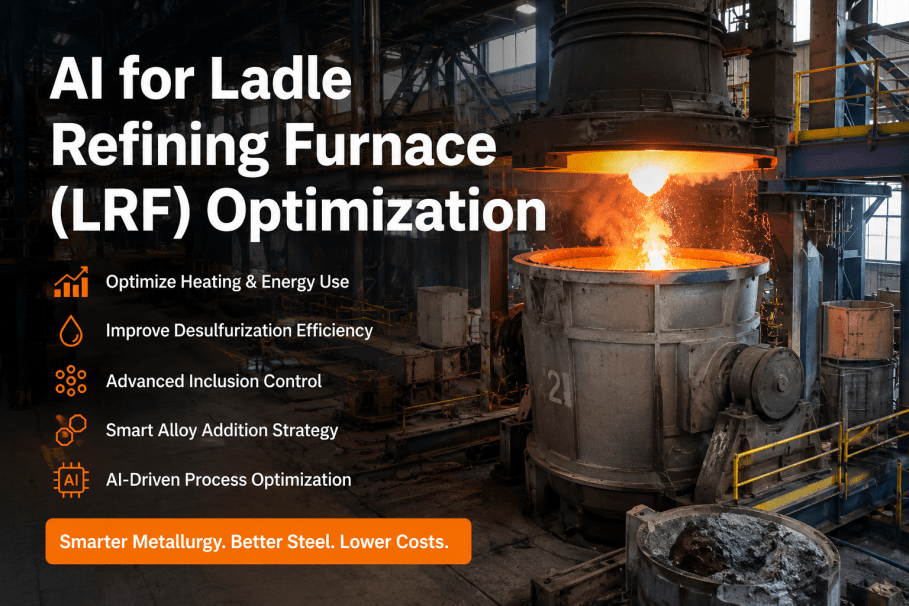
The ladle furnace is where crude EAF steel becomes a grade-compliant product. Temperature homogenization, desulfurization, deoxidation, alloy trimming, and inclusion modification all happen in this vessel. A mistake here either produces off-spec steel or forces costly reprocessing.
The Challenge
✗ Steel arrives from EAF at variable temperatures depending on tap timing
✗ LF must deliver steel within a narrow window (typically ±5°C) for the caster
✗ Overheating wastes energy and damages ladle refractory
AI Solution
✓ ML models predict endpoint temperature with 89% accuracy within ±5°C
✓ Dynamic heating profiles adapt to incoming steel temperature in real time
The Challenge
✗ Ferroalloy additions (V, Mn, Si, Al) rely on operator calculation and experience
✗ Over-alloying wastes $5–15 per tonne in unnecessary ferroalloy consumption
✗ Under-alloying produces off-spec heats requiring re-treatment (15–25 min lost)
AI Solution
✓ Automated alloy dosing calculated from live spectrometer data and recovery models
✓ Genetic algorithm optimization minimizes alloy cost while hitting all spec targets
The Challenge
✗ Argon stirring intensity and duration are often fixed regardless of sulfur level
✗ Insufficient stirring leaves inclusions; excessive stirring re-oxidizes the steel
✗ Slag chemistry optimization requires lab results that arrive too late to act on
AI Solution
✓ Real-time slag composition estimation from process parameters and thermal data
✓ Adaptive argon flow control based on predicted inclusion levels and sulfur targets
AI in Action: What Changes Across Both Furnaces
The power of AI in EAF and LF operations is not abstract — it maps directly to specific process decisions that operators make hundreds of times per day.
EAF Power Profile Selection
Fixed recipe per grade
Dynamic per heat based on scrap mix
-30 to 60 kWh/t
Scrap Recharge Timing
Operator visual judgment
AI meltdown prediction from arc data
-3% charge time, -7% energy
EAF Tapping Temperature
Conservative overshoot (10–20°C high)
Predicted within ±5°C of target
$200K+/yr saved
Electrode Voltage Control
Fixed voltage steps per phase
Dynamic arc length optimization
-8 to 15% electrode wear
LF Alloy Additions
Manual calculation with safety margins
Optimized dosing from live spectrometer
-12 to 18% alloy cost
LF Endpoint Temperature
Sample-based with lag
LSTM neural network prediction
89% hit rate within ±5°C
Refractory Wear Monitoring
Calendar-based reline schedule
Thermocouple trending with AI alerts
+15–25% campaign life
The Hidden Link: Why EAF and LF Must Be Optimized Together
Most plants treat the EAF and LF as separate optimization problems. That is a fundamental mistake. Research confirms that LF operating time has a strong influence on EAF targets — the chemistry connection between these two processes means optimizing one in isolation sub-optimizes the other.
EAF
Tapping Temperature Drives LF Energy
An EAF that taps 15°C too cold forces the LF to compensate with additional heating, consuming 5–8 kWh/t extra and adding 10–15 minutes to refining time. Conversely, tapping too hot wastes EAF energy and damages ladle refractories.
LF
LF Chemistry Targets Constrain EAF Practice
The carbon and phosphorus levels at EAF tap determine how much refining work the LF must perform. AI models that co-optimize both stages find the lowest total cost point — not the lowest cost for each furnace independently.
CCM
Caster Demands Flow Upstream
The continuous caster sets a fixed superheat and chemistry window. When the LF misses these targets, the melt shop either holds the heat (blocking the next EAF tap) or sends marginal steel to the caster, creating billet defects downstream.
Steel plants implementing Industry 4.0 strategies that connect EAF, LF, and caster data streams report 15–20% productivity gains through real-time process optimization and predictive maintenance. The gains come not from optimizing individual furnaces, but from optimizing the flow between them.
Measurable Outcomes: What AI Delivers in 6–12 Months
These are achievable, documented results from EAF and LF optimization deployments in operating steel plants.
30–60
kWh/t Saved
Dynamic power profiles adapted to each heat's scrap mix and melt progression
2–4
Extra Heats/Day
Tap-to-tap time reduction from optimized melt timing and reduced flat bath duration
12–18%
Alloy Cost Reduction
Precise ferroalloy dosing eliminates safety-margin over-addition at the LF
25–40%
Less Unplanned Downtime
Predictive maintenance on electrodes, refractories, and hydraulic systems
89%+
Temperature Hit Rate
LF endpoint within ±5°C target using LSTM-based neural network prediction
$6–10M
Annual Savings / Mt
Combined savings from energy, electrodes, refractories, yield, and downtime reduction
Frequently Asked Questions
How does AI reduce EAF energy consumption?
AI models analyze 5,000+ data points per heat — including scrap composition, charge weight, arc impedance, power factor, and melt progression indicators — to determine the optimal power level for each phase. High power during boring when scrap shields the walls, dynamic voltage adjustment as scrap collapses, and precise flat bath duration control collectively eliminate 30–60 kWh per tonne of unnecessary energy input compared to fixed recipe approaches.
What makes ladle furnace temperature prediction so difficult?
LF temperature is influenced by dozens of interacting variables — incoming steel temperature from EAF, alloy additions (which absorb heat), argon stirring intensity (which drives heat loss), slag composition, ladle refractory condition, and treatment time. Traditional physics models cannot capture all these interactions in real time. Machine learning models trained on historical heats learn these complex relationships and achieve prediction accuracy that manual methods cannot match.
Can AI reduce electrode consumption in EAF steelmaking?
Yes. Electrode consumption at 1.5–3.0 kg per tonne is driven by arc current, voltage, oxidation exposure, and thermal shock. AI controls arc length dynamically — using higher voltages with longer arcs when unmelted scrap protects sidewalls, then shortening arcs in the flat bath phase. This optimized profile reduces electrode wear by 8–15% while simultaneously protecting refractory panels, saving $300,000–750,000 annually on a 1 million tonne furnace.
Does this require replacing existing EAF or LF control systems?
No. iFactory integrates as a layer above existing Level 1 (PLC/SCADA) and Level 2 systems. It ingests data from arc regulation systems, power quality analyzers, spectrometers, temperature probes, and process historians without requiring hardware changes or production shutdowns for installation. The AI models generate recommendations and alerts that either guide operators or feed back into existing automation systems.
Turn Your EAF and LF Into Your Most Efficient Assets
iFactory connects every sensor, every heat, and every process variable across your EAF and ladle furnace — delivering real-time optimization, predictive maintenance, and automated reporting that turns raw process data into recovered dollars per tonne.