Hot Briquetted Iron is emerging as the most strategically important metallic feedstock in the global steel decarbonization transition. A compacted form of Direct Reduced Iron with 90–92%+ iron content and minimal impurities, HBI enables electric arc furnace steelmakers to produce high-quality steel without the carbon intensity of blast furnace production — reducing CO₂ emissions by 50–90% depending on the reduction energy source. The global HBI market reached approximately $5.26 billion in 2025 with production at 11.4 million tonnes, but the real story is what comes next: over 10 hydrogen-ready DRI/HBI facilities are in development, merchant HBI trade volumes are expected to exceed 12 million tonnes, and research shows HBI trade could accelerate the phase-out of BF-BOF steel by 2–5 years while cutting cumulative steel sector CO₂ emissions by 4 gigatonnes. For steel producers navigating EU CBAM compliance, ETS free allowance phase-out, and customer decarbonization demands, HBI represents both a production pathway and a procurement opportunity. For resource-rich nations, green HBI export is becoming a multi-billion-dollar trade flow. iFactory's supply chain intelligence platform tracks HBI market dynamics, supplier quality, logistics optimization and CBAM-compliant emissions data for steel producers making the transition. Book a free demo and explore the HBI opportunity for your operations.
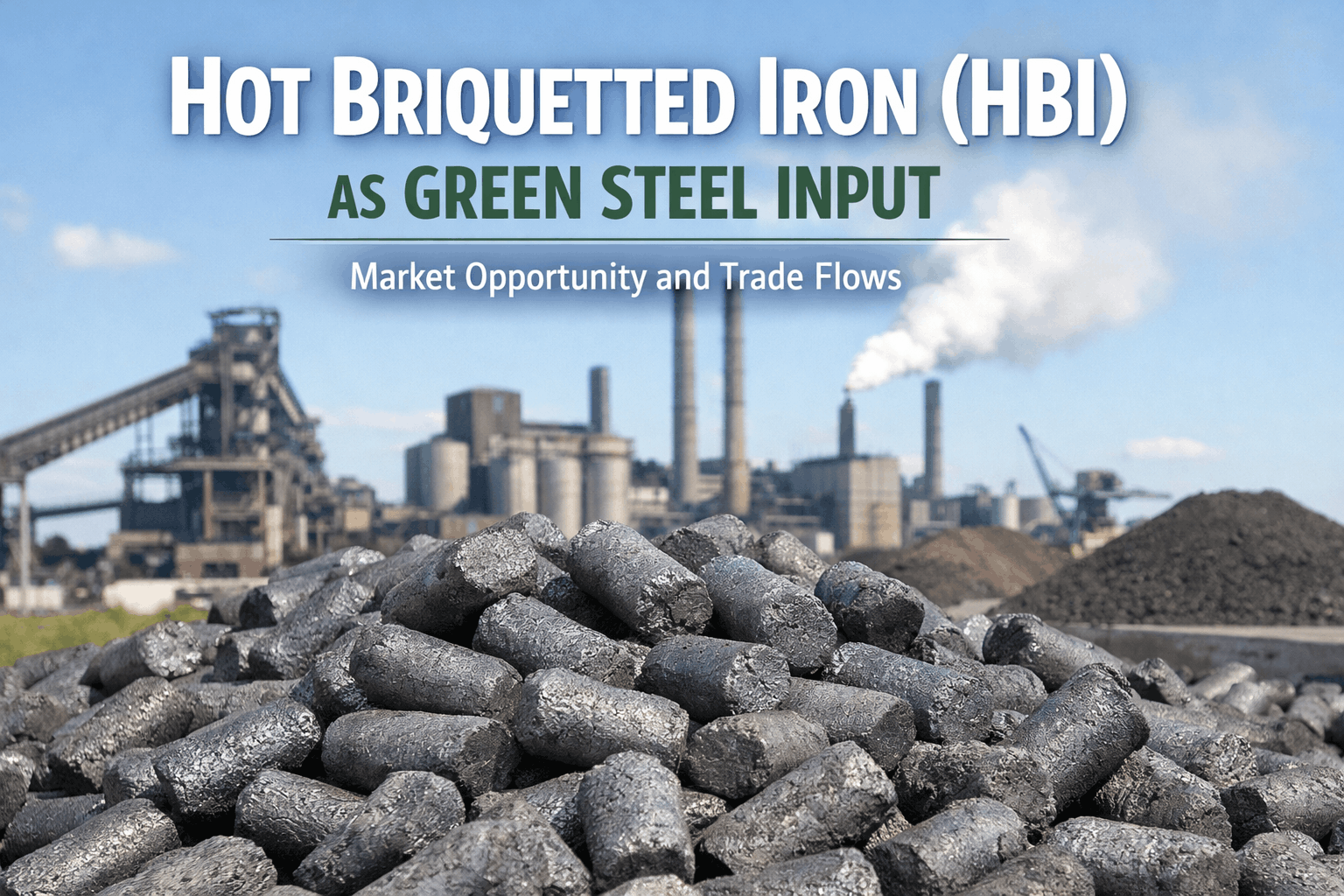
Hot Briquetted Iron (HBI) as Green Steel Input: Market Opportunity and Trade Flows
The Feedstock That Makes Green Steel Possible — At Scale, Across Continents.
HBI is the bridge between abundant renewable energy in exporter nations and carbon-constrained steel production in importer nations. Australia, Brazil, the Middle East, and Africa have the iron ore and renewable energy to produce green HBI. Europe, Asia, and North America have the EAF capacity and decarbonization mandates to consume it. This guide maps the entire opportunity — market size, production economics, trade corridors, quality specifications, regulatory drivers, and strategic positioning for steel producers on both sides of this emerging global trade flow.
Global HBI Market 2025
Global HBI Production
CO₂ Reduction vs BF-BOF
Cumulative CO₂ Savings Potential
What Is HBI — And Why Is It the Key to Green Steel at Scale?
Hot Briquetted Iron is Direct Reduced Iron (DRI) compacted at elevated temperatures into dense pillow-shaped briquettes with iron content of 90–92%+ and density around 5 g/cm³. The compaction process eliminates the re-oxidation risk that makes loose DRI dangerous to transport — making HBI safe, stable, and shippable across oceans.
HBI is the only high-purity metallic feedstock that can be produced from iron ore using hydrogen or natural gas instead of coking coal, transported safely across global distances, and fed directly into EAFs to produce steel with 50–90% lower CO₂ emissions. It bridges the gap between where renewable energy is abundant and where steel demand exists.
HBI serves as premium feedstock in Electric Arc Furnaces (primary application, ~38% of market), Blast Furnaces (as supplement to reduce coke consumption), and hybrid steelmaking routes. It substitutes for scrap metal where high-quality scrap is unavailable or where residual element control is critical for premium steel grades. See HBI in the steelmaking context
The HBI Market in 2026 — Size, Growth Drivers, and Competitive Landscape
Global HBI Trade Flows — Where Production Meets Demand
HBI trade is creating entirely new global commodity corridors — connecting renewable-energy-rich producing regions with carbon-constrained consuming regions.
Why Regulation Is Accelerating HBI Demand — CBAM, ETS & Beyond
EU CBAM (2026 Definitive Phase)
EU importers of steel now pay for embedded carbon at EU ETS prices. Steel produced using HBI in EAFs has dramatically lower embedded emissions than BF-BOF steel — meaning lower CBAM certificate costs and a price advantage for HBI-route steel entering the EU market. This regulatory cost differential is the single strongest demand driver for HBI in 2026.
EU ETS Free Allowance Phase-Out (2026–2034)
EU steel producers losing free carbon allowances face escalating costs on BF-BOF production — projected at 34% of total costs by 2035. Switching to EAF production with HBI feedstock reduces both emission intensity and carbon cost exposure. The phase-out makes HBI-based steelmaking economically compelling even before technology cost parity.
Customer & Investor Decarbonization Mandates
Automotive OEMs, construction firms, and infrastructure developers are setting Scope 3 emission reduction targets that require low-carbon steel inputs. Steel producers who can demonstrate HBI-route, low-emission production gain preferential supplier status with major buyers. Investor ESG pressure adds further urgency. Assess your regulatory exposure
HBI Production Routes — From Natural Gas to Green Hydrogen
HBI production is evolving from natural gas-based reduction toward green hydrogen — with transitional pathways enabling progressive decarbonization.
Natural Gas-Based DRI → HBI
The established production route using Midrex or HYL/Energiron shaft furnace technology. Natural gas reduces iron ore pellets to metallic iron (DRI), which is then hot-compacted into HBI. Produces 50% less CO₂ than BF-BOF route. Dominant in Middle East and North America where gas is abundant and affordable. Approximately 40% of production costs are energy-related.
Gas–Hydrogen Blend DRI → HBI
Progressive replacement of natural gas with green hydrogen in existing DRI shaft furnaces. Meranti Green Steel's Oman facility will start at 85% gas / 15% H₂ and ramp up hydrogen share over time. This pathway enables immediate production start while infrastructure for green hydrogen scales up. Over 35% of new HBI facilities expected to integrate renewable power by 2030.
100% Green Hydrogen DRI → HBI
Iron ore reduced entirely by green hydrogen produced from renewable electricity via electrolysis. Near-zero CO₂ emissions — up to 90% reduction vs. BF-BOF. Voestalpine/Rio Tinto/Primetals pilot in Linz (~3 t/hr) targeting mid-2027 startup. Multiple commercial-scale facilities planned globally. Hydrogen cost reduction is the key variable for cost competitiveness. Explore green HBI economics
How iFactory Helps Steel Producers Navigate the HBI Opportunity
HBI Supplier Intelligence
Track HBI producers globally — production capacity, Fe content consistency, quality certifications, delivery reliability, carbon intensity ratings, and pricing. Score and compare suppliers across multiple dimensions. Identify emerging sources as new facilities come online.
CBAM-Compliant Emissions Data
Automatically calculate and document embedded emissions for HBI-route steel production using EU-prescribed methodologies. Generate CBAM-compliant data packages that demonstrate the carbon advantage of HBI feedstock to EU importers. See CBAM integration
Logistics & Trade Flow Optimization
Optimize HBI procurement across global suppliers factoring in landed cost (product + freight + duties), shipping routes, port congestion, and delivery lead times. Multi-origin sourcing strategies that balance cost, quality, and supply security.
Carbon Cost Modeling
Compare total cost of ownership for BF-BOF (coke + iron ore) vs. EAF (HBI + scrap) routes under multiple EU ETS carbon price scenarios. Identify the crossover point where HBI-route production becomes financially superior for your specific operations and product mix.
Complete HBI Market Coverage
Frequently Asked Questions — HBI as Green Steel Input
What makes HBI different from DRI and scrap metal?
DRI (Direct Reduced Iron) is iron ore reduced to metallic iron using gas or hydrogen — but loose DRI is highly reactive and can spontaneously re-oxidize, making it dangerous to store and transport. HBI is DRI that has been hot-compacted into dense briquettes at elevated temperatures, eliminating re-oxidation risk and enabling safe ocean shipping across global distances. Compared to scrap metal, HBI offers controlled chemistry with 90–92%+ iron content and minimal residual elements (copper, tin, nickel) — critical for producing high-quality steel grades where scrap quality limitations are a constraint. Learn more in a demo
How much does HBI reduce CO₂ emissions compared to traditional steelmaking?
Natural gas-based DRI/HBI production reduces CO₂ emissions by approximately 50% compared to BF-BOF steelmaking. Gas-hydrogen blend DRI achieves 60–80% reductions depending on the hydrogen share. 100% green hydrogen DRI/HBI achieves up to 90% reduction — near-zero carbon steelmaking. When used as EAF feedstock with renewable electricity, the total steel production emissions can be reduced from 1.6–2.1 tonnes CO₂/tonne (BF-BOF) to as low as 0.1–0.3 tonnes CO₂/tonne.
How does HBI relate to EU CBAM compliance?
CBAM requires EU importers to purchase certificates covering embedded carbon in imported steel. Steel produced using HBI in EAFs has dramatically lower embedded emissions than BF-BOF steel — meaning lower CBAM certificate costs. A steel exporter using HBI-route production can demonstrate significantly lower carbon intensity to EU importers, making their products more price-competitive under CBAM. iFactory's platform generates CBAM-compliant emissions documentation automatically. See CBAM-HBI integration
Which countries are the major HBI producers and what's changing?
Currently, the Middle East (Oman, UAE, Qatar) and North America (USA — Cleveland-Cliffs) hold approximately 55% of global HBI market share, driven by abundant natural gas. Russia (Metalloinvest) is also a major producer but faces trade disruptions. The landscape is shifting rapidly: Oman is positioning as a global green HBI hub, Australia is exploring DRI/HBI value-add for its iron ore exports, and multiple hydrogen-ready facilities are planned across the Middle East, Europe, and Australia. Over 10 hydrogen-ready DRI/HBI plants are currently in development.
Is green hydrogen-based HBI economically viable today?
Pure green hydrogen-based HBI is not yet cost-competitive with gas-based production at current hydrogen prices. However, the economics are converging rapidly: declining electrolyzer costs, scaling renewable electricity, and rising carbon costs (EU ETS phase-out) are narrowing the gap. Transitional strategies — starting with gas-hydrogen blends and ramping up hydrogen share over time — are commercially viable now. Under Fastmarkets' base ETS scenario, green steel reaches near cost-parity with BF-BOF by the early 2030s. Model hydrogen economics
What iron ore grades are needed for HBI production?
HBI production requires high-grade iron ore — typically 67%+ Fe content with low impurities (silica, alumina, phosphorus). This is higher quality than what blast furnaces accept, creating a premium market for high-grade ore from producers like Vale, Rio Tinto, and Fortescue. The shift toward green steel is driving 18–22% increases in high-grade feedstock demand from major steel producers. DR-grade pellets are the preferred feedstock, and pellet availability is a key supply chain constraint for HBI capacity expansion.
HBI Is the Feedstock That Makes Green Steel Possible at Scale
From Middle East gas-based production to Australian green hydrogen pilots, the HBI trade map is being redrawn in real time. Whether you're a steel producer evaluating EAF transition, an exporter exploring green HBI, or a trader tracking emerging corridors — iFactory's market intelligence platform gives you the data to act.