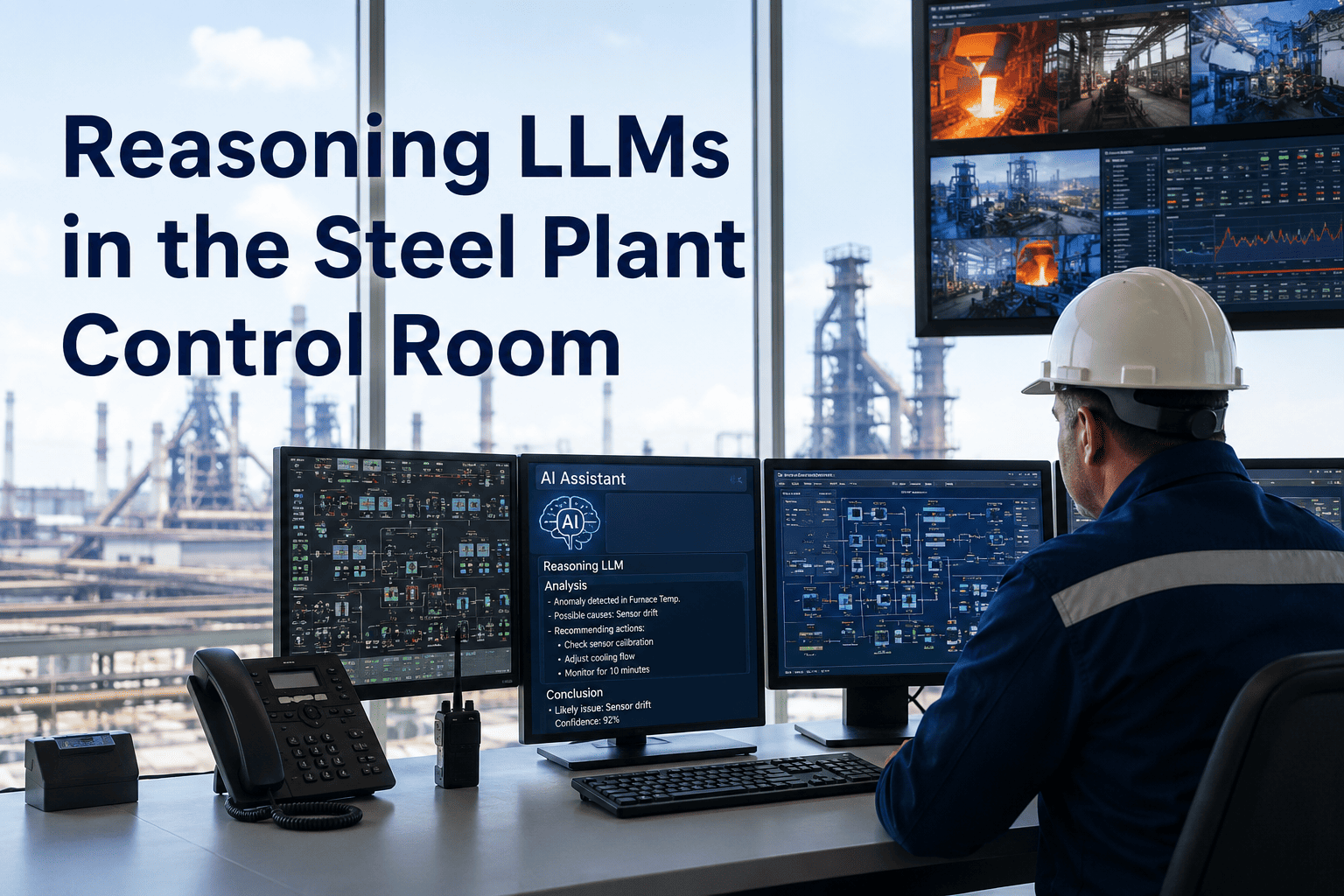
A modern steel plant control room already runs on AI — mold-level sensors flag caster breakout risk in under 200 ms, BOF models predict end-point carbon within 0.02%, and hot strip vision tags defects at line speed. But the operator at the HMI at 3 a.m. still has to answer a harder question than any single model can: given twelve concurrent alerts across melt shop, caster, and reheat, what matters right now and what is the next action. That gap is what reasoning LLMs are finally ready to close — book a demo to see it in your control room.
ARCHITECT · STEEL STRATEGY · REASONING LLM COPILOT
Reasoning LLMs Are Now Ready for the Steel Plant Control Room — Here Is What That Actually Changes for Your Operators
A reasoning LLM copilot sits above your existing steel AI — caster breakout, BOF end-point, hot mill vision — reading their alerts in context and giving the operator a plain-language, procedure-grounded answer to what to do next.
12+
Concurrent Alerts a Melt Shop Operator Faces in a Bad Shift
76%
Alarm Reduction Reported After Adaptive Steel AI Deployment
On-Prem
LLM Runs Inside the Plant Perimeter, Not on the Public Cloud
THE PROBLEM WITH ALERTS ALONE
Your Steel Plant Already Has AI — It Does Not Yet Have Someone Who Reads All of It at Once
Every zone of an integrated steel plant ships with its own AI layer — stave cooler models on the blast furnace, end-point predictors on the BOF, breakout detection on the caster, zone optimizers on the reheat furnace, defect vision on the hot strip mill. Each works on its own. None stitches its alert to the twenty others firing across the plant into a story the operator can act on.
Senior operators have always done this stitching in their heads. They know the caster warning at 03:12 is downstream of ladle drift that started at 02:47, which is downstream of a BOF tap that ran 22 seconds instead of 18. That knowledge is the difference between a controlled slowdown and a $2.4M breakout — and in most integrated mills, it lives in a handful of operators nearing retirement.
THE COPILOT MOMENT
What Changes in the Control Room on Night Three of a Reasoning LLM Deployment
BEFORE — Alerts Without a Reader
03:12 — Caster mold-level alarm on strand 2. Oscillation 4.2 mm above nominal.
03:13 — Reheat furnace zone 3 shows a 15°C drop on a different screen, no visible link.
03:14 — Hot strip mill flags a surface-defect trend on the last three coils.
Twelve minutes of screen-hopping later, the operator stitches it — but the cast is already three coils into the downgrade.
AFTER — A Reasoning LLM That Reads Every Screen for You
03:12 — Caster alarm fires. The copilot reads it, checks the last four heats, and cross-references the reheat drop.
Summary on screen: "Strand 2 oscillation consistent with tundish superheat drop 25 minutes ago. Recommend casting speed 4.6 m/min and argon stir increase per OP-CAST-042."
Procedure, last four heats, and defect trend in one panel — one screen, one recommendation, one reasoning trail.
Decision time drops from twelve minutes to under ninety seconds, every step logged for handover.
Your Operators Already Do the Reasoning — the LLM Documents It, Speeds It Up, and Never Retires
A reasoning copilot captures senior-operator knowledge and applies it consistently across every shift, grounded in your procedures and plant history.
SIX QUESTIONS OPERATORS ASK EVERY SHIFT
The Questions a Steel Plant Reasoning LLM Copilot Is Built to Answer
A reasoning LLM in the control room is not a chatbot. It is trained on your process context — grade specs, alarm codebooks, procedures, and historical heats — so the questions it answers are the ones operators already ask, faster and with a documented reasoning trail.
Q1
Which of these twelve alerts should I act on first?
The copilot ranks concurrent alerts by process criticality and time-to-consequence — surfacing the caster anomaly ahead of the routine deviation before the operator has to guess.
Q2
What did the last shift do when this happened?
The copilot summarizes similar events from the last thirty days and what worked, drawing directly from the shift logbook and procedure history.
Q3
Is this alert a real event or a nuisance alarm?
Grade-aware context lets the copilot distinguish a real deviation from an expected transition — an SPC excursion during a Grade A to B changeover is correctly categorized as normal.
Q4
Which procedure applies to what I am seeing?
Instead of searching a procedure library across three shared drives, the copilot names the procedure, cites the step, and links the exact section from onboarding.
Q5
Where did this defect actually originate?
Surface defects on a hot strip coil trace backward through caster strand, ladle furnace history, and BOF tap chemistry — turning a shift-long spreadsheet investigation into a single query.
Q6
How do I brief the next shift in ninety seconds?
The copilot generates a structured handover — open issues, actions taken, active alerts, grades in progress — from the actual shift log.
THE DATA THE LLM ACTUALLY READS
What Feeds a Steel Plant Reasoning Copilot — and What Stays Off Limits
The quality of a reasoning LLM answer is not about the model — it is about what it can see when it reasons. The LLM has to wire into the same data fabric your Level 2 systems, historians, and MES already use, without becoming another pipeline. Seven standard on-prem read paths below.
Process Historian
PI, Aveva, or Ignition — real-time and historical tags for temperatures, flows, chemistries, and setpoints, inheriting the engineering read path.
Alarm Codebook & Event Log
DCS and PLC alarm history tagged by grade, area, and priority — so the copilot knows which alarms operators treat as critical and which are routine.
Shift Logbook & Operator Notes
Shift reports, defect tags, heat logs, and maintenance notes — the knowledge that lives on paper or shared drives, unified into reasoning context.
Procedure Library
Standard procedures, grade recipes, and emergency response documents — every recommendation cites the procedure and step that applies.
MES & Production Orders
Heat schedule, grade transitions, and order priority feed the copilot's view of what is running, what is next, and where the campaign sits.
Quality & LIMS Data
Chemistry results, inspection outcomes, and downgrade reasons close the loop between operator actions and final quality — so the copilot learns which decisions protected yield.
Existing AI Model Outputs
Caster breakout, BOF end-point, and strip vision models feed alerts into the copilot as inputs.
SAFETY & GOVERNANCE
What a Reasoning LLM Copilot Does — and What It Explicitly Does Not Do
Deploying a reasoning LLM in a control room raises immediate questions about action authority and safety. The answer in every credible on-prem steel deployment is the same: the copilot advises, the operator decides, no LLM output writes directly to a control setpoint. The table below is the boundary that governs every recommendation.
| Capability |
Copilot Role |
Human Role |
| Alert Interpretation |
Reads, ranks, and summarizes concurrent alerts |
Operator confirms priority |
| Procedure Retrieval |
Cites the exact procedure and step |
Operator applies procedure |
| Setpoint Recommendation |
Suggests values grounded in history |
Operator enters setpoint change |
| Control System Write |
Never writes directly to DCS or PLC |
Human action authority preserved |
| Safety Interlock |
Cannot override or bypass any interlock |
Interlocks remain governed by DCS logic |
| Reasoning Trail |
Logs every step of every recommendation |
Auditable by shift lead and engineering |
| Data Egress |
No plant data leaves the perimeter |
IT and OT governance intact |
DEPLOYMENT ARCHITECTURE
How an On-Prem Reasoning LLM Copilot Actually Gets Into Your Control Room
A steel plant reasoning copilot is delivered as a turnkey on-prem appliance — model, retrieval layer, and plant integration run inside the facility perimeter on an NVIDIA edge server. Deployment moves through five phases, timed around your outage calendar so no additional downtime is added.
01
Weeks 1–2 — Perimeter Setup & Data Mapping
Edge appliance installed inside the plant perimeter. Historian, MES, and alarm read paths established through the existing DMZ.
02
Weeks 3–5 — Plant Context Onboarding
Procedure library, grade specifications, alarm codebook, and equipment hierarchy are ingested. Retrieval layer indexed against six to twenty-four months of historical heat data.
03
Weeks 6–8 — Shadow Mode Operation
Copilot runs against live alerts in read-only shadow mode. Operators see recommendations on a side panel while shift leads review reasoning quality.
04
Weeks 9–10 — Operator Rollout & Feedback Loop
Copilot promoted into the primary operator workflow with accept-or-override feedback. Rejections feed corrective training back into the retrieval layer within days.
05
Weeks 11–12 — Cross-Zone Extension
Coverage extends from the initial zone (typically caster or BOF) to adjacent zones. Cross-chain correlation activates once read paths reach every zone.
FREQUENTLY ASKED QUESTIONS
What Steel Strategy Architects Ask Before Deploying a Reasoning LLM Copilot
Does the reasoning LLM replace the caster breakout model, the BOF end-point predictor, or our existing steel AI stack?
No. The copilot sits above your existing AI models, not in competition. The caster breakout model still runs at the machine with sub-100ms latency — you cannot afford a cloud round-trip on a breakout alert. The copilot reads outputs from these specialized models along with historian, MES, and shift log data, giving the operator a unified summary and recommendation. Your existing AI investment is preserved and made more useful.
Book a demo to see integration with the models running in your plant.
Does any plant data or operator conversation leave our network when we deploy an on-prem reasoning LLM copilot?
No. The reasoning model, retrieval layer, and plant integration all run on an NVIDIA edge server inside your facility perimeter. Historian reads, MES queries, and operator interactions are served locally — by architectural design there is no external egress for operational data. This is the standard 2026 on-prem plant copilot pattern for steel, utilities, and defense-adjacent manufacturing.
Talk to our support team to review the network and data governance model for your plant.
Can the LLM copilot write directly to a control setpoint or override a safety interlock on the DCS?
No, and this is a deliberate architectural boundary. The copilot recommends setpoint values and cites the applicable procedure, but the operator enters any control change. Safety interlocks remain governed by DCS logic they were commissioned under, and the copilot has no write path to bypass them. Every recommendation is logged with a full reasoning trail for shift lead and engineering audit.
Book a demo to walk through the action-authority boundary in a live scenario.
How long does it take a reasoning LLM copilot to become useful in a specific steel plant with its own grades and procedures?
A typical deployment moves into shadow mode by week six and into operator rollout by week ten. Meaningful reasoning quality on plant-specific grades and procedures is reached inside the first quarter, given six to twenty-four months of heat data and a current procedure library at onboarding. The accept-or-override feedback loop keeps improving answer quality every week the copilot runs.
Contact steel support for a timeline mapped to your outage calendar.
Does adding a reasoning LLM copilot change our operator training requirements or the qualifications needed for shift lead sign-off?
No. Operator qualification, shift lead authority, and any regulatory training for your operations are unchanged. The copilot supplies decision support and documentation; the operator remains the qualified party for every control action, and the shift lead remains the authority for shift-level decisions. What changes is that the reasoning behind every action is documented in plain language — strengthening handover, new-operator training, and post-incident review.
Book a demo to see the copilot inside a live operator workflow.
SEE IT IN YOUR CONTROL ROOM
Give Your Night Shift the Same Reasoning Depth Your Best Operator Brings on Day Shift
A reasoning copilot captures senior-operator intuition, applies it consistently on every shift, and runs entirely inside your plant perimeter. Book a session to map deployment onto your steel operations.