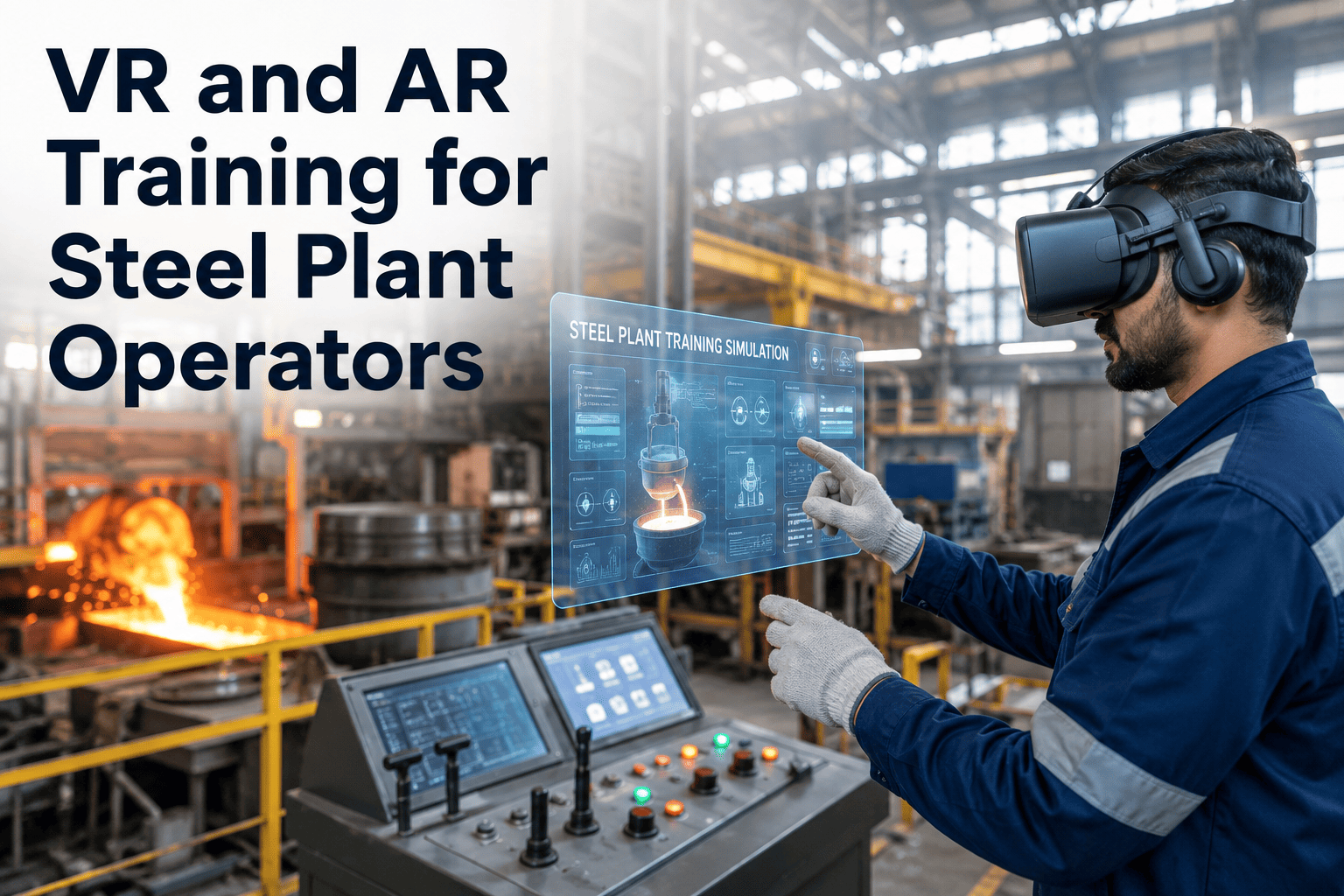
A new operator learning to run a rolling mill traditionally spends somewhere between six and twelve months shadowing a senior colleague before being trusted alone on the floor, and most of that time is spent waiting for the right scenario to naturally occur rather than actively practicing it. A grade-change emergency, a runaway temperature reading, a sudden equipment fault — these are exactly the situations new operators most need to practice, and exactly the ones that cannot be safely or reliably staged on a live production line. iFactory builds VR and AR training environments that recreate those scenarios on demand, with every action tracked against a measurable competency standard, a method covered further in iFactory's support documentation.
The Training Pipeline From Onboarding to Independent Competency
What Training Time Actually Looks Like Today
The bulk of traditional operator training time is not spent learning normal operation, which most new hires pick up reasonably quickly, but waiting for the rare edge-case scenarios that separate a competent operator from an experienced one to occur naturally on shift. Simulated environments remove that waiting period entirely by generating the scenario on demand, as many times as needed, without any production or safety risk.
Traditional Shadowing vs. Simulation-Based Training
Shadowing a senior operator has real value that simulation does not replace entirely, particularly for building floor awareness and team communication habits. The two approaches work best combined rather than treated as substitutes for one another.
Training Modalities and What Each One Is Best Suited For
| Modality | Best Suited For | Typical Use Point |
|---|---|---|
| Full VR Simulation | Emergency procedures, rare fault scenarios, unsafe-to-stage conditions | Pre-floor onboarding and periodic refresher certification |
| AR Floor Overlay | Real equipment operation with step-by-step contextual guidance | First weeks of supervised floor work |
| Desktop 3D Walkthrough | Plant layout familiarization for new hires before equipment access | Day one to week one of onboarding |
| Mixed Reality Team Drills | Multi-role emergency response requiring coordinated team action | Quarterly team-based refresher exercises |
What Competency Tracking Actually Measures
A training program is only as strong as its ability to prove competency, not just log hours completed, and this is where most traditional training records fall short. Measurable tracking gives training leads a defensible record for audits and a clear signal for which operators need additional practice before independent sign-off.
Building the Scenario Library Around Your Actual Incident History
The most valuable VR scenarios are not generic industry templates but ones drawn directly from your own plant's incident and near-miss history, since these represent the exact situations your operators are statistically most likely to encounter. A scenario library built this way turns every past incident into a repeatable training opportunity rather than a one-time lesson learned by whoever happened to be involved. This also means the library grows and improves over time as new incidents occur, rather than remaining a fixed set of exercises that gradually drifts out of relevance.
Training leads working with an existing incident database typically find this integration straightforward, since the same root cause and equipment tagging used for safety reporting can double as the basis for scenario design. A near-miss involving a specific valve failure becomes a simulated scenario new operators practice responding to, closing the loop between what already happened on the floor and what the next generation of operators is prepared for.
Addressing Common Concerns From Training Leads and Union Representatives
Introducing a new training technology often raises legitimate questions from both training leads and workforce representatives about how the data collected during simulated sessions will be used, and getting ahead of these questions builds the trust needed for genuine adoption rather than passive compliance.
Conclusion — Practice the Scenarios That Actually Matter
The scenarios that determine whether an operator is truly ready for independent work are exactly the ones traditional shadowing struggles to provide reliable exposure to. VR and AR training environments close that gap directly, replacing months of waiting for the right situation to occur with structured, repeatable, measurable practice. Book a demo to see how iFactory can build a scenario library specific to your plant's equipment and emergency procedures.
Frequently Asked Questions — VR and AR Training for Steel Plant Operators
The simulation environment is built to closely mirror your actual plant layout, control interfaces, and equipment behavior, since a generic training scenario that does not resemble the real floor tends to transfer poorly when the operator moves to actual equipment. This typically involves an initial assessment of your plant's specific equipment models, control panel layouts, and common fault patterns so the simulated scenarios reflect what an operator will genuinely encounter. iFactory's support documentation outlines the plant assessment process used to build this fidelity.
No prior experience with VR or gaming technology is required, since the training environments are designed around plant operations rather than general gaming interaction patterns, and most new operators become comfortable with the headset controls within their first short session. Training leads typically run a brief orientation session focused purely on headset and interface familiarity before moving into actual scenario practice, which removes technology comfort as a variable in competency assessment. Operators who are less comfortable with the technology initially generally close that gap quickly given the simplicity of the interaction model used.
Yes, AR floor-assist solutions are selected and configured to be compatible with standard plant safety equipment, since requiring operators to choose between AR guidance and required protective equipment would defeat the purpose of a safety-oriented training tool. Compatibility is confirmed against your specific PPE requirements and floor conditions during the initial setup phase, and the overlay display is designed to supplement rather than obstruct an operator's normal field of view and safety awareness while working with live equipment.
Most plants schedule refresher certification on a quarterly or semi-annual basis, particularly for emergency and rare fault scenarios that operators may not encounter often enough in real conditions to maintain sharp response time and procedure recall. The refresh cadence can be adjusted based on how frequently a given scenario type actually occurs on the floor, with higher-risk and lower-frequency scenarios generally warranting more frequent simulated practice than routine operational tasks that operators already perform daily.
Training leads receive competency reports broken down by individual operator, scenario type, and performance trend over time, which supports both day-to-day training decisions and broader audit or compliance documentation needs. Plant management typically receives a higher-level rollup showing time-to-competency trends across the workforce and identifying scenario categories where operators as a group are performing below the defined benchmark, which helps prioritize where additional simulation practice or procedure review is most needed.