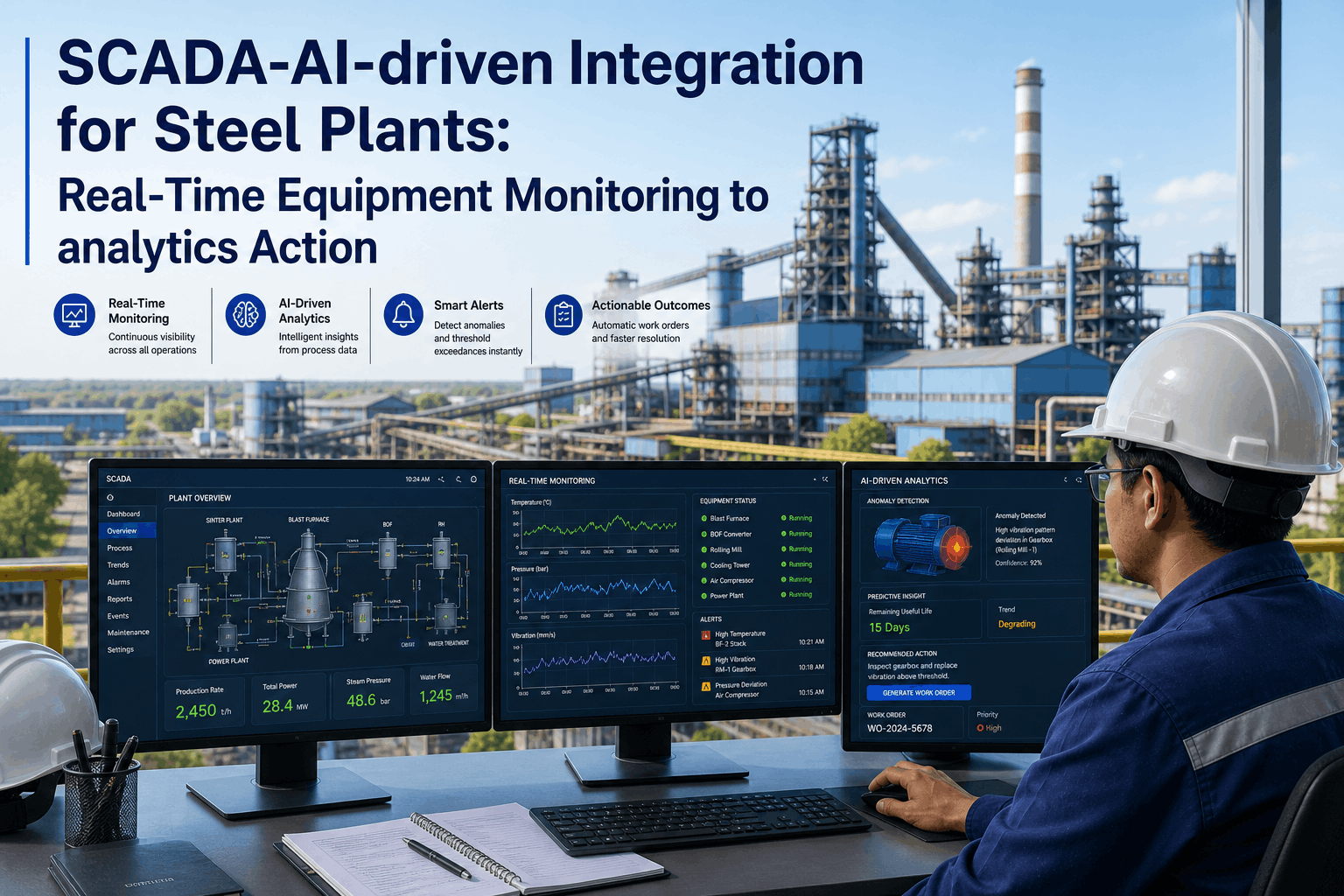
Most steel plant SCADA systems were designed and installed before anyone in the control room was thinking about AI as a category, and replacing them outright is rarely realistic given the cost, the recertification effort, and the operational risk of touching a system that has run reliably for a decade or more. The more practical path is layering AI analysis on top of the SCADA data that already flows through the control room, without ripping out or replacing the underlying system your operators already trust. iFactory builds exactly that kind of overlay, a method explained further in iFactory's support documentation.
Why Rip-and-Replace Is Rarely the Right Answer for Steel Plant SCADA
A SCADA system that has been running a melt shop or rolling mill reliably for years represents an enormous amount of validated logic, alarm tuning, and operator familiarity that a full replacement would put at risk all at once. The overlay approach instead reads the existing data streams your SCADA already produces and adds an AI analysis layer on top, leaving the control logic and operator interface your team already trusts fully intact.
Where the AI Overlay Sits Relative to Existing SCADA Layers
Understanding where an AI overlay fits into the existing plant architecture helps process IT teams evaluate integration risk before committing to any change, since the overlay is designed to sit alongside rather than inside the existing control hierarchy.
| Architecture Layer | Existing Function | Role of AI Overlay |
|---|---|---|
| Field Instrumentation | Sensors and actuators collecting real-time process data | Untouched — data is read, not modified, at this layer |
| SCADA / HMI | Existing control logic, alarms, and operator interface | Untouched — remains the operator's primary control surface |
| Historian / Data Layer | Time-series storage of process and equipment data | Primary integration point — overlay reads historian data continuously |
| AI Analysis Layer | New addition | Runs predictive and diagnostic models on top of historian data, surfaced back to operators as a separate view |
A Phased Integration Path for Process IT Teams
What an On-Prem AI Overlay Can Surface That Legacy SCADA Cannot
Legacy SCADA systems are excellent at real-time control and threshold-based alarming, but most were never designed to detect the slower, cross-variable patterns that often precede equipment degradation or quality drift. An AI overlay reads the same data at a broader time horizon and across more variables simultaneously than a threshold-based alarm ever could.
Why On-Prem Deployment Matters for Steel Plant Data
Addressing Cybersecurity and Network Segmentation Concerns Early
Any conversation about adding a new system near a plant's control network rightly starts with cybersecurity, and process IT teams are correct to scrutinize how an AI overlay connects to historian data without introducing a new attack surface into an environment that was likely never designed with modern network security assumptions in mind. The overlay's read-only historian connection is deliberately scoped to minimize this risk, typically deployed within the same network segmentation boundaries already established for other historian-consuming applications such as reporting dashboards or business intelligence tools.
This means the integration pattern is not fundamentally new to most plants — it follows the same trust boundary already used for existing read-only consumers of historian data, rather than requiring a new class of network access to be opened up. Process IT and OT security teams typically review this architecture during the initial assessment phase alongside existing network diagrams to confirm the deployment aligns with established segmentation policy before any connection is made live.
What Changes for the Control Room Operator Day to Day
Operators who have spent years developing muscle memory around a specific SCADA interface understandably want to know what changes for them personally, and the honest answer during the initial rollout phase is very little. The existing HMI screens, alarm behavior, and control sequences remain exactly as they were, since the overlay is not modifying the underlying control system in any way. What operators eventually gain is a separate, supplementary view that surfaces AI-generated insights alongside their existing screens, introduced only after the parallel validation period has confirmed the insights are reliable.
Conclusion — Modernize the Analysis Layer, Not the Control Room
Steel plants do not need to choose between the reliability of a SCADA system that has run for years and the analytical capability that modern AI can add on top of it. An overlay architecture built to read existing historian data delivers new predictive insight without asking process IT teams to take on the risk of a full system replacement. Book a demo to see how iFactory can layer onto your existing SCADA environment.
Frequently Asked Questions — SCADA Modernization for Steel Plants
The overlay is built to be compatible with standard industrial historian data structures used across most common SCADA platforms deployed in steel plants, since these systems generally follow similar time-series data conventions regardless of vendor. Compatibility is confirmed during the initial data layer assessment, which reviews your specific historian configuration, tag structure, and data resolution before any connection is established, ensuring the overlay reads your data correctly from day one. iFactory's support documentation lists commonly supported historian and SCADA environments in more detail.
During initial deployment and the validation period, the overlay operates strictly as a read-only consumer of historian data, with no write access to your control logic, alarms, or operator interface, which is a deliberate design choice to eliminate any risk to your existing validated control system. Some plants later choose to enable specific, tightly scoped write-back capabilities for particular use cases once trust in the overlay's accuracy is well established, but this is always an explicit opt-in decision made by your process IT team rather than a default behavior.
The validation period is scoped to your plant's specific process cycle and typically runs long enough to observe the overlay's insights against a full range of normal operating conditions and at least one seasonal or maintenance cycle, which for most steel processes means several weeks to a few months. During this period, AI-generated insights are shown alongside existing SCADA alarms without replacing them, giving your team direct visibility into how closely the new layer's findings match what your existing system already catches, and where it adds genuinely new information.
Because the overlay is architected to read from the historian data layer rather than being tightly coupled to a specific SCADA vendor's control logic, a future SCADA upgrade or replacement generally requires reconfiguring the data connection rather than rebuilding the overlay from scratch, provided the new system maintains a comparable historian structure. This decoupling is one of the practical advantages of the overlay approach, since it means your investment in the AI analysis layer is not tied to the lifecycle of any single SCADA vendor's platform.
Yes, the overlay can be deployed entirely within your plant's own on-premises infrastructure, processing historian data locally without requiring sensitive operational data to leave your network boundary, which is a common requirement for steel plants operating under strict data governance or air-gapped network policies. This on-prem deployment model is scoped during the initial assessment alongside your existing network architecture and security requirements to confirm the right configuration for your specific environment.