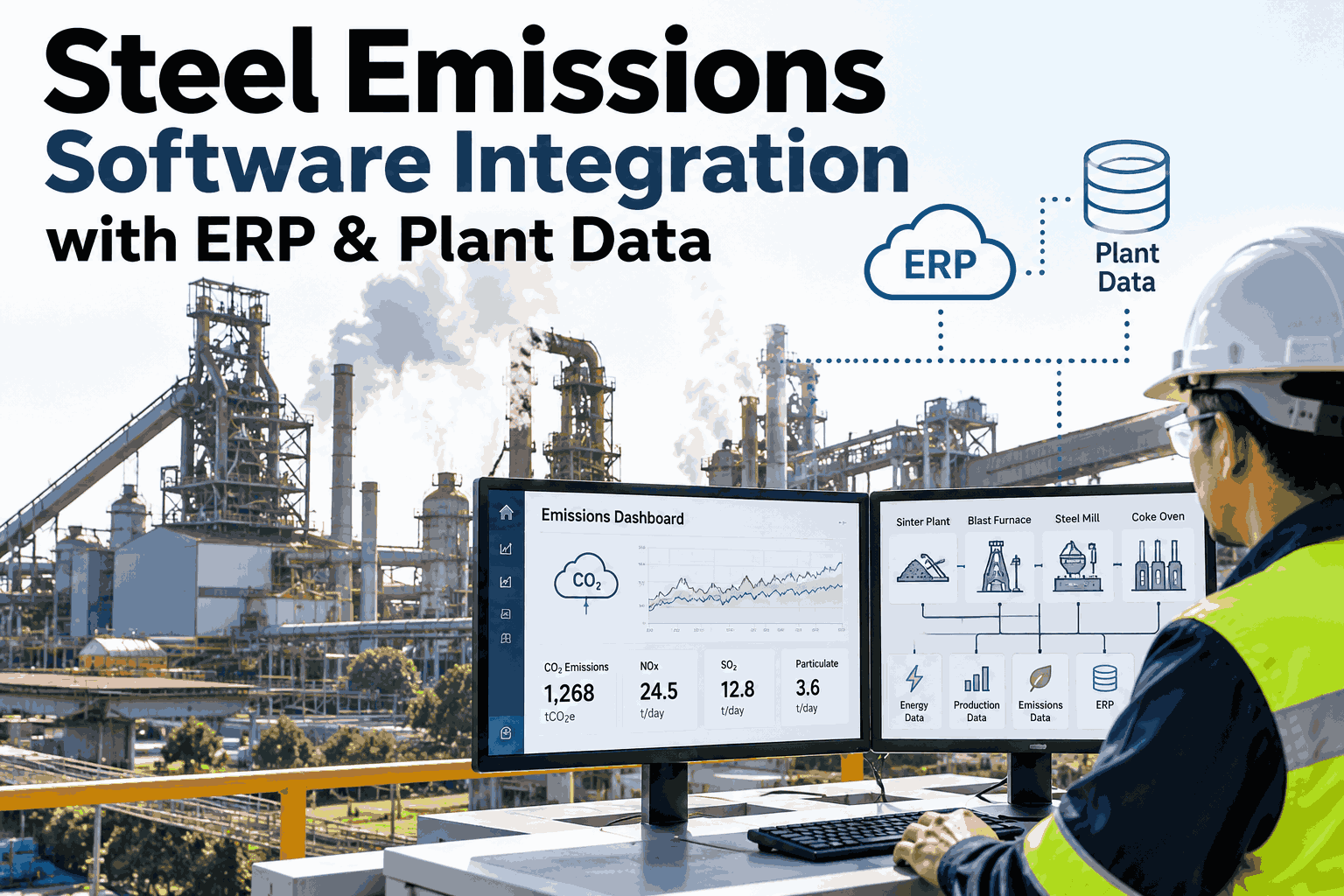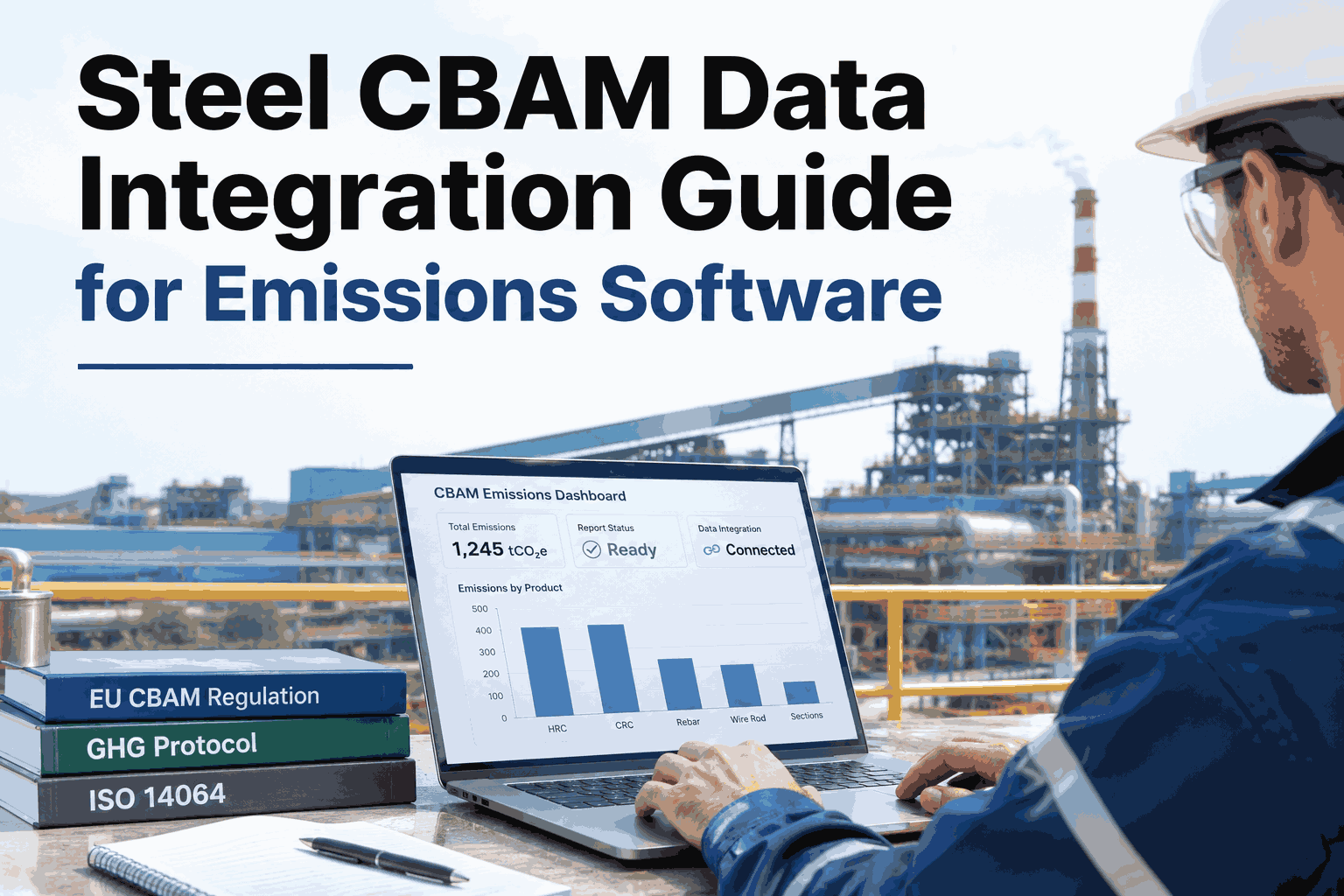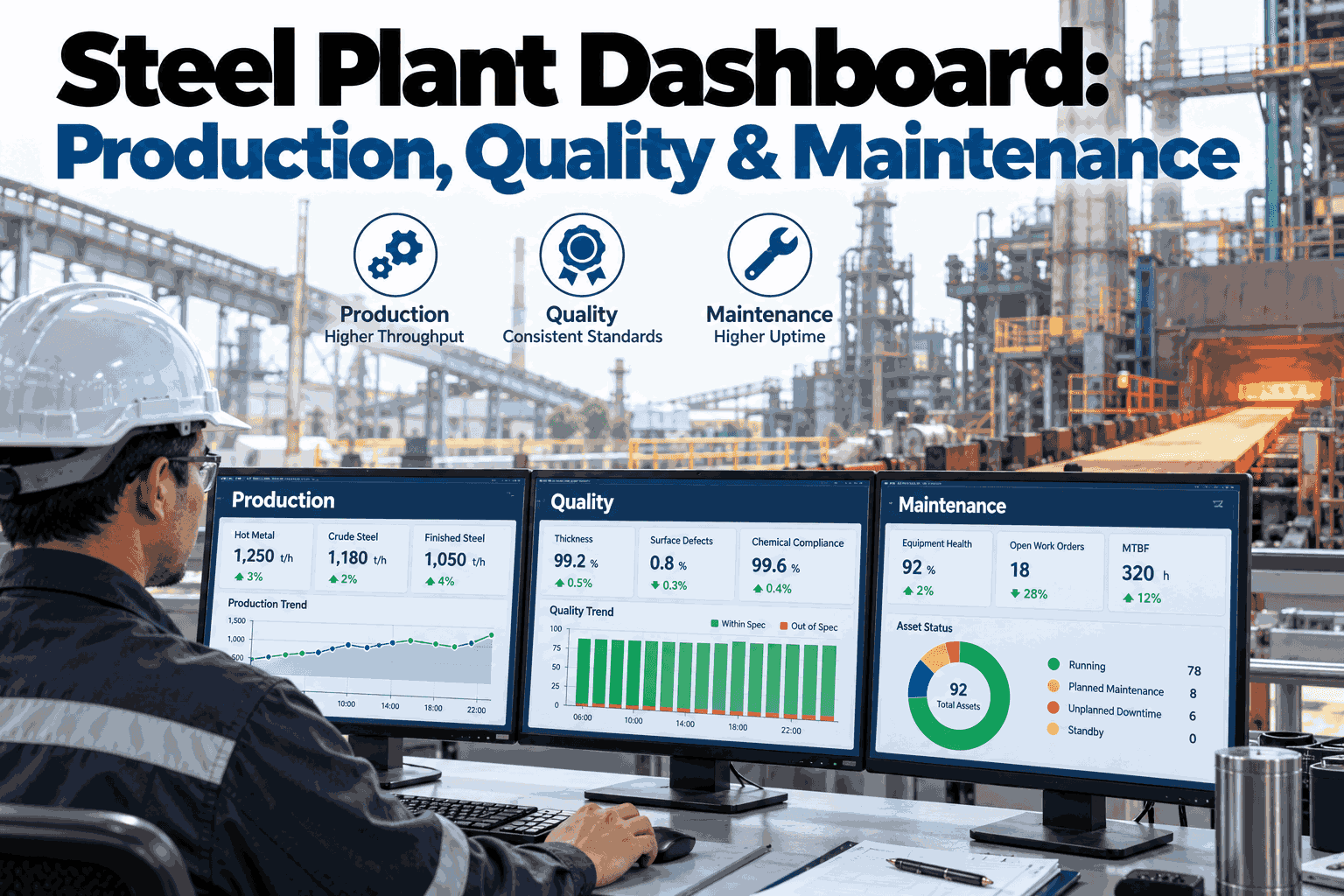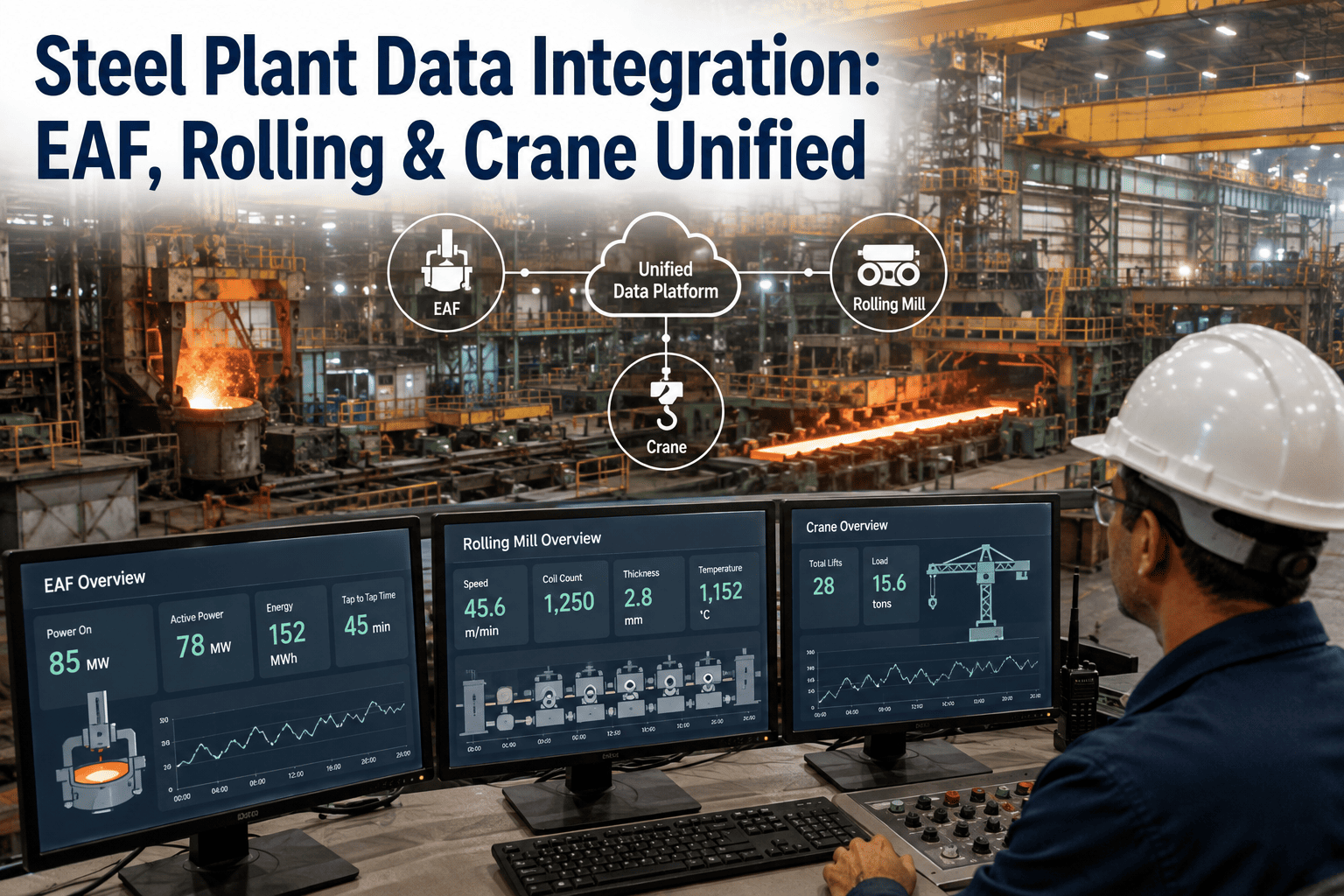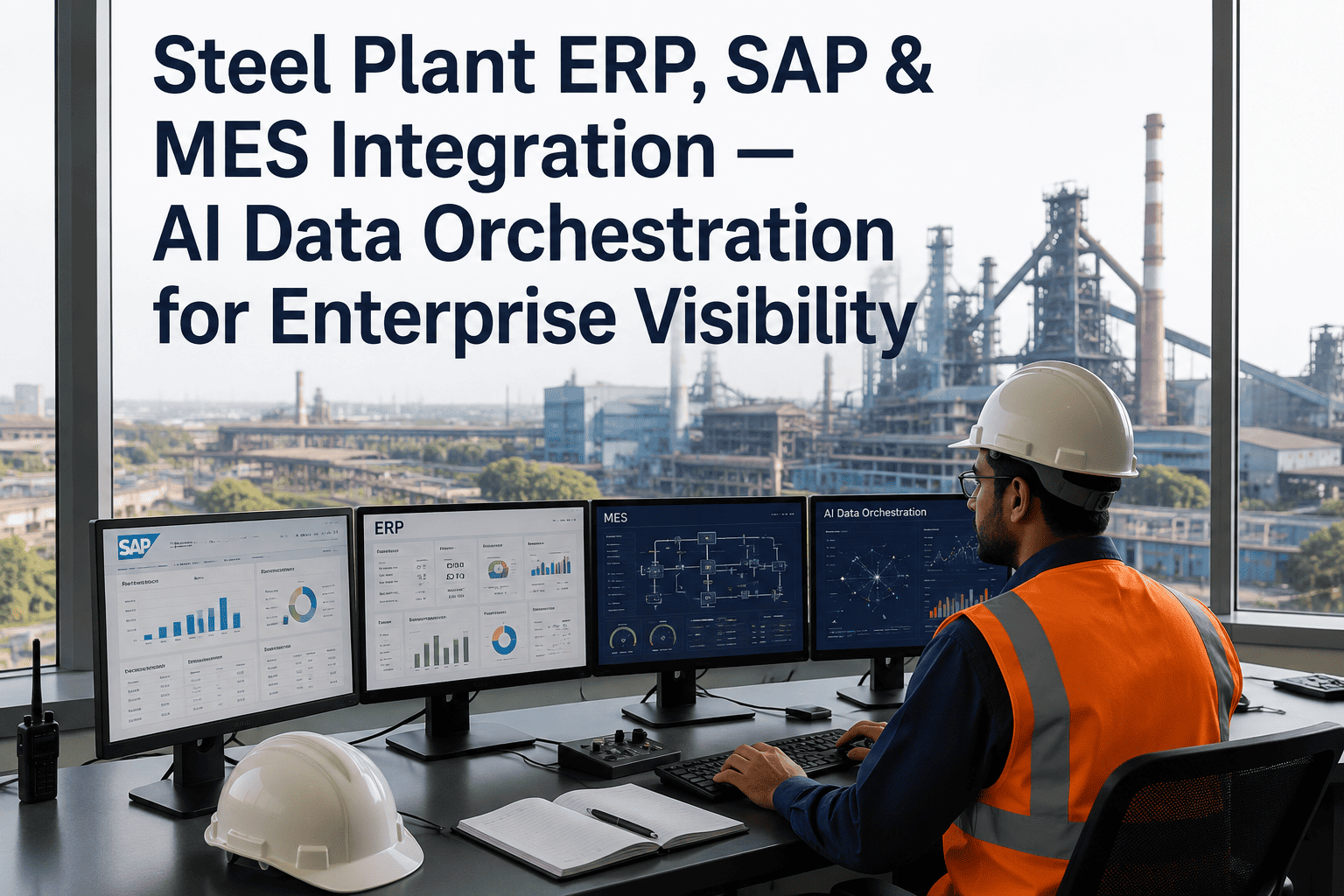
Ask a steel plant operations director where a single ton of production sits right now — commercially, financially, and physically — and the honest answer usually takes three phone calls and two spreadsheets. SAP knows the order. MES knows the process step. CMMS knows whether the equipment making it is healthy. None of the three systems is talking to the others in real time, which means every cross-functional decision runs on data that's already a shift old. AI data orchestration closes that gap by connecting SAP, MES, and CMMS into one live operational picture.
Three Systems of Record. Zero Systems of Truth.
SAP, MES, and CMMS each hold a piece of the same production story. AI data orchestration links them so operations directors get one enterprise-wide view instead of three conflicting reports.
Where Enterprise Visibility Breaks Down Today
Production, quality, maintenance, and commercial data all exist — just never in the same place at the same time.
Four Layers, Four Owners, One Missing Connector
Each system was built to do one job well. Orchestration is what makes them behave like one platform.
SAP ERP
Order books, customer commitments, and financial close depend on production numbers that SAP receives on a delay, not in real time.
MES
Process execution and genealogy data live here, but rarely flow upward to commercial teams or sideways to maintenance planning.
CMMS
Asset health and work order history sit isolated from the production schedule they should be directly informing.
AI Integration Layer
A connective layer that reads and writes across all three systems, keeping every team working from the same live picture.
One Delayed Report Shouldn't Decide a Production Call
iFactory's AI orchestration layer connects SAP, MES, and CMMS without replacing any of them — giving operations directors a single, current view across commercial, production, quality, and maintenance data.
Siloed Reporting vs. Orchestrated Visibility
The difference shows up first in how fast a question gets answered, and second in how many people it takes to answer it.
| Capability | Siloed Systems | Orchestrated Platform |
|---|---|---|
| Order-to-production visibility | Manual cross-reference | Live, linked view |
| Maintenance impact on schedule | Discovered after the fact | Flagged before it disrupts output |
| Quality data reaching commercial | Delayed by a full shift or more | Available in near real time |
| Reporting effort | Multiple teams, multiple exports | Single dashboard, shared source |
| Decision confidence | Based on last known state | Based on current state |
Four Decisions Orchestration Makes Faster
These are the recurring moments where a fragmented data picture costs operations directors the most time.
Order Prioritization
See live production status against SAP order commitments to resequence work without waiting on a manual status call.
Maintenance-Aware Scheduling
Factor CMMS asset health directly into MES production scheduling before a failing asset derails an order.
Quality-Linked Costing
Connect quality outcomes from MES to SAP cost centers so rework and scrap are visible where budgets are managed.
Unified Executive Reporting
Generate a single cross-functional report instead of reconciling exports from three separate teams every week.
How Orchestration Gets Deployed Without Disruption
None of the underlying systems are replaced — the orchestration layer sits on top and connects what already exists.
Map System Interfaces
Identify the existing SAP, MES, and CMMS APIs and data exchange points already available for connection.
Build the Orchestration Layer
Configure bidirectional data flow between systems without modifying core ERP, MES, or CMMS configurations.
Validate Against Live Operations
Run the connected view in parallel with existing reports until accuracy is confirmed across every data source.
Roll Out Unified Dashboards
Replace manual cross-referencing with a single live dashboard available to operations, production, and commercial teams.
ERP and MES Integration — Questions Answered
What operations directors typically ask before scoping a cross-system orchestration project.
Q: Does orchestration replace our existing SAP or MES investment?
No, the orchestration layer is designed to sit alongside SAP, MES, and CMMS rather than replace any of them. It connects to existing APIs and data exchange points to read and share information across systems, which means the investment your team has already made in configuring those platforms stays intact. This approach also shortens deployment time considerably compared to a rip-and-replace project. You can book a demo to see how it connects to your specific SAP and MES versions.
Q: How long does a typical ERP-MES-CMMS orchestration rollout take?
Timelines vary based on how many systems and sites are involved, but most single-plant deployments move from interface mapping to a validated unified dashboard within a few months. The mapping and validation phases usually take longer than the technical connection itself, since accuracy against live operations has to be confirmed before anyone relies on the dashboard for decisions. Multi-site or multi-ERP-instance plants naturally extend the timeline. Our support team can scope a realistic schedule for your environment.
Q: What happens if one of our systems is customized or heavily configured?
Custom fields, workflows, and configurations are common in SAP and MES deployments, and the mapping phase specifically accounts for this by working against your live interface rather than a generic template. This is why the initial system inventory and interface mapping step matters so much before any connection is built. Highly customized environments may require additional mapping time, but this rarely blocks the project entirely. It simply extends the assessment phase to get the connections right the first time.
Q: Who typically owns the orchestration dashboard once it's live?
Operations directors are usually the primary owner since the dashboard consolidates commercial, production, and maintenance data into the cross-functional view they already need for daily decisions. Plant managers, production planners, and maintenance leads also draw on the same connected data for their respective areas. Because the underlying systems remain unchanged, each team's existing reporting tools continue working alongside the new unified view rather than being replaced by it.
Q: Can the orchestration layer trigger actions across systems, or is it view-only?
Both models are supported depending on what a plant is ready for. Many teams start with a read-only unified view to build trust in the data before enabling bidirectional actions, such as automatically flagging a maintenance-driven schedule conflict back into MES. Write-back capabilities are typically introduced in a later phase once the connected data has proven reliable in daily use. Discuss your preferred starting point during a rollout conversation.
One Live Picture. Every Team Aligned.
Stop reconciling SAP, MES, and CMMS reports after the fact. iFactory's AI orchestration layer gives operations directors a single, current view across the entire enterprise — without touching the systems your teams already rely on.