Steel plants operate under the most extreme conditions in heavy industry — blast furnaces at 2,700°F+ for 15–20 year campaigns, BOF converters processing 400-ton heats in 40 minutes, EAFs cycling through 3,000°C arc temperatures every hour, and supporting systems spanning coke ovens, sinter plants, continuous casters, and gas recovery networks. Missing a single inspection point can cascade into a $4–$12 million unplanned blowdown or a catastrophic safety incident. This comprehensive 200+ point audit checklist — organized by asset zone, frequency, and criticality — gives your maintenance team the definitive reference for every steelmaking inspection. iFactory's CMMS digitizes every checkpoint with mobile execution, auto-scheduling, and AI-powered anomaly detection. Book a free consultation to see the digital audit system in action.
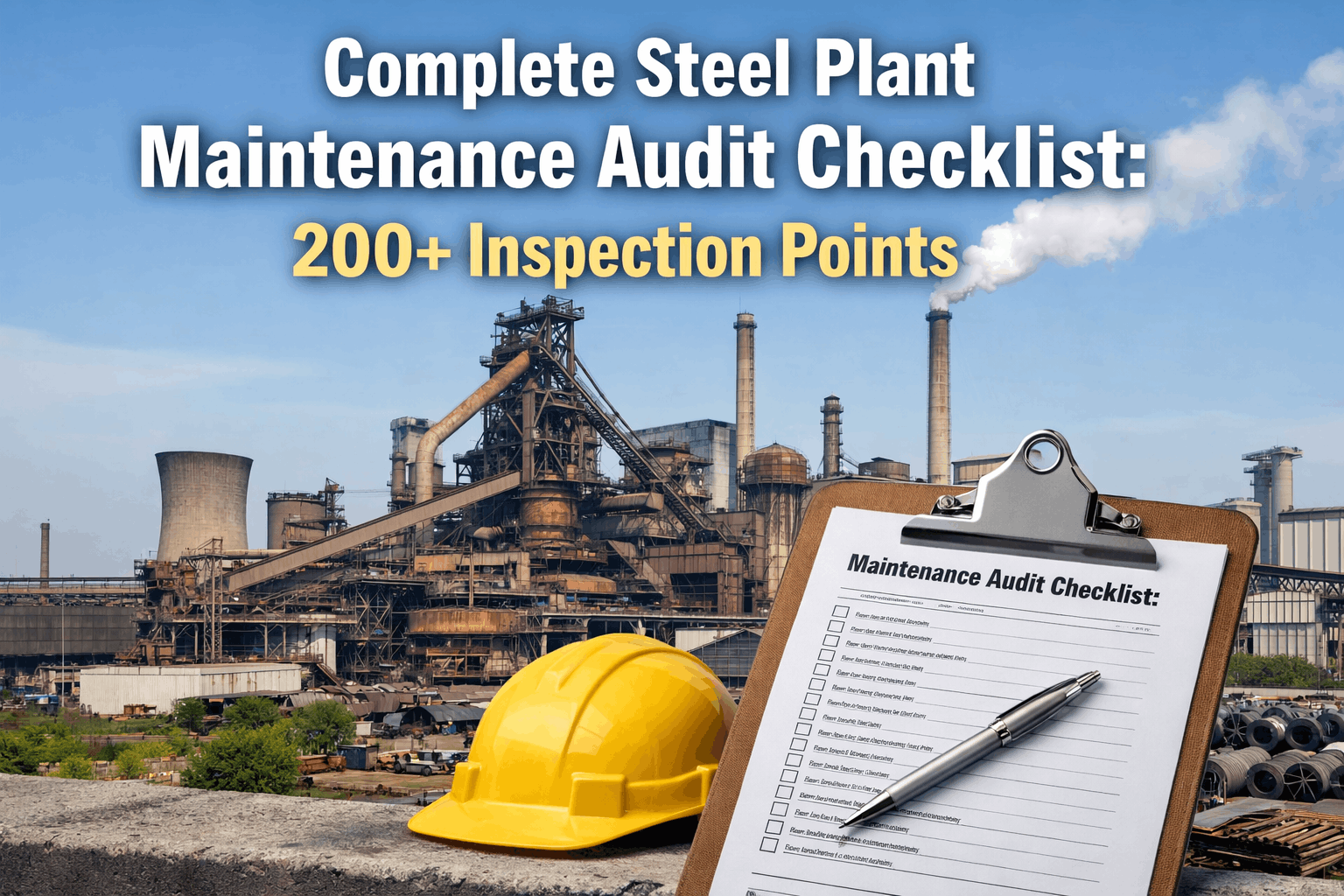
Complete Steel Plant Maintenance Audit Checklist
200+ Inspection Points
From blast furnace hearth thermocouples to EAF electrode holders, from BOF oxygen lances to continuous caster mold oscillation — this audit checklist covers every critical inspection point across the entire steelmaking chain. Each checkpoint is mapped to frequency (daily, weekly, monthly, campaign-based), criticality tier (safety-critical, production-critical, efficiency), and the specific failure mode it prevents. iFactory's CMMS turns this paper checklist into a living digital system with mobile execution, photo documentation, and AI anomaly alerts.
Across 12 Asset Zones
Preventable With Audits
With Systematic Auditing
What Happens When Steel Plant Audits Fall Short
Paper checklists get lost. Inspection points get skipped under production pressure. Critical anomalies go undocumented. The result is catastrophic failures that were entirely preventable — and audit trails that crumble under regulatory scrutiny.
============ ZONE 1: BLAST FURNACE ============
Blast Furnace Inspection Points (55 Checkpoints)
The blast furnace is the most maintenance-critical asset in steelmaking — operating continuously for 15–20 year campaigns at 2,700°F+ where direct inspection is impossible. These 55 checkpoints cover every monitorable zone from hearth to throat.
| # | Inspection Point | Frequency | Criticality | Failure Mode Prevented |
|---|---|---|---|---|
| 1 | Hearth thermocouple readings (all embedded sensors) | Continuous / Daily review | Safety-Critical | Hearth penetration / campaign loss |
| 2 | Hearth bottom temperature trend analysis | Daily | Safety-Critical | Salamander buildup / hot metal breakout |
| 3 | Hearth sidewall refractory thickness (calculated) | Weekly | Safety-Critical | Refractory erosion beyond safe limits |
| 4 | Cooling stave water inlet/outlet ΔT — all circuits | Continuous / Daily review | Safety-Critical | Cooling circuit failure / water leak into furnace |
| 5 | Cooling water flow rate per circuit | Continuous | Safety-Critical | Blocked circuit / reduced cooling capacity |
| 6 | Cooling water pressure differential | Daily | Production-Critical | Scale buildup / flow restriction |
| 7 | Shell temperature scanner readings (infrared) | Daily | Safety-Critical | Hotspot formation / shell burn-through |
| 8 | Shell plate visual inspection for discoloration | Weekly | Production-Critical | Localized overheating / lining loss |
| 9 | Tuyere condition — visual through peep sight | Every shift | Safety-Critical | Tuyere burnback / water leak |
| 10 | Tuyere cooling water ΔT — individual tuyeres | Continuous | Safety-Critical | Nose damage / impending failure |
| 11 | Tuyere stock condition and blowpipe connections | Weekly | Production-Critical | Gas leaks / blast loss |
| 12 | Bustle pipe pressure and temperature | Continuous | Production-Critical | Blast distribution imbalance |
| 13 | Bustle pipe expansion joint inspection | Monthly | Production-Critical | Joint failure / gas leak |
| 14 | Bosh area thermocouple readings | Daily | Safety-Critical | Bosh lining erosion |
| 15 | Stack thermocouple array — all levels | Daily | Production-Critical | Scaffold formation / burden hang |
| 16 | Top gas temperature profile | Continuous | Production-Critical | Irregular burden descent / channeling |
| 17 | Top gas composition (CO, CO₂, H₂, N₂) | Continuous | Production-Critical | Fuel efficiency loss / process instability |
| 18 | Burden descent rate monitoring | Continuous | Production-Critical | Hanging / slipping events |
| 19 | Stockline level and distribution pattern | Every charge | Production-Critical | Uneven burden distribution |
| 20 | Charging equipment — bell/bell-less top mechanism | Weekly | Production-Critical | Charging failure / gas seal loss |
| 21 | Gas cleaning system — dust catcher efficiency | Daily | Efficiency | Downstream equipment fouling |
| 22 | Gas cleaning — venturi scrubber performance | Daily | Efficiency | Environmental emission breach |
| 23 | Taphole condition — post-tap inspection | Every cast | Safety-Critical | Taphole erosion / uncontrolled tap |
| 24 | Taphole drill and mud gun operation | Every cast | Safety-Critical | Failure to open/close taphole |
| 25 | Cast house runner and tilting spout condition | Daily | Safety-Critical | Hot metal spillage |
| 26 | Slag granulation system operation | Daily | Production-Critical | Slag handling failure |
| 27 | Hot metal ladle condition and refractory | Before each use | Safety-Critical | Ladle breakout |
| 28 | Torpedo car refractory and tilt mechanism | Before each use | Safety-Critical | Transport failure / metal spillage |
| 29 | BF gas holder level and pressure | Continuous | Production-Critical | Gas supply interruption |
| 30 | Furnace probes — above burden & in-burden | Per schedule | Efficiency | Loss of process visibility |
| 31–35 | Cooling system valves, pumps, heat exchangers, water treatment quality, emergency backup systems | Weekly / Monthly | Safety-Critical | Total cooling loss scenario |
| 36–40 | Instrumentation calibration: thermocouples, flow meters, pressure transmitters, gas analyzers, level sensors | Monthly / Quarterly | Production-Critical | Inaccurate readings / missed anomalies |
| 41–45 | Structural: shell plate thickness ultrasonic, mantle rings, foundation settlement, skip bridge alignment, top platform | Annually / Campaign-based | Safety-Critical | Structural failure |
| 46–50 | Electrical: transformer, switchgear, cable trays, grounding, lightning protection for furnace top | Monthly / Quarterly | Production-Critical | Electrical failure / arc flash hazard |
| 51–55 | Safety systems: gas detection, CO alarms, emergency ventilation, fire suppression, emergency communication | Weekly / Monthly | Safety-Critical | Personnel safety hazard |
============ ZONE 2: HOT STOVES ============
Hot Stove Inspection Points (20 Checkpoints)
Hot stoves preheat blast air to 1,100–1,300°C. They must operate trouble-free for the entire BF campaign. Failure reduces blast temperature, lowers productivity, and creates safety hazards.
| # | Inspection Point | Frequency | Criticality | Failure Mode Prevented |
|---|---|---|---|---|
| 56 | Checker brick temperature profile (top/middle/bottom) | Every cycle | Production-Critical | Checker degradation / reduced heat storage |
| 57 | Dome temperature and refractory condition | Weekly | Safety-Critical | Dome cracking / hot gas escape |
| 58 | Combustion chamber burner performance | Daily | Production-Critical | Incomplete combustion / efficiency loss |
| 59 | Hot blast valve seat condition and seal | Monthly | Safety-Critical | Hot gas bypass / personnel burn risk |
| 60 | Cold blast valve operation and seal integrity | Monthly | Production-Critical | Blast air loss |
| 61 | Chimney valve and waste gas valve operation | Monthly | Production-Critical | Stove changeover failure |
| 62 | Mixing chamber temperature control | Continuous | Production-Critical | Blast temperature instability |
| 63 | Shell expansion joint inspection | Monthly | Safety-Critical | Shell cracking from thermal stress |
| 64 | Refractory lining — visual via inspection ports | Quarterly | Production-Critical | Lining spalling / reduced performance |
| 65 | Gas piping connections and flange integrity | Monthly | Safety-Critical | BF gas leak (CO poisoning risk) |
| 66–70 | Instrumentation: blast temperature, pressure, flow, flue gas analysis, flame detection sensors | Monthly | Production-Critical | Inaccurate process control |
| 71–75 | Structural: foundation, shell thickness UT, support steelwork, access platforms, insulation condition | Annually | Safety-Critical | Structural integrity loss |
============ ZONE 3: BOF ============
BOF Inspection Points (30 Checkpoints)
The BOF produces ~67% of the world's crude steel — processing 400-ton heats in under 40 minutes at supersonic oxygen velocities. Every component operates under extreme thermal and mechanical stress. Book a demo to digitize these checkpoints.
| # | Inspection Point | Frequency | Criticality | Failure Mode Prevented |
|---|---|---|---|---|
| 76 | Refractory lining thickness — laser measurement | After each heat / daily | Safety-Critical | Lining breakthrough / vessel failure |
| 77 | Refractory hotspot mapping (IR thermal scan) | Every heat | Safety-Critical | Localized burn-through |
| 78 | Oxygen lance tip erosion measurement | Daily | Production-Critical | Lance failure / water jacket breach |
| 79 | Oxygen lance water cooling flow and ΔT | Every blow | Safety-Critical | Water leak into molten steel (explosion risk) |
| 80 | Lance hoist and positioning mechanism | Weekly | Production-Critical | Lance jamming / positioning failure |
| 81 | Taphole refractory condition | After each tap | Safety-Critical | Taphole erosion / uncontrolled metal flow |
| 82 | Taphole slide gate mechanism | Daily | Safety-Critical | Failure to stop pour |
| 83 | Trunnion ring and bearing condition | Monthly | Safety-Critical | Vessel tilting failure |
| 84 | Vessel tilting mechanism — hydraulic/drive | Weekly | Safety-Critical | Inability to tilt for charging/tapping |
| 85 | Sub-lance operation and probe insertion | Per heat | Production-Critical | Inability to sample/measure bath |
| 86 | Bottom stirring plugs — gas flow and pattern | Per heat | Production-Critical | Stirring inefficiency / quality loss |
| 87 | Slag detection during tapping (IR/radar) | Every tap | Production-Critical | Slag carryover into ladle |
| 88 | Gunning system — nozzle, hose, material supply | Daily | Production-Critical | Inability to perform maintenance gunning |
| 89 | Primary off-gas hood and skirt seal | Weekly | Safety-Critical | Fugitive emissions / gas escape |
| 90 | Off-gas quenching and cleaning system | Daily | Production-Critical | Emission limit breach |
| 91–95 | Alloy and flux addition systems: bins, feeders, conveyors, weigh systems, chute wear | Daily / Weekly | Production-Critical | Incorrect chemistry / addition failure |
| 96–100 | Instrumentation: bath thermocouples, O₂ flow, vessel pressure, off-gas analysis, static model calibration | Per heat / Monthly | Production-Critical | Process control deviation |
| 101–105 | Safety: CO monitoring, flame detection, emergency tilt, vessel integrity UT, charging floor barriers | Weekly / Monthly | Safety-Critical | Personnel safety / regulatory violation |
============ ZONE 4: EAF ============
EAF Inspection Points (30 Checkpoints)
EAFs melt 130–180 ton heats with arc temperatures exceeding 3,000°C. Every heat is a thermal shock cycle — making refractory, electrode, and water-cooled panel monitoring essential for preventing catastrophic failures.
| # | Inspection Point | Frequency | Criticality | Failure Mode Prevented |
|---|---|---|---|---|
| 106 | Graphite electrode consumption tracking | Per heat | Production-Critical | Excessive cost / tip breakage |
| 107 | Electrode column alignment and clamping | Daily | Safety-Critical | Electrode drop / arc flash |
| 108 | Electrode holder and conductive arm insulation | Weekly | Safety-Critical | Electrical short / equipment damage |
| 109 | Electrode lifting mechanism — hydraulic/mechanical | Weekly | Production-Critical | Arc control failure |
| 110 | Refractory hearth condition (shell temp monitoring) | Per heat / Daily | Safety-Critical | Hearth burn-through |
| 111 | Sidewall refractory and water-cooled panel integrity | Per heat | Safety-Critical | Panel leak / steam explosion risk |
| 112 | Roof water-cooled panel condition | Daily | Safety-Critical | Roof leak into molten bath |
| 113 | Roof swing mechanism and seal | Per heat | Production-Critical | Charging delay / gas seal loss |
| 114 | Scrap charging bucket and crane condition | Daily | Safety-Critical | Bucket failure / dropped load |
| 115 | Oxygen/carbon injectors — tip wear and flow | Per heat | Production-Critical | Inefficient decarburization |
| 116 | Oxy-fuel burners — flame pattern and refractory | Daily | Production-Critical | Cold spots / extended tap-to-tap time |
| 117 | EBT (eccentric bottom tapping) mechanism | Per tap | Safety-Critical | Tapping failure / slag carryover |
| 118 | Transformer and power supply — oil temp, gas analysis | Daily / Monthly | Safety-Critical | Transformer failure (multi-$M replacement) |
| 119 | Flexible power cables condition | Weekly | Safety-Critical | Cable failure / arc flash |
| 120 | Off-gas duct and elbow wear measurement | Weekly | Production-Critical | Duct erosion / emission breach |
| 121–125 | Baghouse: filter condition, pressure drop, fan operation, spark arrestor, ash handling | Daily / Weekly | Production-Critical | EPA compliance failure / production stop |
| 126–130 | Cooling: closed loop water quality, heat exchangers, pumps, emergency backup, panel flow per zone | Daily / Weekly | Safety-Critical | Cooling loss / panel failure |
| 131–135 | Safety: arc flash boundaries, electrical interlocks, tilt limit switches, CO/fume monitoring, emergency stops | Weekly / Monthly | Safety-Critical | Personnel safety / regulatory violation |
============ ZONE 5: LADLE & CASTER ============
Ladle, LMF & Caster Inspection Points (30 Checkpoints)
From ladle metallurgy furnaces through continuous casting — every checkpoint protects steel quality, prevents breakouts, and ensures safe handling of molten material at every transfer point.
| # | Inspection Point | Frequency | Criticality | Failure Mode Prevented |
|---|---|---|---|---|
| 136 | Ladle refractory lining — visual & laser scan | After each heat | Safety-Critical | Ladle breakout |
| 137 | Ladle slide gate / porous plug condition | After each heat | Safety-Critical | Uncontrolled pour / stirring failure |
| 138 | LMF electrodes and power system | Daily | Production-Critical | Heating failure / alloy loss |
| 139 | LMF alloy wire feeding system | Per heat | Production-Critical | Chemistry miss |
| 140 | Argon stirring system — flow and plug condition | Per heat | Production-Critical | Insufficient steel homogeneity |
| 141 | Tundish refractory and flow control | Per sequence | Safety-Critical | Tundish breakout / nozzle blockage |
| 142 | Submerged entry nozzle (SEN) condition | Per sequence | Production-Critical | Steel quality defects |
| 143 | Mold copper plate condition & taper | Monthly / Per campaign | Safety-Critical | Breakout — most dangerous caster event |
| 144 | Mold oscillation mechanism | Weekly | Production-Critical | Surface quality defects / sticking |
| 145 | Mold level control (eddy current sensor) | Continuous | Safety-Critical | Overflow / breakout |
| 146 | Secondary cooling spray nozzles — per zone | Weekly | Production-Critical | Uneven cooling / internal cracks |
| 147 | Segment rolls condition and alignment | Monthly | Production-Critical | Bulging / internal quality defects |
| 148 | Strand guide alignment verification | Quarterly | Production-Critical | Breakout / cracking |
| 149 | Withdrawal and straightener rolls | Monthly | Production-Critical | Strand speed instability |
| 150 | Torch cutting machine condition | Daily | Efficiency | Cut quality / production delay |
| 151–155 | Breakout detection system, mold flux delivery, electromagnetic stirrer, turret/ladle change mechanism, emergency containment | Per sequence / Weekly | Safety-Critical | Breakout / quality / safety |
| 156–165 | Instrumentation & utilities: water quality, hydraulic systems, roller bearings, segment clamping, ladle tracking system | Daily / Weekly / Monthly | Production-Critical | Equipment failure / quality loss |
============ ZONE 6–8: SUPPORTING SYSTEMS ============
Upstream Process Inspection Points (25 Checkpoints)
The blast furnace is only as reliable as its feed systems. Coke quality, sinter consistency, and raw material handling directly impact furnace stability, campaign life, and production efficiency.
| # | Inspection Point | Frequency | Criticality | Failure Mode Prevented |
|---|---|---|---|---|
| 166 | Coke oven battery wall condition (thermal scan) | Weekly | Safety-Critical | Wall collapse / gas release |
| 167 | Coke oven door seal and frame condition | Daily | Production-Critical | Fugitive emissions / gas loss |
| 168 | Coke pushing and quenching equipment | Daily | Production-Critical | Pushing failure / production delay |
| 169 | Coke quality metrics (CSR, CRI, sizing) | Per batch | Production-Critical | BF fuel efficiency loss |
| 170 | By-product plant — gas treatment & recovery | Daily | Efficiency | Gas value loss / emission breach |
| 171 | Sinter strand condition and pallet grates | Weekly | Production-Critical | Sinter quality / strand stoppage |
| 172 | Sinter ignition hood and main fan | Daily | Production-Critical | Ignition failure / fan failure |
| 173 | Sinter cooler and screening equipment | Weekly | Efficiency | Sinter sizing issues for BF |
| 174 | Ore and coal stockyard stacker/reclaimer | Weekly | Production-Critical | Raw material handling failure |
| 175 | Conveyor belt condition, alignment, and splices | Daily | Production-Critical | Belt failure / material spillage |
| 176–180 | Weighing systems, moisture analyzers, bin level indicators, dust suppression, raw material sampling | Daily / Weekly | Efficiency | Burden composition errors |
| 181–190 | Environmental: dust collectors, water treatment, stack emissions monitoring, waste handling, noise monitoring | Daily / Weekly / Monthly | Production-Critical | Environmental compliance failure |
============ ZONE 9–12: UTILITIES & SAFETY ============
Infrastructure & Safety Inspection Points (25+ Checkpoints)
Steel plant utilities and safety systems are the invisible backbone of every production operation. A single gas leak, water system failure, or electrical fault can shut down the entire plant and endanger lives.
| # | Inspection Point | Frequency | Criticality | Failure Mode Prevented |
|---|---|---|---|---|
| 191 | BF gas network — pressure, flow, moisture content | Continuous | Safety-Critical | Gas explosion / CO poisoning |
| 192 | Coke oven gas network — H₂S removal, holder level | Daily | Safety-Critical | Toxic gas release |
| 193 | BOF gas recovery system — flare, holder, valves | Daily | Safety-Critical | Gas venting failure |
| 194 | Oxygen plant — compressor, cold box, storage | Daily | Safety-Critical | Oxygen supply loss to BOF/EAF |
| 195 | Industrial water system — cooling towers, pumps | Daily | Production-Critical | Cooling capacity loss |
| 196 | Steam generation and distribution | Weekly | Production-Critical | Steam supply interruption |
| 197 | Power generation — TRT, waste heat boilers | Weekly | Efficiency | Energy recovery loss |
| 198 | Main electrical substation & distribution | Monthly | Safety-Critical | Plant-wide power failure |
| 199 | Emergency power / UPS systems | Monthly | Safety-Critical | Critical system loss during outage |
| 200 | Compressed air system — compressors, dryers | Weekly | Production-Critical | Pneumatic system failure |
| 201–205 | Fixed gas detection: CO monitors, O₂ deficiency, combustible gas, toxic gas, alarm panel operation | Weekly / Monthly | Safety-Critical | Undetected gas release / fatality risk |
| 206–210 | Fire protection: hydrants, sprinklers, foam systems, fire detection, emergency access roads | Monthly / Quarterly | Safety-Critical | Fire escalation / property loss |
| 211–215 | Crane systems: overhead cranes, ladle cranes, charging cranes — rope, brake, limit switches, load test | Daily / Monthly / Annual | Safety-Critical | Dropped load / crane failure |
============ HOW iFactory DIGITIZES THIS ============
How iFactory Turns 200+ Checkpoints Into a Living Digital System
Paper checklists can't trigger alerts, track trends, or survive an ISO audit. iFactory's CMMS digitizes every inspection point with mobile execution, auto-scheduling, photo documentation, and AI anomaly detection. Book a demo to see the digital audit system.
Mobile-First Inspection Execution
Technicians complete checklists on tablets or smartphones at the point of inspection. Each checkpoint includes step-by-step guidance, acceptable ranges, photo capture requirements, and immediate work order creation when anomalies are found. No more illegible paper forms that never get reviewed.
Auto-Scheduled Inspection Rounds
Every checkpoint is automatically scheduled based on its assigned frequency — daily, weekly, monthly, per-heat, per-cast, or campaign-based. The system generates work orders, assigns them to qualified technicians, and escalates overdue inspections. No checkpoint falls through the cracks.
AI Anomaly Detection & Trend Analysis
When technicians log readings — thermocouple temperatures, cooling water ΔT values, lining thickness measurements — AI compares each entry against historical trends and acceptable thresholds. Anomalous readings trigger immediate alerts and auto-generated corrective work orders before degradation reaches critical levels.
Audit-Ready Documentation — Always
Every completed checklist generates a permanent, timestamped record with technician ID, GPS location, photos, readings, findings, and corrective actions. ISO 9001, OSHA, and EPA audit trails are automatically maintained. When regulators arrive, documentation is accessible in seconds — not days of paper searching.
Safety Permit Integration
Inspection work orders in safety-critical zones automatically require completion of relevant safety permits — confined space, hot work, LOTO, fall protection, gas testing — before the checklist can proceed. Permits include expiration timers and auto-renewal triggers, ensuring continuous compliance during extended inspection campaigns.
Knowledge Capture & Transfer
Detailed inspection criteria, photo references of acceptable vs. defective conditions, and historical anomaly data are embedded in every checklist. When experienced technicians retire, their institutional knowledge lives on in the system — ensuring critical inspection standards are maintained regardless of workforce changes.
See how iFactory digitizes every checkpoint with mobile execution, AI anomaly detection, and audit-ready documentation.
Paper Audits vs. iFactory Digital Inspection Intelligence
200+ Inspection Points by Zone — At a Glance
Steel Plant Maintenance Audit — Common Questions
How do I implement 200+ inspection points without overwhelming my maintenance team?
That's exactly why digital CMMS implementation is essential. iFactory auto-schedules each checkpoint at its correct frequency and assigns it to the right technician based on qualifications and zone responsibility. Daily inspections (like tuyere peep sight checks) go to shift operators. Monthly items (like trunnion bearing inspections) go to specialized mechanics. The system distributes the workload intelligently — no single person is responsible for all 200+ points. Book a demo to see how workload distribution works.
Which inspection points are most critical for blast furnace campaign life?
Hearth thermocouple monitoring (points 1–3) and cooling system integrity (points 4–6) are the campaign-determining checkpoints. The hearth cannot be repaired without a full reline — making continuous hearth wall thickness monitoring the single most important audit activity in the entire steel plant. The cooling system protects the hearth; any degradation in cooling water flow, ΔT, or pressure directly accelerates refractory wear and shortens campaign life.
How often should a complete steel plant audit be conducted?
A complete plant-wide audit covering all 200+ points should be conducted quarterly, with high-criticality safety items audited monthly. However, individual inspection frequencies range from continuous (thermocouple monitoring, cooling water flows) to per-heat (BOF lining laser scans, EAF electrode tracking) to annual (structural UT measurements, foundation settlement checks). The key is matching frequency to failure mode progression speed.
Does iFactory integrate with our existing SCADA and plant historian?
Yes. For continuous monitoring points (thermocouples, flow meters, gas analyzers), iFactory connects directly to SCADA systems and process historians like OSIsoft PI and Wonderware. These readings flow automatically into the audit system — so AI trend analysis runs continuously without requiring manual data entry. Manual inspection points (visual checks, mechanical measurements) are captured via the mobile app during scheduled rounds.
How does the digital audit system handle safety compliance (OSHA, EPA)?
Every safety-critical inspection point includes mandatory safety permit integration. LOTO procedures, confined space permits, hot work permits, and fall protection requirements must be completed digitally before the inspection work order can proceed. All records are timestamped, GPS-tagged, and permanently stored — creating the audit trail that OSHA and EPA inspectors require. Expired permits trigger automatic alerts and block further work until renewal. Book a demo to see the safety compliance workflow.
Can we customize this checklist for our specific plant configuration?
Absolutely. This 200+ point checklist represents the comprehensive baseline for integrated steel plants with BF-BOF and/or EAF routes. During implementation, we customize every checkpoint to match your specific furnace configurations, equipment manufacturers, refractory types, cooling system designs, and operational procedures. Plants with unique equipment (DRI units, vacuum degassers, specialized casters) receive additional custom inspection modules.
What ROI can we expect from digitalizing our audit process?
Plants implementing digital audit systems typically see up to 40% reduction in maintenance costs through early anomaly detection, 70%+ reduction in unplanned downtime incidents, complete elimination of ISO and OSHA documentation gaps, 18+ hours per month saved in documentation search time, and measurable campaign life extension through consistent monitoring. The platform costs less than one hour of unplanned blast furnace downtime. Visit our Support Center for case studies.
200+ Inspection Points. Zero Excuses for Paper.
Every skipped checkpoint is a failure waiting to happen. Every illegible paper form is an audit trail that crumbles under scrutiny. iFactory's digital CMMS turns this complete 200+ point audit checklist into a living, AI-powered inspection system — with mobile execution, auto-scheduling, anomaly alerts, and permanent documentation. See it working in a free 30-minute demo tailored to your steel plant.