When Mukand Special Steels' quality director reviewed the 2022 annual customer claim report, the number was impossible to ignore: 47 defect escape incidents, ₹14.8 crore in customer claims, and three automotive OEM customers who had placed the plant on formal quality probation. Every incident traced back to the same root cause — surface defects that had passed through the plant's 14-inspector final inspection line undetected. The inspectors were experienced, motivated, and working to documented procedures. But at line speeds of 400–600 m/min, under fluorescent inspection lighting designed for general illumination rather than surface defect detection, catching a 200-micron roll chatter mark or a 3mm² bare zinc patch on a moving GI coil without AI assistance is physically impossible. The plant's quality team had tried three incremental fixes over four years: better lighting, more inspectors on Night B shift, and a statistical sampling programme. Each improved detection marginally. None solved the problem. In October 2022, Mukand deployed iFactory's AI Vision Inspection system across their cold rolling and galvanising lines — and in the 14 months that followed, customer defect escapes fell by 94%.
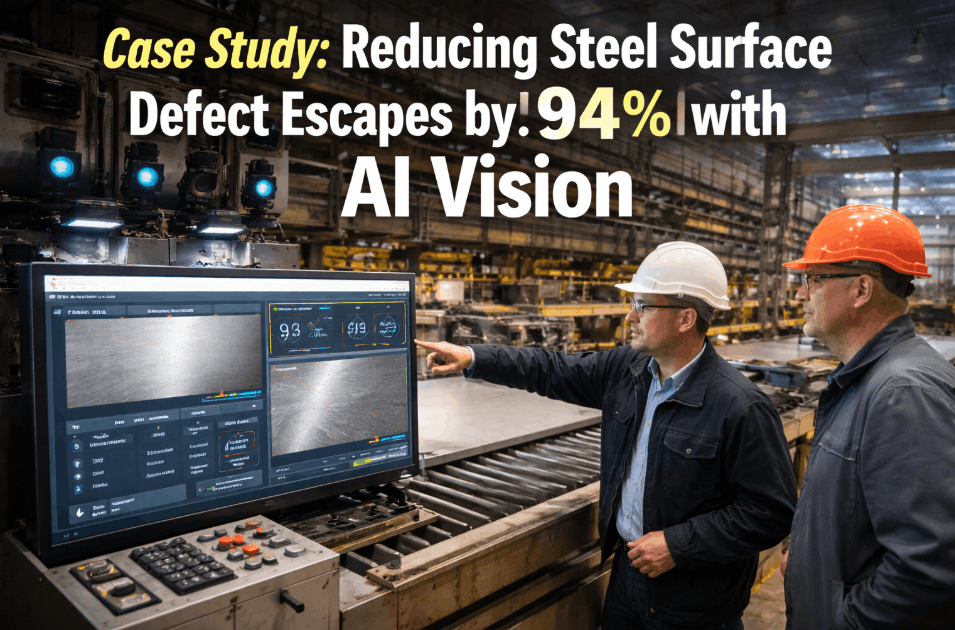
Case Study: Reducing Steel Surface Defect Escapes by 94% with AI Vision
How a special steel producer eliminated ₹14.8 crore in annual customer claims — by replacing human visual inspection with iFactory AI Vision across cold rolling and galvanising lines.
The Plant — Mukand Special Steels, Ginigera
The Challenge — Why 14 Inspectors Could Not Stop 47 Escapes per Year
The inspection team was not the problem. The physics were. At 600 m/min, a coil passes the inspection station at 10 metres per second — that is 10mm of strip every millisecond. A 200-micron roll chatter mark exists in the inspector's field of view for under 20 milliseconds. Under fluorescent overhead lighting, the contrast between a chatter mark and the surrounding cold-rolled surface is less than 4% — below the threshold of reliable human detection even under optimal conditions.
What iFactory Deployed — Hardware, Models, and MES Integration
iFactory's deployment team implemented a complete AI Vision inspection architecture across all five production lines in a single 16-day programme — with zero unplanned production stoppages during installation.
Camera & Illumination Installation
Days 1–616,384-pixel line-scan camera pairs (top + bottom) installed at Cold Mill 1 exit, Cold Mill 2 exit, Annealing Line exit, GI Line 1 downcoiler, and GI Line 2 downcoiler. Multi-spectral LED arrays — raking angle for scratches, diffuse for pitting, UV for GI bare spots — installed on dedicated gantry frames above and below strip path. All mechanical work completed during scheduled weekend stops.
PLC Coil Tracking Integration
Days 4–8iFactory connected to each line's rolling PLC via OPC-UA — reading coil head/tail detection signals, strip speed pulses, and production order parameters (grade, thickness, width, customer). Every defect is tagged with distance from coil head (metres) and cross-width position (mm from edge) — creating a georeferenced defect map per coil.
AI Model Deployment & Calibration
Days 6–14iFactory's pre-trained CRC/GI model (trained on 3.1 million defect images) was deployed and calibrated to Mukand's specific illumination setup, strip grades, and surface finish. Plant-specific defect variants — Mukand's roll chatter signature, GI line 1 dross pattern — were added to the model via active learning from commissioning coils. Detection accuracy reached 97.2% at Day 14, 99.4% by Week 6.
SAP QM Quality Disposition
Days 10–16At coil completion, iFactory auto-generates a SAP QM quality notification with full defect map, defect severity score by grade specification, and a pre-populated usage decision. Grade-specific acceptance matrices — IF automotive has tighter limits than commercial GI — are applied automatically from the MES production order. Quality engineers review and confirm in SAP; borderline cases route to a re-inspection station.
14-Month Results — Before vs After iFactory AI Vision
All metrics verified by plant quality director and plant finance. The comparison period is January–December 2022 (before deployment) vs November 2022–December 2023 (during deployment, excluding the 6-week calibration period).
| Quality Metric | Before (2022) | After (2023) | Change |
|---|---|---|---|
| Customer defect escape incidents | 47 incidents/yr | 3 incidents/yr | −94% |
| Customer claim value | ₹14.8 Cr/yr | ₹0.9 Cr/yr | −94% |
| Internal rework cost | ₹3.2 Cr/yr | ₹0.6 Cr/yr | −81% |
| Coil downgrade rate | 4.1% of coils | 0.7% of coils | −83% |
| Surface defect detection rate | ~54% (human) | 99.4% (AI) | +45pp |
| Root cause identification time | 3–7 days (manual) | <4 seconds (auto) | −99.9% |
| Total annual value recovered | Baseline | $1.8M / ₹15.2 Cr | +$1.8M |
Month-by-Month: The 14-Month Quality Transformation
The improvement was not instantaneous — it followed a structured learning curve as the AI model calibrated to Mukand's specific defect patterns and the quality team learned to act on AI-generated root cause recommendations.
What the Quality Director Said
47 customer incidents in one year. I had explained to our automotive customers three consecutive times that we were taking corrective action. I had spent a total of 60 days on customer quality audits. After iFactory, we had three zero-escape quarters in a row. The one escape in 14 months was caused by a human override of the AI's recommendation — and we have now changed the procedure so that cannot happen again. The AI is not a tool our inspectors use. The AI is the inspection system. Our inspectors are now quality analysts reviewing AI findings, not standing on a line trying to see sub-millimetre defects on moving strip.
Frequently Asked Questions
How did iFactory achieve 99.4% detection accuracy when the plant's previous best attempt at improved detection (better lighting) achieved only modest improvement?
Better lighting alone addresses only one of three detection constraints — contrast. iFactory addresses all three simultaneously: contrast (multi-spectral illumination tuned to specific defect types), speed (80,000 line-scan captures per second vs human perception at ~30 frames/sec), and consistency (AI does not fatigue, does not have off-shifts, does not miss Night B). The combination of purpose-designed illumination, ultra-high-speed cameras, and a model trained on 3.1 million defect images from the same product family produces detection rates that are physically impossible with human inspection alone.
The one remaining escape in 14 months was caused by a human override — how has iFactory's process handled that going forward?
The specific incident involved a GI coil that iFactory had classified as "review required" (not outright reject — the bare spot measured 3.8mm², just below the Grade Z automotive threshold of 4mm²). A quality engineer made a judgement call and approved the coil without re-inspection. It reached the customer and was rejected. Mukand's corrective action: all AI "review required" dispositions now require physical re-inspection at the dedicated re-inspection station before release, with the re-inspection result logged in SAP QM. Override without re-inspection is no longer permissible.
Did the inspectors' roles change after deployment — were positions eliminated?
No positions were eliminated. The 14 line inspectors were redeployed: 6 moved to the re-inspection station (reviewing AI-flagged borderline coils), 4 became quality data analysts (managing the AI defect database and root cause reporting), and 4 moved into process quality roles (working with the rolling and galvanising teams on the root causes the AI had identified). The quality team's output improved significantly — the same number of people now generate far more actionable quality intelligence than before.
What was the total investment and payback period for the iFactory AI Vision system?
The full iFactory AI Vision deployment — hardware, installation, model training, SAP QM integration, and 12 months of support — was recovered in the first 8 months through claim cost reduction alone (₹14.8 Cr claims reduced to ₹0.9 Cr, plus ₹2.6 Cr rework reduction). This excludes the commercial value of three OEM quality probations being removed and the subsequent 22% increase in automotive order volume, which the plant attributes directly to the quality improvement programme.
How Many Customer Defect Escapes Can You Eliminate This Year?
We'll map your current escape rate by defect type and show exactly what iFactory AI Vision would catch — before we install anything.