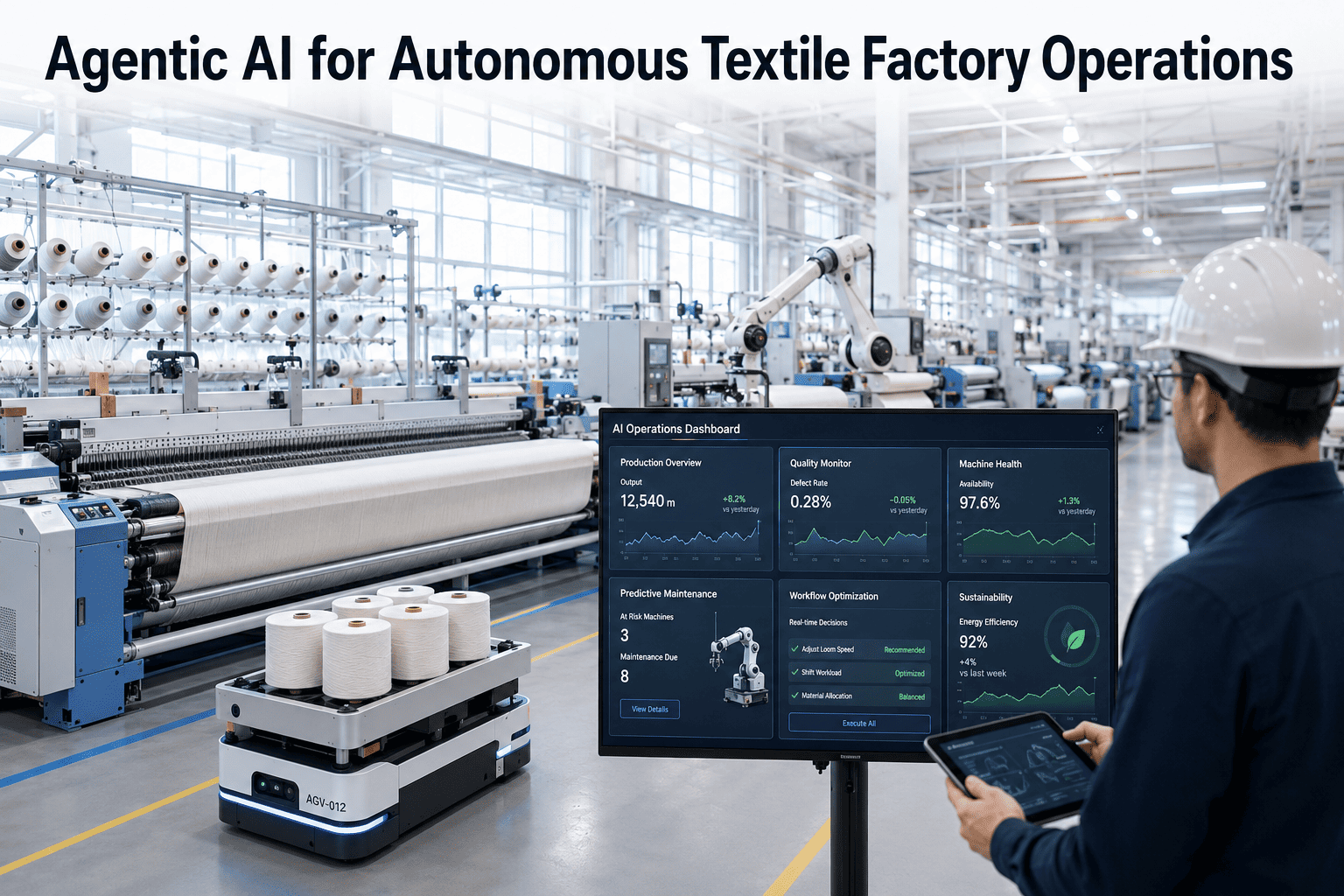
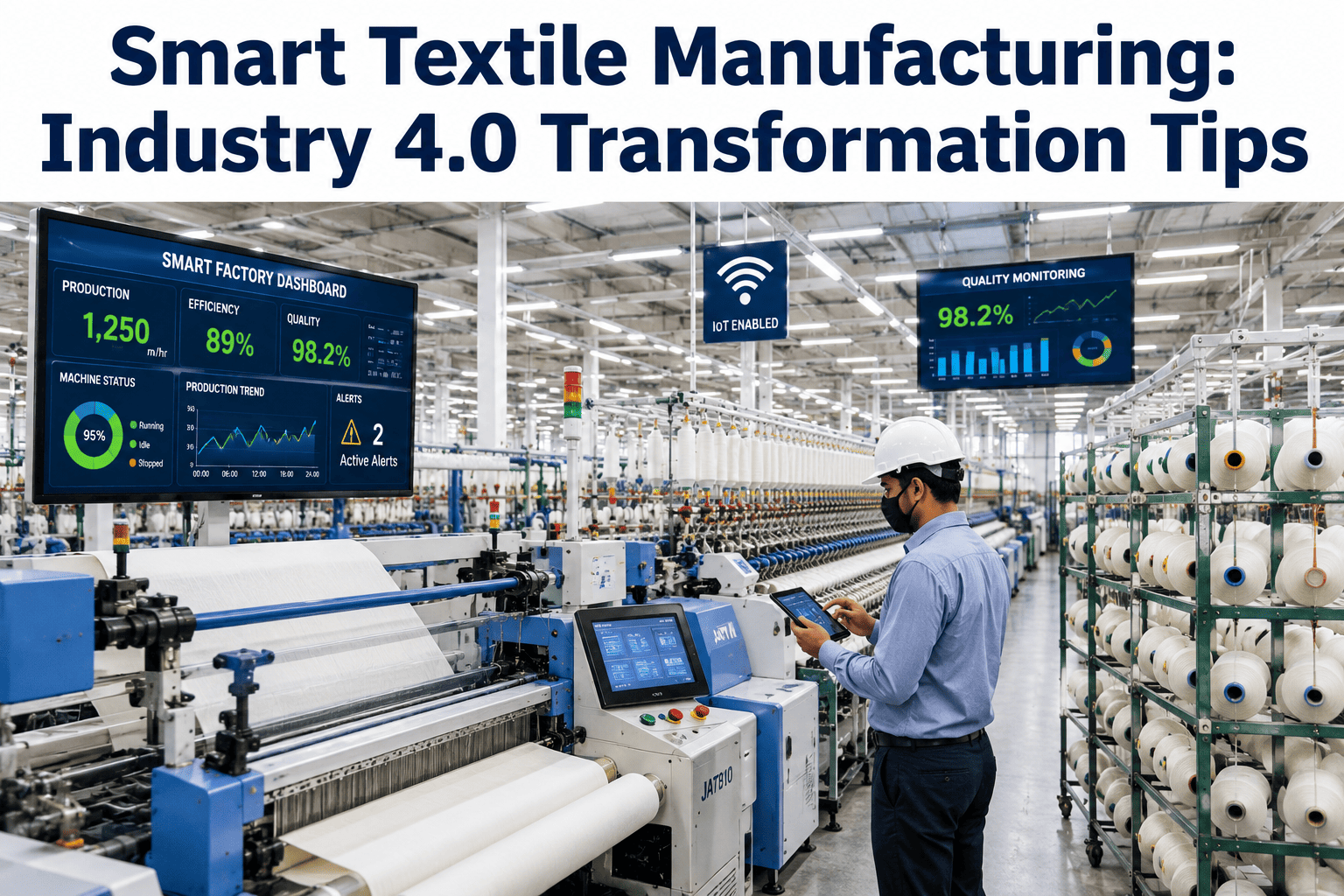
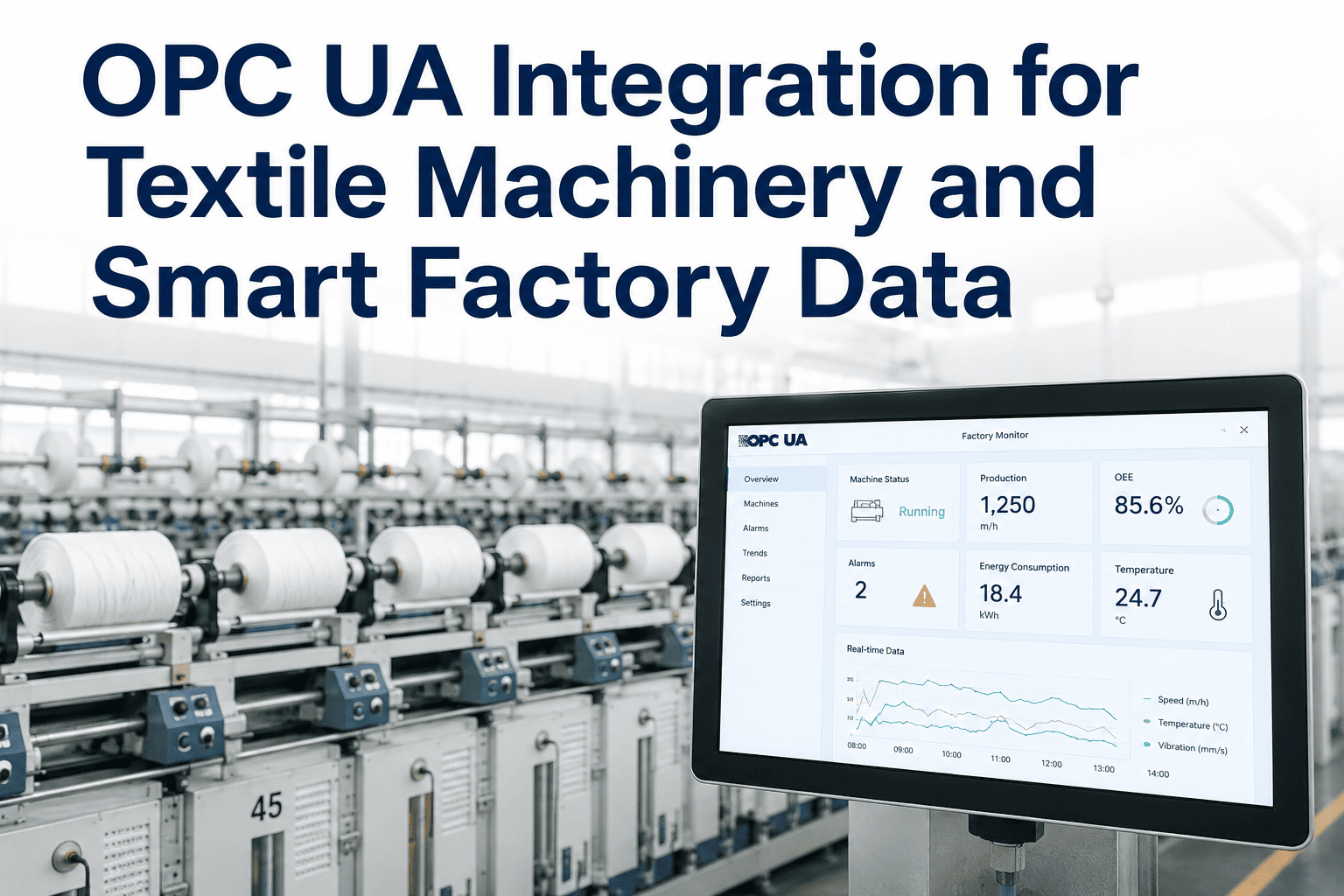
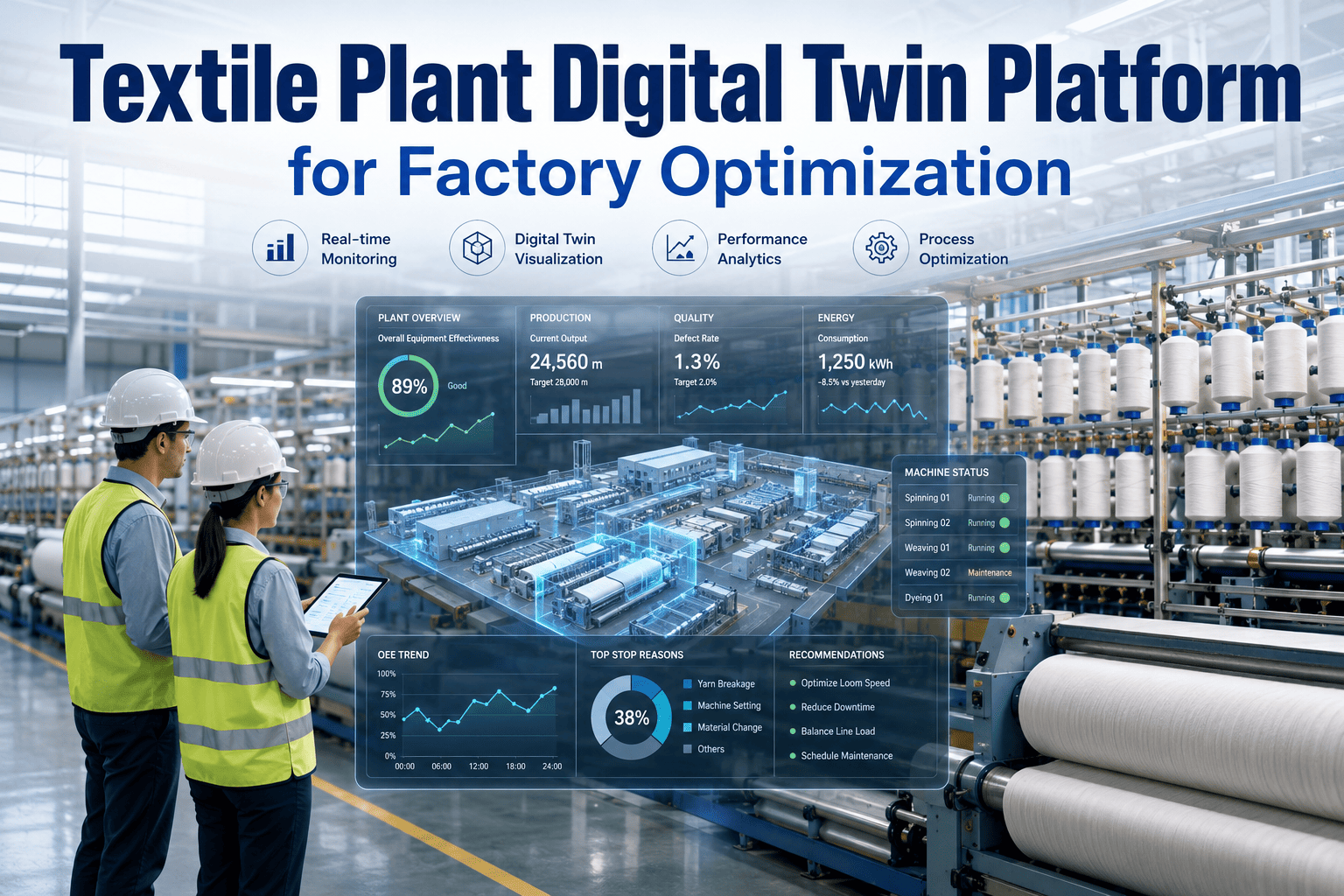
"Agentic AI" gets used loosely enough in manufacturing circles that it's worth being precise about what it actually means for a textile factory: not a chatbot that answers questions, but a system that can monitor a condition, decide what to do about it, and take that action inside a defined workflow without waiting for someone to approve every step. Manufacturing has already reached meaningful adoption of this shift, with around 68% of manufacturers using agentic AI in some capacity, though most of that sits in narrower use cases like supply chain optimization rather than full autonomy. Book a demo to see where your own operation could realistically start.
AI Trend · Agentic Operations
From Watching the Floor to Acting On It
Agentic AI moves textile factories beyond dashboards and alerts, toward systems that monitor conditions, recommend or trigger a response, and learn from what happens next.
Five Levels of Factory Autonomy
Almost no textile plant jumps straight to full autonomy, and almost none should. Most operations sit somewhere on this ladder today, with the realistic near-term goal being one level up, not five.
Level 5
Autonomous Optimization
The system continuously adjusts scheduling, dosing, or maintenance timing on its own, escalating only genuine exceptions to a human.
Level 4
Supervised Autonomous Action
The agent takes a defined action automatically, like adjusting a dye recipe mid-cycle, within pre-approved guardrails and full audit logging.
Level 3
Recommended Action, Human Approves
The system proposes a specific next step, a work order, a schedule change, and a person clicks to approve or reject it.
Level 2
Explained Alerts
The system doesn't just flag an anomaly, it explains the likely cause, but a human still decides what to do next.
Level 1
Monitoring & Alerts
Sensors and dashboards report what's happening, but a person still interprets every number and decides every next step.
Where Adoption Actually Stands
The gap between executive intent and deployed reality is still wide, which is exactly why a measured, level-by-level approach beats a rushed leap to full autonomy.
89%
Of manufacturing executives plan to implement AI in production
69%
Have already implemented at least one AI use case
68%
Manufacturing adoption rate for agentic AI specifically
40%+
Of agentic AI projects are expected to be scaled back or cancelled where scope and guardrails were unclear
The factories succeeding with agentic AI aren't the ones chasing full autonomy first. They're the ones who moved one level up, proved it worked, then moved again.
Where Agentic AI Fits Today vs. Traditional Automation
Traditional automation and agentic AI aren't competitors — they solve different parts of the same problem.
| Factor |
Traditional Automation |
Agentic AI |
Where It Fits |
| Trigger |
Fixed rule or threshold |
Pattern recognized across changing conditions |
Complements existing PLC logic |
| Scope |
Single machine or line |
Can reason across shifts, lines, and plants |
Adds cross-line context automation lacks |
| Adaptability |
Requires manual reprogramming to change |
Adjusts recommendations as conditions shift |
Reduces engineering rework over time |
| Human role |
Sets the rule once, then monitors |
Approves, adjusts, or overrides ongoing decisions |
Keeps accountability with people |
| Best starting point |
Repetitive, well-defined tasks |
Judgment-adjacent decisions with clear guardrails |
Level 2-3 on the autonomy ladder |
Field Insight
Every factory that's succeeded with agentic AI treated it as a ladder, not a light switch. The mistake we see most often is a plant trying to jump from basic monitoring straight to full autonomous action, skipping the stage where a human still approves every recommendation. That middle stage isn't a delay tactic — it's how the system earns the trust it needs before anyone is comfortable letting it act on its own.
Smart Manufacturing Strategist, Textile & Apparel Operations
Frequently Asked Questions
Is agentic AI safe to trust with real production decisions?
It's safe within clearly defined guardrails, which is exactly why the maturity ladder approach matters so much. A well-implemented system starts by only recommending actions for a human to approve, and only moves toward autonomous action within a narrow, well-tested scope once that recommendation stage has built a track record. Full, unsupervised autonomy across an entire factory isn't the realistic near-term goal for most textile operations, and treating it as one is where projects tend to run into trouble.
Book a demo to see how guardrails are scoped for a specific process.
Where should a textile factory realistically start with agentic AI?
The best starting points are judgment-adjacent decisions that already follow a somewhat repeatable pattern, like maintenance work order prioritization or flagging a dye batch likely to drift off-shade. These are narrow enough to scope clear guardrails around, but valuable enough that a faster or better-informed decision genuinely helps. Full-line scheduling or cross-plant optimization are reasonable later goals, not starting points.
Contact support to map a starting use case to your specific operation.
What happens when the agentic system gets a recommendation wrong?
Every recommendation and action is logged with the reasoning behind it, which makes it possible to trace exactly why a wrong call was made and adjust the underlying logic or guardrails accordingly. At the recommendation and supervised-action levels, a human is still in the loop to catch errors before they affect production, which is precisely why factories are encouraged to prove reliability at those levels before granting broader autonomy. Mistakes become a tuning input rather than an uncontrolled failure.
Book a demo to see how override and audit logging work in practice.
Does this require replacing our existing automation and control systems?
No. Agentic AI is designed to sit alongside existing PLC logic and automation rather than replace it, adding a reasoning layer on top of rules that already work well for repetitive, well-defined tasks. Traditional automation remains the right tool for fixed-threshold actions, while agentic AI is reserved for the more judgment-adjacent decisions that don't reduce cleanly to a fixed rule.
Contact support to review how this layers onto your current control systems.
How long does it typically take to move up one level on the autonomy ladder?
Moving from basic monitoring to explained alerts is usually the fastest step, often achievable within a few weeks since it mainly involves better contextualizing data you already collect. Progressing from explained alerts to human-approved recommendations typically takes one to two months of building trust in the system's reasoning. Reaching supervised autonomous action for a narrow, well-scoped process is generally a multi-month program built on a demonstrated track record at the level below it.
Book a demo for a realistic timeline based on your current systems.
Find Out Which Rung of the Ladder You're Actually On
A clear, guardrailed path from monitoring to autonomous action, one proven level at a time.