A mid-size textile mill in Gujarat lost 11 production shifts in a single quarter — not because of machine failure, but because their scheduling team couldn't respond fast enough when three looms went down simultaneously. Order backlogs stacked up, overtime costs ballooned, and two buyers moved their orders to a competitor. The entire crisis was avoidable. AI-powered production scheduling can predict bottlenecks days in advance, auto-adjust workflows, and keep your output on track — before a bad shift becomes a lost contract. If your facility still runs on spreadsheets and gut feel, book a demo with iFactory and see how intelligent scheduling transforms your floor.
How AI is Optimizing Textile Production Schedules and Reducing Downtime
Textile mills running manual schedules lose up to 15% of annual production to avoidable stoppages, shift conflicts, and reactive planning. AI scheduling systems change the equation — balancing machine loads, predicting delays, and keeping every loom, spinner, and dye bath running at peak throughput.
Why Textile Production Schedules Break Down — Every Single Week
Manual scheduling cannot keep pace with the complexity of a live textile floor. When one variable shifts, everything cascades.
Production plans built on fixed weekly cycles cannot adapt when a loom trips, a yarn batch is delayed, or an urgent order arrives. Managers spend hours manually rebuilding schedules that AI can re-optimize in minutes.
By the time a scheduler spots a bottleneck at the dyeing stage, spinning has already overproduced. Traditional systems react. AI systems see the pinch point 48–72 hours in advance and route around it.
Loom status lives in one system, order data in another, maintenance records in a third. Schedulers reconcile these manually — introducing errors, delays, and blind spots that cost production hours every week.
Without real-time schedule visibility, shift handovers lose 20–45 minutes per changeover in status briefings, re-setups, and priority confusion. Across 3 shifts, that is 2+ hours of lost output daily.
What AI Scheduling Actually Does on a Textile Floor
Five live intelligence layers working simultaneously — invisible to operators, invaluable to output.
AI analyzes historical order data, seasonal trends, and buyer behavior to predict demand weeks ahead — so spinning capacity is allocated before the rush, not during it.
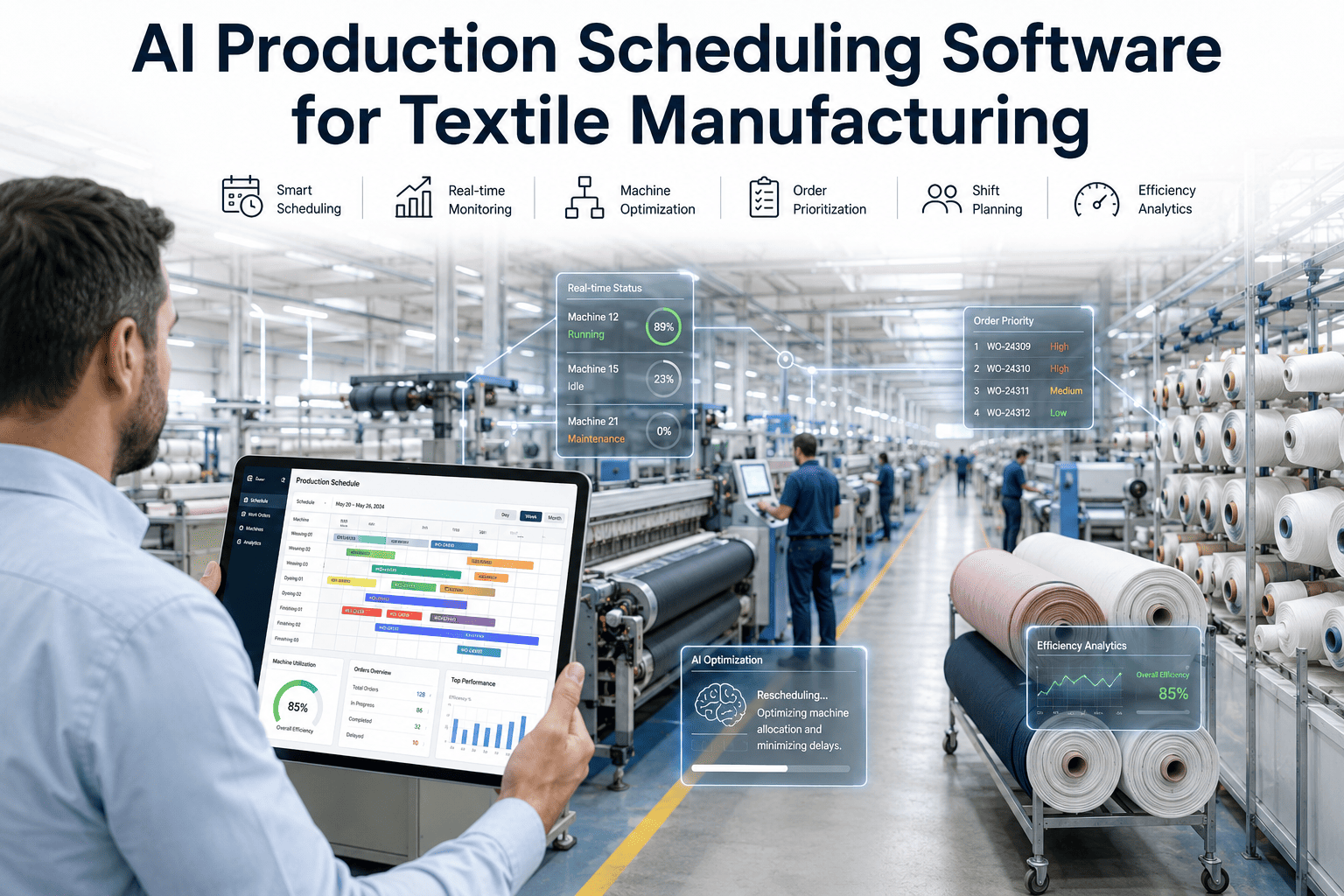
Real-time OEE data feeds the scheduler. When a rapier loom runs ahead of target, AI automatically queues the next batch to prevent idle time downstream in finishing.
When a machine trips or a yarn lot fails QC, AI instantly recalculates the production sequence, reassigns jobs, and alerts the floor — with zero manual intervention required.
Predictive maintenance alerts feed directly into the scheduler. Planned repairs are slotted into low-demand windows, protecting peak production from being interrupted by avoidable stoppages.
AI staggers high-draw equipment — stenters, dyeing jets, compressors — to avoid simultaneous peak loads. Mills reduce energy spend without touching output targets.
A Day in Your Mill — Without AI vs With iFactory Running
Still running production schedules on spreadsheets?
Every week you delay, you're leaving output on the table. Talk to our support team or book a 30-minute live walkthrough — see iFactory re-schedule a real disruption scenario with your machine data.
What Textile Mills Gain After Switching to AI-Driven Scheduling
AI-monitored facilities consistently report 40–50% fewer unplanned stoppages in the first year of deployment — combining predictive maintenance with proactive schedule adjustments.
Condition-based scheduling eliminates unnecessary preventive tasks while catching real faults early — shifting spend from reactive to planned.
AI-enabled energy management reduces consumption by staggering high-draw equipment and catching motor efficiency losses at 3–5% deviation before they compound.
AI process control keeps equipment within performance spec — directly cutting defect rates, material waste, and the rework cost that inflates cost-per-meter.
Most textile facilities of 50+ machines reach full investment payback within a single production season — driven by avoided emergency costs, energy recovery, and output gains.
iFactory AI Scheduling — From Setup to Live Optimization
No production shutdown. No new hires. Live in 14 days.
iFactory integrates with your existing ERP, MES, SCADA, or PLC systems. IoT sensors deploy on spindles, looms, and dyeing equipment — non-invasively, without halting production. Legacy machines included.
Machine learning maps normal operating patterns across every asset — factoring in shift cycles, load variation, machine age, and order mix. This baseline becomes the engine for all future scheduling decisions.
AI generates and updates production schedules in real time — responding to machine status, order priority changes, maintenance alerts, and demand signals simultaneously. Planners review, not rebuild.
Every disruption, every resolved anomaly, and every completed order makes iFactory smarter. Scheduling accuracy improves with every production cycle — compounding gains over time.
Your Production Schedule Is Costing You More Than You Think
iFactory deploys AI-powered production scheduling and predictive monitoring across your textile facility in 7–14 days — with pre-built templates for spinning, weaving, knitting, and dyeing operations and a dedicated onboarding team from day one.