Fabric Grading System AI 4 Point and 10 Point Methods

By Adam Sinclair on June 3, 2026

fabric-grading-system-ai-4-point-10-point

Every fabric inspection ends with the same question: is this roll first quality or second quality? The answer depends on which grading system the buyer uses and how consistently the inspector applies the point rules. Textile mills shipping fabric to multiple buyers must manage grade expectations across the 4-point system preferred by US apparel brands, the 10-point system used by military and industrial fabric buyers, and a growing number of buyer-specific grading variations that combine elements of both. The difference between a first-quality grade of A and a second-quality grade of B can be 15 to 40 cents per yard in selling price. Mills that rely on human inspectors for grading face 15 to 25 percent disagreement rates between inspectors grading the same roll, and up to 40 percent disagreement between the mill grade and the buyer audit grade on the same shipment. AI-powered fabric grading systems apply point rules consistently across every roll, every inspector, and every shift, and produce grades that match buyer audit results with 96 percent or higher agreement. Mills using AI grading reduce grade disputes with buyers by 70 to 85 percent and capture an additional 3 to 5 percent of production as first-quality fabric that human inspectors had incorrectly downgraded.

Automate Fabric Grading with AI-Powered Inspection

iFactory AI grading supports the 4-point system, 10-point system, and custom buyer grading standards. Consistent scoring across every roll, every shift. Deployed in 7 to 14 days.

4-Point versus 10-Point Grading Systems

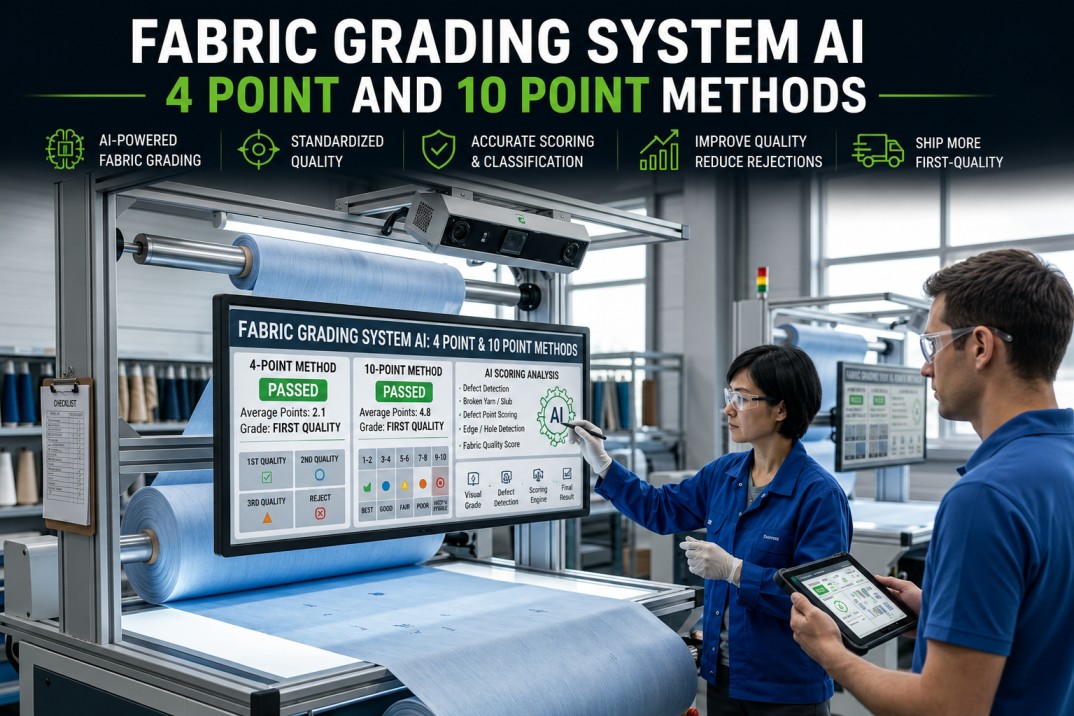
Both grading systems assign penalty points based on defect size, but they differ in the maximum points per defect, the defect length thresholds, and the acceptable point limits per 100 square yards. The cards below compare the two systems side by side.

4-Point System

Preferred by US apparel and retail buyers
≤ 3 inches 1 point
3 – 6 inches 2 points
6 – 9 inches 3 points
> 9 inches 4 points
Max per defect 4 pts
Max per yard 4 pts
Acceptable limit 40 pts / 100 yd2

10-Point System

Used by military, industrial, and technical fabric buyers
≤ 1 inch 1 point
1 – 2 inches 2 points
2 – 3 inches 3 points
3 – 5 inches 5 points
> 5 inches 10 points
Max per defect 10 pts
Max per yard 10 pts
Acceptable limit Varies by fabric type

Point Accumulation Example

The table below shows how the same fabric roll with 6 defects would be scored under both the 4-point and 10-point systems. The final grade depends on the total points per 100 square yards after all defects are scored.

Warp break 4"
Weft slub 2"
Hole 0.5mm
Oil stain 7"
Warp float 1.5"
Weft bar 12"
Roll start Roll end
Defect Size 4-Pt Pts 10-Pt Pts
Warp break 4 in 2 2
Weft slub 2 in 1 2
Hole 0.5 mm 4 4
Oil stain 7 in 3 10
Warp float 1.5 in 1 2
Weft bar 12 in 4 10
4-Point Total 15 pts Grade: A
10-Point Total 30 pts Grade: B
Roll length 40 yd Width: 62 in
Pts / 100 yd2 8.7 Well within limit

Grade Conversion Table

Total points per 100 square yards determine the fabric grade. The table below shows the standard grade boundaries for the 4-point system, the corresponding quality level, and the typical price impact for each grade.

Grade Points / 100 yd2 Quality Level Typical Price Impact Buyer Acceptance
A 0 – 20 First quality Full price Accepted by all buyers
B 21 – 40 First quality (close-out) 5–10% discount Accepted by most buyers with allowance
C 41 – 60 Second quality 15–30% discount Limited buyer acceptance
D 61 – 80 Third quality 40–50% discount Close-out or salvage channels
Reject 81+ Waste Salvage value only Not shippable

Ship More First-Quality Fabric with Consistent AI Grading

iFactory AI grading applies the 4-point or 10-point system consistently across every roll. Eliminate human grading variation and match buyer audit results with 96 percent agreement. Deployed in 7 to 14 days.

Sample Inspection Report

The inspection report below shows the detailed grading result for a single fabric roll as generated by the AI grading system. The report includes all detected defects, their sizes, assigned points, and the final grade calculation.

Inspection Report FGR-2026-04-4821
Grade A
Roll ID R-44291-05
Fabric style Cotton twill 200 GSM
Grading system 4-Point System (ASTM D5432)
Inspection date 2026-04-15
Inspected by AI Vision System v4.2
Defect Log
# Defect Type Size (in) Position (yd) Points
1 Warp break 2.5 3.2 1
2 Weft slub 1.0 8.7 1
3 Warp break 4.5 14.1 2
4 Oil stain 3.0 22.6 1
5 Weft bar 8.0 31.4 3
Total defects 5
Total points 8
Roll length 42 yd
Roll width 62 in
Points / 100 yd2 4.4
Final grade A

Human versus AI Grading Consistency

The bars below compare grading consistency between human inspectors and AI vision across 1,000 fabric rolls inspected in a controlled study. AI grading eliminates the inspector-to-inspector variation that causes grade disputes with buyers.

Human Inspectors

Same roll, same inspector

78%
Same roll, different inspector

62%
Mill grade vs buyer audit

58%
Re-inspection after dispute

45%

AI Vision System

Same roll, same system

100%
Same roll, different line

99.7%
Mill grade vs buyer audit

96%
Re-inspection agreement

100%

Frequently Asked Questions

The 4-point system and 10-point system are both defect penalty scoring methods used to assign quality grades to fabric rolls, but they differ in three key ways. The 4-point system uses a maximum of 4 penalty points per defect with size thresholds at 3, 6, and 9 inches, and a maximum of 4 points per linear yard. The 10-point system uses a maximum of 10 points per defect with smaller size thresholds at 1, 2, 3, and 5 inches, and a maximum of 10 points per linear yard. The 4-point system is specified by most US apparel brands and retailers under ASTM D5432, while the 10-point system is specified by military, government, and industrial fabric buyers under federal standards. A roll that receives a grade of A under the 4-point system might receive a grade of B or C under the 10-point system because the 10-point system penalizes medium and large defects more heavily. Mills that ship to both types of buyers must track grades under both systems simultaneously. iFactory AI grading calculates both scores from the same defect detection data and reports the grade under whichever system each buyer requires.
The points per 100 square yards calculation normalizes the total penalty points across fabric rolls of different lengths and widths so that grades are comparable. The formula is total points multiplied by 3,600 divided by fabric width in inches divided by roll length in yards, then multiplied by 100. In simplified form, points per 100 square yards equals total points times 3,600 divided by the product of width in inches times length in yards. For example, a roll with 15 total points, 62 inches wide, and 40 yards long yields 15 multiplied by 3,600 equals 54,000, divided by 62 times 40 equals 2,480, which equals 21.8 points per 100 square yards, corresponding to a grade of B under the standard grade table. AI grading systems calculate this automatically for every roll, applying the correct formula for the grading system and fabric width specified by the buyer. The calculation accounts for all defects on the roll, including those on the selvage and those that span across the fabric width.
Yes. AI grading systems support fully configurable grading rules that can be customized for each buyer. Beyond the standard 4-point and 10-point systems, mills can configure maximum point limits per defect per buyer, different grade conversion tables for different buyers, special rules for specific defect types that automatically trigger a grade reduction regardless of point count, width-based grading tables that adjust acceptable point limits based on fabric width, and first-quality checklists that require zero critical defects regardless of total points. When a work order is created for a specific buyer, the AI grading system automatically applies that buyer rules and generates the inspection report in the format that buyer requires. This eliminates the need for mill quality teams to remember which rules apply to which buyer and prevents the costly mistake of applying the wrong grading standard to a shipment.
Grade disputes between mills and buyers arise from three main sources: different inspectors assigning different points to the same defect, different defect classification leading to different point assignments, and different grading rule interpretation. AI vision eliminates the first two sources entirely by detecting and measuring every defect with sub-millimeter precision and applying the point rules programmatically. The third source is eliminated because the AI grading system records the complete defect data for every roll, including images of each detected defect with its size measurement and point assignment. When a buyer audit disagrees with the mill grade, the mill can produce the inspection report showing each defect, its measured size, the points assigned, and the grade calculation. In practice, mills using iFactory AI grading resolve grade disputes in under 24 hours compared to 2 to 6 weeks for mills relying on paper inspection records, and the resolution nearly always confirms the mill initial grade because the AI grading data is objective and reproducible.

Grade Every Roll Consistently with AI-Powered Fabric Inspection

iFactory AI grading supports 4-point and 10-point systems with buyer-specific rule configuration. Consistent grades across every shift. Deployed in 7 to 14 days.



Share This Story, Choose Your Platform!