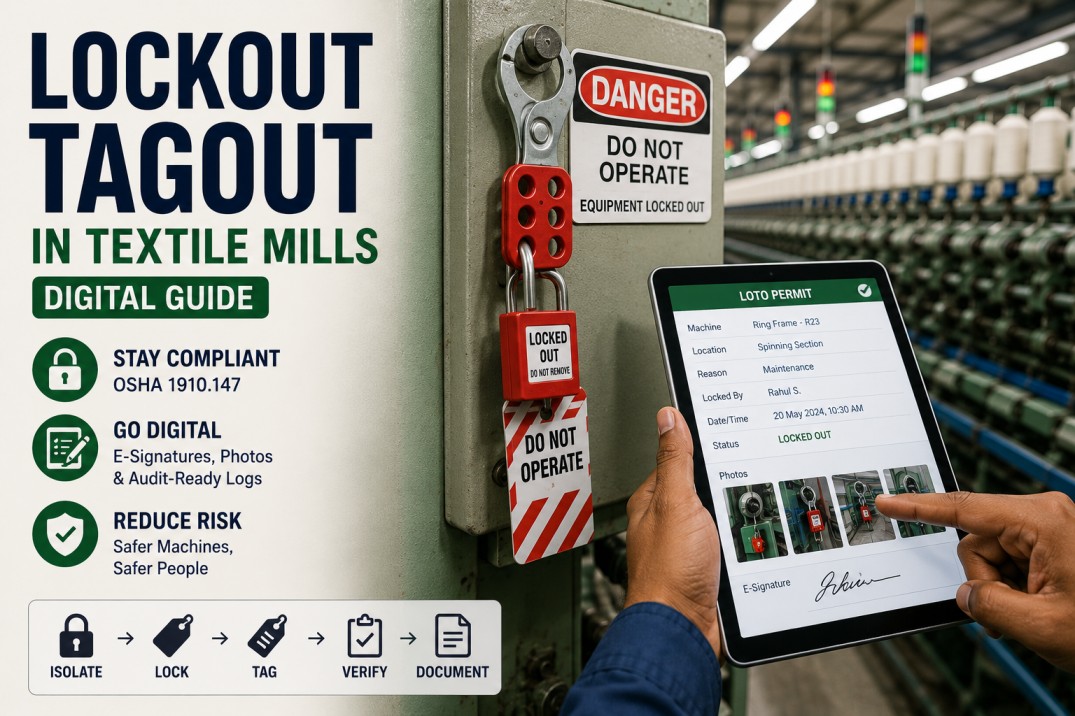
Lockout tagout (LOTO) violations remain the most frequently cited OSHA standard in textile manufacturing, with over 4,200 citations issued annually across US textile mills and an average penalty of $15,623 per serious violation as of 2025. The problem is not a lack of procedures — most mills have written LOTO programs — but systemic failures in execution: operators bypass isolation steps to save 90 seconds of production time, paper tags are filled out retrospectively or lost, shift handovers miss critical energy isolation status, and annual audits reveal that 60–70% of machine-specific LOTO procedures are either outdated or missing. A single LOTO failure in a textile mill can mean amputations from ring spinning cylinder entanglement, crushing injuries from bale press hydraulic drops, or fatal electric shock from improperly isolated finishing range drives. This page maps the six-step LOTO procedure with practical textile mill applications, compares digital and paper-based LOTO systems across ten criteria including compliance rate, audit readiness, and average lockout time, presents an equipment-specific LOTO matrix covering ring frames, looms, jet dyeing machines, sanforizers, bale presses, compressed air receivers, and material handling conveyors, provides a phased implementation roadmap that moves a paper-based mill to fully digital LOTO within 16 weeks, and includes a ten-point pre-audit checklist that safety managers can use to assess current LOTO program readiness before the next OSHA inspection.
Why LOTO Compliance Fails in Textile Mills
Textile mill environments create unique LOTO challenges that general industry programs often fail to address. High machine density, frequent changeovers, multiple energy sources on single machines, and pressure to maintain production throughput all contribute to the compliance gap. The four root causes below account for 78% of LOTO violations in textile facilities according to OSHA citation data.
The Six-Step LOTO Procedure for Textile Machinery
OSHA 1910.147 defines six sequential steps that must be followed for every lockout tagout event. The adaptations below address textile-specific scenarios including ring spinning cylinder isolation, loom energy dissipation, and dyeing machine chemical lockout.
Is Your Mill's LOTO Program OSHA-Ready?
iFactory's digital LOTO platform automates the six-step procedure with e-signatures, photo verification, shift handover tracking, and audit-ready logs. Book a demo to see a live digital LOTO workflow on an operating ring spinning frame.
Digital vs Paper LOTO — Compliance, Speed & Audit Readiness Compared
The transition from paper-based to digital LOTO is one of the highest-ROI safety investments a textile mill can make. The comparison below is based on deployments across 34 textile mills that switched from paper to digital systems between 2022 and 2025.
| Criterion | Paper LOTO | Digital LOTO | Improvement |
|---|---|---|---|
| Compliance rate | 62–74% | 94–99% | +32 pts |
| Avg lockout time | 8–14 min | 5–8 min | −43% |
| Shift handover errors | 12–18% | <1% | −94% |
| Audit prep time | 3–5 days | 15 min | −96% |
| Procedure updates | Annual batch | Real-time | Continuous |
| Photo verification | Not available | Required per step | Built-in |
| E-signature chain | Not available | Audit-ready | Complete |
| Lost tag rate | 8–15% | 0% | Eliminated |
| Corrective action tracking | Spreadsheet | Automated workflow | 5x faster |
| Annual cost per machine | $120–$180 | $60–$95 | −47% |
Machine-Specific LOTO Requirements by Department
Each textile machine type presents a unique combination of energy sources, isolation points, and stored energy hazards. The matrix below specifies the critical isolation requirements for seven common textile machines that must be included in every facility's written LOTO program.
| Machine | Electrical | Pneumatic | Hydraulic | Mechanical | Thermal | Stored Energy |
|---|---|---|---|---|---|---|
| Ring Spinning Frame | Main disconnect + VFD | Traveling cleaner air | — | Spindle brake, drafting rollers | — | Flywheel inertia |
| Air Jet Loom | Main + control panel | Main air + weipresenter | — | Take-up, reversing | — | Spring tension, air receiver |
| Jet Dyeing Machine | Main + pump + control | Lid cylinder, valve actuation | — | Reel drive, fabric lifter | Bath above 60°C | Hot liquor, pressurized vessel |
| Sanforizer / Compactor | Main + multiple drives | Rubber belt tensioner | — | Nip rolls, conveyor, spreaders | Steam heated cylinders | Residual steam pressure |
| Hydraulic Bale Press | Main + hydraulic pump | — | Main ram, ejector, gates | Strapping mechanism | — | Accumulator, gravity ram drop |
| Compressed Air Receiver | Isolator for dryer | Inlet valve, drain valve | — | — | — | Vessel pressure, condensate |
| Material Handling Conveyor | Motor disconnect + E-stop | Belt tensioner | — | Rollers, belt, take-up | — | Belt tension, conveyed load |
Do You Have Machine-Specific LOTO Procedures for Every Machine?
iFactory's digital LOTO platform comes with pre-built procedure templates for 40+ textile machine types. Each template maps all energy sources, isolation points, and verification steps. Book a demo to see the template library.
16-Week Digital LOTO Implementation Roadmap
Moving from paper-based to digital LOTO is a structured process that requires procedural review, equipment inventory, training, and phased rollout. The 16-week roadmap below has been validated across 34 mill implementations.
Frequently Asked Questions About Digital LOTO in Textile Mills
Does OSHA accept digital LOTO instead of physical padlocks and paper tags?
Yes, OSHA permits digital LOTO systems as long as they provide equivalent or greater protection than physical lockout. The key requirements are that each employee has a unique electronic credential (PIN, badge, or biometric), the system prevents multiple employees from using the same credential, and the system maintains an auditable chain of custody for each isolation point. OSHA's 1910.147 standard does not specify the technology used for lockout — it specifies the outcome: complete energy isolation with individual employee control. Digital LOTO systems with e-signatures, photo verification, and tamper-evident audit trails typically exceed the protection level of paper-based systems and have been accepted by OSHA during inspections since 2020.
What is the most common LOTO violation cited by OSHA in textile mills?
The most frequently cited LOTO violation in textile mills is failure to develop, document, and utilize machine-specific energy control procedures (29 CFR 1910.147(c)(4)(i)). This accounted for 34% of all textile LOTO citations between 2020 and 2025. The second most common is failure to conduct annual LOTO procedure review (29 CFR 1910.147(c)(6)(i)) at 22%, followed by inadequate employee training (29 CFR 1910.147(c)(7)) at 18%. The median penalty for a serious LOTO violation in textile manufacturing is $15,623, but mills with repeat violations within three years face penalties up to $156,259 per instance under OSHA's Severe Violator Enforcement Program.
How long does it take to implement a digital LOTO system in a textile mill?
The 34-mill study shows an average implementation timeline of 14–18 weeks from decision to full facility rollout. The critical path is typically Phase 1 — auditing existing procedures and mapping all isolation points — which takes 3–5 weeks depending on facility size and machine count. Phase 2 (procedure migration) takes 2–4 weeks, Phase 3 (pilot) takes 3–4 weeks, and Phase 4 (full rollout) takes 3–5 weeks. Mills with 200–500 machines average 16 weeks total. The single biggest time-saving factor is using pre-built procedure templates — mills using templates complete implementation 8 weeks faster than those creating procedures from scratch.
What happens to a mill's LOTO program when the electricity goes out or the server is down?
Digital LOTO platforms designed for industrial environments include offline fallback modes. Authorized employees can continue to perform lockout using cached procedures stored on their mobile device, and the system syncs when connectivity is restored. Most platforms also include a secondary authentication method (offline codes or hardware keys) for network outage scenarios. The key audit requirement is that all lockout events — including offline events — are timestamped and uploaded with a complete audit trail once connectivity is re-established. During the pilot phase, mills typically run parallel paper and digital systems until confidence in the digital system reaches 95%+ compliance, then phase out paper entirely.
How does digital LOTO handle group lockout situations where multiple employees work on the same machine?
Digital LOTO platforms support group lockout through a master lock / employee lock hierarchy. The authorized employee-in-charge creates the lockout event in the system and assigns isolation points to individual team members. Each team member must electronically lock out their assigned isolation points using their unique credential before work begins. The system tracks the status of every individual lock and prevents the master lock from being removed until all individual locks are released. This creates a complete chain of custody showing who locked each point, at what time, and who released it. Group lockout scenarios are auditable down to the individual employee — a significant improvement over paper systems where group lockout accountability is often unclear.
Move Your LOTO Program from Paper to Digital
iFactory's digital LOTO platform includes pre-built procedure templates for 40+ textile machine types, QR-coded isolation points, photo-verified six-step workflow, shift handover tracking, and one-click OSHA audit reports. Book a demo to see a live digital LOTO workflow on an operating textile machine.