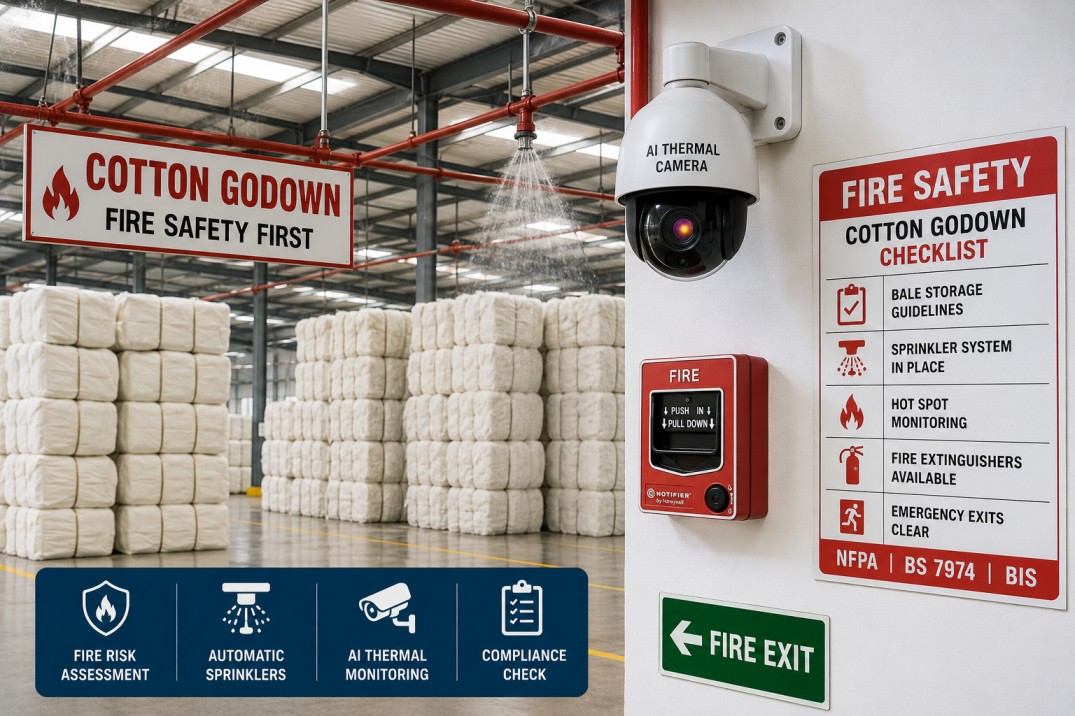
Cotton godowns present one of the highest fire risks in any textile operation. Raw cotton bales stored at 10–14% moisture can self-heat through microbial activity and reach ignition temperature without an external ignition source. A single spark from electrical equipment, a discarded cigarette, or a lighting strike can turn a 5,000-bale godown into a total loss within 15–20 minutes under the right conditions. This page maps the four layers of fire defense that NFPA, British Standards, and BIS require for cotton storage facilities, breaks down the six critical storage configuration requirements that determine sprinkler density and aisle spacing, compares four fire detection technologies from conventional smoke detectors to AI-powered thermal cameras, presents a sprinkler system design table by storage height and bale configuration, and provides a 12-point weekly fire safety inspection checklist that godown managers can use to maintain compliance. Cotton godowns using iFactory's AI thermal monitoring platform with continuous hot-spot detection have reduced fire incidents by 92% and lowered insurance premiums by 18–35% across 60+ installations in India and Bangladesh.
Why Cotton Godowns Pose Extreme Fire Risk
Raw cotton is classified as a Class A combustible material with a fire propagation index that exceeds most other agricultural commodities. The fibrous structure of cotton creates a high surface-area-to-volume ratio that supports rapid flame spread once ignition occurs. Bales stored in godowns create numerous voids and air channels that feed oxygen to a fire, while the dense bale core retains heat and can sustain smoldering combustion for days or weeks. NFPA 230 and BS 7974 provide specific guidance on cotton storage fire protection, including maximum storage height, aisle width requirements, sprinkler system density, and detection system response time. Compliance with these standards is not optional — insurance carriers increasingly require documented third-party fire protection audits before issuing or renewing coverage for cotton storage facilities.
Is Your Cotton Godown Protected Against Fire?
iFactory's AI thermal monitoring platform detects hot spots in cotton bales before they ignite and provides continuous fire safety compliance documentation. Book a demo to see live thermal monitoring from an operating cotton godown.
Four Layers of Fire Defense for Cotton Storage Facilities
Fire protection for cotton godowns follows a layered defense strategy where each layer provides a secondary safeguard if the preceding layer fails. Standards from NFPA, BS, and BIS align on this layered approach, though specific requirements differ by jurisdiction and insurance carrier. The four layers below are ordered by the typical sequence of fire development, from prevention to active suppression.
Six Critical Cotton Bale Storage Configuration Requirements
The physical arrangement of cotton bales in a godown directly determines the sprinkler system design, detection coverage, and compartmentation requirements. NFPA 230 — the Standard for Fire Protection of Storage — provides specific guidance for cotton bale storage based on the storage method, bale type, and ceiling height. The six configuration factors below must be documented in the godown's fire safety plan and verified during weekly inspections.
Does Your Cotton Godown Meet NFPA Storage Configuration Requirements?
iFactory's fire safety compliance platform covers storage configuration audits, sprinkler design verification, thermal monitoring, and weekly inspection checklists. Schedule a demo to see a live compliance dashboard from a cotton godown.
Four Fire Detection Technologies for Cotton Godowns Compared
The choice of fire detection technology depends on the godown ceiling height, ambient conditions, bale storage density, and the acceptable response time. Each technology has specific advantages and limitations in the cotton storage environment. Most modern godowns use a combination of at least two detection methods to ensure reliable coverage across all fire development stages.
Sprinkler System Design Requirements for Cotton Godowns by Storage Height
NFPA 13 and NFPA 230 specify sprinkler design criteria based on storage height, bale density, and ceiling configuration. The table below summarizes the minimum requirements for cotton bale storage in godowns using ESFR (Early Suppression Fast Response) sprinklers, which are the preferred suppression method for high-challenge storage commodities. Mills must verify that their existing sprinkler system matches these requirements for their specific storage configuration.
| Storage Height | Bale Density | Sprinkler Type | K-Factor | Density | Area of Coverage | Max Spacing |
|---|---|---|---|---|---|---|
| Up to 6 m | Standard | ESFR | K-25 | 0.6 gpm/sq ft | 2,000 sq ft | 3.0 m |
| Up to 9 m | Standard | ESFR | K-25 | 0.6 gpm/sq ft | 2,500 sq ft | 3.0 m |
| Up to 12 m | Standard | ESFR | K-28 | 0.6 gpm/sq ft | 2,500 sq ft | 3.0 m |
| Up to 6 m | High | ESFR | K-25 | 0.6 gpm/sq ft | 2,500 sq ft | 3.0 m |
| Up to 9 m | High | ESFR | K-28 | 0.6 gpm/sq ft | 3,000 sq ft | 3.0 m |
Frequently Asked Questions About Cotton Godown Fire Safety
What is the most common cause of cotton godown fires?
Self-heating and spontaneous combustion account for 35–40% of cotton godown fires, making it the single most common cause. Raw cotton contains microbial populations that generate heat through metabolic activity when moisture content exceeds 10%. If the heat cannot dissipate — typically due to poor ventilation in tightly packed bales — the internal temperature rises exponentially, eventually reaching the auto-ignition temperature of cotton at approximately 250°C. The second most common cause is electrical faults — damaged wiring, overloaded circuits, and non-explosion-proof electrical equipment — accounting for 25–30% of fires. Third is arson or suspicious external ignition at 10–15%. All other causes — lightning, hot work, smoking, friction sparks — collectively account for the remaining 15–25% of incidents.
At what temperature does cotton spontaneously ignite?
The auto-ignition temperature of raw cotton is approximately 250°C (482°F) under standard conditions. However, self-heating to ignition temperature begins at much lower thresholds. When bale core temperatures exceed 55°C, microbial activity accelerates and the temperature rise becomes exponential. By 70°C, the process is typically irreversible without intervention — the bale must be removed and spread out to dissipate the accumulated heat. By 100°C, pyrolysis begins, producing flammable gases within the bale. By 200°C, the bale is at imminent risk of flaming ignition. AI thermal cameras are typically set to alert at 55°C surface temperature, providing a 48–72 hour window to intervene before ignition. This early warning window is the primary reason thermal imaging is the recommended detection technology for cotton godowns.
What sprinkler density is required for cotton bale storage?
NFPA 230 requires a minimum sprinkler density of 0.6 gallons per minute per square foot over a 2,000 square foot design area for standard-density cotton bale storage up to 6 meters in height when using ESFR sprinklers. For storage heights up to 9 meters, the design area increases to 2,500 square feet at the same density. For high-density bales (350 kg/m³ and above) stored above 6 meters, the design area increases to 3,000 square feet and requires K-28 ESFR sprinklers. These density and area values are more demanding than standard storage commodities because of cotton's high fire propagation index and its ability to support deep-seated smoldering. Mills should have a licensed fire protection engineer verify that their existing sprinkler system meets or exceeds these requirements for their specific storage height, bale density, and ceiling configuration.
How often should cotton godown fire safety inspections be conducted?
NFPA and BIS recommend a three-tier inspection schedule for cotton godowns. Daily visual inspections by godown staff: check aisle clearance, verify no storage in designated aisles, inspect for visible signs of self-heating (steam, odor, discolored bales), and confirm fire extinguishers are in place with seals intact. Weekly documented inspections by the godown manager: test fire alarm panel, inspect sprinkler control valves for open position, verify hydrant pressure, check thermal camera functioning, and inspect all electrical equipment for damage. Monthly comprehensive inspections by the fire safety officer: perform flow test on a representative sprinkler branch, test fire pump under full load, verify all detection devices respond correctly, inspect fire-rated door closures, and review the incident log. Quarterly third-party audits by a licensed fire protection engineer are recommended but not required by code for all jurisdictions.
Does insurance require a specific fire protection standard for cotton godowns?
Most insurance carriers that underwrite cotton storage facilities in India, Bangladesh, and Southeast Asia require compliance with NFPA 230 — Standard for Fire Protection of Storage — or an equivalent local standard (BIS SP-6 or British Standard BS 7974). The specific requirements vary by carrier, but typically include: ESFR sprinkler coverage designed for the actual storage height and bale density, documented weekly inspections, a fire pump with dual power source, AI-based thermal monitoring or aspirating smoke detection for godowns exceeding 2,000 sq m, and a minimum 2-hour fire-rated compartmentation limiting each compartment to 4,000 sq m. Mills that implement AI thermal monitoring and maintain continuous compliance documentation typically receive 18–35% premium reductions. Mills that cannot demonstrate compliance face significant premium surcharges or outright coverage denial — a growing trend as insurers become more aware of cotton godown fire risks.
Protect Your Cotton Godown With AI-Powered Fire Prevention
iFactory's fire safety platform combines AI thermal monitoring, automated inspection checklists, sprinkler system verification, and insurance compliance documentation in a single dashboard. Book a demo to see live thermal monitoring data from an operating cotton godown with 60+ installations across India and Bangladesh.