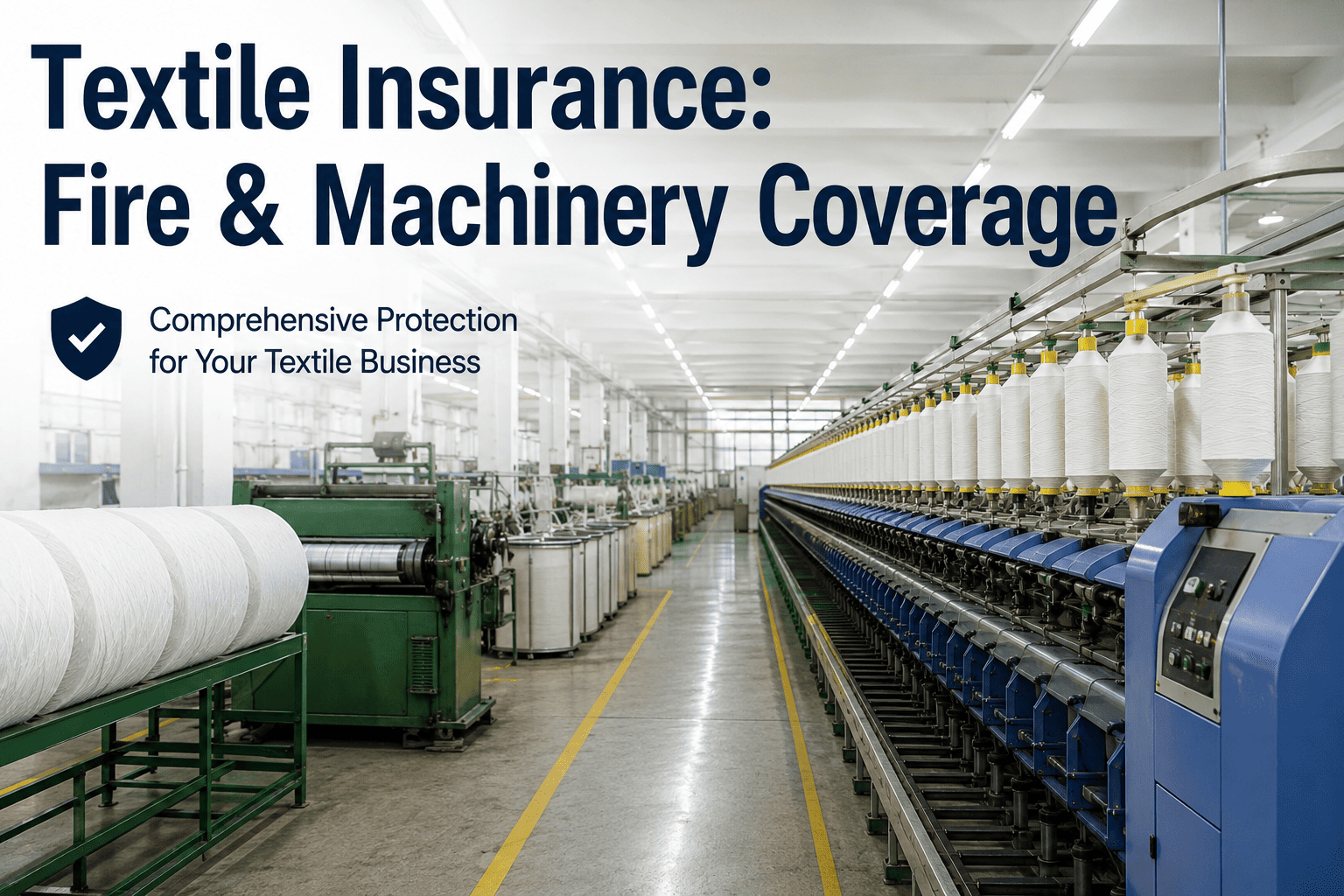
A textile mill carries risk that most insurance policies were not written with in mind, dense fiber storage that fuels fire spread, high-value spinning and dyeing machinery that fails expensively, and production lines so interconnected that one department's stoppage halts three others behind it. Getting coverage right means looking past the premium quote and asking whether the policy actually pays out the way the mill needs it to when something goes wrong. A gap discovered after a loss is far more expensive than the extra premium it would have cost to close it in advance. Book a demo to see how iFactory's maintenance records support faster insurance claims.
Four Coverage Types Every Mill Should Evaluate
Common Coverage Gaps Discovered Only After a Loss
| Coverage Area | Common Gap | Why It Gets Missed |
|---|---|---|
| Business Interruption | Indemnity period too short for full recovery | Standard periods assume faster restart than textile machinery allows |
| Machinery Breakdown | Older equipment excluded or undervalued | Asset valuations not updated as equipment ages |
| Stock-in-Transit | Coverage limited to owned vehicles only | Third-party transporter risk overlooked |
| Fire Insurance | Underinsurance against current replacement value | Sums insured not revised with inflation or expansion |
Levers That Actually Reduce Premium Without Cutting Coverage
Frequently Asked Questions
Standard business interruption policies are often written with a generic indemnity period that does not account for how long textile machinery actually takes to source, install, and recommission after major damage, particularly for specialized spinning or dyeing equipment with long lead times. A mill that assumes a standard twelve-month indemnity period is adequate can find itself out of coverage months before production is actually fully restored, turning what should be a covered loss into an uncovered gap in income. Book a demo to review your maintenance documentation ahead of a policy renewal.
No, machinery breakdown coverage is specifically designed for sudden and unforeseen failures, not gradual deterioration from normal wear and tear, which is generally excluded across virtually all policies of this type. This is exactly why maintaining documented preventive maintenance records matters, insurers frequently investigate whether a failure was genuinely sudden or the predictable result of deferred maintenance, and clear records help demonstrate the former when a claim is filed.
Sum insured values should ideally be reviewed annually, particularly for machinery and stock, since replacement costs for textile equipment and raw material can shift meaningfully within a single year due to currency movement, import cost changes, or general inflation. Underinsurance penalties, where an insurer pays out proportionally less than the full claimed loss because the declared value was too low, are one of the most financially painful surprises a mill can face after a major fire or machinery loss. Contact support to align your asset records ahead of renewal.
Yes, insurers generally price risk more favorably for mills that can demonstrate a consistent, documented maintenance and fire safety program, since this reduces both the likelihood and severity of claims from their perspective. Beyond premium savings, documented records also significantly speed up claim processing and settlement when a loss does occur, since much of the investigation an insurer would otherwise need to conduct is already available in verified form.
Yes, and this is a commonly overlooked gap, many mills assume the transporter's own insurance covers loss or damage in transit, but transporter liability is often limited and does not fully compensate the actual value of the goods lost. A mill's own stock-in-transit policy should extend to goods moved by third-party carriers, not just owned vehicles, particularly for high-value finished goods or dyed fabric moving between processing units and customers.