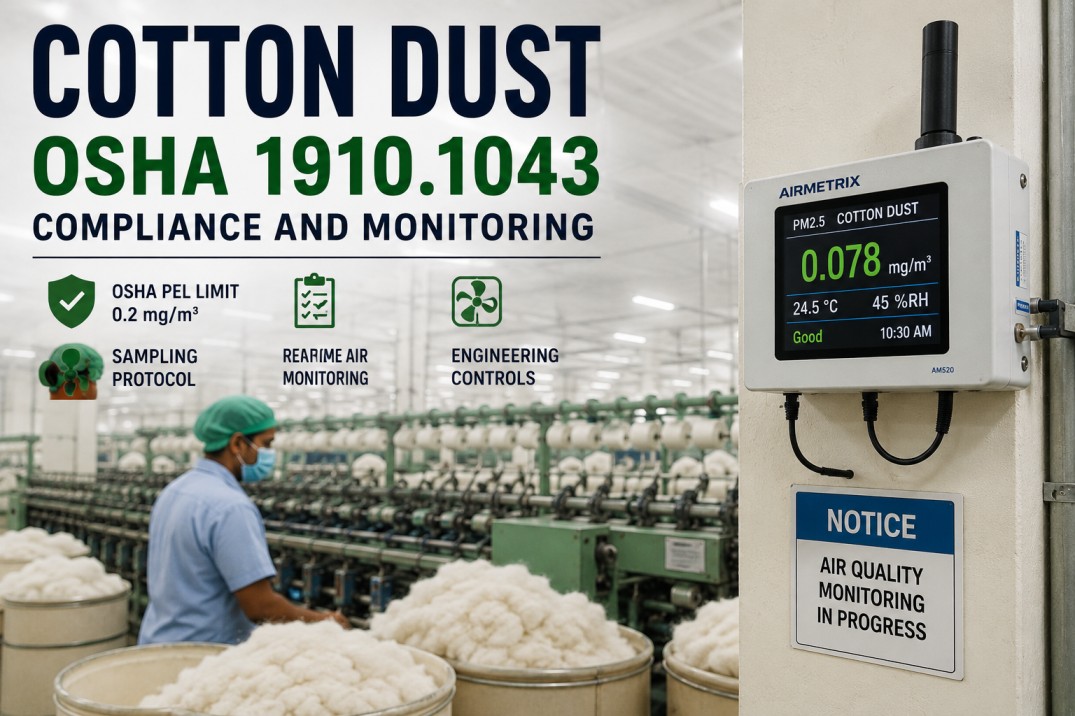
OSHA 1910.1043 establishes a permissible exposure limit for cotton dust of 0.2 mg per cubic meter of air in yarn manufacturing areas, with lower limits of 0.5 mg for weaving and 0.75 mg for waste processing operations. Non-compliance carries fines of $16,131 per serious violation, and chronic overexposure exposes mills to costly byssinosis liability claims. This page maps the seven mill zones that require dust monitoring under 1910.1043, compares the typical dust levels found in each zone against the OSHA PEL, presents four engineering control methods ranked by effectiveness, details the five-step air sampling protocol that OSHA compliance officers expect to see documented, and summarizes the medical surveillance schedule required for all employees who work in areas where dust levels exceed 50% of the PEL. Mills using iFactory's real-time air monitoring platform maintain continuous compliance records and receive automated alerts when dust levels approach the PEL, reducing the risk of violation citations and employee respiratory illness by 60–80%.
Understanding OSHA's Cotton Dust Standard for Textile Mills
OSHA 1910.1043 — the Cotton Dust Standard — was established in 1978 and updated most recently in 2024 to address the risk of byssinosis, a chronic respiratory disease caused by inhaling raw cotton dust. The standard applies to all workplaces where cotton is handled, processed, or manufactured, including opening, blending, carding, drawing, roving, spinning, winding, twisting, weaving, and waste processing operations. Unlike general particulate standards, 1910.1043 specifically regulates the lint-free respirable fraction of cotton dust, measured using a vertical elutriator or equivalent sampling method calibrated to capture particles between 7 and 10 microns. The standard also requires engineering controls first — ventilation, filtration, isolation — before relying on personal protective equipment, and mandates medical surveillance for all employees who work in areas where dust concentrations reach or exceed 0.1 mg per cubic meter, which is 50% of the PEL.
Is Your Mill's Cotton Dust Compliance Current?
iFactory's real-time air monitoring platform tracks cotton dust levels across every mill zone and generates automated OSHA 1910.1043 compliance reports. Book a demo to see a live dust monitoring dashboard for a spinning mill.
Cotton Dust Levels by Mill Zone vs OSHA Permissible Exposure Limit
Cotton dust levels vary significantly across different mill zones, depending on the process stage, machine type, and existing ventilation. The table below shows typical dust concentration ranges for seven common mill zones compared to the OSHA PEL. Mills should use this data as a benchmark when prioritizing engineering control investments and scheduling periodic monitoring.
| Mill Zone | Typical Range mg/m³ |
OSHA PEL mg/m³ |
Compliance Status |
Primary Hazard |
|---|---|---|---|---|
| Blow Room / Opening | 0.4 – 1.2 | 0.2 | Exceeds PEL | Raw cotton trash and field dust |
| Carding | 0.3 – 0.8 | 0.2 | Exceeds PEL | Lint and fine particulate from fiber separation |
| Drawing / Combing | 0.15 – 0.35 | 0.2 | Near PEL | Silver dust and fiber fragments |
| Roving | 0.10 – 0.25 | 0.2 | Within PEL | Minimal dust — wet processing begins |
| Ring Spinning | 0.08 – 0.20 | 0.2 | Within PEL | Low dust but high operator density |
| Weaving | 0.10 – 0.50 | 0.5 | Within PEL | Sizing residues and lint from warp |
| Waste Processing | 0.5 – 1.5 | 0.75 | Near PEL | Mixed waste dust with high trash content |
Four Engineering Control Methods Ranked by Effectiveness
OSHA 1910.1043 requires mills to implement engineering controls before relying on respiratory protection. The hierarchy below ranks control methods from most to least effective based on actual dust reduction measurements in textile mill environments. Most mills need a combination of at least two methods to achieve consistent compliance across all zones.
Reduce Cotton Dust Below PEL With Proven Engineering Controls
iFactory's environmental monitoring platform measures dust levels in real time and recommends the most cost-effective combination of controls for each mill zone. Schedule a demo to review your current dust levels.
Five-Step OSHA Cotton Dust Sampling Protocol
OSHA 1910.1043 requires mills to conduct initial dust monitoring in all zones where cotton is processed, with periodic re-monitoring at intervals determined by the previous exposure level. The sampling must use a vertical elutriator or an equivalent method that separates the respirable dust fraction from larger lint particles. The five-step protocol below follows OSHA's published compliance guidance for cotton dust sampling in textile mills.
Required Medical Surveillance Schedule for Cotton Dust Exposure
OSHA 1910.1043 requires medical surveillance for all employees who work in areas where cotton dust concentrations reach or exceed 0.1 mg per cubic meter (50% of the PEL) for 30 or more days per year. The surveillance includes baseline and periodic examinations focused on respiratory health. Mills that document and track medical surveillance demonstrate a proactive approach to worker health that OSHA recognizes during inspections.
Frequently Asked Questions About Cotton Dust OSHA Compliance
Does OSHA 1910.1043 cover synthetic fibers like polyester and nylon?
No — OSHA 1910.1043 applies exclusively to raw cotton dust. Synthetic fibers such as polyester, nylon, acrylic, and polypropylene are covered under the general particulate standard 1910.1000 Table Z-1, which sets a PEL of 5 mg per cubic meter for respirable synthetic dust and 15 mg per cubic meter for total dust. However, mills that process cotton blends (e.g., 50% cotton / 50% polyester) must comply with 1910.1043 for the cotton component. The practical implication is that any area processing cotton or cotton-blend fibers must be monitored under the stricter 0.2 mg PEL, even if synthetic fibers are also present. Mills that switch to 100% synthetic production can move to the less stringent general dust standard, but must document the change and update their compliance program accordingly.
What is the difference between total dust and respirable cotton dust?
Total dust includes all airborne particles regardless of size, including large lint fibers that are visible to the naked eye. Respirable cotton dust is the fraction of airborne dust that penetrates to the alveolar region of the lungs — particles approximately 7 to 10 microns in diameter and smaller. OSHA 1910.1043 regulates respirable cotton dust specifically, because only particles in this size range can cause byssinosis. The standard requires sampling with a vertical elutriator or equivalent device that selectively captures the respirable fraction while excluding larger lint particles. Mills that measure total dust only — using a standard gravimetric sampler without a respirable cut — will overestimate their actual 1910.1043 exposure and may invest in unnecessary controls. The respirable fraction typically represents 30–50% of total cotton dust in textile mill environments.
Can real-time dust monitors replace gravimetric sampling for OSHA compliance?
As of 2026, OSHA still requires gravimetric sampling using a vertical elutriator or equivalent as the reference method for 1910.1043 compliance determination. However, real-time dust monitors — using light-scattering or tapered element oscillating microbalance technology — are widely accepted for supplemental monitoring, trend analysis, and early warning systems. Many mills use real-time monitors to identify peak dust events and engineering control failures between gravimetric sampling periods. iFactory's platform integrates both methods: real-time sensors provide continuous visibility, and the system schedules and documents the required gravimetric samples. OSHA has accepted this combined approach during inspections when the real-time monitors are calibrated against gravimetric results at least quarterly.
What respiratory protection is required when engineering controls cannot reduce dust below the PEL?
When engineering controls cannot reduce cotton dust below the PEL, OSHA 1910.1043 requires a complete respiratory protection program under 1910.134. For cotton dust, the minimum acceptable respirator is a half-mask N95 or N100 filtering facepiece. For dust levels exceeding 10 times the PEL (above 2 mg per cubic meter), a full-face respirator with N100 filters or a powered air-purifying respirator (PAPR) with HEPA filters is required. All respirator users must be fit-tested annually and medically cleared. Importantly, 1910.1043 requires that respirator use be considered a temporary measure — mills must continue to implement engineering controls to reduce dust levels, and OSHA expects to see a written plan with specific milestones for achieving compliance through engineering methods rather than relying on PPE as a permanent solution.
How long must cotton dust exposure records be retained?
OSHA 1910.1043 requires exposure monitoring records to be retained for at least 30 years under 1910.1020. This includes all gravimetric sample results, calibration records, zone mapping documentation, and any real-time monitoring data used for compliance purposes. Medical surveillance records must be retained for the duration of employment plus 30 years. The extended retention period reflects the long latency of byssinosis and other occupational lung diseases, which may not manifest until decades after initial exposure. Mills that use a digital compliance platform benefit from automated record retention with cloud backup, eliminating the risk of lost paper records. iFactory's platform maintains all 1910.1043 records in OSHA-compliant format with configurable retention schedules and instant audit report generation.
Achieve Full Cotton Dust Compliance With Continuous Monitoring
iFactory's OSHA 1910.1043 compliance platform combines real-time dust monitoring, automated gravimetric sampling scheduling, engineering control tracking, and medical surveillance management in a single dashboard. Book a demo to see a live cotton dust compliance report from an operating spinning mill.