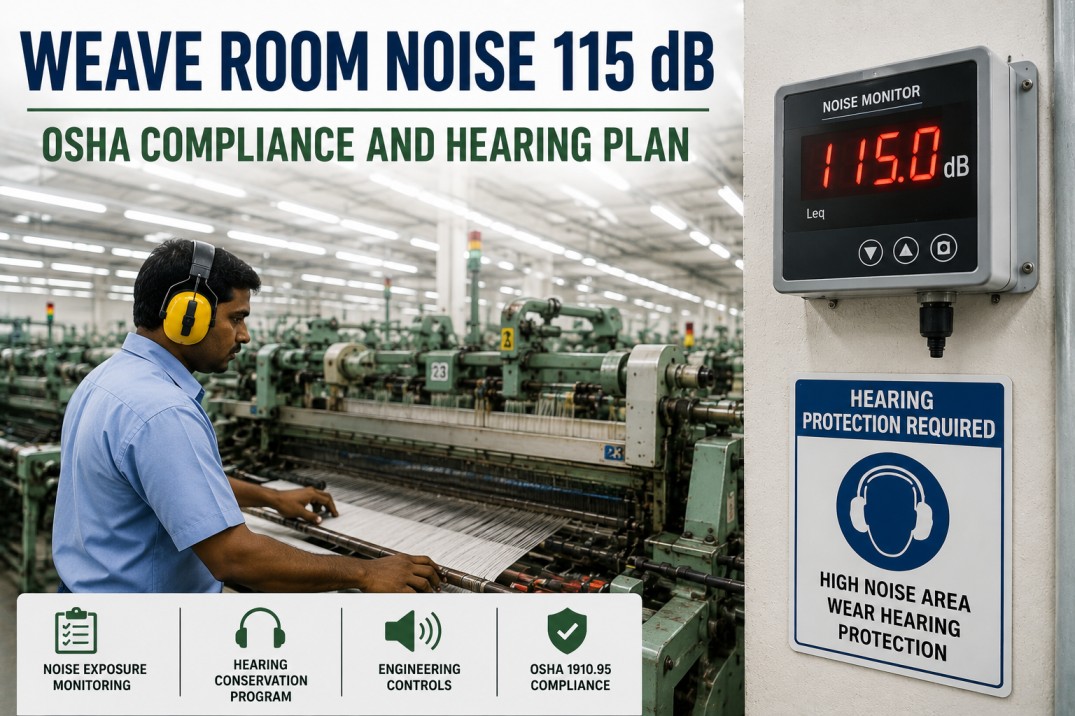
Modern weave rooms produce noise levels between 105 and 118 dB — well above the OSHA 1910.95 permissible exposure limit of 90 dB for an 8-hour time-weighted average and far exceeding the 85 dB action level that triggers mandatory hearing conservation program requirements. At 115 dB, OSHA permits only 15 minutes of unprotected exposure per day. This page maps the seven highest-noise zones in a typical weave room with their measured dB levels and permissible exposure times, breaks down the six components of an OSHA-compliant hearing conservation program from noise monitoring through audiometric testing, compares four engineering control methods ranked by actual dB reduction measured in operating textile mills, and provides a dosimetry sampling protocol that properly characterizes shift-long noise exposure for weavers, fixers, and supervisors. Mills using iFactory's real-time noise monitoring platform maintain continuous dosimetry records, receive automated alerts when time-weighted averages approach the action level, and reduce hearing loss incidence by 50–70% within 12 months of deployment.
Understanding Noise Exposure Limits in Textile Weave Rooms
OSHA 1910.95 — the Occupational Noise Exposure Standard — requires textile mills to implement a hearing conservation program whenever employee noise exposure reaches or exceeds an 8-hour time-weighted average of 85 dB. At 90 dB TWA, mills must use engineering or administrative controls to reduce exposure. Weave rooms are consistently the noisiest areas in any textile mill due to the mechanical impact of picking, beat-up, and take-up mechanisms on high-speed looms. Air-jet looms generate 100–108 dB, rapier looms produce 105–112 dB, and projectile looms reach 110–118 dB at the operator position. Understanding which zones exceed each threshold is the first step toward a compliant hearing conservation program.
Is Your Weave Room Exceeding OSHA Noise Limits?
iFactory's real-time noise monitoring platform provides continuous dosimetry across every weave room zone with automated OSHA 1910.95 compliance reporting. Book a demo to see a live noise exposure dashboard from an operating weaving mill.
Noise Levels Across Weave Room Zones Compared to OSHA Limits
The bar chart below displays measured noise levels for seven zones within a typical high-speed weaving mill, plotted against the OSHA action level (85 dB), the permissible exposure limit (90 dB), and the ceiling limit (115 dB for impact noise). Each bar represents the average dB reading at the operator's ear position during normal production, measured using a Type 2 sound level meter with A-weighting on slow response.
Six Components of an OSHA-Compliant Hearing Conservation Program
OSHA 1910.95 requires mills to implement a hearing conservation program whenever any employee's 8-hour TWA exposure reaches or exceeds 85 dB. The program must include six mandatory components, each with specific documentation and procedural requirements. Mills with a fully implemented program can reduce hearing loss incidence by 50–70% and demonstrate good faith compliance during OSHA inspections, which can reduce proposed penalties by up to 25%.
Build a Compliant Hearing Conservation Program for Your Weave Room
iFactory's noise monitoring and hearing conservation module covers dosimetry, audiometric tracking, training management, and OSHA recordkeeping in a single platform. Schedule a demo to see a live program dashboard from a weaving mill.
Noise Control Methods for Weave Rooms Ranked by dB Reduction
OSHA 1910.95 requires mills to use engineering and administrative controls to reduce noise exposure before relying on hearing protection alone. The four methods below are ranked by the actual dB reduction measured in operating weave room environments, along with typical installation costs and payback periods for a 50-loom weaving shed.
Hearing Protection Selection and Noise Dosimetry Sampling
When engineering controls alone cannot reduce noise below 90 dB TWA, OSHA 1910.95 requires mills to provide hearing protectors that reduce exposure to at least 90 dB TWA (or 85 dB TWA for employees with a standard threshold shift). Proper selection depends on the measured noise level, the spectral content of the noise, and the employee's individual fit. The dosimetry sampling protocol must characterize each employee's full-shift exposure across all tasks and locations within the weave room.
Frequently Asked Questions About Weave Room Noise Compliance
What is the difference between the OSHA action level and the PEL for noise?
The OSHA action level is 85 dB as an 8-hour time-weighted average. At or above this level, the mill must implement a hearing conservation program including noise monitoring, audiometric testing, hearing protection availability, training, and recordkeeping. The permissible exposure limit (PEL) is 90 dB TWA. At or above this level, the mill must use engineering or administrative controls to reduce exposure, and hearing protection must be worn. In practice, most weave rooms exceed 85 dB in all production zones, triggering the full hearing conservation program. Zones above 90 dB — which includes most loom operator positions — require both controls and mandatory hearing protection. The 5 dB exchange rate used by OSHA means that every 5 dB increase halves the allowable exposure time: 8 hours at 85 dB, 4 hours at 90 dB, 2 hours at 95 dB, 1 hour at 100 dB, and so on.
How is noise dosimetry different from a sound level meter reading?
A sound level meter provides a spot reading of noise at a specific moment and location — useful for identifying peak sources and mapping zones. A noise dosimeter is worn by an employee for the full work shift and continuously integrates all noise exposure, providing the 8-hour time-weighted average required for OSHA 1910.95 compliance. Dosimeters capture the cumulative effect of moving between different zones, breaks, and varying production levels. OSHA requires that compliance determinations be based on dosimetry rather than spot readings, because a weaver who spends 6 hours at a 96 dB loom and 2 hours in a 75 dB control room has a very different TWA than a dosimeter placed at the loom for 8 hours. Mills should conduct dosimetry on a representative sample of at least 2–3 employees per job classification per shift.
Can new weaving technology reduce noise below OSHA limits?
Modern air-jet and water-jet looms are significantly quieter than projectile and rapier looms, typically operating at 92–100 dB compared to 110–118 dB for projectile machines. Some newer air-jet models with optimized nozzle designs and carbon fiber reed elements have achieved 88–92 dB at the operator position, which approaches the OSHA PEL without additional engineering controls. However, even the quietest air-jet looms still exceed the 85 dB action level, triggering the hearing conservation program requirements. For mills with existing projectile or rapier fleets, retrofitting acoustic enclosures and ceiling absorption remains the most cost-effective noise control strategy. Mills planning new weave rooms should specify acoustic treatment in the building design phase, as retrofitting is 2–3 times more expensive than installing acoustic ceilings, barrier walls, and isolated control rooms during construction.
What is a standard threshold shift and how is it determined?
A standard threshold shift (STS) is a change in hearing threshold relative to the baseline audiogram of an average of 10 dB or more at 2000, 3000, and 4000 Hz in either ear. OSHA requires mills to compare each annual audiogram to the employee's baseline to detect STS. When an STS is identified, the mill must notify the employee in writing within 21 days, fit the employee with hearing protectors that provide greater attenuation (or refit existing ones), and refer the employee for a clinical audiological evaluation if the shift is 20 dB or greater. The baseline can be revised if the employee's hearing improves or stabilizes. Mills using iFactory's audiometric tracking module automatically receive STS alerts with comparison to the OSHA baseline and can generate the required notification letters and follow-up documentation.
What records must a textile mill maintain for OSHA noise compliance?
OSHA 1910.95 requires textile mills to maintain three categories of records. First, noise exposure records: all dosimetry measurements, sound level survey data, and zone mapping documentation must be kept for 30 years. Second, audiometric test records: baseline and annual audiograms, STS determinations, and clinical referrals must be kept for the duration of employment plus 30 years. Third, training records: annual hearing conservation training attendance records must be kept for the duration of employment. All records must be made available to employees, former employees, and OSHA within 15 days of a request. Mills that use a digital compliance platform maintain all three categories in a single system with automated retention schedules. iFactory's platform generates a complete OSHA noise compliance report with all required documentation in under five minutes.
Achieve Full OSHA 1910.95 Noise Compliance in Your Weave Room
iFactory's noise compliance platform covers dosimetry monitoring, audiometric tracking, engineering control management, hearing conservation training, and OSHA recordkeeping in a single dashboard. Book a demo to see a live noise compliance report from an operating weaving mill.