Bow and skew are weft-alignment defects that leave the stenter looking fine to the eye and destroy the fabric downstream in cutting and sewing. A weft that curves 2% (bow) or angles 3% (skew) across the width will not match at seams in a checked shirt, will torque a knit garment out of shape, and will show up in a home-textile stripe as an obvious misalignment. Weft straightening devices from Mahlo, Erhardt+Leimer, and Pleva have corrected bow and skew at the stenter exit for decades — but their effectiveness depends on live measurement, and legacy sensors miss subtle patterns that vision AI catches consistently across every metre of the finishing run.
iFactory / Stenter bow & skew vision
Correct Bow and Skew Live at Stenter Exit — Before the Fabric Is Cut
Live vision at stenter exit reading weft angle in percentage bow and degree skew, driving weft-straightening device correction (Mahlo, Erhardt+Leimer, Pleva) and writing the residual deviation to the finishing MES for cutting-room visibility.
Every metre
weft angle read
Correction
drives straightener
The Problem in Stenter Bow & Skew Control
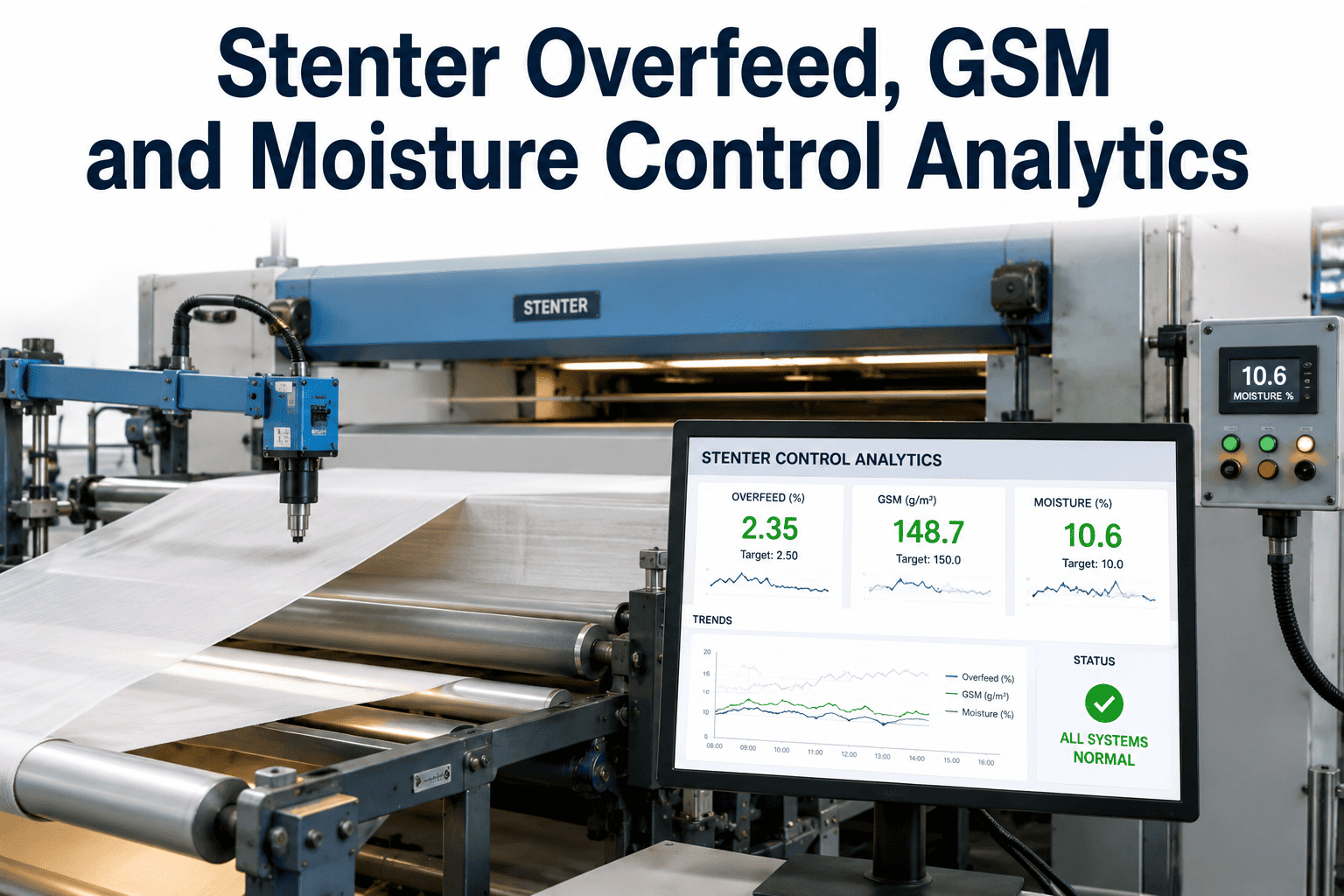
A typical finishing stenter runs at 25-60 m/min processing 10,000-30,000 metres per shift. The weft goes into the stenter more or less straight and comes out with whatever bow and skew the process induced — pin chain differential, uneven overfeed, dryer air pattern, tension imbalance across width. A weft-straightening device (Mahlo Orthopac, Erhardt+Leimer, Pleva) is mounted at stenter exit to correct in real time — but only as well as its own sensor sees. Legacy sensors read one or two width positions at coarse cadence and miss subtle bow patterns; fabric passes as acceptable and fails at cutting.
Where Bow & Skew Actually Escape
Stenter bow/skew failure modes are consistent across finishing operations. Each is a live-vision-detectable pattern that legacy point sensors miss.
Subtle bow
Bow pattern of 1-2% across width that legacy sensor misses at its point read. Human eye can't judge. Discovered at cutting when checked-pattern panels don't align at seams.
Asymmetric skew
Skew that is greater on one side than the other because pin chain tension differs. Legacy sensor averages across width. Full-width vision surfaces the asymmetry.
Overfeed drift
Overfeed setting drifts causing lengthwise weft displacement. Legacy sensor misses because the metric read is at width. Vision-mapped fabric grid shows the pattern.
MES silent
Even when bow/skew is measured, the value doesn't reach the finishing MES. Cutting room doesn't know what came off the frame. Same defect recurs and cutting scraps repeatedly.
What Good Looks Like in Bow/Skew Vision
A working stenter bow/skew vision holds four disciplines together — every-metre full-width reading, live straightening-device correction, residual measurement, and MES deviation logging.
Full-Width Vision
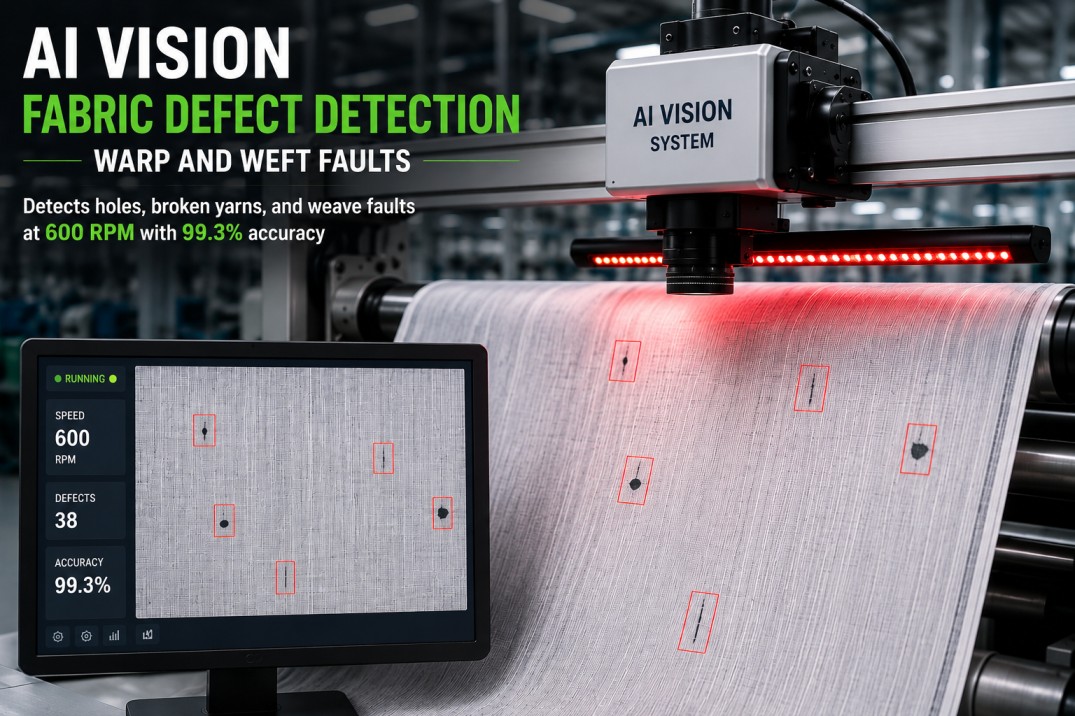
Vision cameras across the full fabric width at stenter exit reading weft angle continuously. Not point measurement — width map showing bow shape and skew angle every metre.
Width map, every metre
Live Correction
Vision feed drives the weft-straightening device (Mahlo, E+L, Pleva) with per-position correction commands. Straightener corrects bow shape and skew angle before fabric leaves the frame.
Vision-driven correction
Residual Measured
Post-correction bow and skew measured and displayed live. Where residual exceeds threshold, operator alerted. Fabric that exceeds cutting tolerance flagged before winding.
Residual, not just corrected
MES Deviation Log
Every roll's bow/skew profile written to finishing MES. Cutting room reads the profile before laying up. Recurring patterns per stenter surface for maintenance.
MES, cutting-room visible
How iFactory AI Fits
iFactory AI overlays your finishing stenters, weft-straightening devices (Mahlo, Erhardt+Leimer, Pleva), MES, and QMS — providing the full-width vision layer that legacy point sensors lack and the MES deviation logging that cutting rooms actually need.
Width Vision
Vision Layer
Vision cameras across full fabric width at stenter exit. Weft angle mapped every metre with bow shape and skew angle quantified. Full-width visibility, not point sample.
Correction Driver
Vision + Straightener
Vision feed drives the weft-straightening device with per-position correction commands. Straightener response verified by post-correction vision reading.
Residual Monitor
Vision Layer
Post-correction bow and skew measured live. Threshold breach alerts operator. Rolls exceeding cutting tolerance flagged before winding.
MES Bridge
Vision + MES
Every roll's bow/skew profile written to finishing MES. Cutting room reads profile before layup. Recurring patterns per stenter raise CMMS work order.
Ask your finishing stenter in-charge how many cutting-room rejects last month traced to bow or skew — and whether the stenter's bow/skew data reaches the cutting room. If either answer is uncomfortable, full-width vision at stenter exit is where the recovery lives. Book a stenter bow/skew review.
10-Week Bow/Skew Vision Pilot on One Stenter
One finishing stenter, ten weeks. The pilot mounts full-width vision, connects to the existing weft-straightening device, activates MES logging, and closes the first month of cutting-room-visible bow/skew data.
Weeks 1–2
Vision Mount
Vision cameras mounted across width at stenter exit. Calibration against reference fabrics with known bow/skew. Baseline current-state defect rates from cutting room.
Weeks 3–5
Straightener Link
Vision output connected to existing weft-straightening device (Mahlo, E+L, Pleva). Correction response tested. Residual bow/skew measured post-correction.
Weeks 6–8
MES Logging
Bow/skew profile per roll written to finishing MES. Cutting room reads profile before layup. First rolls processed through the new discipline.
Weeks 9–10
Cutting-Room Impact
Cutting-room rejects for bow/skew measured against baseline. Recurring patterns per stenter raise CMMS work orders. Rollout to sister stenters scoped.
Who Owns the KPI
Bow/skew crosses finishing, cutting, quality, and maintenance. Each function owns a specific KPI or the defect keeps escaping to cutting.
Finishing Stenter In-Charge
Residual bow/skew at exit
Owns the finishing outcome — residual bow and skew after weft-straightening device correction. Below cutting tolerance is the requirement, not the target.
Cutting Room Head
Cutting rejects for bow/skew
Owns the cutting outcome — panels rejected at layup for bow/skew misalignment. Rising signals stenter output is not meeting cutting tolerance.
Quality Manager
Buyer returns for pattern misalign
Owns the customer-facing outcome — buyer returns for pattern misalignment at seams. Zero is the target.
Stenter Maintenance
Pin chain / straightener MTBF
Owns the reliability outcome — MTBF on pin chain and weft-straightening device. Vision-attributed drift drives planned intervention.
FAQ
How does this integrate with our existing Mahlo, Erhardt+Leimer, or Pleva weft-straightening device?
Vision output feeds the straightening device through its native input interface — most modern straighteners accept correction commands via analogue, digital, or fieldbus (Profibus, Profinet, Ethernet/IP). The vision layer replaces or augments the straightener's own sensor input, providing full-width mapping instead of point measurement. Mahlo Orthopac RVMC, Erhardt+Leimer ELSTRAIGHT, and Pleva WFS series all support external sensor input. Where the straightener is a legacy unit without external input capability, the vision layer displays correction guidance to the operator for manual adjustment while the straightener runs on its own sensor. Either way, vision provides the visibility the legacy sensor lacks.
What about home textile products where bow/skew tolerance is looser than apparel?
Home textile tolerance varies by product and buyer — bedsheets and curtains carry tighter tolerance than kitchen towels or utility fabrics; premium checked and striped patterns carry the tightest. Configuration is per product family and per buyer specification, with threshold values applied at the roll level rather than universal defaults. For premium home-textile customers requiring roll-level QC data with shipment (many now do), the MES-logged bow/skew profile provides audit-ready evidence that ships with the roll. Where the operation runs both apparel (tight tolerance) and industrial fabrics (loose tolerance), the workflow applies each product family's specific rules automatically.
Book a demo to see the tolerance-configured workflow.
How does this handle knit fabrics where bow/skew reads differently than woven?
Knit fabrics present differently — course and wale replace weft and warp, and knit relaxation after finishing can cause dimensional change that woven does not. The vision layer trains classification models on knit-specific structures so it reads course angle rather than weft angle, and integrates with pin-chain overfeed control that knit finishing depends on. For circular knits post-stenter, the vision reads the tubular fabric structure; for warp knits, the vision reads the specific wale pattern. What the workflow doesn't do is force knit finishing into a woven-first framework; what it does is adapt the vision and MES logging to knit's own tolerance and terminology.
Stop letting bow and skew reach cutting.
Full-Width Bow/Skew Vision on One Stenter — Live
Bring one finishing stenter's last month of cutting-room reject data, the current weft-straightening device model, and one product family with tight tolerance specs. We'll walk what full-width vision would have caught, and demonstrate the MES deviation logging cutting rooms actually use.