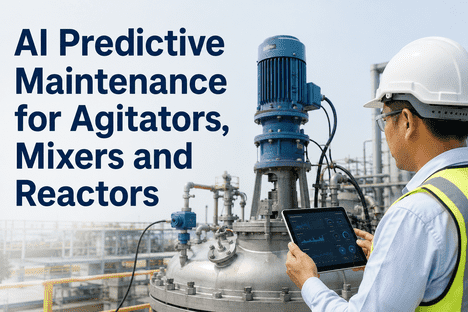
AI Predictive Maintenance for Agitators, Mixers and Reactors
By Daniel Carter on June 10, 2026
In chemical processing, food & beverage production, and pharmaceutical manufacturing, agitators, mixers, and reactors rank among the most critical process assets on the plant floor, where unplanned mechanical seal failures, impeller erosion, gearbox bearing degradation, and motor drive faults are leading causes of batch losses and production stoppages. A single mechanical seal failure on a 5,000-litre reactor agitator can cost $15,000–$45,000 in emergency repair and seal replacement, plus $10,000–$80,000 per hour in lost production, scrapped batches, and hazardous material containment. Traditional time-based maintenance schedules cannot address the variable operating conditions — batch-to-batch viscosity swings from 100 to 50,000 cP, thermal cycling between ambient and 300°C, corrosive process media that accelerates impeller and shaft attack, and seal face wear from abrasive slurries — that accelerate mechanical seal degradation, gearbox bearing fatigue, impeller imbalance, and shaft misalignment. iFactory's predictive maintenance platform fuses IoT vibration sensors, motor current signature analysis, bearing RTD temperature probes, torque telemetry, and oil analysis data into machine learning models that forecast agitator mechanical seal failure, impeller wear, gearbox bearing degradation, and motor drive faults 3–12 months in advance, enabling maintenance teams to intervene before catastrophic batch loss occurs. Book a Demo to see how iFactory connects your agitator, mixer and reactor telemetry to predictive intelligence.
Predictive Maintenance · Process Manufacturing 2026
AI Predictive Maintenance for Agitators, Mixers and Reactors
Mechanical seal failure prediction · Impeller wear monitoring · Gearbox bearing degradation detection · Motor drive fault forecasting · All flowing into iFactory CMMS & Shift Logbook.
Mechanical seal wear · leak detection · shaft condition
▤
Reactor Vessels
Impeller health · torque profile · thermal monitoring
◈
Mixer Gearboxes
Bearing wear · oil condition · gear mesh analysis
⟐
Motor Drives
Current signature · torque ripple · fault prediction
Why Reactive Maintenance Fails for Agitators, Mixers and Reactors
Agitators, mixers and reactors operate inside sealed, pressurised, or hazardous vessels where physical inspection requires isolation, draining, confined-space entry, and often full production stoppage. Most agitators in chemical, food, and pharmaceutical plants run without any continuous condition monitoring until product quality drops or a seal leaks — creating a structural monitoring blind spot that costs the industry $20 billion annually in unplanned downtime. Mechanical seal failures alone account for 60–70% of all agitator maintenance events, yet fixed-interval seal replacement either wastes 30–50% of remaining useful life or arrives too late after catastrophic leakage has already contaminated the batch. Impeller erosion from abrasive process media goes undetected until blending efficiency drops 15–20% below baseline, while gearbox bearing degradation in high-torque planetary and helical gear drives accumulates silently until tooth fracture or bearing seizure halts production. iFactory's condition-based approach replaces the calendar with sensor-driven prediction tailored to each vessel's actual batch chemistry, cycle profile, thermal history, and duty cycle.
LIMITATIONS OF TIME-BASED MAINTENANCE FOR AGITATORS, MIXERS & REACTORS
1
Variable batch conditions ignored — same maintenance interval applied regardless of viscosity, temperature, solids content, corrosive media exposure, or batch cycle duration
2
Sensor-blind to seal and bearing faults — mechanical seal wear, impeller imbalance, and gearbox degradation remain unmonitored between quarterly or semi-annual inspection windows
3
Confined-space inspection penalties — each vessel inspection requires process shutdown, inert-gas purging, confined-space permits, and sometimes full vessel entry, taking 8–48 hours per check
4
No fleet-wide degradation visibility — maintenance decisions based on the last failure rather than cross-fleet wear patterns across multiple reactors, mixers, and agitators of the same design
Three Failure Categories iFactory Predicts for Agitators, Mixers and Reactors
01
Mechanical Seal and Shaft Failure Prediction
Mechanical seals on agitators and mixers are the single largest maintenance cost driver in process plants — accounting for 60–70% of all agitator maintenance events. Seal faces degrade from abrasive slurry contact, thermal stress from rapid temperature cycling, chemical attack from corrosive process media, and shaft deflection caused by bearing wear or misalignment. A single mechanical seal failure on a reactor agitator can cost $15,000–$45,000 in emergency replacement plus $10,000–$80,000 per hour in lost production, off-spec product, and hazardous-material containment. iFactory ingests vibration sensor data at the seal housing, motor current draw, torque telemetry, and acoustic emission signatures to train ML models that predict seal face degradation and shaft misalignment 3–12 months in advance. Research validates that axial and radial vibration analysis at the seal face can detect incipient faults 10–12 months before actual failure, enabling planned interventions during scheduled turnarounds rather than emergency shutdowns. Book a Demo to see iFactory's seal failure prediction models in production.
3-12 month lead timeSeal wear detection60-70% of failures addressed
02
Impeller Erosion and Blade Wear Monitoring
Impeller degradation from erosive slurries, corrosive chemicals, and cavitation damage is the dominant cause of mixing performance decline in reactors, crystallisers, and blending vessels. As impeller blades lose diameter and profile, power draw at a given speed decreases proportionally — a 10–15% decline in power consumption at constant speed reliably indicates that the impeller has lost enough material to warrant inspection. Reduced impeller diameter extends batch cycle times, degrades heat transfer, and increases energy consumption per kilogram of product. iFactory monitors motor current draw, torque ripple, and vibration spectrum trends to detect impeller wear patterns 4–8 weeks before blending efficiency drops below specification. The Shift Logbook captures blade inspection findings, wear measurements, and operator observations alongside sensor data to build increasingly accurate impeller degradation prediction models across your vessel fleet.
Impeller wear detectionPower draw trendingBlade life optimisation
03
Gearbox Bearing and Motor Drive Degradation Forecasting
Agitator and mixer gearboxes — particularly right-angle helical-bevel, planetary, and parallel-shaft designs — operate under high-torque, low-speed conditions that accelerate bearing race fatigue, gear tooth wear, and lubricant degradation. Contamination ingress through shaft seals introduces abrasive particles that accelerate gear wear 3–5× above normal rates. Servo and VFD-driven agitator motors develop rotor bar defects, air-gap eccentricity, and bearing faults that produce distinct signatures in motor current harmonics and torque ripple. iFactory's ML models learn to recognise these patterns from current signature analysis, vibration spectral data, oil debris analysis, and temperature trending. The platform's continuous learning loop improves prediction precision as more telemetry and maintenance event data accumulates across different vessel types, process chemistries, and duty cycles.
Ensemble ML modelsContinuous learning loopOil analysis integration
How iFactory Transforms Agitator, Mixer and Reactor Telemetry Into Predictive Intelligence
iFactory is the AI software intelligence layer — not a sensor manufacturer or hardware vendor. The platform integrates with existing agitator and reactor telemetry from VFD drives, motor control centres, PLCs, DCS systems, SCADA platforms, ERP (SAP, Oracle), vibration sensors, bearing RTD probes, motor current transducers, thermal cameras, and oil analysis labs already deployed on your process vessels. The Shift Logbook captures operator shift reports, daily inspection findings, vibration reading trends, and maintenance notes alongside the real-time sensor stream, creating a unified data fabric for predictive model training and fleet-wide agitator, mixer and reactor reliability analysis.
Asset Class
Telemetry Sources
iFactory Prediction Output
Business Impact
Agitator Seals
Vibration · motor current · acoustic emission · torque
Seal degradation forecast · RUL estimate
$15K–$45K per prevented failure
Reactors
Vibration · RTD temp · current draw · torque profile
Impeller wear alert · blade health score
Reduced batch scrap & rework
Mixer Gearboxes
Vibration · oil analysis · temp · current signature
Bearing & gear degradation prediction
Extended gearbox overhaul intervals
Motor Drives
Current harmonics · torque ripple · temp · vibration
Predictive Maintenance Use Cases for Agitators, Mixers and Reactors
Chemical Processing
Reactor Agitator Mechanical Seal Condition Monitoring
Continuous
Reactor agitator mechanical seals operate in the most demanding environment — high temperature, corrosive media, pressure cycling, and abrasive byproducts. Unplanned seal failure causes hazardous chemical release, batch contamination, and emergency shutdowns that cost $50,000–$100,000 per hour in continuous processes. iFactory monitors seal housing vibration, motor current harmonics, torque trends, and acoustic emissions continuously. ML models trained on historical seal failure patterns predict face degradation and shaft misalignment 3–12 months in advance. Predicted failures include a confidence score and recommended intervention window — maintenance teams schedule seal replacements during planned turnarounds, avoiding emergency repairs. Every prediction event is logged in iFactory's Shift Logbook with full traceability to the sensor data that triggered the alert.
Mixer Impeller Wear and Blade Integrity Monitoring
Continuous
In food and beverage production, undetected mixer impeller wear is the leading cause of inconsistent product texture, extended blend cycles, and unplanned vessel entry for inspection. A worn impeller that goes undetected can produce thousands of kilograms of off-spec product before the next scheduled maintenance window. Process vessels in sanitary environments require CIP validation before entry, making inspection a 12–24 hour operation. iFactory detects early-stage impeller degradation through motor current harmonic analysis, torque trend deviation, and vibration spectrum shifts. The platform pinpoints the specific impeller and blade requiring attention, enabling targeted inspection during planned CIP cycles. Alerts route directly to the production shift in the Shift Logbook with severity score and recommended intervention scope.
Agitator gearboxes in pharmaceutical and specialty chemical production face variable operating conditions — different batch volumes, viscosities, and mixing speeds throughout the day — producing complex vibration and current signatures that challenge conventional threshold-based monitoring. GMP clean-room restrictions limit sensor access, making remote monitoring through motor current signature analysis the only practical continuous monitoring path. iFactory applies ensemble ML models with a continuous learning loop that improves prediction precision for gearbox bearing wear, gear mesh degradation, and motor rotor bar defects as more operating data accumulates. The Shift Logbook captures operator-reported anomalies — unusual sounds, position errors, quality deviations — alongside sensor data to build richer training corpora for variable-duty-cycle agitator equipment.
What iFactory Delivers for Agitator, Mixer and Reactor Reliability
3-12 mo
Mechanical seal failure warning lead time
Advance detection vs catastrophic leakage
30-40%
Reduction in unplanned agitator downtime
Planned intervention replaces emergency response
20%
Fewer off-spec batches from impeller wear
Impeller · seal · gearbox monitoring
$80K+
Prevented loss per seal failure avoided
Repairs + production loss + batch scrap
FAQ
iFactory is the AI software intelligence layer — not a sensor manufacturer or hardware vendor. The platform integrates with vibration sensors, bearing RTD probes, motor current transducers, thermal cameras, VFD drives, PLCs, DCS, SCADA, ERP (SAP, Oracle), and IoT gateways already deployed on your process vessels. Your plant selects the sensor and telemetry hardware; iFactory turns the data into predictive intelligence, maintenance alerts, and shift-ready work orders.
Model tuning typically requires 6–12 months of operation on a specific vessel fleet to eliminate false positives from variable batch conditions, tune threshold parameters for seal vibration monitoring and impeller wear detection, and build maintenance team confidence. The platform's continuous learning loop improves precision over time as more operating data and failure events accumulate across different vessel types, process chemistries, and duty cycles. iFactory recommends starting with one vessel type and one failure mode — such as reactor agitator mechanical seal prediction — proving value before expanding to the full process vessel fleet.
Yes. iFactory connects to SAP, Oracle, JDE, Microsoft Dynamics, and major CMMS platforms. The Shift Logbook captures operator defect reports, shift handover notes, and maintenance actions alongside sensor-generated predictions. Every prediction event, sensor reading, and maintenance action is recorded with full traceability for audit, compliance, and continuous model improvement — enabling your team to move from reactive agitator repairs to data-driven reliability.
Deploy iFactory for Agitator, Mixer and Reactor Predictive Maintenance
AI-powered predictive maintenance platform connecting agitator seals, reactor impellers, mixer gearboxes, and motor drive telemetry into one unified intelligence layer — with ML-based failure prediction, Shift Logbook integration, CMMS workflow automation, and plant-wide process vessel reliability analytics.