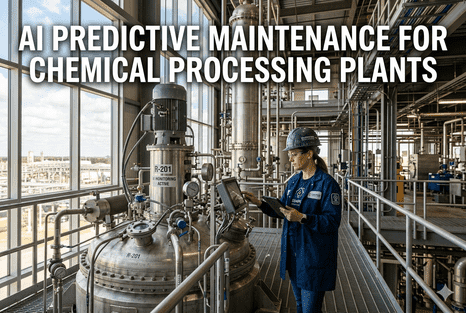
Industrial facility managers in 2026 face a persistent challenge — critical asset uptime commitments of 99.9% depend on mechanical, electrical, and process infrastructure maintained on fixed schedules rather than actual condition. A single cooling tower fan bearing failure in a chemical processing plant can halt production across three downstream units within 45 minutes, triggering cascading downtime that exceeds $250,000 per hour in lost output. Meanwhile, pump impeller wear that reduces flow efficiency by 12% over eight weeks remains invisible on weekly vibration logs until the pump cavitates catastrophically during a peak demand shift. iFactory's AI-powered predictive maintenance now detects bearing degradation, motor winding temperature rise, pump impeller wear, heat exchanger fouling, and compressor valve degradation 48–96 hours before failure — integrating with existing DCS, PLC, SCADA, and IoT sensor infrastructure without cloud dependency
Pump bearing wear · Motor winding degradation · Heat exchanger fouling · Compressor valve failure · Cooling tower deterioration · All predicted in real time by iFactory with zero cloud dependency.
Why Fixed-Threshold DCS and SCADA Alarms Fail to Protect Critical Assets
Most industrial facilities today rely on DCS and SCADA systems that apply fixed thresholds to individual parameters — bearing temperature limits, motor current draw ranges, vibration amplitude dead bands, or pressure setpoint ranges. These systems generate alarms only after a parameter has already exceeded its configured range, by which point the asset is already degrading or has failed. A centrifugal pump drawing 9% above nameplate current due to impeller wear over six weeks never triggers a single alarm threshold on a DCS — until the pump cavitates and seizes during a critical production run, shutting down the entire process line. iFactory's machine learning models compute adaptive anomaly detection limits that account for your facility's actual operational variability, seasonal production loads, feedstock changes, and equipment duty cycles — detecting multivariate degradation patterns that fixed-threshold systems miss entirely.
Three Critical Industrial Failure Categories iFactory Predicts
How iFactory Turns Industrial Telemetry Into Predictive Intelligence
iFactory is the AI software intelligence layer — not a sensor manufacturer or hardware vendor. The platform integrates with existing industrial facility telemetry from DCS controllers, PLCs, SCADA historians, vibration monitoring systems, motor protection relays, process analyzers, and IoT sensor gateways. The Shift Logbook captures operator shift reports, maintenance crew handover notes, and vendor service records alongside the sensor stream — creating a unified data fabric for predictive model training across every critical asset in your facility. iFactory's on-premise deployment ensures all operational data remains within your facility network, meeting the security requirements of chemical processing, oil and gas, power generation, and pharmaceutical manufacturing environments that cannot transmit operational telemetry off-site.
Connect your existing DCS, PLC, SCADA, and IoT sensor infrastructure to iFactory's on-premise predictive engine and start receiving 48–96 hour advance warnings on rotating equipment, motor winding, heat exchanger, and valve degradation. No cloud dependency — all data remains on your facility network.
Predictive Maintenance Use Cases in Industrial Operations
iFactory monitors pump bearing temperature, vibration velocity and acceleration, motor current draw, discharge pressure, and flow rate. ML models trained on 6-12 months of historical process data detect multivariate degradation patterns — a bearing running 6°F above baseline with correlated vibration trends — 72 hours before catastrophic failure. Alerts include asset ID, parameters triggered, current vs. baseline trend, and recommended corrective action.
Motor winding insulation breakdown is the leading cause of unplanned motor failure in industrial plants. iFactory monitors winding temperature per phase, insulation resistance, partial discharge activity, and VFD output harmonics. Insulation degradation trends are flagged 48 hours before winding failure risk exceeds safe operating thresholds. Recommended motor replacement windows align with planned maintenance schedules — eliminating emergency change-outs.
Heat exchanger fouling degrades invisibly between cleaning cycles. iFactory monitors fouling factor, differential pressure, tube wall temperature profiles, and approach temperature. Fouling factor drift beyond 80% of the design cleaning threshold triggers a 96-hour predictive alert with recommended corrective action — chemical cleaning, mechanical cleaning, or tube bundle replacement scheduling.
Control valve sticking and positioner degradation are early indicators of impending process control failures. iFactory monitors stem position vs. setpoint deviation, actuator cycle time trends, seat leakage class, and packing friction. Positioner drift trends and stem friction patterns generate predictive alerts 48 hours before control loop instability affects process quality. All events log to the Shift Logbook with full traceability for compliance and reporting.
On-premise AI-powered predictive maintenance platform connecting pumps, motors, heat exchangers, compressors, valves, and cooling tower telemetry into one unified intelligence layer — with ML-based failure prediction, Shift Logbook integration, CMMS workflow automation, and fleet-wide asset reliability analytics. Zero cloud dependency.