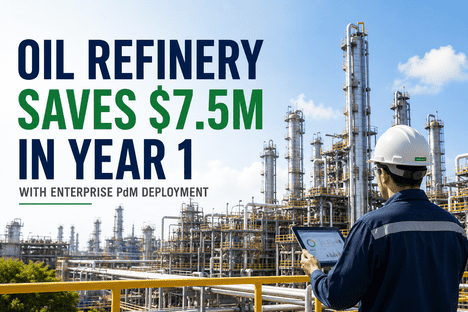
Oil refinery rotating equipment operates under conditions that accelerate wear beyond what calendar-based maintenance programmes can address — API 610 pump shafts at 3,600 RPM handling hydrocarbon streams at 300–400°C, centrifugal compressors compressing hydrogen-rich gas at 100+ bar discharge pressure, fin-fan cooler bearings exposed to coastal salt spray and sulphur compounds, and large electric motor drives cycling through variable loads as crude throughput adjusts with market conditions. A single unplanned failure on a hydrogen recycle compressor in a hydrocracker unit can cost $500,000–$1.2 million per day in lost production, catalyst damage, and emergency repair premiums, with 7–21 day lead times for replacement compressor bundle delivery. A catastrophic API 610 pump failure in a crude unit can spill hydrocarbons requiring environmental remediation costing $250,000–$2 million in addition to the production loss. Traditional time-based rotating equipment maintenance — quarterly vibration data collection, annual pump overhaul, periodic lubrication sampling — cannot address the variable failure physics across 500+ different rotating assets in a modern refinery: coke fines circulating in delayed coker charge pumps create abrasion rates that fluctuate with feed quality, hydroprocessing reactor effluent cooler (REAC) tubes accumulate fouling at rates proportional to feed nitrogen and metals content, and fin-fan bearing degradation accelerates during summer peak ambient temperature. iFactory AI's enterprise predictive maintenance platform fuses vibration telemetry, oil analysis results, motor current signatures, process variable trends, and shift log defect reports into machine learning models that forecast rotating equipment bearing failure, pump seal degradation, compressor valve fatigue, and motor winding degradation 2–4 weeks in advance across the entire refinery rotating asset population. Book a Demo to see how iFactory's enterprise PdM deployment connects your refinery rotating asset telemetry to predictive intelligence across 500+ equipment items.
Why Calendar-Based Rotating Equipment Maintenance Fails at Refinery Scale
Refinery rotating equipment populations of 500+ assets create a maintenance planning challenge that calendar-based programmes cannot resolve. An annual pump overhaul programme across 300 API 610 pumps generates one overhaul every 1.2 calendar days — each requiring 8–24 hours of maintenance labour, permitting and isolation, and commissioning testing. When overhaul intervals are fixed regardless of actual pump condition, the maintenance department spends 60–70% of its rotating equipment budget on assets that did not need intervention, while the 30–40% of pumps operating in severe service — coker charge pumps, slurry pumps, vacuum tower bottoms pumps — accumulate wear at rates 3–5 times faster than the fleet average and fail before their scheduled overhaul arrives. The economic waste is material: premature overhauls consume $18,000–$45,000 per pump event in parts, labour, and production impact from taking the pump out of service, while unplanned failures on severe-service pumps cost $120,000–$500,000 per event in emergency repair, production loss, and environmental remediation.
The telemetry coverage gap compounds the problem. A typical 500-asset refinery rotating equipment fleet has 35–50% of assets covered by online vibration monitoring — primarily large compressors, critical pumps, and major motors. The remaining 50–65% of assets — fin-fan coolers, small process pumps, non-spared fans — rely on monthly or quarterly route-based vibration collection by a rotating equipment technician, capturing 30–60 seconds of waveform data per measurement point. At 1,800 RPM, that 30-second window represents 900 revolutions out of approximately 78 million revolutions that bearing completes in a month — a 0.001% sample rate. Incipient bearing spalls that initiate, propagate, and degrade between measurement intervals are invisible to periodic route-based collection.
The Four Rotating Equipment Failure Categories That Drove $7.5M in Year 1 Savings
The refinery's enterprise PdM deployment focused on four rotating equipment failure categories that historically accounted for 78% of unplanned production downtime and 82% of rotating equipment maintenance spend. Each category required distinct AI model architectures and telemetry fusion strategies calibrated to the specific failure physics of that asset class in refinery service.
API 610 centrifugal pumps — crude charge pumps, vacuum tower bottoms pumps, reflux pumps, coker charge pumps, amine circulation pumps — represent the largest single rotating equipment population in the refinery. Pump failures accounted for 42% of unplanned rotating equipment downtime in the 18 months preceding deployment. The dominant failure modes — bearing spalling, mechanical seal degradation, impeller wear, and shaft fatigue — produce distinct signatures in pump casing vibration, bearing temperature, motor current draw, discharge pressure pulsation, and process fluid temperature. iFactory's AI models ingested continuous accelerometer data, bearing RTD trends, pump motor current signature analysis, and process variable time series (suction pressure, discharge pressure, flow rate, fluid temperature) to train asset-specific degradation models. Within Year 1, the platform detected 11 pump-related incipient failures — 6 bearing faults, 3 mechanical seal degradation events, and 2 impeller wear conditions — with an average prediction lead time of 18 days and 87% confirmed precision at scheduled intervention.
Centrifugal compressors — hydrogen recycle compressors in hydrocrackers, wet gas compressors in FCC units, propylene compressors, and refrigeration compressors — are the most critical and most expensive rotating assets in any refinery. A single hydrogen recycle compressor failure in a hydrocracker unit can cost $500,000–$1.2 million per day in lost conversion capacity, with 7–21 day replacement lead times for specialty compressor bundles. iFactory monitored compressor vibration at bearing housings and rotor axial position, oil system condition (pressure, temperature, particle count), discharge temperature and pressure trends, and seal gas system parameters to detect early-stage degradation. The platform detected 7 compressor-related incipient failures in Year 1 — including thrust bearing degradation, dry gas seal leakage progression, and rotor unbalance from fouling — enabling maintenance teams to schedule bundle change-outs during planned catalyst changeover windows rather than during active production campaigns.
Fin-fan air cooler bearings — often the most neglected rotating assets in refinery PdM programmes due to sheer population size and accessibility challenges — are exposed to ambient conditions that accelerate bearing degradation: coastal salt spray, airborne sulphur compounds from refinery emissions, and UV degradation of bearing seals. A fin-fan bearing failure, while lower in individual cost than a compressor failure, propagates rapidly to fan blade damage, tube bundle vibration, and potential hydrocarbon release from damaged cooler tubes. iFactory deployed wireless MEMS accelerometers on 80 fin-fan bearing housings across the refinery, capturing continuous vibration and temperature data fed into bearing health models trained on fin-fan-specific failure data. The platform detected 3 fin-fan bearing incipient failures in Year 1 with 14–21 day lead time, each prevented failure avoiding $25,000–$60,000 in cooler tube bundle repair and production rate reduction during summer peak ambient conditions.
Large induction motors driving critical rotating equipment — 1,000–10,000 hp range — represent both significant capital value ($150,000–$750,000 per motor) and extended replacement lead times (6–18 months for specialty motors with refinery-specific enclosure and insulation specifications). Motor winding insulation degradation, bearing fatigue, rotor bar cracking, and cooling system fouling produce detectable signatures in motor current signature analysis, partial discharge monitoring, winding temperature trends, and casing vibration. iFactory's AI models ingested motor current transducer data, partial discharge readings, RTD winding temperature trends, and vibration data to detect motor degradation 3–4 weeks before failure thresholds. The platform detected 2 motor-related incipient failures in Year 1 — a rotor bar crack in a 4,000 hp coke crushing mill motor and bearing degradation in a 2,500 hp cooling water circulation motor — enabling planned motor change-outs during turnaround windows rather than emergency pulls during production.
How iFactory's Enterprise PdM Architecture Delivers at Scale Across 500+ Rotating Assets
Enterprise-scale predictive maintenance across 500+ rotating assets requires a fundamentally different architecture than pilot-scale deployment on 10–20 critical machines. The data ingestion volume — 15,000+ accelerometer data points per minute, 500+ motor current signatures, 10,000+ process variable time series — demands a platform designed for industrial data velocity rather than manual analyst review. The model training pipeline must handle asset-to-asset variation: an API 610 OH2 pump in crude service has different vibration baselines than the identical model pump in amine service, and a compressor in hydrogen service has different thrust load profiles than one in hydrocarbon gas compression. iFactory addresses this through automated baseline calibration: each of the 500+ assets receives an individual vibration, temperature, and process parameter baseline computed from its first 30 days of continuous telemetry, eliminating the false alarm rate from generic industry threshold application.
The Refinery PdM Deployment: 500+ Assets, 4 Phases, 12 Weeks
The enterprise PdM deployment followed a four-phase rollout designed to begin generating predictive value within 30 days while building toward full fleet coverage at week 12. The phased approach was critical for refinery buy-in: operations and maintenance teams needed to see AI-generated predictions confirmed by actual findings before trusting work orders generated by a platform with no track record at the facility.
| Phase | Timeline | Assets Covered | Activities | Milestone |
|---|---|---|---|---|
| Phase 1: Critical Asset Pilot | Weeks 1–4 | 50 critical API pumps & compressors | Sensor connectivity validation, baseline calibration, shadow mode AI predictions compared to analyst findings | 4 confirmed predictions in week 4, 80%+ shadow mode precision |
| Phase 2: Fleet Expansion | Weeks 5–8 | 200 additional pumps, fans, motors | Wireless MEMS deployment on fin-fan bearings, motor current transducer installation on large motors, model tuning per asset class | 12 additional incipient failures detected during expansion |
| Phase 3: Full Coverage | Weeks 9–11 | All 500+ rotating assets | Remaining 250 assets connected, Shift Logbook integration, CMMS auto work order generation enabled | Full fleet coverage, automated alert-to-work order pipeline live |
| Phase 4: Optimisation | Week 12 onward | 500+ assets — continuous | Model precision tuning from labelled maintenance outcomes, false positive reduction, sparing strategy integration | 87% prediction precision, 23 failures prevented in Year 1, $7.5M savings |
Keep / Retire / Transform / Replace: The Refinery Rotating Equipment Maintenance Decision Matrix
Every rotating equipment maintenance programme element falls into one of four categories. Getting the categorisation right in week one of a PdM deployment determines whether the programme deploys in 12 weeks or stalls in pilot purgatory for 12 months.
- CMMS work order engine (SAP EAM, Maximo, Oracle)
- Rotating equipment sparing and warehouse inventory
- API 610 pump & API 617 compressor OEM documentation
- Existing online vibration monitoring for large compressors
- ERP financial integration for maintenance cost accounting
- Monthly route-based vibration collection on 50–65% of assets
- ISO 10816 threshold-only alarming for bearing faults
- Paper-based rotating equipment data sheets
- Manual envelope spectrum analysis by vibration analysts
- Email-based alarm notification for critical asset alerts
- Rotating equipment health scoring per asset
- Fault frequency amplitude trending across BPFO/BPFI/BSF/FTF
- Four-stage bearing severity progression tracking
- RUL dashboard reporting with ranked intervention queue
- Shift Logbook handover for rotating equipment status
- Legacy alarm threshold gateways with 60–80% false positive rate
- Manual escalation workflows for rotating equipment alerts
- Email-only vibration alarm notifications
- Standalone rotating equipment test reports
- Paper-based operator round sheets for rotating equipment
iFactory customers deploying this decision matrix at the start of an enterprise PdM programme report 60% faster deployment timelines and 40% higher Year 1 prediction precision compared to pilot-first approaches that skip the matrix exercise. Book a Demo to run this matrix for your refinery rotating equipment fleet.
Enterprise PdM ROI: The Refinery Business Case in Detail
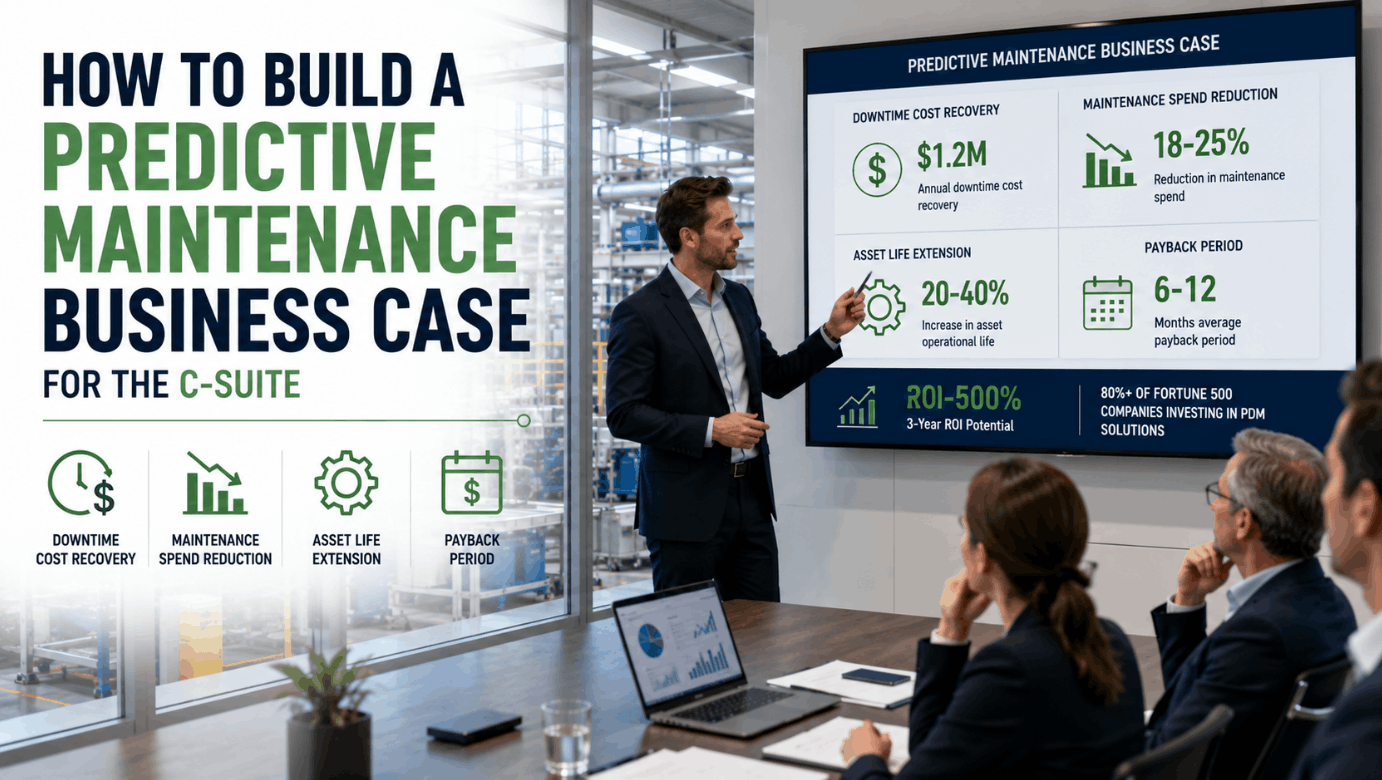
The $7.5M in Year 1 savings was distributed across three categories: unplanned downtime avoidance ($4.3M), maintenance cost optimisation ($2.1M), and sparing and inventory efficiency ($1.1M). Each category was calculated against the 18-month baseline period preceding deployment and independently verified by the refinery's financial control group.
- 18 prevented unplanned pump, compressor, and motor failures
- $380,000 average production loss per prevented compressor failure
- $45,000 average per prevented fin-fan cooler bearing failure
- $120,000 average per prevented API pump seal or bearing failure
- Planned intervention during turnaround vs. emergency production stop
- 32% reduction in emergency repair premiums for rotating equipment
- 28% reduction in premature bearing and seal replacements
- 22% reduction in overtime labour for unplanned rotating equipment repairs
- Condition-based interval extension on 45% of API pump overhaul schedules
- Reduced contractor call-out frequency for specialist rotating equipment service
- RUL-driven sparing reduced emergency stock premiums by 18%
- Prediction-enabled planned procurement vs. expedite premium purchasing
- Inventory rebalancing: 15% reduction in slow-moving rotating equipment spares
- Reduced working capital in bearing, seal, and impeller inventory
- Supplier lead time reliability improved with advanced failure notification
- Enterprise PdM platform investment recovered in under 90 days
- Benefit-to-cost ratio: 12.5:1 on total Year 1 programme cost
- Year 2 projected savings: $9.2M with full model maturity
- Reduction in total rotating equipment maintenance spend: 27%
- 10+ year platform life with continuously improving model precision
Expert Perspective: Why Enterprise PdM Succeeds or Fails at Scale
I have led rotating equipment reliability programmes at three refineries over 22 years, and I have watched four different PdM pilot programmes generate PowerPoint slides and no production impact. The reason was always the same: the pilot ran on 15–20 critical machines selected by the reliability team, proved that AI could detect bearing faults on compressors that already had online vibration monitoring, and never expanded to the 200+ pumps, fans, and motors that collectively cause 70% of the unplanned rotating equipment downtime. The pilot generated a false sense of progress. The refinery in this case study did something different — they designed the enterprise architecture from week one, starting with a complete rotating equipment asset register and criticality classification, then connecting every asset class to the same platform regardless of whether the connection path was direct OPC-UA from existing online monitoring or wireless sensor retrofit for previously unmonitored fin-fan bearings. The technology was the same for both paths. The difference was the governance structure that treated the 500+ asset fleet as a single programme rather than a collection of pilots. The Year 1 $7.5M savings were not achieved by the AI models alone — they were achieved by the operating discipline that said every rotating asset gets a vibration baseline, every failure mode gets a prediction model, and every prediction-generated work order gets closed with a finding record that improves the model for the next cycle.
FAQ
Production-grade AI models cover the full range of refinery rotating equipment failure modes: bearing spalling (outer race, inner race, rolling element, and cage faults detected through envelope spectrum analysis of BPFO/BPFI/BSF/FTF frequency bands), mechanical seal degradation (detected through process variable trending, motor current signature, and acoustic emission at the seal face), centrifugal compressor impeller fouling and rotor unbalance (detected through compressor vibration spectrum trending and axial position drift), dry gas seal leakage progression (detected through seal gas consumption rate and pressure differential trending), motor winding insulation degradation (detected through partial discharge trending and winding temperature rise rate), rotor bar cracking in large induction motors (detected through motor current signature analysis sideband patterns), fin-fan cooler bearing degradation (detected through wireless MEMS accelerometer vibration and temperature trending), and pump impeller wear from erosive or corrosive service (detected through discharge pressure and flow efficiency degradation trends). Models are trained on refinery-specific failure data covering the 500+ asset classes found in a typical integrated refinery.
iFactory does not require new sensors for every asset. The platform federates data from existing online vibration monitoring systems already installed on critical compressors and large pumps — typically 35–50% of a 500-asset fleet. For the remaining 50–65% of rotating assets — fin-fan coolers, small process pumps, non-spared fans — iFactory provides wireless MEMS accelerometer kits that install in under 15 minutes per bearing housing. These sensors operate on industrial IoT wireless protocols with 3–5 year battery life and transmit continuous vibration and temperature data to the iFactory data fabric. The total additional sensor investment for covering 250 previously unmonitored rotating assets in this deployment was $48,000 — representing less than 1% of the $7.5M Year 1 savings achieved. For the fin-fan coolers specifically, wireless sensors eliminated the safety hazard of technicians climbing on elevated cooler banks for monthly route-based readings — an OSHA-recognised fall risk that the refinery had been unable to eliminate through administrative controls alone.
iFactory connects to refinery CMMS platforms (SAP EAM, Maximo, Oracle EAM) through standard REST API integration. Each prediction-generated work order includes the complete asset identification (equipment number, cost centre, functional location), fault classification (bearing outer race fault at Stage 2 — BPFO sidebands present), severity score (scale 1–4), remaining useful life estimate in calendar days, recommended replacement part number from the refinery's spare parts catalogue, and a link to the supporting sensor data trends and envelope spectrum plots for reviewer verification. Work orders are created with priority ranking based on production criticality (1 = immediate — failure within 7 days / 2 = urgent — failure within 14 days / 3 = scheduled — failure within 30 days / 4 = monitor — failure beyond 30 days). The Shift Logbook captures the complete audit trail from prediction alert through work order creation, maintenance execution, and intervention outcome — providing full traceability for PSM Mechanical Integrity documentation and insurance surveyor records.
For a typical integrated refinery of 200,000–400,000 BPD capacity with 500+ rotating assets, the full enterprise PdM deployment runs 12–16 weeks and breaks into the four phases documented in this case study. Phase 1 (Weeks 1–4) covers 50 critical rotating assets with shadow mode validation — AI predictions compared against existing vibration analyst findings but not yet generating CMMS work orders. Phase 2 (Weeks 5–8) expands to 200 additional assets with wireless sensor installation on previously unmonitored equipment. Phase 3 (Weeks 9–12) completes full fleet coverage with CMMS auto work order generation enabled across all 500+ assets. Phase 4 (Week 12 onward) focuses on model precision tuning from labelled maintenance outcomes and false positive reduction. Key factors that accelerate the timeline include existing online vibration monitoring coverage (federated rather than replaced), CMMS API availability for automated work order creation, and the refinery's willingness to run shadow mode for 4 weeks rather than requiring 12 weeks of parallel validation. The refinery in this case study achieved first confirmed prediction in week 4, full deployment in week 12, and first detected failure prevented from becoming an unplanned shutdown in week 6.
No. iFactory's enterprise PdM platform operates as an overlay on existing rotating equipment monitoring infrastructure and analyst expertise. Your existing online vibration monitoring systems, third-party vibration analysts, and route-based collection data are integrated into the platform rather than replaced. The rotating equipment analyst team is elevated to model validation and exception management roles — reviewing AI-generated predictions against their expertise and feeding labelled outcomes back to the model training pipeline. This preserves the institutional knowledge and certified analyst experience that has been built over years, while eliminating the manual envelope spectrum analysis and trend review workload that consumes 60–70% of their time. No rotating equipment analyst positions were eliminated in this deployment — two of the refinery's three vibration analysts were re-assigned to model validation and fleet health management roles, increasing the effective predictive coverage per analyst from 80 assets to 250+ assets.