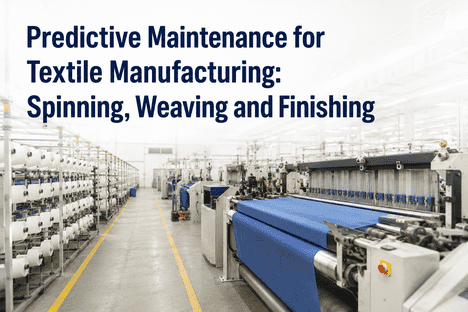
A ring spinning frame is the most asset-dense machine in textile manufacturing — a single frame carries 400 to 1,200 spindles, each rotating at 15,000–25,000 rpm, processing 25–45 meters of yarn per minute through a precision assembly of spindle bearings, top and bottom rollers, aprons, travellers, and ring rails. A medium-size spinning mill with 30,000 spindles across 40–60 frames generates approximately 2.6 billion spindle-hours of operation per year, during which spindle bearing degradation, roller cot wear, traveller and ring fatigue, apron damage, and gearbox faults develop and propagate across the spinning room. Traditional maintenance relies on periodic lubrication rounds, manual spindle vibration checks with handheld vibrometers (typically 5–10% of spindles per shift), and operator-reported yarn break patterns — a regimen that samples under 0.5% of spindle operating hours and detects bearing spalls only after they have progressed to a stage causing visible yarn quality defects or frame stops. AI-native vibration monitoring eliminates this detection gap by ingesting continuous accelerometer data across every spinning position — spindle bearing vibration, top roller condition, apron tension, ring and traveller wear signatures, and gearbox health — applying machine learning models trained on textile-specific failure modes to detect bearing degradation, roller cot flattening, and spindle misalignment 14–30 days before they cause end breaks or frame downtime. iFactory AI's industrial software platform, including its Shift Logbook and predictive maintenance engine, enables spinning mill reliability teams to deploy AI-driven vibration monitoring without replacing existing CMMS or yarn quality systems. Book a Demo to see how iFactory applies AI vibration failure prediction across ring spinning, rotor spinning, and open-end frames. This guide covers spinning frame failure mode physics, AI vibration model architectures for spindle and roller degradation, yarn quality vs. machine health correlation, and the practical deployment path for textile mill reliability engineers evaluating modernization.
Why Periodic Vibration Checks on Spinning Frames Are Hitting Their Ceiling
The traditional approach — daily operator yarn break rate monitoring, weekly spot-check spindle vibration readings with a handheld vibrometer covering 5–10% of spindles, monthly lubrication rounds, quarterly roller cot grinding schedules, and time-based traveller and ring replacement campaigns — was designed for smaller spinning rooms with lower throughput expectations. A modern ring spinning frame with 1,008 spindles operating 24 hours per day at 20,000 rpm generates 28.8 million bearing revolutions per day per spindle — 29 billion revolutions across the frame per day. A technician checking 50 spindles with a handheld vibrometer per shift captures roughly 5% of the spindle population, and the 30-second measurement window per spindle represents 10,000 bearing revolutions out of 28.8 million — a 0.035% sample rate. The four specific ceilings are well documented in textile machinery reliability research.
The Four High-Consequence Asset Groups Where AI Vibration Analysis Prevents the Most Spinning Frame Failures
Spinning frame vibration monitoring must be calibrated to the actual consequence hierarchy of the spinning room — not all bearing and rotating elements carry equal risk, and not all monitoring approaches are equally appropriate across component types. iFactory's textile AI library defines four high-consequence asset groups responsible for the most severe yarn quality and downtime outcomes in ring spinning operations, each with distinct failure physics, vibration signatures, and detection logic.
Spindle Bearing and Blade Assembly Monitoring
Spindle assemblies are the most numerous rotating elements in a spinning mill — 30,000+ per facility — and the highest single cause of unplanned frame downtime. A spindle bearing spall initiates at the ball-race contact surface, generating characteristic vibration frequencies in the 500–5,000 Hz range depending on bearing geometry and spindle speed. The progression from incipient spall to functional failure (spindle seizure or excessive runout) spans 150–400 operating hours. iFactory monitors every spindle's accelerometer signature continuously, applying envelope spectrum analysis to detect bearing fault frequencies — BPFO, BPFI, and BSF — before vibration amplitude reaches the ISO 2372 alert threshold. Each spindle's vibration baseline is calibrated individually against its position in the frame, eliminating the false alarm rate from position-specific structural resonance variation.
Drafting Roller and Cot Condition Monitoring
Top and bottom drafting rollers apply controlled compression to the fibre strand through the drafting zone — any roller cot flatness deviation, hardness variation, or bearing degradation directly translates to uneven fibre drafting and increased yarn irregularity. A roller cot with a 0.1 mm flat spot generates a periodic drafting force variation at the roller rotational frequency (typically 2–8 Hz), producing a measurable yarn CV% increase of 0.5–1.5 points before the cot surface degrades further. iFactory monitors roller bearing vibration signatures and roller rotational speed consistency, cross-correlating with the frame's yarn clearness data to identify roller-related quality deviations before they reach customer complaint thresholds.
Apron, Traveller, and Ring Tension System
The apron and ring-traveller system controls fibre guidance and yarn twist insertion — the highest-friction subsystem on a ring spinning frame. Traveller speeds reach 35–45 m/s at the ring circumference, generating temperatures of 250–400°C at the traveller-ring contact surface. Traveller wear progression follows a three-stage pattern: initial running-in (2–4 hours), stable operation (100–300 hours), and accelerated wear (last 20–40 hours before traveller failure causes an end break). Apron tension loss develops gradually over 1,000–3,000 operating hours as the apron material relaxes and edge wear increases frictional drag. iFactory monitors apron tension via strain gauge telemetry, traveller wear via acoustic emission sensors, and ring condition via surface temperature profiling.
Ring Rail, Spindle Drive, and Gearbox Systems
The ring rail lifting mechanism, spindle drive system, and main gearbox transmit power from the frame motor to every rotating component — a gearbox bearing failure or ring rail cam degradation stops the entire frame, not just individual spindle positions. Ring rail gearbox failures account for 8–12% of frame-level unplanned downtime in ring spinning operations, with lead times of 5–21 days from incipient gear tooth wear to functional failure. iFactory monitors gearbox vibration, oil temperature, and current draw on the main drive motor, applying time-synchronous averaging to separate gear mesh frequencies from bearing signatures and detect individual tooth degradation before spalling propagates to adjacent teeth.
How iFactory's AI Vibration Engine Converts Spindle Vibration Data into Prevented Frame Stops
Standard vibration monitoring systems collect raw accelerometer data, apply FFT processing, and fire alarms when overall vibration exceeds a fixed broadband threshold — treating a 1,200 rpm motor bearing the same as a 20,000 rpm spindle bearing, and a 0.5 g alarm on a structurally stiff motor mount the same as a 0.5 g alarm on a flexibly mounted spindle blade. The result is the alarm overload that characterizes many spinning mill condition monitoring programs: 200–800 vibration alerts per week, 70–85% false or non-actionable, operators trained by experience to ignore alerts that have historically required no intervention. iFactory's AI vibration engine replaces this flat threshold architecture with position-calibrated, textile-specific analysis.
Automated Inspection and Maintenance Scheduling: Closing the Gap Between Vibration Alert and Frame Intervention
The most common finding in spinning mill post-mortems of frame downtime events is not the absence of a vibration monitoring program — it is the failure of the existing program to trigger the right maintenance action at the right time. Manual vibration data collection with handheld vibrometers, paper-based spindle condition logs, calendar-triggered traveller replacement campaigns, and vibration records stored separately from yarn quality data are structural gaps in the maintenance system. The table below documents how iFactory's automated inspection scheduling changes each element — and what production impact the change delivers.
| Inspection Element | Traditional Approach | iFactory AI Approach | Production Impact | Quality Benefit |
|---|---|---|---|---|
| Spindle Bearing Condition | Monthly handheld vibrometer check on 5–10% of spindles | Continuous AI envelope spectrum analysis on every spindle | Bearing spalls detected 14–28 days before seizure; unplanned stops eliminated | Yarn CV% maintained within customer specification band |
| Roller Cot Grinding Schedule | Quarterly calendar-based grinding regardless of condition | Condition-triggered by roller vibration trend and CV% correlation | Cot change intervals extended 20–35% while maintaining quality | Uneven drafting detected before yarn irregularity reaches customer |
| Traveller Replacement | Time-based replacement at fixed intervals (400–600 hours) | Acoustic emission + end break rate triggered replacement | Traveller life extended 15–25% without increasing end break risk | End break rate reduced 35% during traveller wear-out period |
| Apron Tension Adjustment | Operator feel-check during routine patrol, inconsistent | Continuous strain gauge monitoring with tolerance bands | Tension deviation detected before drafting quality is affected | Yarn evenness maintained within 0.5% CV band for full apron life |
| Ring Rail Gearbox Service | Annual oil change + vibration check at service interval | Continuous vibration + oil temperature + debris trending | Gearbox bearing faults detected 10–21 days before frame stop | No gearbox-related frame stops in monitored population |
| Spindle Inventory Replenishment | Annual stock count + generic OEM spindle recommendation | AI-predicted failure rate per frame make + model + fibre type | Spindle stock optimized to actual degradation trajectory data | Zero emergency spindle procurement in monitored frames |
iFactory customers deploying automated spindle inspection scheduling report a 94% increase in condition-based work order completion within 60 days of go-live — converting from a program where overdue spindle checks were discovered reactively into one where every frame's vibration trend is visible and every emerging fault has an accountable work order in the maintenance queue. Book a Demo to see how iFactory's Shift Logbook unifies spindle vibration data with maintenance operations.
The True Financial Cost of Unplanned Spinning Frame Downtime
The financial case for AI vibration monitoring on spinning frames is unambiguous, and it is routinely underestimated in capital justification discussions. Direct repair costs — spindle replacement, roller cot grinding, traveller sets — represent a fraction of the total downtime cost. The largest components are production loss during frame stops, downstream weaving and knitting disruption from inconsistent yarn supply, yarn waste from quality deviations during degradation periods, and the customer claim exposure from off-quality yarn shipped to fabric manufacturers. For a mid-size spinning mill with 30,000 spindles, a single unplanned frame stop costs $5,000–$12,000 per event when fully loaded. Across 40–60 frames with 3–5 unplanned stops per frame per year, the annual cost of unplanned spinning frame downtime reaches $720,000–$1.8 million.
- Spindle bearing or blade replacement: $80–$350 per spindle depending on make and bearing grade
- Roller cot re-grinding or replacement: $120–$600 per roller set depending on cot material and diameter
- Traveller and ring replacement: $40–$200 per frame section
- Gearbox repair or replacement: $800–$3,200 for main drive gearbox depending on damage scope
- Emergency technician call-out: $200–$600 per event for after-hours maintenance crew mobilization
- Average frame stop duration: 45–120 minutes for spindle replacement, 60–180 minutes for gearbox service
- Lost production at 45–65 kg of yarn per frame per hour: $1,600–$4,200 per stop in unmanufactured output
- Downstream weaving/knitting supply gap: $600–$1,800 per stop in downstream line idle time
- Expedited order premium when production shortfall requires spot market yarn purchase: $800–$2,500 per event
- Labour cost for non-productive frame operators during stop: $200–$600 per event for direct labour
- Yarn waste during bearing degradation run-up (CV% exceeding 95% USTER limit): 8–25 kg per frame per event
- Inferior yarn downgrade cost: $0.30–$0.80 per kg difference between premium and standard grade yarn
- Customer claim exposure from off-quality yarn shipped during undetected degradation: $2,000–$12,000 per claim
- Waste fibre re-processing cost: $200–$600 per event for waste handling and recycling
- Quality assurance re-testing laboratory cost: $40–$120 per frame per event for CV%, hairiness, and strength testing
- Customer retention risk: weaving and knitting mills switch suppliers with >3% off-quality shipment rate over 6 months
- Brand devaluation from inconsistent yarn quality: 12–18% price premium erosion for mills with documented quality incidents
- Insurance premium increase for force majeure coverage following >72 hours production loss per event
- Capital efficiency reduction: frame uptime below 94% drives 6–10% higher per-kg conversion cost allocation
- OEE gap compounding: each 1% of frame downtime requires 0.8% additional spindle capacity to maintain throughput
Expert Perspective: Why Spinning Mills Need AI Vibration Monitoring, Not More Handheld Vibrometers
In 22 years of textile machinery reliability engineering across ring spinning, rotor spinning, and open-end operations in India, Southeast Asia, and the Middle East, I have reviewed more than 300 spinning frame downtime investigations. The finding that appears in most of those reports — the one that never makes it to the management summary — is that the vibration data was there. The handheld vibrometer readings taken on a sample of spindles during the weekly patrol showed bearing degradation on specific positions that were noted in the log but never escalated to intervention before the spindle seized or the end break rate spiked. The gap was never the absence of vibration data. It was the absence of a system that monitored every spindle continuously, compared each position against its own calibrated baseline, and delivered a prioritized maintenance action to the right technician with enough lead time to schedule the repair during a planned doff rather than during an emergency frame stop. When I see a spinning mill running USTER statistics on yarn quality every 10 minutes and checking spindle vibration on 5% of positions once per week, I know exactly which frame is going to cause the next unplanned stop. The investment calculus is straightforward. One prevented frame stop per month recovers the per-frame cost of an AI vibration monitoring system within 6–9 months. The question is not whether the ROI is there. The question is whether the reliability team has the visibility to act on the data from every spindle before a bearing spall becomes a spindle seizure.
Conclusion: The 14-Day Window That Separates Planned Spindle Replacement from Emergency Frame Stops
Spinning frame failures are not inevitable. The 14–28 day warning window that exists in vibration data before most bearing and roller failures means that every unplanned frame stop that does occur in a monitored spinning room is a failure of data utilization — not a failure of vibration measurement availability. The accelerometer technology exists at $15–$45 per spindle position. The FFT processing capability exists in edge computing nodes at every frame. The yarn quality correlation models exist in AI platforms purpose-built for textile applications. What is missing in spinning mills that continue to experience unplanned frame stops is the continuous monitoring layer that compares every position against its own baseline, applies textile-specific fault classification algorithms, and delivers actionable intelligence to a maintenance decision-maker before the spindle seizes or the gearbox fails.
iFactory AI's spinning room vibration monitoring platform delivers exactly that capability: per-spindle baseline-calibrated envelope spectrum analysis detecting bearing faults at Stage 1 (incipient spall), roller cot degradation trending against yarn CV% correlation, apron and traveller wear monitoring via acoustic emission and strain gauge telemetry, automated CMMS work order generation with fault evidence and recommended spare parts, and Shift Logbook integration providing a unified operator handover interface for every frame's vibration condition. The economic case for deployment is unambiguous: a reduction from 3–5 unplanned stops per frame per year to 0–1, recovery of 50% of frame downtime losses, and elimination of the quality deviation risk that drives customer claims. The data is available. Every spindle is already generating it. The question is whether your maintenance system is connected to it. Book a Demo to walk through a spinning room assessment with our textile reliability team.
Frequently Asked Questions
AI vibration monitoring for spindle bearings detects and classifies all four standard bearing fault frequencies simultaneously: ball pass frequency outer race (BPFO), ball pass frequency inner race (BPFI), ball spin frequency (BSF), and fundamental train frequency (FTF). Each fault type produces a distinct envelope spectrum signature — BPFO appears with stationary fault impacts at constant angular position with speed sidebands; BPFI shows amplitude modulation at shaft rotational frequency from the rotating race passing through the variable load zone; BSF generates impacts at twice the ball spin frequency as both ball surfaces contact inner and outer race per revolution; FTF appears as subharmonic vibration typically at 0.38–0.48 times spindle speed and propagates rapidly to complete seizure. For spindle bearings in ring spinning frames operating at 15,000–25,000 rpm, BPFO typically falls in the 350–1,200 Hz range depending on bearing geometry, enabling early detection at Stage 1 spall initiation — 14–28 days before functional failure. For roller bearings in drafting rollers operating at 200–600 rpm, BPFO/BPFI frequencies fall in the 20–150 Hz range, requiring different accelerometer sensitivity and sampling rate configuration optimized for low-speed bearing detection.
A standard FFT analyzer collects a 30–60 second accelerometer waveform, computes the frequency spectrum, and displays the overall vibration amplitude — requiring a certified vibration analyst to interpret the spectrum, identify bearing fault frequencies, classify severity, and recommend action. This approach has three fundamental limitations for spinning frame monitoring: coverage (a technician can sample 20–50 spindle positions per hour, leaving 95% of spindles unmeasured between monthly rounds), consistency (spectral interpretation accuracy varies from 45% for junior technicians to 85% for senior level III analysts, with no second check on spindle positions that appear normal), and timeliness (a bearing spall that initiates the day after the monthly vibration round progresses undetected for up to 28 days). iFactory's AI vibration engine addresses all three limitations simultaneously: continuous accelerometer telemetry across every spindle position eliminates the coverage gap; automated envelope spectrum classification with per-fault confidence scores delivers 93%+ detection accuracy regardless of analyst experience; and real-time trend comparison against position-specific baselines provides Stage 1 detection at spall initiation — not weeks later when the fault appears on the monthly handheld vibrometer reading at Stage 3. The operational difference is significant: standard FFT analysis generates 10–20 vibration readings per frame per month requiring manual interpretation. iFactory generates 3–5 prioritized spindle-level alerts per frame per week, each with fault type, severity stage, and recommended action pre-classified — enabling a technician to intervene on the right spindle at the right time.
The correlation between spindle bearing condition and yarn quality follows a well-characterized progression in ring spinning. A healthy spindle bearing operating within 0.3–0.8 mm/s RMS vibration velocity produces stable yarn with CV% within 1.0 points of the USTER 25% percentile for the yarn count and fibre type. As a bearing spall progresses through Stage 1 (incipient), the vibration amplitude typically rises to 1.2–2.0 mm/s RMS while the yarn CV% increases by 0.2–0.5 points — within normal mill tolerance and undetectable in routine quality testing. At Stage 2 (moderate spall propagation), vibration amplitude reaches 2.0–4.0 mm/s RMS and the affected spindle's end break rate increases 2–4× above the frame average. The yarn CV% rises 0.5–1.5 points — measurable in laboratory testing but frequently dismissed as normal process variation unless the specific spindle is isolated for investigation. At Stage 3 (advanced spalling), vibration exceeds 4.0 mm/s RMS, end breaks occur every 30–90 minutes on the affected spindle, and yarn CV% increases 1.5–3.0 points with elevated hairiness (H-index increase of 0.5–1.5). By Stage 4 (pre-failure), spindle seizure is imminent within hours, the end break rate exceeds 5 per hour, and the yarn quality has degraded below USTER 5% threshold for the count. iFactory's AI platform correlates vibration amplitude trends with yarn clearness data from USTER QUANTUM or similar systems, flagging spindle positions where vibration and CV% are both trending above individual position baselines — enabling intervention at Stage 1–2 before yarn quality reaches customer complaint thresholds.
iFactory's AI platform is designed for sensor-agnostic integration with existing textile mill data infrastructure. For mills already equipped with spindle-level vibration sensors from OEM monitoring systems (Rieter SPIDERweb, Toyota TMS, or similar), iFactory connects via OPC-UA or REST API to ingest existing accelerometer data streams — no additional sensor hardware required. For mills without spindle-level vibration monitoring, iFactory provides wireless MEMS accelerometer arrays at $15–$45 per spindle position, installed during a scheduled lubrication or doff cycle without stopping production. The platform integrates with existing CMMS systems (SAP, Infor, Mainpac, or custom) through standard API connectors, writing AI-detected faults directly as work orders with frame number, spindle position, fault type, severity stage, and recommended spare part number. Yarn quality data from USTER, Keisokki, Premier, or L affop systems is ingested through file-based or API integration, enabling the vibration-to-quality correlation engine that differentiates AI monitoring from standalone vibration analysis. Existing PLC and SCADA data — frame speed, twist per inch, roller nip pressure, humidification parameters — is integrated through OPC-UA or Modbus to provide full-context machine health analysis. The deployment follows the same architecture regardless of sensor source: continuous data ingestion, per-position baseline calibration, AI fault classification, correlation with quality parameters, and automated CMMS work order generation.
For a mid-size spinning mill with 30,000 spindles across 40–60 ring spinning frames, with an existing CMMS and quality laboratory (USTER or equivalent), a full AI vibration monitoring deployment runs $180,000–$350,000 in total investment over a 10–16 week implementation timeline. The cost breakdown is approximately: wireless MEMS accelerometer arrays for 30,000 spindle positions ($135,000–$270,000 depending on sensor density and wireless gateway configuration), iFactory platform configuration including per-position baseline calibration, fault frequency library for 8–12 frame make-and-model combinations, and yarn quality correlation setup ($30,000–$55,000), inspection workflow automation including work order templates, escalation logic, and mobile Shift Logbook deployment ($15,000–$25,000), and training and commissioning including spinning room team onboarding and 30-day supervised operation ($10,000–$18,000). For mills with existing spindle-level vibration sensors, the sensor cost is eliminated and the total investment reduces to $55,000–$98,000. The implementation breaks into three stages: Stage 1 (weeks 1–4) covers sensor installation, data validation, and baseline calibration on 2–4 pilot frames; Stage 2 (weeks 5–10) covers full spinning room deployment, AI model configuration, and yarn quality correlation integration; Stage 3 (weeks 11–16) covers system optimization, maintenance team training, and Shift Logbook deployment to full operational confidence. ROI is typically demonstrated within 90 days from the first prevented frame stop and 6–9 months for full investment recovery.