Fleet operators and maintenance leaders evaluating digital shift logbooks face a rapidly expanding market with varying levels of capability — from basic note-taking apps to AI-native platforms that predict component failures, automate work orders, and integrate with existing CMMS and telematics systems. The gap between a simple digital form and a production-grade shift logbook platform is substantial, and choosing incorrectly means months of wasted deployment effort while critical fleet data remains fragmented across spreadsheets, paper logs, and siloed systems. iFactory AI's Shift Logbook provides fleet operators with a unified interface for equipment status updates, shift handovers, AI-generated maintenance recommendations, and predictive failure alerts — all integrated with existing fleet management workflows. Book a Demo to see how iFactory's Shift Logbook transforms fleet shift handovers and maintenance coordination. This FAQ answers the most common questions buyers ask when evaluating digital shift logbook platforms for fleet and transportation operations.
Shift Logbook · Fleet Management · 2026
Shift Logbook FAQ: Answers to Common Buyer Questions
Digital shift handovers · AI-native maintenance · telematics integration · mobile-first operations — answers to the questions fleet leaders ask when evaluating shift logbook platforms.
What Is a Digital Shift Logbook and Why Does Fleet Management Need One?
A digital shift logbook replaces paper-based shift handover logs, clipboard inspection forms, and fragmented status reports with a unified mobile-first platform that captures equipment status, maintenance events, operator notes, and AI-generated recommendations in real time. For fleet operations managing multiple vehicles across dispersed sites, the shift logbook serves as the single source of truth between shifts — eliminating the information loss that occurs when one driver reports an issue verbally and the next shift has no record of it. Unlike basic note-taking apps, a production-grade shift logbook like iFactory AI's platform integrates directly with telematics data streams, CMMS work order engines, and parts inventory systems, transforming raw operator observations into actionable maintenance triggers. The platform applies AI to correlate shift log entries with telemetry data — identifying patterns like repeated brake temperature warnings that indicate systemic issues rather than isolated events, or fuel efficiency drops that signal engine degradation before fault codes appear.
What Problems Does a Digital Shift Logbook Solve for Fleet Operations?
Fleet operators typically adopt digital shift logbooks to solve five specific operational problems that paper-based or basic digital alternatives fail to address.
01
Lost Shift Information
Verbal handovers between shifts result in critical equipment status information being forgotten, miscommunicated, or documented in inconsistent formats. iFactory Shift Logbook captures structured data per vehicle with timestamps, driver signatures, and media attachments — ensuring nothing is lost between shifts.
02
Delayed Issue Escalation
When a driver notes a vibration or warning light on paper, the information sits in a clipboard until someone manually enters it into the maintenance system — often 24–48 hours later. AI-native shift logbooks flag critical entries in real time and trigger automated escalation to maintenance teams.
03
Compliance Documentation Gaps
DOT and FMCSA regulations require detailed maintenance and inspection records with immutable audit trails. Paper logs are vulnerable to loss, illegible handwriting, and retrospective entries. Digital shift logbooks provide tamper-evident records with electronic signatures.
04
Fragmented Data Silos
Driver logs live in one system, telematics in another, maintenance records in a third. No cross-system correlation exists. iFactory Shift Logbook fuses these streams into a unified vehicle health timeline with AI-powered pattern detection across the fleet.
05
Reactive Maintenance Traps
Without systematic shift log data feeding predictive models, fleet operators react to failures after they occur. AI-native shift logbooks use structured driver observations combined with telemetry to predict component failures 7–14 days in advance.
Key Capabilities: What Sets iFactory AI Shift Logbook Apart
Not all shift logbook platforms deliver the same capabilities. The table below maps the difference between basic digital shift logs and iFactory AI's production-grade platform across the criteria that matter most to fleet operators.
Integration — Does iFactory Shift Logbook Work With Our Existing Systems?
Integration depth is the most common concern fleet operators raise when evaluating shift logbook platforms. The answer depends on the platform's architectural approach — point solutions that replace existing systems versus federation platforms that connect to them. iFactory AI's Shift Logbook is built on a federation architecture: it connects to your existing telematics providers, CMMS platforms, ERP systems, and parts inventory databases through standard APIs rather than requiring you to migrate data into a proprietary system. This means your existing investment in Samsara, Geotab, Verizon Connect, or other telematics systems is preserved. Your CMMS work order engine continues handling maintenance execution exactly as today. The shift logbook layer adds structured data capture at the point of operator handover, feeds AI predictions into existing maintenance workflows, and provides a unified mobile interface for drivers and mechanics — without disrupting the systems your fleet already relies on.
Deployment Paths — How Fast Can We Get a Digital Shift Logbook Live?
Deployment timeline depends on fleet size, telematics integration requirements, and the depth of CMMS connectivity needed. iFactory AI offers three deployment paths aligned with fleet modernization maturity, each with a clear timeline and defined scope.
Path A
Quick Start
4–6 weeks
Mobile shift logbook deployed with structured forms, e-signatures, and media capture. Standalone operation or basic CMMS export. Ideal for fleets wanting immediate digitization of paper shift logs.
Best fit
Small–mid fleets · first digital deployment · short evaluation cycle
Wk 1–2 Form configuration + mobile app
Wk 3–4 Pilot with 1 shift
Wk 5–6 Fleet rollout + training
Path B
Integrated Deployment
8–12 weeks
Full shift logbook with telematics integration, AI-powered maintenance triggers, and CMMS bidirectional sync. Shift handovers digitized with predictive insights surfaced to operators.
Best fit
Mid–large fleets · existing telematics + CMMS · moderate integration needs
Wk 1–3 Telemetry federation + form design
Wk 4–8 CMMS integration + AI model tuning
Wk 9–12 Pilot + full rollout
Path C
Full Modernization
10–14 weeks
Complete shift logbook deployment with AI-native predictive maintenance, automated work order creation, cross-fleet analytics, and parts inventory integration. Legacy paper processes retired entirely.
Best fit
Large diverse fleets · multiple legacy systems · strategic consolidation goal
Wk 1–4 Full fleet discovery + integration plan
Wk 5–10 Parallel build + test
Wk 11–14 Cutover + paper process retirement
Find the Right Shift Logbook Path for Your Fleet
iFactory AI's fleet practice runs a focused 90-minute workshop against your specific vehicle classes, telematics coverage, existing CMMS configuration, and compliance requirements. You leave with a defended path recommendation, a deployment timeline, and a cost reduction projection grounded in your fleet's maintenance history.
Vendor Evaluation Criteria — What to Ask Before Buying a Shift Logbook
The shift logbook market includes everything from simple form builders to AI-native fleet platforms. These eight evaluation criteria separate purpose-built fleet shift logbooks from generic form apps that lack the integration depth, AI capability, and compliance readiness that fleet operations require.
01
Telematics data integration
Ask:
"Does your shift logbook automatically pull telemetry data from our existing fleet tracking system, or do drivers enter data manually?"
Driver manual entry is the #1 cause of shift log abandonment. Production-grade platforms auto-populate vehicle ID, mileage, hours, fault codes, and location from telematics — drivers only add observations.
02
CMMS & ERP connectivity
Ask:
"Does the shift logbook create work orders in our CMMS automatically, or do we need to export and re-enter data?"
A bidirectional CMMS connection is essential — shift log entries flagged as maintenance items should appear as work orders automatically, and completed work orders should update vehicle status in the shift logbook.
03
AI & predictive capability
Ask:
"Does your platform apply AI to shift log data for pattern detection and failure prediction?"
Look for platforms that correlate structured shift log entries with telemetry data to detect patterns — repeated brake temperature warnings across drivers, fuel efficiency drops correlated with specific routes, etc.
04
Mobile experience & offline mode
Ask:
"Can drivers complete shift logs on mobile devices without cellular connectivity, and does the app sync when connectivity returns?"
Fleet operations require mobile-first design with full offline capability — vehicles operate in remote areas with intermittent connectivity. Offline data must sync automatically without driver intervention.
05
Compliance & audit readiness
Ask:
"Does the platform generate DOT/FMCSA-compliant maintenance records with immutable audit trails?"
Regulated fleets need tamper-evident records with electronic signatures, timestamps, and complete history. Paper shift log replacement must meet or exceed regulatory documentation standards.
06
Form flexibility & customization
Ask:
"Can we customize shift log forms per vehicle type, shift, and site without developer involvement?"
Different vehicle classes (reefer, dry van, tanker, flatbed) and sites have different inspection requirements. A drag-and-drop form builder with conditional logic is the minimum acceptable capability.
07
Multi-site & multi-fleet support
Ask:
"Does the platform support multiple sites, fleets, and user roles with granular access control?"
Fleet operators managing multiple sites need role-based access (driver, mechanic, site manager, fleet manager) with per-site data isolation and consolidated cross-fleet analytics.
08
Deployment and change management
Ask:
"What is the typical deployment timeline, and what onboarding support do you provide for driver adoption?"
Driver adoption is the critical success factor. Look for vendors offering structured change management: pilot programs, driver training materials, adoption analytics, and ongoing usage monitoring. 4–6 weeks for quick start, 8–12 for integrated deployment.
Want to evaluate your shortlisted shift logbook vendors against this 8-criterion framework? Book a Demo to run a vendor evaluation working session with our team.
The ROI of Digital Shift Logbooks — What Fleet Operators Actually Save
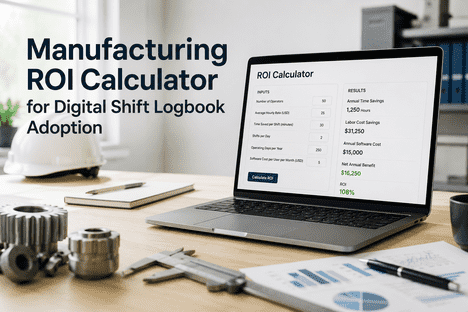
The ROI case for digital shift logbooks extends beyond paper reduction. Fleet operators who deploy production-grade shift logbooks with AI-native capabilities see measurable improvements across four dimensions in the first quarter.
−60–80%
Shift handover time reduction
Structured digital forms with auto-populated telematics data replace paper logs and verbal handovers. Drivers complete shift reports in 2–3 minutes instead of 10–15 with paper.
−40–60%
Unplanned breakdown reduction
AI-native shift logbooks detect patterns in driver-reported issues combined with telemetry data 7–14 days before failure, shifting emergency repairs to planned service.
−30–50%
Data entry & admin labor
Auto-populated telemetry fields, structured form data, and CMMS integration eliminate manual data entry from paper logs — saving 4–8 hours per week per fleet administrator.
3–6 mo
Typical ROI payback
Full investment recovery through reduced admin labor, fewer breakdowns, lower parts rush-order premiums, and extended vehicle component life across the fleet.
Expert Perspective
"The biggest mistake fleet operators make when evaluating shift logbook platforms is treating it as a forms replacement project. It isn't. A production-grade shift logbook is an operations intelligence platform — it standardizes how data enters your fleet management system, feeds predictive models that detect failure patterns, and creates an auditable chain of custody for every vehicle status change between shifts. The platforms that deliver ROI aren't the ones with the best form builder — they're the ones with the deepest integration into telematics, CMMS, and parts systems. If your shift logbook can't create a work order automatically from a driver's brake temperature warning, you've bought a digital clipboard, not a shift logbook."
— Fleet Technology Practice, 2026 industry insight
4–6 wk
quick-start deployment with pre-configured templates
70–90%
reduction in manual data entry with telematics integration
Zero rip
of existing CMMS, telematics, or ERP required
Frequently Asked Questions
Does iFactory Shift Logbook replace our existing CMMS?
No. iFactory Shift Logbook integrates with your existing CMMS rather than replacing it. The shift logbook captures structured vehicle status data, operator observations, and AI-generated maintenance recommendations at the point of shift handover — then writes work orders, inspection records, and maintenance recommendations to your CMMS via API. Your existing work order workflows, parts procurement processes, and maintenance scheduling systems continue operating exactly as today, but with higher-quality, earlier input from the shift logbook layer.
Can iFactory Shift Logbook work with our existing telematics provider?
Yes. iFactory AI's platform is telematics-agnostic and integrates through standard API and J1939 connectors with major telematics providers including Samsara, Geotab, Verizon Connect, Omnitracs, and others. The integration is bidirectional — the shift logbook receives vehicle location, mileage, hours, fault codes, and telemetry data for auto-population, and can send shift log status updates back to the telematics dashboard. No telematics replacement is required.
Does the mobile app work without internet connectivity?
Yes. The iFactory Shift Logbook mobile app includes full offline capability — drivers can complete shift logs, capture photos, record voice notes, and add observations without cellular connectivity. Data syncs automatically when connectivity is restored, with conflict resolution built in. This is essential for fleet operations where vehicles operate in remote areas, underground parking, or other locations with intermittent coverage.
How does shift log data feed into predictive maintenance?
Each shift log entry is structured and tagged by vehicle, component, issue type, and severity. AI models correlate these structured driver observations with telemetry data streams — engine temperature, brake pressure, vibration patterns, fuel consumption. When the AI detects a pattern of similar observations across multiple shifts or vehicles (e.g., repeated brake temperature warnings on a specific route), it generates a predictive alert with a remaining useful life estimate and recommended action. This transforms raw driver observations from isolated data points into fleet-wide predictive intelligence.
What does deployment and onboarding look like for a typical fleet?
iFactory AI offers three deployment paths. Path A (Quick Start, 4–6 weeks) is ideal for fleets wanting immediate digitization of paper shift logs — forms are configured in week 1–2, a single shift pilots in week 3–4, and fleet rollout completes by week 6. Path B (Integrated Deployment, 8–12 weeks) adds telematics integration and CMMS connectivity. Path C (Full Modernization, 10–14 weeks) adds AI-native predictive maintenance and parts inventory integration. Each path includes structured change management: pilot programs, driver training materials, adoption analytics, and ongoing usage monitoring to ensure driver adoption and ROI realization.
Run the Shift Logbook Evaluation Workshop for Your Fleet
iFactory AI's fleet practice runs a 90-minute workshop against your real vehicle classes, telematics coverage, and CMMS configuration. You leave with a defended path recommendation, a deployment timeline, and a cost reduction projection grounded in your fleet's maintenance history.