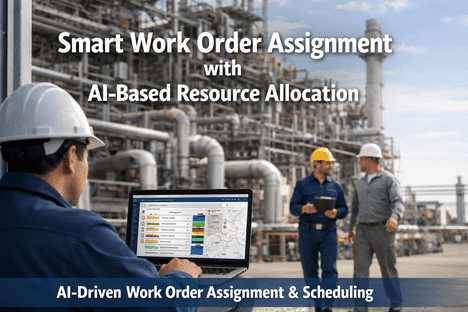
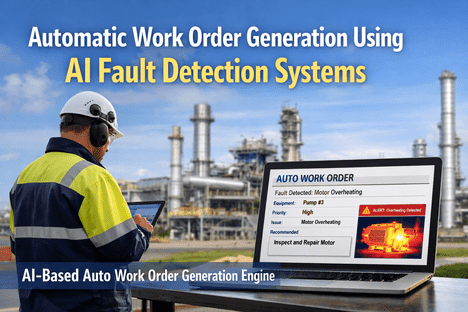
A food processing plant in Michigan ran its maintenance operation the way most plants still do: a supervisor received a phone call or radio message that something was wrong, hand-wrote a work order on a clipboard, walked it to the maintenance office, where a planner assigned it to whoever was available — not necessarily whoever was best qualified or closest. Average time from equipment alarm to technician on-site: 3 hours 42 minutes. Average time from work order creation to closure: 4.6 days. When the plant deployed an AI-driven work order system connected to its IoT sensors and CMMS, the entire workflow inverted. Sensors detected a bearing vibration anomaly on a packaging line conveyor at 2:14 AM. By 2:15 AM, the system had auto-generated a prioritised work order, identified the failure mode from historical patterns, attached the repair procedure and parts list, checked inventory for the replacement bearing (in stock, bin C-17), and assigned it to the technician with the right skill set who was starting the morning shift in four hours. The technician arrived, scanned the QR code, completed the repair in 28 minutes, and closed the work order on his phone. Total time from detection to resolution: 4 hours 43 minutes — including the wait for shift start. The old system would have discovered the problem after the conveyor seized mid-shift.
iFactory AI Maintenance Automation
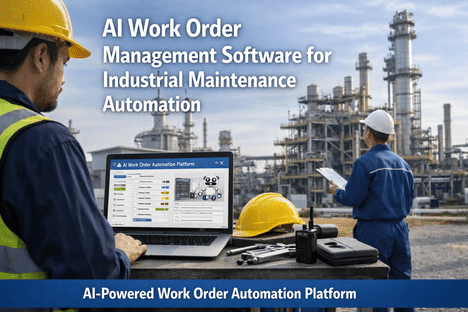
AI Work Order Management Software for Industrial Maintenance Automation
How AI turns sensor alerts into completed repairs — automatically creating, assigning, tracking, and closing work orders without human bottlenecks
65%
Of maintenance teams plan to adopt AI by end of 2026
40%
Reduction in Mean Time To Repair with AI work orders
$260K
Average hourly cost of unplanned downtime in manufacturing
326hrs
Lost annually per plant to unplanned downtime events
The Work Order Problem Every Plant Manager Knows
Maintenance work orders are the backbone of every industrial operation. Yet in most plants, the work order process is still the slowest, most manual, and most error-prone workflow on the floor. Equipment fails. Someone notices. Someone reports it. Someone writes it up. Someone assigns it. Someone finds the parts. Someone does the repair. Someone closes the paperwork. Every handoff is a delay. Every delay is lost production.
The numbers tell the story: 58% of facilities spend less than half their time on scheduled maintenance. The average plant suffers 25 unplanned downtime incidents per month. And the top challenge maintenance leaders cite is not technology — it is lack of resources and a skilled labour shortage that gets worse every year as experienced technicians retire, taking decades of knowledge with them.
The Traditional Work Order Lifecycle — And Where It Breaks
Detect
Operator notices problem visually or by sound. Often missed on off-shifts.
Delay: hours to days
Report
Phone call, radio, or verbal report to supervisor. Details lost in translation.
Delay: 15–60 min
Create
Handwritten or manually typed into CMMS. Incomplete data, wrong asset tags, missing details.
Delay: 30 min–2 hrs
Assign
Planner assigns to whoever is available — not who is best qualified or closest.
Delay: 30 min–4 hrs
Execute
Technician arrives, diagnoses from scratch, hunts for parts manually, improvises repair.
Delay: variable
Close
Paperwork completed hours or days later. Data quality poor. Knowledge lost.
Delay: hours to days
Recognise this workflow? See how AI eliminates every bottleneck in a live demo.
How AI Transforms Every Stage of the Work Order
AI-driven work order management does not just digitise the old process — it replaces it with an automated, intelligent, closed-loop system where sensor data triggers work orders, AI assigns them optimally, knowledge is surfaced at the point of work, and the loop closes itself.
Sensor-Triggered Detection
IoT sensors detect vibration anomalies, temperature drift, pressure drops, or power signature changes — 24/7, across every shift. AI models identify the failure pattern and severity. No human observation required.
Problems detected 30–90 days before failure
AI-Generated Work Orders
The system auto-generates a complete work order: asset ID, failure mode, priority level, repair procedure, required parts, estimated duration, and safety precautions — all pulled from historical data and AI analysis. Zero manual data entry.
Work order creation time: seconds, not hours
AI-Optimised Assignment & Scheduling
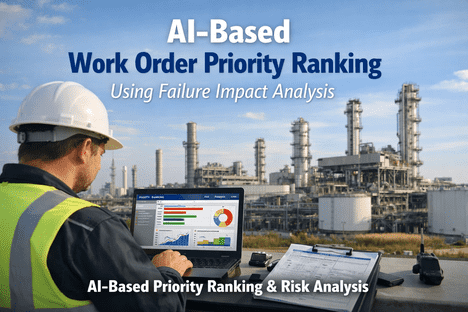
AI analyses technician availability, skill certifications, current workload, proximity, and asset criticality — then assigns the work order to the optimal person at the optimal time. Parts are pre-staged from inventory automatically.
Right technician, right parts, right time — every time
AI-Assisted Execution & Knowledge Surfacing
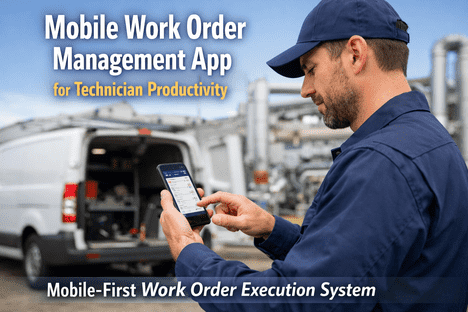
The technician receives the work order on their mobile device with step-by-step repair instructions, past repair history for that specific asset, and AI-suggested time estimates. Tribal knowledge from retired experts is preserved and surfaced at the point of work.
MTTR reduced by up to 40%
Automated Closeout & Continuous Learning
Technician closes the work order on their phone with completion notes and photos. The system auto-updates asset history, recalculates maintenance schedules, adjusts failure predictions, and feeds the data back into the AI model. The system gets smarter with every repair.
100% data capture, zero paperwork
The Measurable Impact of AI Work Order Management
The business case for AI-driven work orders is not theoretical — it is documented across thousands of industrial deployments. Here is what the data shows when you replace manual workflows with intelligent automation.
Before AI vs After AI — Maintenance KPI Shifts
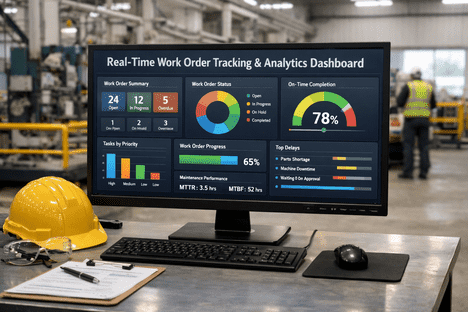
Mean Time To Repair
Up to 40% reduction
Unplanned Downtime
Up to 65% reduction
Work Order Cycle Time
Days to hours
Maintenance Cost
25% cost reduction
Five Capabilities That Define AI-Powered Work Order Software
Not all CMMS platforms are equal. AI-powered work order management requires specific capabilities that separate intelligent automation from digitised paperwork. Here is what to look for.
1
Sensor-to-Work-Order Automation
IoT sensor alerts automatically generate prioritised work orders with failure mode, asset details, and repair procedures attached. No human triage required. The gap between detection and action shrinks from hours to seconds.
Eliminates manual reporting and triage delays
2
Intelligent Scheduling & Assignment
AI analyses technician skills, certifications, workload, shift schedules, and geographic proximity to assign every work order to the optimal person. Dynamic re-scheduling when priorities shift or emergencies arise.
Right person, right skill, right time
3
Knowledge Capture & AI Surfacing
Past repair procedures, technician notes, failure history, and parts usage are captured automatically with every work order closure. AI surfaces this knowledge at the point of work — so every technician has the combined experience of the entire team.
The top AI benefit reported by maintenance teams
4
Predictive Parts & Inventory Integration
When a work order is generated, the system checks parts inventory in real time. If the required part is in stock, it is pre-staged. If not, a purchase order is triggered automatically. Dynamic safety stock models reduce parts-out-of-stock incidents by 55%.
Parts ready before the technician arrives
5
Mobile-First Execution & Offline Capability
Technicians receive, execute, and close work orders entirely from their mobile device — even in areas with no connectivity. QR/NFC scanning for asset identification, photo documentation, voice-to-text notes, and digital checklists replace every piece of paper.
Works anywhere on the plant floor
Want to see these capabilities in action on your own equipment data? Talk to our maintenance automation specialists.
Who Benefits Most from AI Work Order Automation
AI work order management delivers value in any asset-intensive operation, but certain environments see outsized returns because of equipment complexity, shift coverage challenges, or the criticality of uptime.
Manufacturing Plants
CNC machines, robotic cells, assembly lines, packaging equipment. High asset density, multi-shift operations, and tight production schedules make manual work order routing a critical bottleneck.
Food & Beverage Processing
Regulatory compliance documentation, hygiene-critical equipment, and continuous production lines where downtime means spoiled product and audit risk.
Energy & Utilities
Turbines, transformers, pumps, and grid infrastructure. Remote assets, regulatory mandates, and safety-critical equipment where failures have cascading consequences.
Oil, Gas & Chemicals
Extreme operating conditions, hazardous environments, and equipment where failures carry safety and environmental risk beyond production loss.
Fleet & Logistics Operations
Vehicle maintenance, warehouse equipment, conveyor systems, and cold-chain infrastructure where asset availability directly determines delivery commitments.
Frequently Asked Questions
How does AI work order software integrate with our existing CMMS?
Modern AI work order platforms are designed to integrate with existing CMMS, ERP, MES, and SCADA systems via standard APIs. Predictions and auto-generated work orders flow directly into your existing workflow — no separate dashboards or manual re-entry required. Most integrations deploy in 2–4 weeks.
What if our equipment is old or does not have built-in sensors?
Non-invasive retrofit sensors (vibration, temperature, current, acoustic) connect to virtually any equipment regardless of age or manufacturer. Edge gateways normalise data from legacy PLCs via protocols like Modbus that have been standard since 1979. Some of the highest ROI comes from monitoring aging, failure-prone assets that lack native connectivity.
How quickly can we see results from AI work order automation?
Pilot deployments on 5–10 critical assets deliver measurable results within 4–8 weeks — typically by identifying previously unknown failure patterns and eliminating manual triage delays. Full facility rollouts typically take 8–14 weeks with structured implementation. ROI is visible within the first 45–90 days of sensor deployment.
What does AI work order software cost?
Cloud-based platforms typically use subscription pricing of $2K–$10K per month depending on asset count and feature set. Pay-per-asset models start as low as $50–100 per asset per month. Initial investments of $50K–$500K for 10–20 assets commonly generate $1–3 million in annual operational improvements through avoided downtime and reduced maintenance costs.
Will AI replace our maintenance team?
No. AI augments your team — it eliminates the manual, low-value tasks (data entry, paperwork, triage, parts hunting) so technicians spend more time on actual repairs and less time on administrative overhead. With 65% of maintenance teams planning AI adoption by end of 2026, the goal is making existing teams more productive, not replacing them.
Ready to Automate Your Work Orders?
Every Minute Between Detection and Repair Is Money Lost. AI Closes That Gap.
iFactory's AI work order platform connects to your sensors, generates prioritised work orders automatically, assigns them to the right technician with the right parts, and closes the loop — so your maintenance team fixes problems instead of chasing paperwork.