Your maintenance team completed 847 work orders last quarter. But how many were completed on time? How many sat in a queue for days before anyone noticed? How many emergency breakdowns happened while planned tasks were still waiting for parts? If you cannot answer those questions in under ten seconds, you do not have a work order tracking problem — you have a visibility problem. And visibility problems cost industrial plants an average of $125,000 per hour of unplanned downtime. Real-time work order dashboards turn maintenance from a black box into a live operation you can see, measure, and optimise minute by minute.
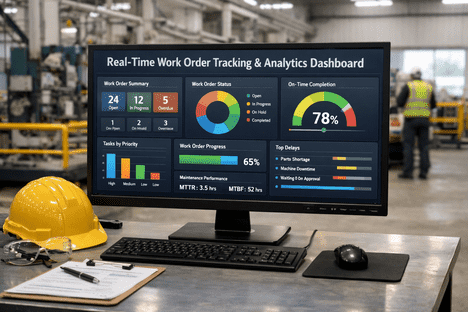
Real-Time Work Order Tracking & Analytics Dashboard
Stop Guessing. Start Seeing Every Work Order in Real Time.
AI-powered dashboards that track every work order from request to close-out — showing status, delays, technician workload, and maintenance KPIs live across your entire operation
$125K
Avg. cost per hour of unplanned downtime
72%
Of plants have undocumented fixes hiding true downtime
800+
Hours of unplanned downtime per year in avg. facility
40%
Maintenance cost reduction with predictive analytics
The Hidden Cost of Not Tracking Work Orders in Real Time
Most maintenance teams track work orders in spreadsheets, whiteboards, or legacy systems that show you what happened last week — not what is happening right now. That delay between reality and visibility is where money disappears. A technician finishes a repair but forgets to close the ticket. A high-priority task sits in queue because nobody saw it come in. A recurring failure pattern goes unnoticed because the data lives in three different places. These are not edge cases — they are the daily reality in plants without real-time dashboards.
How Blind Spots in Work Order Tracking Drain Your Budget
-$260K/hr
Unplanned Downtime Losses
-38%
Wasted Wrench Time on Low-Priority Tasks
-30%
Hidden Downtime from Undocumented Fixes
1.5-3x
Emergency Repair Labour Premium
+40%
Cost Savings with Real-Time AI Dashboards
Sources: ABB Reliability Report, Siemens True Cost of Downtime Report, Aberdeen Group Research
What a Real-Time Work Order Dashboard Actually Shows You
A real-time dashboard is not a prettier version of your spreadsheet. It is a live operational nerve centre that pulls data from every work order, every technician action, and every asset event — and turns it into decisions you can make right now, not next quarter.
OpenIn ProgressCompletedOverdue
Live Work Order Status Board
See every work order across your facility in one view — open, in progress, completed, and overdue. Status updates automatically as technicians take action. No manual dropdown changes. No chasing people for updates.
Technician Workload & Capacity View
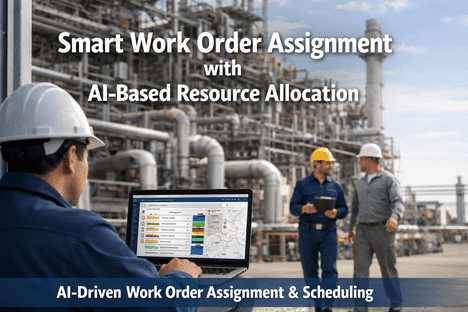
See who is overloaded and who has capacity — live. Balance workloads instantly instead of discovering at end-of-shift that one technician handled 12 tasks while another completed two.
Maintenance KPI Scoreboard
Track MTTR, PM completion rate, wrench time, planned-to-reactive ratio, cost per work order, and backlog age — updated continuously from closed work orders. No spreadsheet assembly. Leadership sees the same data as the floor.
Want to see what your maintenance data looks like on a live dashboard? Book a personalised demo.
The Work Order Lifecycle — From Request to Intelligence
A real-time tracking system captures every transition in the work order lifecycle automatically — creating the data trail that powers your KPIs, compliance records, and predictive insights. Each stage generates the analytics that make your next decision better than your last one.
1
Request Received
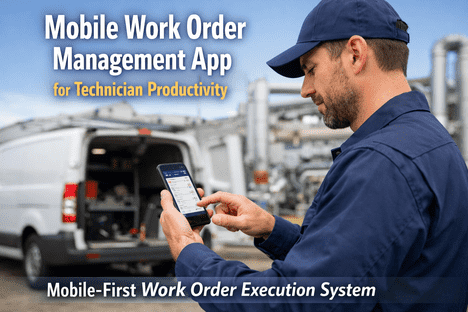
Work order enters via mobile app, IoT sensor alert, PM schedule trigger, or manual request. Timestamped automatically.
Tracks: Response time from request to acknowledgement
2
Classified & Prioritised
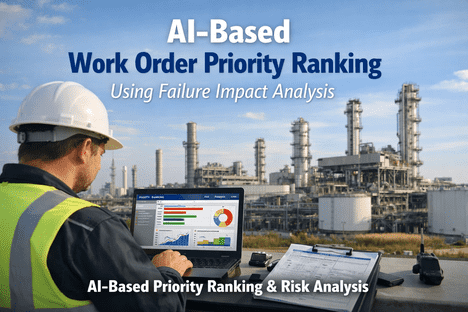
AI or supervisor classifies by type (corrective, preventive, emergency, predictive) and assigns priority. Critical assets auto-escalate.
Tracks: Classification accuracy, priority distribution
3
Assigned & Dispatched
Matched to the right technician based on skill, certification, location, and current workload. Full task details sent to mobile.
Tracks: Assignment-to-arrival time, technician utilisation
4
In Progress — Live Tracking
Status updates automatically as the technician scans parts, logs time, attaches photos. Dashboard reflects progress without manual changes.
Tracks: Wrench time, parts consumed, labour hours
5
Completed & Verified
Supervisor reviews, approves close-out. Costs finalised. Data feeds into asset history, compliance records, and KPI calculations permanently.
Tracks: First-time fix rate, total cost per work order
6
Intelligence & Feedback Loop
Every closed work order teaches the system. AI identifies recurring failures, flags assets nearing end-of-life, and recommends PM adjustments.
Tracks: Failure patterns, MTBF trends, cost-per-asset trajectory
See It Live
Your Work Orders Are Already Telling a Story. Are You Listening?
iFactory's AI-powered dashboard turns every work order into actionable intelligence — tracking status, workload, delays, costs, and performance patterns across your entire operation in real time.
25%
Reduction in unplanned downtime
15-25%
Lower maintenance cost per sq ft in 12 months
80%+
Planned vs reactive ratio achieved
Zero
Manual status updates from technicians
Five KPIs Your Dashboard Should Track Automatically
The difference between a dashboard that looks good and one that drives decisions is the KPIs it tracks. These five metrics — calculated automatically from work order data — give maintenance leaders the visibility to shift from reactive firefighting to proactive operations.
01
PM Completion Rate
Target: 90%+
The most commonly tracked maintenance KPI, used by 56% of facilities. Measures whether scheduled preventive tasks are actually getting done — the single strongest predictor of whether your plant runs on prevention or emergencies.
02
Work Order Backlog
Target: 2-4 weeks
Tracked by 53% of facilities as their second-most important metric. A growing backlog signals your team is falling behind — either understaffed, under-resourced, or spending too much time on reactive work.
03
Mean Time to Repair
Target: Declining trend
Measures how quickly your team resolves issues once work begins. Improving MTTR signals better diagnostics, parts availability, and technician skill. A rising MTTR often means ageing equipment or knowledge gaps.
04
Planned vs Reactive Ratio
Target: 80:20 or better
World-class maintenance organisations run 80%+ planned work. If your ratio is 50:50 or worse, every emergency is stealing time from the preventive work that would have prevented it — a self-reinforcing downward spiral.
05
Cost Per Work Order
Target: Stable or declining
Combines labour, parts, and contractor costs per completed task. Rising cost-per-WO often flags inefficient routing, parts hoarding, or equipment that costs more to maintain than to replace.
Industries Where Real-Time Tracking Delivers the Biggest Impact
Every facility with maintenance staff benefits from real-time work order tracking. But the ROI is largest where downtime is most expensive, compliance is most demanding, and maintenance teams are most stretched.
Manufacturing & Production
Downtime cost: $260K+/hr avg.
High-speed production lines where a single unplanned stop cascades into missed deliveries, idle labour, and scrap. Real-time tracking ensures PM compliance stays above 90% and emergency work orders get routed in seconds, not hours.
Oil, Gas & Energy
Downtime cost: $500K+/hr avg.
Safety-critical environments where work order documentation must be audit-ready at all times. Dashboards track permit-to-work status, compliance completion, and safety task prioritisation in real time.
Automotive & Assembly
Downtime cost: $2M+/hr avg.
The most expensive downtime in any industry. Every minute of unplanned stoppage costs thousands. Real-time dashboards give shift supervisors instant visibility into maintenance status across every line.
Food, Pharma & Healthcare
Compliance: GMP / HACCP / FDA
Regulated environments where maintenance records are legal documents. Real-time tracking creates timestamped, tamper-proof work order histories that satisfy auditors without manual log assembly.
Frequently Asked Questions
How quickly can a real-time dashboard be deployed?
Most facilities go live within 2-4 weeks. The dashboard connects to your existing work order data — no IoT sensors, no hardware installation, and no historical data migration required for initial deployment. Technicians start generating live data from day one through their normal mobile workflow.
Do technicians need to manually update work order status?
No. The system infers status from the technician's natural actions — tapping start, arriving at the asset location, scanning a part, attaching a photo, tapping complete. Every workflow action the technician already performs generates the status update automatically.
What KPIs does the dashboard calculate automatically?
Core KPIs include PM completion rate, work order backlog, mean time to repair (MTTR), planned-to-reactive ratio, wrench time, cost per work order, response time, and emergency ratio. All calculated from work order status transitions — no manual data entry required.
Can the dashboard integrate with our existing CMMS or ERP?
Yes. iFactory connects to all major CMMS platforms, ERP systems, IoT sensor networks, and building management systems via standard APIs. Data flows bidirectionally so your dashboard reflects the complete operational picture across all systems.
What is the ROI of real-time work order tracking?
Facilities implementing real-time tracking report a predictable improvement sequence: response time improves in month one, PM compliance rises by month three, emergency ratio drops by month six, and total maintenance cost per square foot decreases 15-25% within twelve months. The dashboard cost is a fraction of a single prevented downtime event.
Ready to See Everything?
Every Work Order. Every Technician. Every KPI. One Live Dashboard.
Stop assembling spreadsheets. Start making decisions from live data. iFactory gives your maintenance team the visibility to prevent problems — not just report them after the damage is done.
56%
Of facilities track PM completion as top KPI
67%
Still rely on reactive maintenance
$125K
Average hourly cost of unplanned downtime
4 wks
Average time to full dashboard deployment