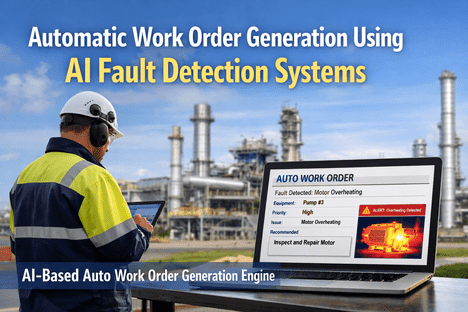
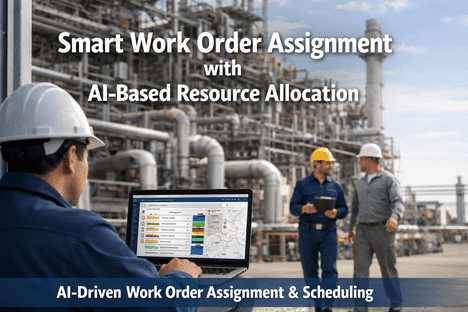
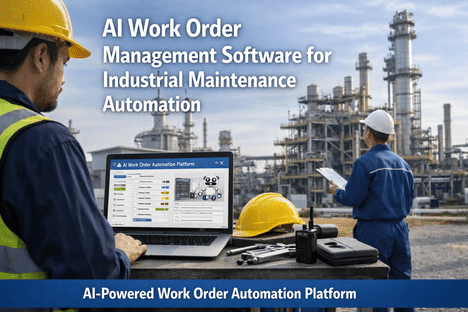
At 3:47 AM on a Tuesday, a compressor at a petrochemical facility began exhibiting a subtle change no human would have caught. Vibration on the drive-end bearing increased by 0.3 mm/s — well within normal range. Lube oil return temperature rose 2 degrees Celsius — barely noticeable on a trend chart. Motor current draw during loaded operation climbed 1.7% — invisible to the operator console. Each reading alone meant nothing. Together, they formed a failure signature the AI had learned from 14,000 similar compressor datasets across 340 facilities. At 3:48 AM — 61 seconds after the pattern crossed the confidence threshold — the system auto-generated a prioritised work order. It contained the diagnosed failure mode (inner race bearing defect, stage 2), the specific bearing part number, the recommended repair window (within 21 days), the estimated labour hours, and the name of the technician with the right certification who was scheduled for the next available shift. No one woke up. No one triaged an alarm. No one typed a single character. The work order existed — complete, accurate, and actionable — before any human knew there was a problem to solve.
iFactory AI Fault-to-Fix Automation
Automatic Work Order Generation Using AI Fault Detection Systems
From sensor anomaly to complete, pre-filled, assigned work order — in under 60 seconds, with zero human input
97%
Failure prediction accuracy in leading AI implementations
60sec
Detection to complete work order — fully automated
30–90d
Advance warning before functional failure
$7
Return for every $1 invested in predictive + auto WO
Why Manual Fault Response Is the Most Expensive Workflow in Your Plant
In most industrial facilities, fault detection and work order creation are still two disconnected processes operated by different teams using different systems. A sensor trips an alarm or a threshold is breached. An operator or analyst notices — eventually. They interpret the data, decide whether it is urgent, and manually create a work order in the CMMS. Then a planner reads that work order, interprets it again, finds available resources, and assigns it. Every step is a handoff. Every handoff is a delay. Every delay lets the fault progress closer to failure.
The result: 80% of organisations still struggle to turn raw sensor data into clear action triggers. The average time from fault detection to work order assignment is measured in hours to days, not minutes. And 25 unplanned downtime incidents per month per plant show that the current approach does not work — not because the data is missing, but because the response pipeline is broken.
The Gap Between Detection and Action
Sensor Detects Anomaly
T = 0
Manual Process: 4–72 hours of delays across triage, reporting, WO creation, assignment
Technician Arrives
T = hours to days
vs
AI Detects + Creates WO
T = 0 to 60 sec
Auto-assigned, parts staged, tech notified
Technician Arrives Prepared
T = next planned window
How much does that gap cost your plant every month? Get a free fault-response audit.
What an Auto-Generated Work Order Contains
An AI-generated work order is not a simple alert with a timestamp. It is a complete, actionable maintenance instruction package created in seconds — containing everything a technician needs to arrive, diagnose, repair, and close without any additional research or guesswork.
Anatomy of an AI-Generated Work Order
Asset Identification
Auto-populated asset ID, location, equipment type, OEM data, and criticality rating from the asset registry
Diagnosed Fault Type
AI-identified failure mode — e.g., "inner race bearing defect, stage 2" — from pattern matching across thousands of similar assets
Severity & Priority
Confidence score, severity classification (P1–P5), and Remaining Useful Life estimate with recommended repair window
Repair Procedure
Step-by-step instructions pulled from historical repairs on the same asset type, including AI-suggested best approach
Parts & Materials
Required parts with part numbers, current inventory status, bin location, and auto-PO if stock is insufficient
Labour Estimate
Estimated hours based on historical repair times for this fault type on this equipment class
Technician Assignment
Optimal technician selected by AI based on skill certification, current workload, shift schedule, and proximity
Safety & Compliance
LOTO procedures, PPE requirements, permit-to-work references, and regulatory compliance tags auto-attached
The AI Fault Detection Engine — How It Works
Automatic work order generation requires an AI system that does more than trigger alarms when thresholds are breached. It must understand what normal looks like for each individual asset, detect the subtle multi-parameter patterns that precede failure, classify the fault type, and estimate how much time remains before functional failure.
The AI Learns What "Normal" Looks Like
During the first 4–8 weeks, the AI ingests sensor data — vibration, temperature, pressure, current, acoustic — and builds a unique baseline profile for each asset under various operating conditions. Unlike static thresholds, this baseline is dynamic and adapts to load changes, ambient conditions, and production cycles.
Multi-Parameter Pattern Recognition
The AI continuously compares live sensor readings against the learned baseline. Unlike single-threshold alarms, it correlates multiple parameters simultaneously — a small vibration increase plus a slight temperature rise plus a minor current change may individually mean nothing, but together form a failure signature invisible to human analysis.
Identifying What Is Failing and Why
Once an anomaly is confirmed, the AI classifies the specific fault type — bearing defect, misalignment, imbalance, looseness, lubrication degradation, cavitation — by matching the pattern against libraries of 70,000+ failure signatures from similar equipment worldwide. The diagnosis is specific, not generic.
Calculating Remaining Useful Life
The AI estimates how much operational life the component has left before functional failure — expressed in days, operating hours, or production cycles. This determines the urgency of the work order and the optimal repair window. Accuracy ranges from 80–97% depending on data quality and failure mode.
Complete Work Order Created in Seconds
When the confidence threshold is crossed, the system auto-generates a fully populated work order in the CMMS — with all eight fields from the anatomy above pre-filled. The technician, parts, and schedule are all selected before any human is notified. The entire sequence from detection to WO creation takes under 60 seconds.
The Sensor Inputs That Drive Fault Detection
AI fault detection is only as good as the data it receives. These are the five primary sensor types that feed industrial fault detection systems — and what each one reveals about equipment health.
The most widely used technique. Detects bearing defects, misalignment, imbalance, looseness, gear mesh faults, and resonance issues. Frequency-domain analysis identifies the specific component causing the vibration signature.
Detects: bearing defects, misalignment, imbalance, looseness, gear faults
Detects hot spots from friction, electrical faults, insulation breakdown, blocked cooling, and overloaded circuits. Non-contact measurement allows monitoring of energised equipment without shutdown.
Detects: overheating, electrical faults, insulation failure, blocked cooling
Motor Current Analysis
18%
Analyses electrical current signatures to detect rotor bar cracks, stator winding faults, eccentricity, and load-related mechanical issues. Requires no additional hardware on motors with existing power monitoring.
Detects: rotor defects, winding faults, mechanical load changes
Acoustic / Ultrasonic
12%
Detects compressed air leaks, steam trap failures, electrical discharge (arcing), and early-stage bearing defects through high-frequency sound patterns inaudible to the human ear.
Detects: leaks, arcing, cavitation, early bearing wear
Analyses lubricant condition for metal wear particles, contamination, viscosity changes, and chemical degradation. Online sensors now provide continuous monitoring versus traditional lab-based sampling intervals.
Detects: wear debris, contamination, lubricant degradation
Already have sensors deployed? Talk to us about connecting them to auto-WO generation.
The ROI of Closing the Fault-to-Fix Loop
When the gap between fault detection and completed repair collapses from days to hours, the financial impact compounds across every maintenance metric. Here is what documented deployments show.
$7
return per $1 invested
IoT + AI fault detection + auto work order generation delivers 7:1 average ROI within 12–18 months
40%
faster repairs
Technicians arrive with diagnosis, parts, and procedures — no investigation from scratch
65%
less unplanned downtime
Faults caught and addressed weeks before they cause production-stopping failures
55%
fewer parts stockouts
Auto-PO triggers when predicted repairs require parts not currently in inventory
Frequently Asked Questions
How accurate is AI fault detection compared to manual inspections?
Leading AI fault detection systems achieve 80–97% prediction accuracy, compared to manual inspection catch rates that vary widely depending on technician experience and inspection frequency. More importantly, AI monitors continuously 24/7 across all shifts, while manual inspections are periodic snapshots. The AI also detects multi-parameter patterns that no individual human analyst would correlate.
Can auto-generated work orders be reviewed before execution?
Yes. Most deployments include a configurable approval workflow. Low-severity work orders (P4/P5) can execute fully autonomously. High-severity or safety-critical work orders (P1/P2) can require supervisor approval before technician dispatch — while still being auto-created with all details pre-filled. The approval adds minutes, not hours, because the work order is already complete.
Does this work with our existing CMMS and sensors?
Yes. Auto-generated work orders flow into your existing CMMS via standard APIs. The AI platform connects to existing condition monitoring sensors, SCADA data, and PLC outputs — as well as retrofit IoT sensors on unmonitored equipment. No CMMS replacement is required. The AI layer sits on top of your existing infrastructure.
How long does it take for the AI to learn our equipment?
Baseline learning typically takes 4–8 weeks of normal operation. During this period, the system collects operating data and builds asset-specific models. However, pre-trained models for common industrial equipment (pumps, motors, compressors, fans, conveyors) can deliver fault detection from day one — the baseline period refines accuracy to your specific operating conditions.
What about false positives? Will we be flooded with unnecessary work orders?
AI confidence thresholds are configurable by asset criticality. Work orders are only generated when the pattern confidence crosses your defined threshold. Systems continuously learn from confirmed and false alerts, reducing false positives over time. Typical mature deployments report false positive rates below 5% — significantly lower than threshold-based alarm systems.
Ready to Close the Fault-to-Fix Gap?
Your Sensors Already Know What Is Failing. Let AI Write the Work Order.
iFactory connects your condition monitoring data to an AI fault detection engine that auto-generates complete, pre-filled, assigned work orders — so your maintenance team fixes problems before they become failures.