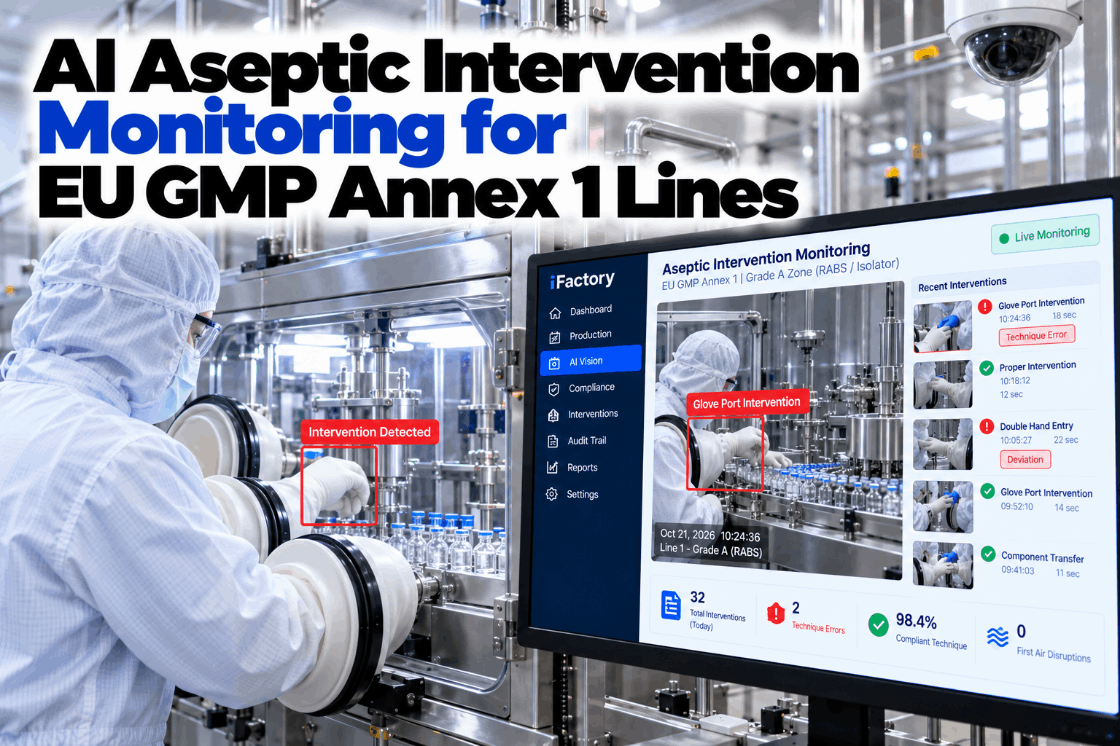
On a RABS or isolator filling line, every hand that goes through a glove port is a contamination risk. EU GMP Annex 1 expects each intervention to be on an approved list, done with good aseptic technique and recorded in the batch record with its time, duration and operator. On a busy shift, much of that still depends on paper logs and memory. Aseptic intervention monitoring with AI vision records each glove-port event as it happens and flags technique slips for QA review. See it on a filling line in a short intervention demo.
AI VISION · STERILE MANUFACTURING
Log Every Glove-Port Intervention Without Adding Paperwork
iFactory Vision Safety Monitoring records each RABS and isolator intervention with its time, type and duration, and flags technique errors such as broken first air. Each event gets an audit-trail record that QA can review alongside the batch record and the media fill intervention list.
Filling line 2 · RABSBatch B-2417
Glove-port interventions this shift
06:14 · GP3Inherent · stopper bowl refill0:48
06:52 · GP5Corrective · fallen vial removed1:36Flag: arm over open vials
07:20 · GP2Inherent · settle plate change0:55
EU GMP ANNEX 1 INTERVENTIONS
What the 2022 Annex 1 Asks For
The revised Annex 1 was published in August 2022 and came into force on 25 August 2023. Several clauses deal with interventions directly. Together they expect an approved list of interventions, a record of each one in the batch record, regular observation of how operators work, and a contamination control strategy (CCS) that ties it all together. The six points below are the ones intervention logging supports. Check your own reading of them with our support team.
8.16
Approved listAn authorised list of allowed and qualified interventions, both inherent and corrective. Non-qualified ones are for exceptional cases and are assessed by the quality unit for batch disposition.8.17
Batch record entryInterventions and stoppages are recorded in the batch record with the time, the duration and the operators involved.8.19
Regular observationAseptic operations, including APS, are observed by people with aseptic expertise to check operator behaviour.7.18
Movement and first airMovement is slow, controlled and methodical, and the path of first air is not obstructed.4.21
Glove systemsGloves are visually checked with each use and integrity tested at defined points, with replacement frequency set in the CCS.2.3
Contamination control strategyA CCS across the facility that is actively reviewed and drives continual improvement.
INHERENT VS CORRECTIVE
Two Kinds of Intervention, Two Kinds of Review
The Annex 1 glossary separates the two. Inherent interventions are an integral part of the process, needed for set-up, routine operation or monitoring. Corrective interventions fix or adjust the process while it runs and do not happen at a set frequency. Both must be on the approved list, but corrective ones usually tell you more about the health of the line. Map your own list in an intervention workshop.
INHERENT INTERVENTIONS
- Aseptic assembly of filling parts at line start
- Stopper bowl or container replenishment
- Environmental monitoring: settle plates, contact plates
- Required by procedure, so the count per batch is predictable
- Review question: was it done as the procedure says?
CORRECTIVE INTERVENTIONS
- Clearing a stopper or container jam
- Removing fallen or broken containers
- Adjusting a sensor or fill needle mid-run
- Unplanned, so the count and type vary by batch
- Review question: why did it happen and is it rising?
RABS GLOVE PORT MONITORING
What the Camera Records for Each Event
Cameras sit outside the barrier and look through the panels at each glove port, so nothing new is added inside grade A. When a gloved hand enters the barrier, the system opens an event. It labels the type against your approved list, times it and links it to the batch running at that moment. The matrix shows a typical setup for a RABS vial line. Talk through your own barrier layout with our support engineers.
ASEPTIC TECHNIQUE ERRORS
Six Technique Slips the AI Flags
Good aseptic technique has not changed much since FDA's 2004 aseptic processing guidance listed it: move slowly and deliberately, keep the body out of the path of unidirectional airflow, and touch sterile materials only with sterile tools. Annex 1 says the same in 7.18 and asks for gloves to be disinfected regularly during operations in 7.16. The flags below are prompts for review, not findings. Walk through each one in a technique review.
FA
First air brokenHand or sleeve passes between the HEPA supply and open product or stoppers
OC
Arm over open containersReaching across open vials or the stopper bowl instead of around them
GS
Glove sanitising skippedHand enters the barrier without the disinfection step your procedure requires
MV
Fast or sweeping movementMovement speed well above the site baseline for that intervention type
TL
Long dwell timeIntervention runs well past the time set for it on the approved list
NL
Not on the listActivity that does not match any approved intervention, sent to QA at once
A Batch Intervention Summary Ready Before QA Asks
At the end of a batch, QA can see every intervention, its type and duration, and any technique flags in one place. Reviewers spend their time on the events that matter, not on piecing together paper logs.
QA review · Batch B-2417
QA reviewerSummarise the interventions for B-2417.
iFactoryFourteen in total: eleven inherent, three corrective, all on the approved list. Two technique flags, one first-air break at GP5 and one skipped glove sanitise at GP2.
QA reviewerAnything not covered by the last media fill?
iFactoryFill needle adjustment happened twice. It is not on the current APS intervention list, so I have raised it for the APS review.
ISOLATOR INTERVENTION LOGGING
From Glove Port to Batch Disposition
Each event moves through the same five steps, whether it happens at a RABS glove port or an isolator. The AI does the counting and timing. People make every quality decision, including how a flagged event affects batch disposition. Set up the review flow with our QA team.
1DetectHand enters a glove port, event opens with time and port
2ClassifyMatched to an approved inherent or corrective intervention
3CheckArm path, first air, glove step and dwell time reviewed
4RecordAudit-trail entry linked to batch, line state and operator
5ReviewQA assesses flags and off-list events before disposition
MEDIA FILL INTERVENTION RECORD
Check Production Against Your APS Intervention List
Annex 1 expects the APS to include inherent and corrective interventions that represent the routine process, at a similar frequency, with each one recorded with its start and end time and the person involved. It also says the APS should not be used to justify practices that carry needless contamination risk. A count of real interventions shows whether your media fill still reflects the line. The chart is an illustration. Build yours with an APS review.
Corrective interventions · last 20 batchesIllustrative example
Stopper jam cleared18
Fallen vial removed12
Sensor adjusted6
Fill needle adjusted4
ANNEX 1 VIDEO EVIDENCE
What the Guidance Says About Cameras and Video
Annex 1 does not require AI or video monitoring of interventions, and no vision system replaces the observation by aseptic experts that 8.19 asks for. It does mention cameras and recording in a few places, and FDA's 2004 guidance goes a step further for media fills. These are the passages worth knowing. Discuss how they apply to your site with our compliance team.
Annex 1 · 4.17
Observation without entryFacilities should allow production to be observed from outside grade A and B, for example through windows or remote cameras. Applies to new builds and refurbishments.Annex 1 · 4.15
Airflow video retainedVideo recordings of airflow visualisation studies should be retained, including studies that simulate operator interventions.Annex 1 · 2.1
Consider new technologyBarrier systems, robotics and continuous monitoring systems should be considered to increase product protection.FDA 2004 · IX.A
Media fill videoVideo recording of a media fill may serve as a useful aid in spotting personnel practices that could harm the aseptic process.
ASEPTIC OPERATOR BEHAVIOR AND PRIVACY
Cameras That Operators and Works Councils Can Accept
Video of named operators is personal data under the GDPR. The EDPB's video device guidelines (3/2019) stress that video must be necessary for its purpose. In Germany, works councils have a say over technical devices suitable for monitoring employee behaviour or performance. Plan a data protection impact assessment and agree the setup with employee representatives before go-live. Start that plan with our deployment team.
Purpose stated up frontProduct protection and GMP records, not performance scoring
No face recognitionOperators linked through the shift roster or badge sign-on
Barrier view onlyCameras frame glove ports and the critical zone, not the room
Clip retention set by QAShort by default, longer only for flagged or investigated events
FILL FINISH COMPLIANCE AND ALCOA+
Event Records Built for Data Integrity
If an intervention record supports batch disposition, it is GMP data. It has to meet ALCOA+ like any other record, and the system that produces it should be validated as a computerised system under Annex 11 and, for US products, 21 CFR Part 11. Here is how each event record maps to the principles. Get a sample record from our support team.
AttributableEach event carries line, port, batch and operator from the roster
ContemporaneousWritten the moment the hand leaves the barrier, with a synced clock
OriginalSource clip and event kept together; edits leave the original intact
Accurate and completeEvery glove-port entry counted, including ones the AI cannot classify
ConsistentSame type labels as your approved list and batch record
Enduring and availableRetained for the record period and retrievable for inspection
GRADE A ZONE SURVEILLANCE CHECKLIST
Intervention Review Checklist for Each Batch
Use this list when you review the intervention summary for a batch. Tick each item as you go. It works with or without AI logging and fits alongside your existing batch record review. Adapt it with our QA specialists.
TURNKEY AI DEPLOYMENT
Cameras, Edge Server and Audit Trail in One Package
iFactory delivers intervention monitoring as a turnkey bundle. Cameras are mounted outside your RABS or isolator, and a pre-configured NVIDIA AI server ships racked and ready with the intervention and technique models pre-loaded, so video stays on site. You rack it, plug in power and Ethernet, and the AI is live. Ask our support team to scope it for your filling line.
What's Included
- Pre-configured NVIDIA AI edge server, racked and ready
- Cameras mounted outside the barrier, one view per port group
- Intervention models tuned to your approved list
- PLC and MES links for line state and batch ID
- Audit-trail event log with QA review workflow
- APS intervention coverage report
- 24×7 remote monitoring of models and hardware
Live in 6–12 weeks
Wk 1–4
Survey and Install
Camera views agreed with QA and employee representatives, server and cameras installed, PLC and MES linked.
Wk 5–8
Tune and Shadow
Models trained on your interventions and run silently while QA compares them with paper logs.
Wk 9–12
Validate and Go Live
Validation protocol run, QA reviewers trained, batch summaries switched on.
HOW iFACTORY FITS
Sterile Manufacturing AI That Supports QA, Not Replaces It
iFactory gives QA a complete, timed record of what happened at each glove port, and leaves every quality judgement with people. Map out a first line in a pilot call.
1
Logs every intervention. Time, type, duration, port and operator for each RABS or isolator entry.
2
Flags technique slips. First air breaks, arms over open containers and skipped glove sanitising go to QA.
3
Keeps an audit trail. Each event is a traceable record ready for batch review.
4
Checks APS coverage. Real interventions are compared with your media fill intervention list.
1000+
Industrial clients running iFactory
99.9%
Platform uptime for continuous lines
6-12 wks
From racked server to live batch summaries
FREQUENTLY ASKED QUESTIONS
What QA and Production Leaders Ask About Intervention Monitoring
Does EU GMP Annex 1 require AI or video monitoring of interventions?
No. Annex 1 requires an approved list of interventions, a batch record entry for each one with time, duration and operators, and regular observation of aseptic operations by experts. It mentions remote cameras for observing production from outside grade A and B, and asks sites to consider continuous monitoring technology. AI vision is one way to make the required records more complete. It is not a requirement.
What is the difference between inherent and corrective interventions?
Inherent interventions are part of the process by design, such as aseptic assembly, container replenishment and environmental sampling. Corrective interventions fix or adjust the process during the run, such as clearing a jam or removing a fallen vial. Both must be on the approved list and both are recorded, but corrective ones vary by batch and are often the better signal of line problems.
Does the AI decide whether a batch can be released?
No. The system counts, times and classifies interventions and flags possible technique slips. QA reviews every flag and off-list event and decides what it means for batch disposition, as Annex 1 8.16 expects. The AI makes the review faster and more complete. It does not make the decision.
How do you handle operator privacy and works councils?
Cameras frame the barrier and glove ports, not faces or the wider room, and operators are linked through the shift roster rather than face recognition. Clip retention is set by QA and kept short unless an event is under review. We recommend a data protection impact assessment and an agreement with employee representatives, such as a works council, before go-live.
How does it help with media fills?
It gives you a real count of interventions by type and frequency across production batches. You can compare that with the interventions in your APS design and spot types that occur in production but are not simulated. During the APS itself, the same logging records each intervention with its start and end time.
How do we start?
Start with one filling line. Agree camera views with QA and employee representatives, load your approved intervention list and run the system in shadow mode alongside paper logs. Once QA is happy with the match, validate it and switch on batch summaries. Our
support team can plan the pilot with you.
Make Every Intervention Count in the Batch Record
Log each glove-port and isolator intervention, flag technique slips for QA and check your media fill against real production. Delivered turnkey and live in 6 to 12 weeks.
Example batch summary · B-2417
Interventions logged14 (11 inherent, 3 corrective)
Off-list events0
Technique flags2, sent to QA
APS coverage gaps1 type to review
Summary attached to batch record review