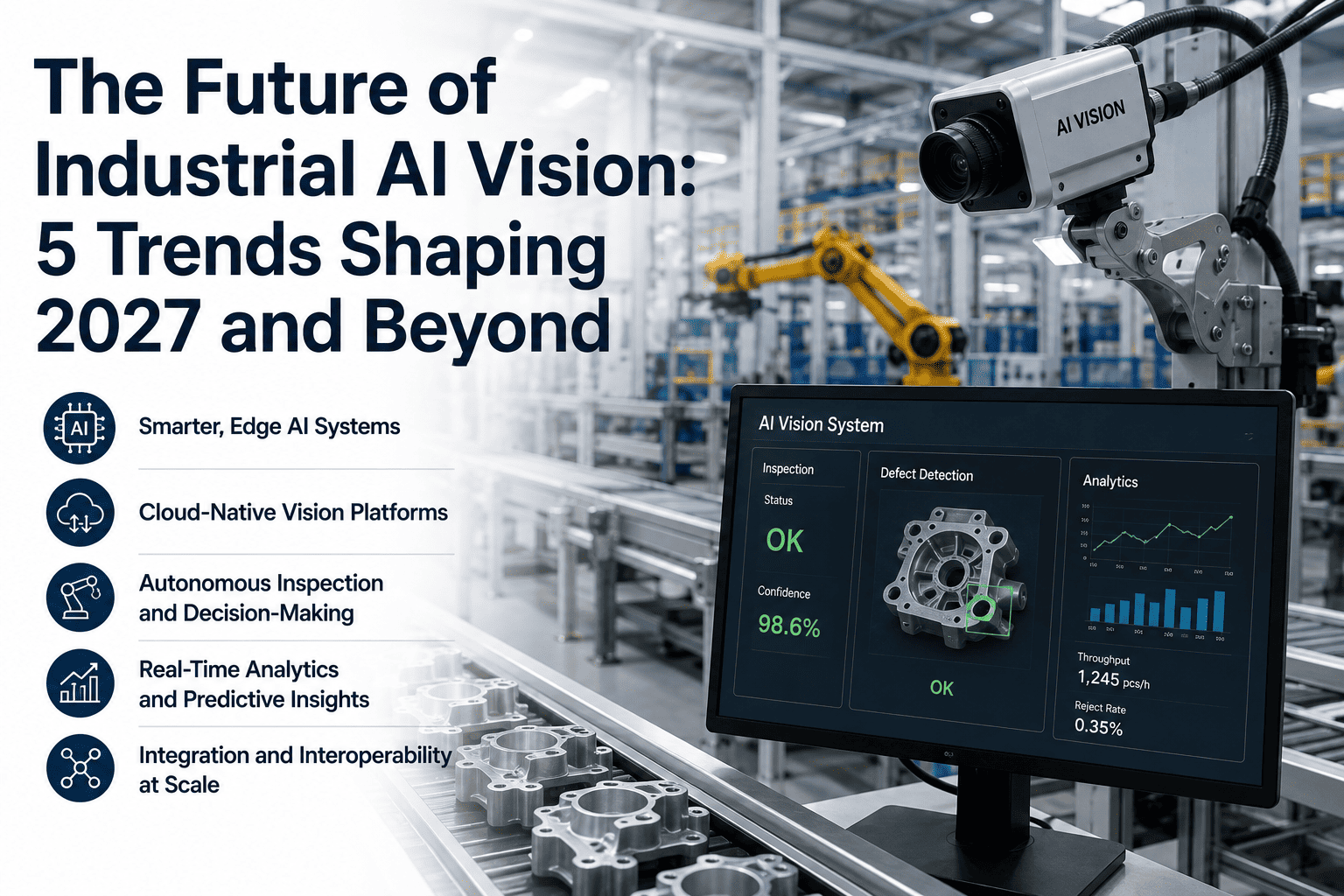
Most industrial AI vision deployed today does one job well: it looks at a part, compares it against a trained defect model, and returns pass or fail. That is genuinely useful, and it is also close to the ceiling of what a single-purpose inspection camera can do on its own. The systems arriving over the next few years look different, they reason about what they see, connect that reasoning to the equipment causing the problem, and in some cases correct it without a person in the loop. Five shifts are driving that change, and understanding them now shapes which vision investments hold up over the next several years. You can book a demo to see how iFactory's platform already reflects where this is heading.
Five Shifts Defining the Next Generation of Industrial AI Vision
The vision systems built for 2027 will not just detect defects, they will reason about causes, act on findings, and improve themselves without waiting for a data science team to retrain a model. Here is what is changing, why it matters on your production line, and how to position your inspection strategy now.
Foundation Models Replace the Build-a-Model-Per-Defect Approach
Most industrial vision deployed over the last decade required a dedicated model trained from scratch for every defect class, every product line, every camera angle. That approach does not scale well when a plant runs hundreds of SKUs or changes tooling frequently, because every new variant means a new data collection and training cycle before inspection is even possible. Vision foundation models change this equation by providing a general-purpose visual understanding layer, pretrained on enormous and varied image data, that adapts to a specific inspection task with a fraction of the examples a from-scratch model would need.
The practical effect on a plant floor is a collapse in time-to-deployment. A defect type that used to require weeks of image collection and labeling before a usable model existed can now be configured from a much smaller sample set, because the foundation model already understands general visual concepts like edges, textures, and shape deviation, and only needs to learn what counts as acceptable for your specific part. This matters most for facilities with high product mix or frequent changeovers, where the old model-per-SKU approach was the single biggest bottleneck to expanding AI vision coverage across the plant.
Agentic AI Closes the Loop Between Detection and Correction
Traditional machine vision follows a simple pattern: sense, analyze, alert a person, wait for that person to act. Agentic AI breaks that pattern by giving the system a goal, maintaining quality within a defined tolerance, and the authority to act toward that goal without waiting for approval on every step. In practice, an agentic vision system does not just flag that a drilled hole has drifted off-center by a fraction of a millimeter across consecutive parts, it calculates the offset, sends a correction to the machine, and verifies the fix on the next part, closing an entire monitoring-and-response loop that used to require a person watching a dashboard.
This shift is not hypothetical, it is already running in production at scale. Manufacturers deploying agentic quality systems report inspection labor reductions in the range of 40 to 60 percent on triage tasks that previously required a technician to review every flagged image, because the agent handles routine disposition and root-cause categorization automatically, escalating to a person only when confidence is low or the deviation exceeds a defined threshold. The gap between a copilot that answers questions and an agent that removes the entire monitoring loop from a human queue is the single biggest capability jump happening in industrial AI right now.
Autonomous Drones and Robots Extend Vision Beyond Fixed Cameras
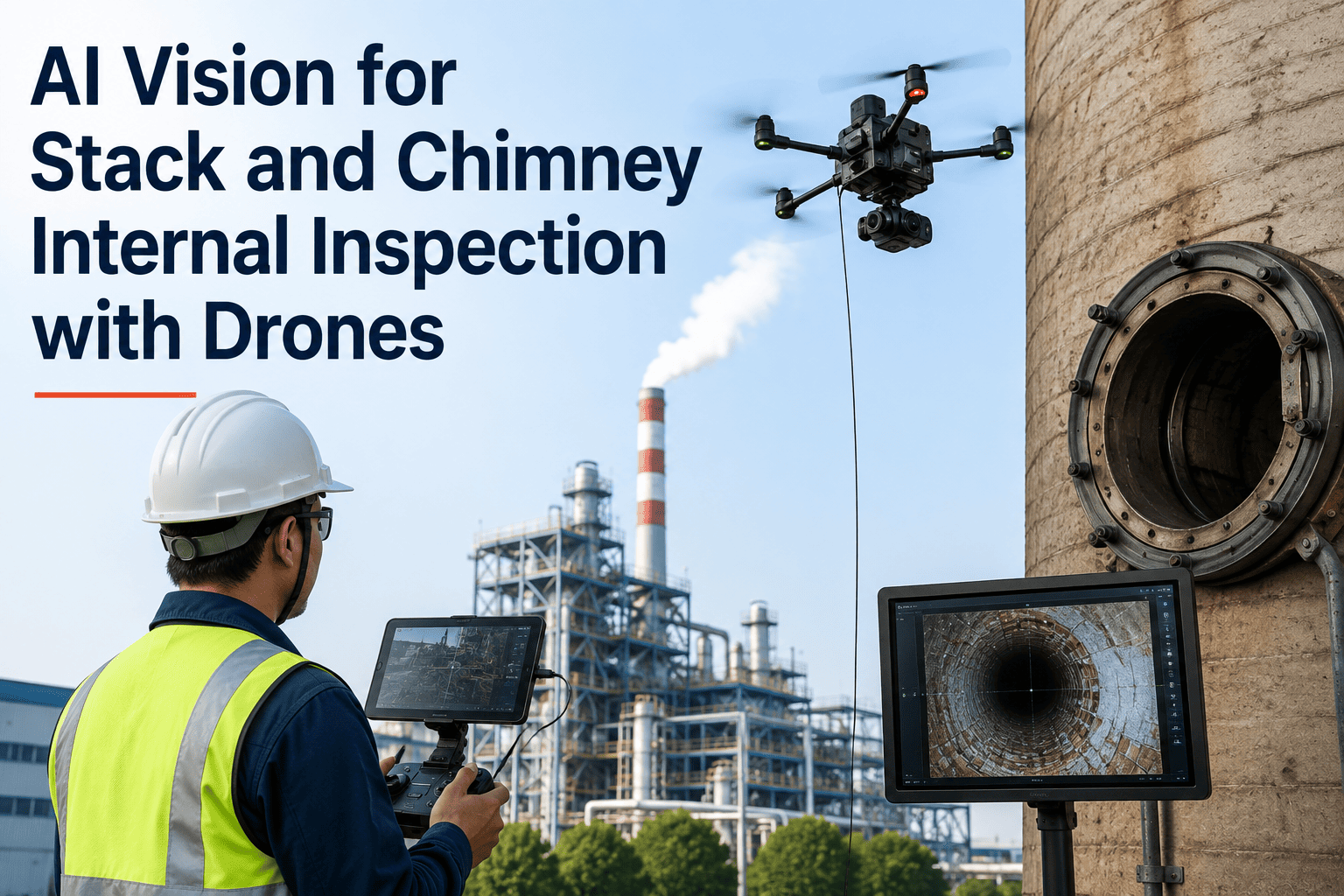
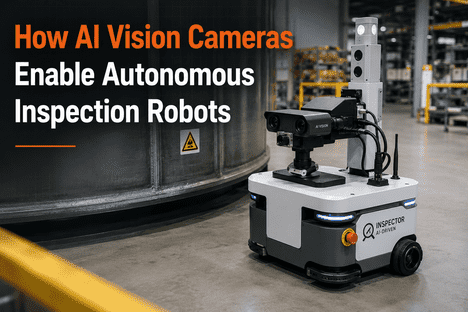
A fixed camera can only inspect what is directly in front of it, which has always limited machine vision to assembly lines and other locations where a part can be brought to a stationary station. Autonomous inspection platforms remove that constraint. Drones now navigate GPS-denied interiors like tanks, boilers, and enclosed structures without a pilot, using onboard LiDAR and visual-inertial navigation to build their own map of the space in real time, while ground robots and robotic arms carry vision payloads to parts and structures too large, too tall, or too hazardous for a fixed installation to reach.
What makes this more than a novelty is how quickly the inspection turns into usable data. An autonomous drone can now map a confined industrial asset in minutes and hand back a searchable 3D model with defects already tagged to their exact location, work that previously required scaffolding, a confined space entry permit, and a full day of manual inspection. As these platforms mature, expect vision coverage to extend from the parts moving past a camera on a line to the entire physical footprint of a facility, structural steel, elevated piping, tank interiors, and outdoor infrastructure included.
Digital Twins Turn Inspection Data Into a Living Model of the Plant
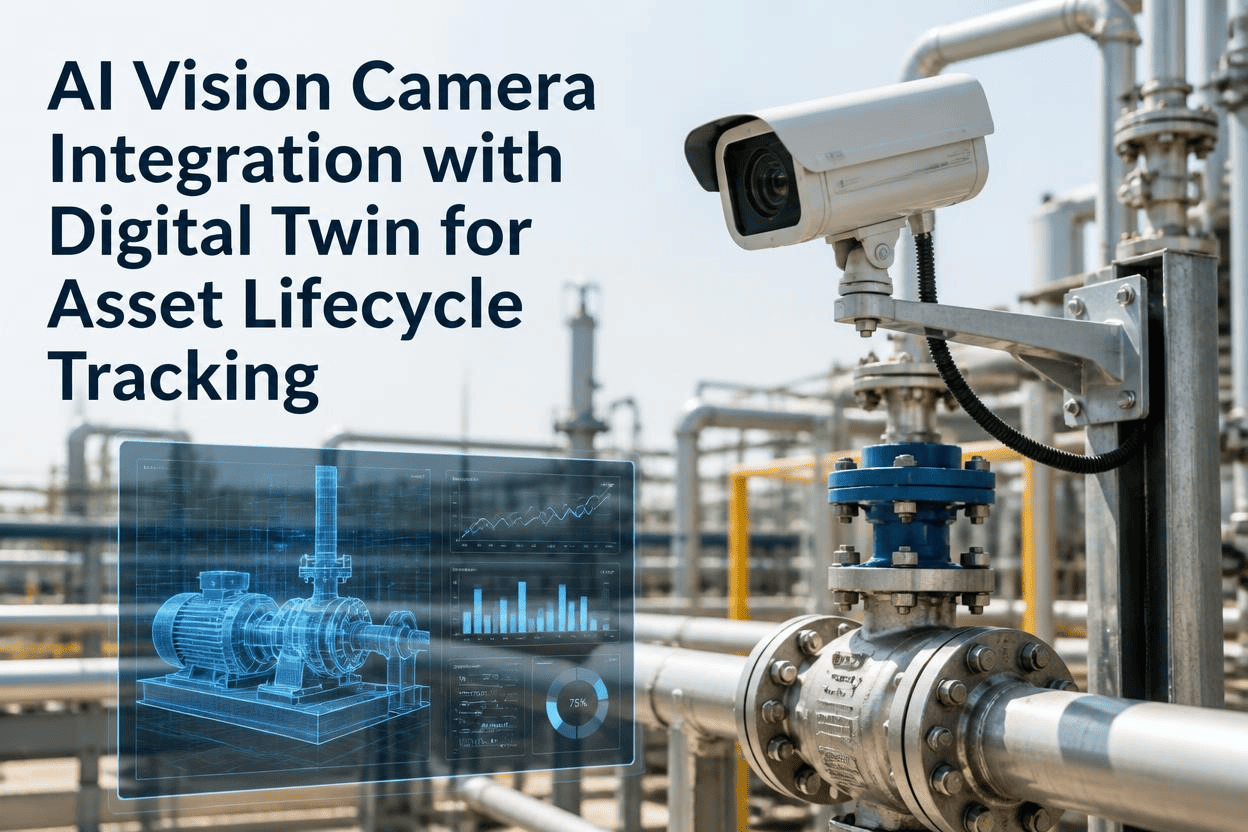
Digital twins have existed for years as static virtual replicas, useful for design review but disconnected from what was actually happening on the floor in real time. That is changing as inspection data starts feeding directly into the twin, turning it from a snapshot into a continuously updated model that reflects live production conditions. When a vision system detects a quality drift, that signal does not just trigger a local alert, it updates the twin's representation of that asset, making the connection between what the camera saw and how the rest of the production system should respond visible in one place instead of scattered across separate quality and maintenance tools.
The deeper value shows up in simulation. A plant running a live digital twin fed by real inspection data can test a process change virtually before touching the physical line, verifying whether a tooling adjustment or a new material would actually resolve a defect pattern before committing production time to find out. Manufacturers combining this with synthetic defect generation are already cutting new model preparation time for unfamiliar defect types dramatically, because the twin can simulate variations of a defect that has not yet appeared in enough real examples to train on directly.
Self-Improving Systems Stop Waiting for a Retraining Cycle
Every AI vision model degrades over time as production conditions shift, a new material supplier, a lighting change, a press maintenance event, and the traditional fix has been a scheduled retraining cycle, often monthly, run by a dedicated model management team. Self-improving systems compress that cycle by continuously monitoring their own detection performance and flagging drift automatically, rather than waiting for a calendar date or a person to notice the false reject rate creeping up.
The next step beyond automatic drift detection is automatic correction, models that incorporate new production examples into their own training process with minimal manual intervention, effectively narrowing the gap between when a process changes and when the inspection model reflects that change. This does not eliminate the need for oversight, a model champion still validates that retraining improved rather than degraded performance, but it does shrink what used to be a multi-week model management cycle down to something closer to continuous tuning, which matters enormously for facilities running the kind of high product mix that used to make model maintenance a full-time job on its own.
See Which of These Trends Are Already Live in iFactory
Foundation-model inspection, closed-loop correction, and continuous model monitoring are not roadmap items, they are running in iFactory deployments today. Book a demo and see how the platform is built for where industrial AI vision is heading, not just where it has been.
The Fundamentals a New Vision Strategy Should Not Skip
It is tempting to read a trends roundup like this as a call to rip out existing inspection infrastructure and chase whatever is newest. That instinct usually backfires. Every one of these five shifts builds on the same foundation that has always mattered in industrial vision, reliable camera and lighting setup, clean and well-labeled training data, and a clear connection between what the system detects and what a person or process does in response. Foundation models still need representative examples of your specific defects to configure well. Agentic AI still needs a defined tolerance and escalation path before it is given authority to act. None of these technologies substitute for that groundwork, they extend what becomes possible once it is in place. Facilities that skip straight to the newest capability without that groundwork tend to see the same pattern researchers have documented across agentic AI pilots broadly, a promising demo that never reaches production because the underlying data and integration work was never done first.
From Passive Detection to Active, Self-Correcting Quality
The clearest way to see the shift is side by side. What used to be a purely reactive inspection function is becoming an active participant in keeping the process in tolerance, and understanding this contrast is useful even for facilities that plan to adopt these capabilities gradually rather than all at once, since it clarifies which investment actually moves the needle first.
| Capability | Traditional AI Vision | Where Industrial AI Vision Is Heading |
|---|---|---|
| Model Setup | Custom model trained per defect class and SKU | Foundation model configured with a small sample set |
| Response to a Defect | Alert sent to a person for manual review | Agent diagnoses cause and corrects the process directly |
| Inspection Reach | Fixed cameras at defined stations only | Autonomous drones and robots extend coverage plant-wide |
| Process Visibility | Quality data isolated in a separate dashboard | Digital twin reflects live inspection data across the plant |
| Model Maintenance | Scheduled manual retraining, typically monthly | Continuous drift detection with self-directed retraining |
What Plant and Quality Leaders Ask About These Shifts
Build Your Inspection Strategy for Where AI Vision Is Going
iFactory's AI vision platform is built on the same foundation-model, closed-loop, and continuous-learning architecture defining the next generation of industrial inspection. Book a demo and see it running on your own production data.