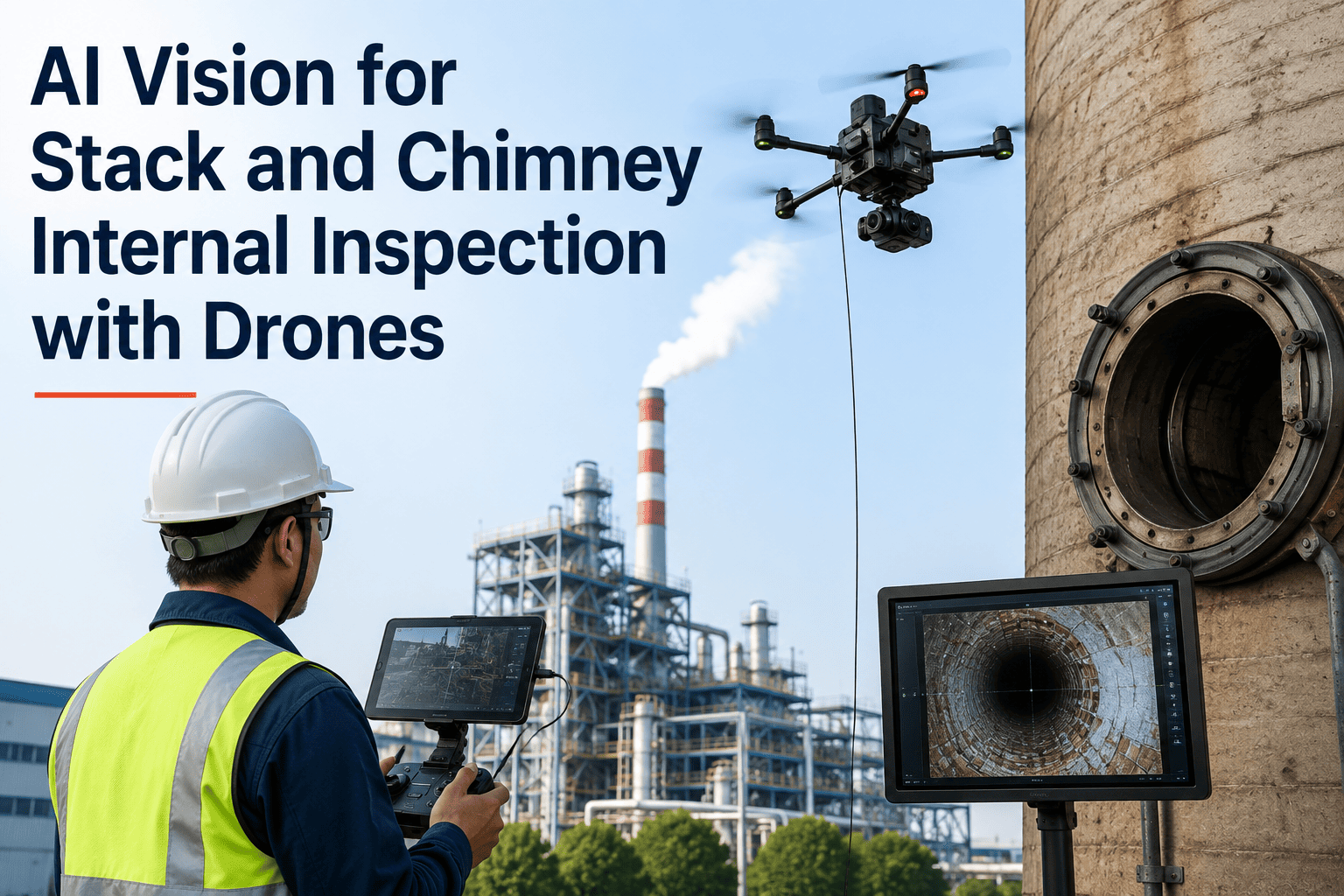
Every flue gas stack and industrial chimney hides a slow-motion crisis on its inner wall — refractory erosion, acid dew-point attack, spalling brick, cold-face corrosion, and hairline cracks that quietly march toward an unplanned shutdown. Traditional internal inspection means cool-down, scaffolding to 200 feet, rope-access teams, and workers breathing residual SO2 inside a confined vertical shaft. AI vision drones flip that equation — a collision-tolerant, LiDAR-equipped drone flies the stack interior in a single morning, and iFactory's AI vision engine classifies every defect frame-by-frame with quantified severity, location, and repair urgency. In the last line: request a walk-through and book a demo to see a live internal-stack AI inspection replay.
Inspect Chimneys From The Inside — Without Scaffolding, Rope Access, Or Cool-Down
iFactory's AI vision platform ingests 4K video, thermal frames, and 3D LiDAR point clouds from confined-space drones flying inside your stacks — auto-detecting refractory loss, acid attack, brick displacement, cracks, and thermal anomalies with defect coordinates ready for the work order.
Why The Inside Of A Stack Is The Hardest Asset In Your Plant To See
A flue gas stack lives in one of the most punishing chemical environments on your site — SO2, SO3, chlorides, condensing acids at the dew point, particulates, and cyclic thermal loads between 200°C and 400°C. Damage accumulates on the inner surface long before anything is visible from the top platform or the ground. By the time a lining failure produces external staining, refractory has usually been thinning for months, and a shell burn-through window may be measured in weeks.
The conventional response is a full outage — cool-down over 24–72 hours, internal scaffolding built stage by stage, rope access teams working at height inside a confined vertical shaft, hot-work permits, atmospheric monitoring, and a crew of specialists moving upward one belt-and-suspenders lift at a time. A single 85-meter kiln stack inspection has been documented at over $45,000 with a 4-person rope team working three days — plus the production loss of the shutdown itself. AI vision drones and iFactory's analytics layer collapse that same scope into a 55-minute flight with zero human exposure and a defect-tagged digital record you can trend across cycles.
What The AI Vision Engine Actually Detects Inside The Flue
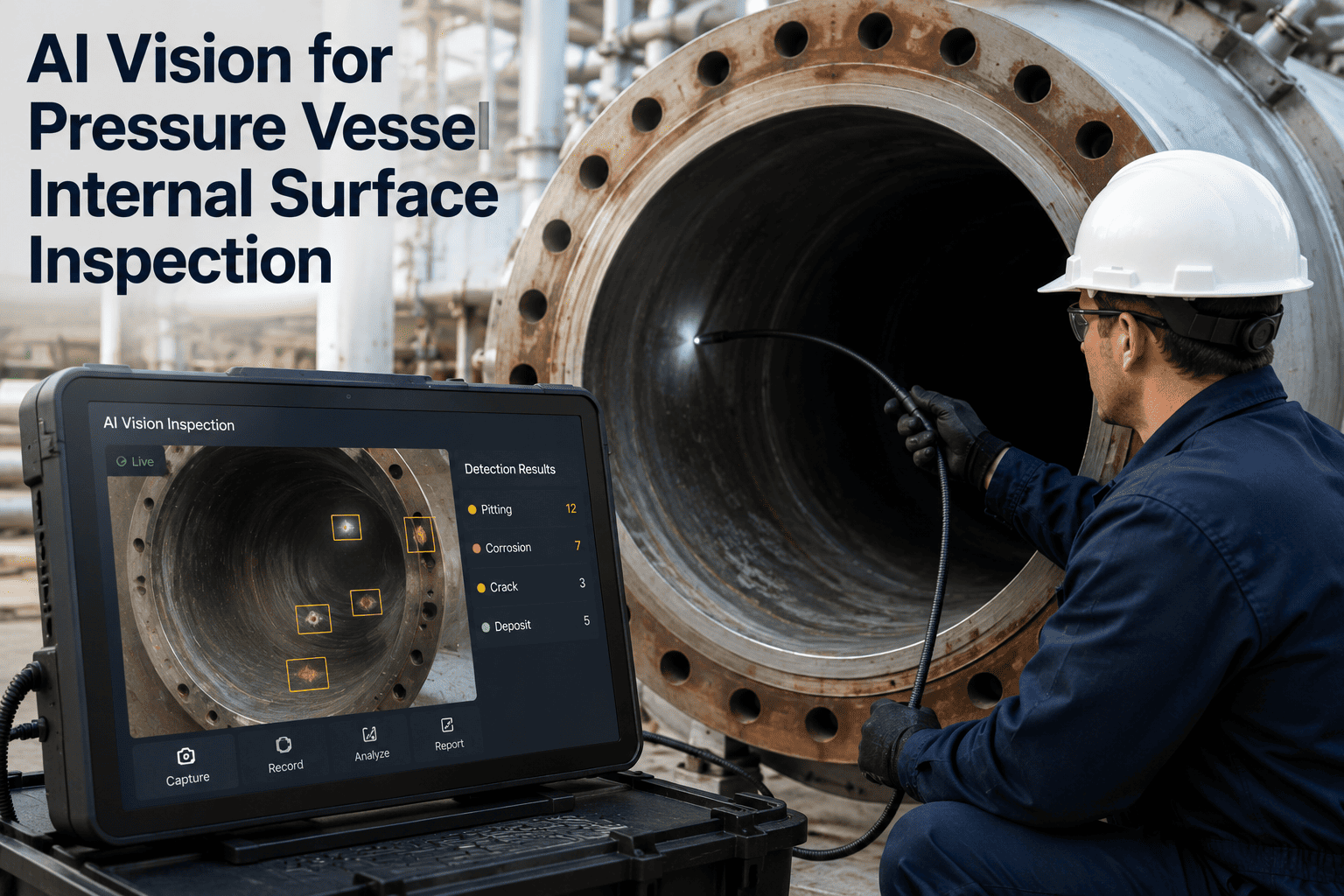
The value is not the drone — it is what iFactory's AI does with the 60,000+ frames captured on a single flight. Every RGB frame is scored against a refractory-defect model, every thermal frame is analysed for temperature anomalies invisible to the naked eye, and every LiDAR return is aligned to build a spalling-depth map you can measure in millimetres. Below are the defect classes the vision engine tags automatically.
Refractory Erosion & Thinning
Gradual loss of firebrick or castable lining thickness from thermal cycling and gas velocity. AI compares point-cloud depth against the digital birth certificate to quantify millimetres of loss per zone.
Acid Dew-Point Attack
Sulfuric acid condensation below the dew point corrodes steel liner sections and stains cold-face brick. Vision AI flags the characteristic banded discoloration and pitting patterns near the transition zone.
Brick Spalling & Displacement
Individual bricks fracturing, shifting, or falling out of the lining course. The model tags missing courses, gap widening, and displacement vectors so repair crews arrive knowing exact ring elevation.
Structural Cracks & Fissures
Vertical and circumferential cracks in concrete windshields, brick liners, and FRP inner ducts. Crack width, length, and orientation are auto-measured against previous cycles to flag propagation.
Thermal Hotspots & Cold Bands
Localised temperature spikes on the shell indicate refractory failure with imminent burn-through risk. Cold bands indicate air ingress or insulation loss. Radiometric thermal cameras quantify every anomaly.
Deposit Build-Up & Fouling
Salt deposits, ash accumulation, and condensate residue that restrict flow and accelerate corrosion. The AI segments deposit coverage percentage per elevation band for cleaning scope planning.
Every tagged defect gets a severity score, GPS-free position within the stack (X-Y-Z from the LiDAR SLAM), and a suggested repair action pushed directly to the CMMS. Book a demo to walk through a real refinery stack inspection replay with our engineers.
How A Confined-Space Drone Actually Flies Inside A 200-Foot Stack
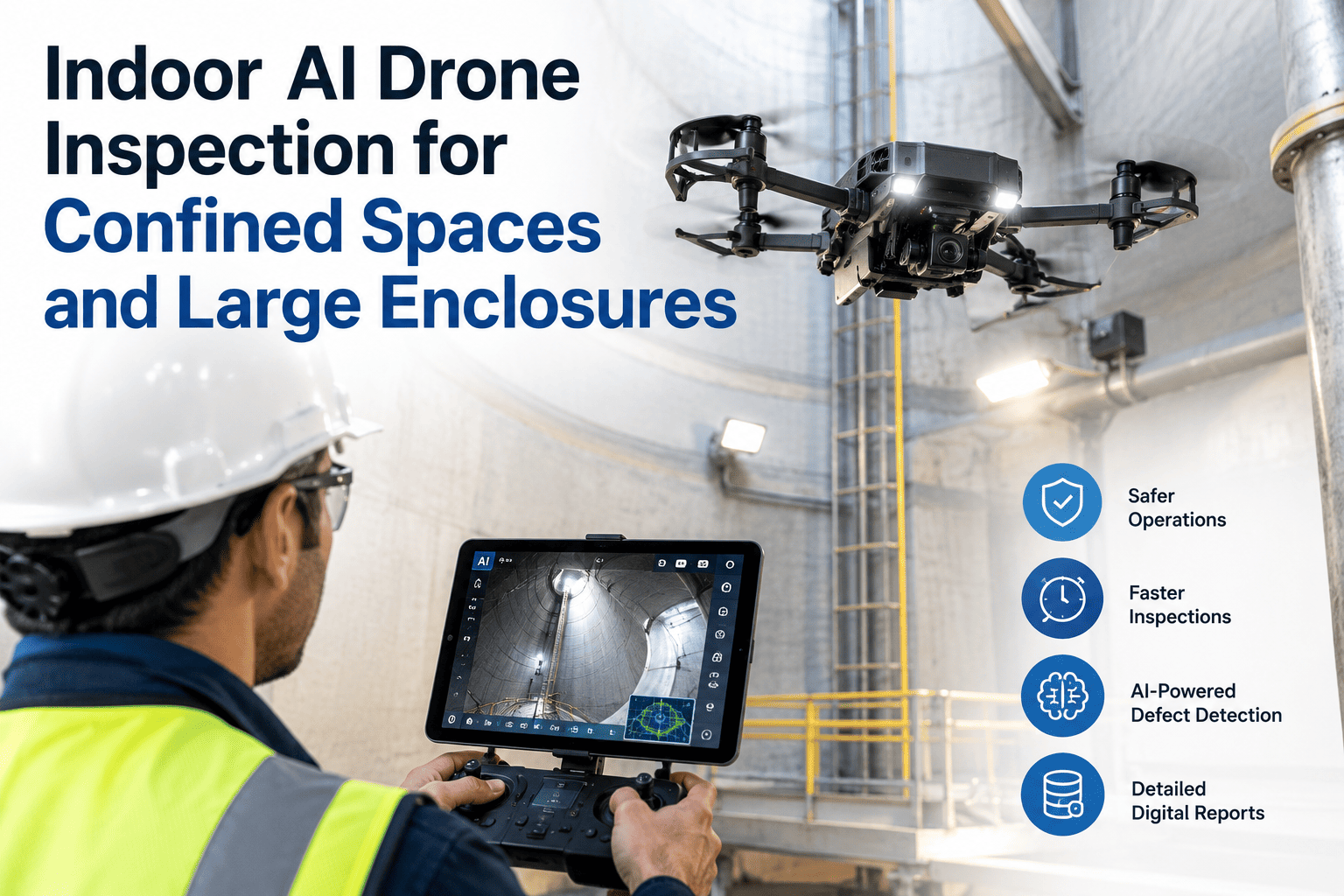
The physics of internal stack inspection are brutal — GPS signals are dead inside a steel or concrete shaft, radio links fade fast, thermal updrafts create violent turbulence, walls sit within one meter on every side, and the drone must survive contact with brick, steel, and residue. Standard industrial drones cannot operate here. The category of aircraft that can is called a collision-tolerant confined-space drone — protected by a full carbon-fibre cage, navigating on visual-inertial odometry and LiDAR SLAM rather than GPS.
Entry From The Top Platform Or Cleanout Door
The drone enters through the stack cap, a dedicated inspection door, or a cleanout at the base. Minimum opening is roughly DN 600 for current-generation confined-space platforms. Pilot stays outside the stack — the video feed and telemetry come back over a tethered or high-gain wireless link.
GPS-Free SLAM Navigation Locks In
The onboard LiDAR and VIO cameras build a live 3D map of the interior as the drone descends. Position holds against the geometry — not against GPS satellites the walls block. This is what makes stable flight possible inside a shaft with zero external reference.
Collision-Tolerant Cage Absorbs Wall Contact
The carbon protective cage lets the drone bump refractory, brush residue, and touch off obstructions without losing flight stability. Pilots fly right up to the wall to capture defect close-ups that rope-access inspectors physically cannot reach at height.
Simultaneous Multi-Sensor Capture
A single flight captures 4K RGB video, radiometric thermal, and dense LiDAR point clouds — the three data streams the AI vision model needs to classify defects, quantify severity, and generate the 3D digital twin used for trending and repair planning.
AI Processing & Defect Tagging
Footage uploads to iFactory. Within hours the AI vision engine tags every defect frame, measures crack widths and refractory loss depth, cross-references against previous inspection cycles, and generates the annotated defect report with severity, coordinates, and repair urgency.
Rope Access vs Scaffolding vs AI Drone — The Real Numbers
The comparison below reflects actual documented performance on process stacks between 60 and 100 metres. The delta on inspection coverage — from 10–20% for a rope-access walkdown to 95%+ for a systematic drone flight — is the metric most reliability teams underweight when they run the business case.
| Inspection Dimension | Scaffolded Internal Inspection | Rope Access Team | AI Vision Drone (iFactory) |
|---|---|---|---|
| Typical Duration | 7–14 days build + inspect + tear-down | 2–4 days inside the stack | 55 min flight + same-day report |
| Cool-Down Required | Full 24–72 hr cool-down | Full 24–72 hr cool-down | Ambient stack only (fully cool) |
| Worker Exposure | Multi-crew at 60–200 ft height | Fall + confined-space + residual gas | Zero — pilot stays at grade |
| Interior Coverage | 60–80% (line-of-sight limited) | 10–20% walkdown coverage | 95%+ systematic surface scan |
| Documented Cost Range | $50K–$250K per event | $15K–$80K per event | $3K–$8K per drone mission |
| Defect Documentation | Photos + handwritten notes | Body-cam video + notes | 3D twin + AI-tagged defect log |
| Trending Between Cycles | Manual, subjective | Manual, subjective | Auto delta vs prior point cloud |
| Production Impact | Weeks of stack downtime | Multiple days of downtime | Single-shift outage window |
Where AI Drone Stack Inspection Delivers The Biggest Win
Not every stack needs the same inspection strategy. The economics of drone-plus-AI shift with stack height, process temperature, refractory type, and inspection frequency. The categories below are where iFactory customers see payback in the first inspection cycle.
Cement Kiln & Preheater Stacks
85–140 m kiln stacks with 200–400°C flue gas, high SO2, and firebrick liners. Acid-resistant chassis and thermal-updraft-tolerant flight controllers are mandatory. Typical customer replaces one $45K rope-access event per year with a $4.5K drone mission and gains complete interior coverage.
Refinery Flare & Process Stacks
External thermal drone inspection catches refractory failure on live flares approaching 1500°F without shutdown. Internal drone flights on process stacks during turnaround windows catch acid attack in the dew-point zone and cold-face corrosion on steel liners.
Power Plant & Utility Boiler Stacks
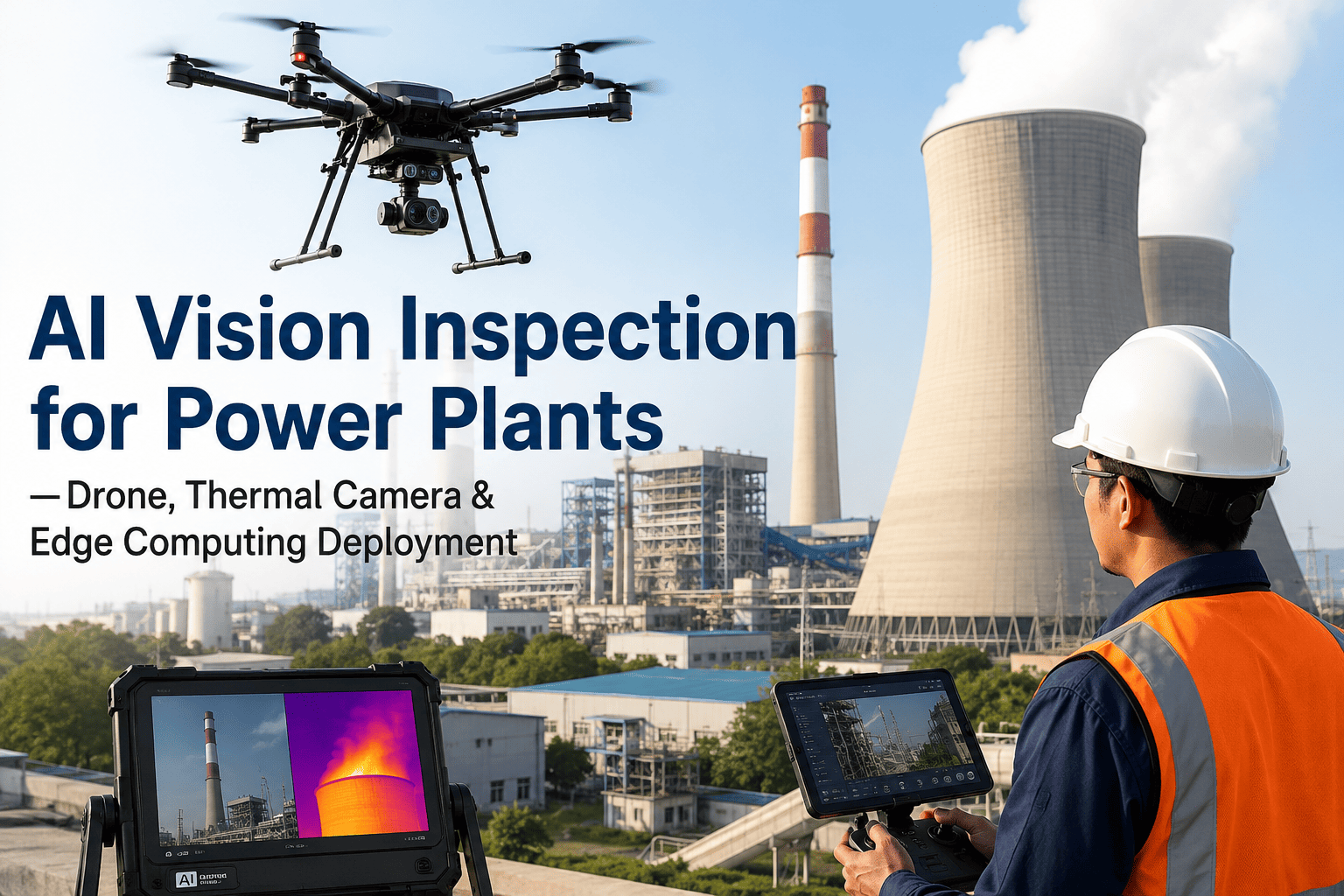
Coal, biomass, and waste-to-energy boiler stacks accumulate deposit build-up and suffer FGD-related acid attack. Drone flights during scheduled outages inspect FRP inner ducts, brick liners, and mist-eliminator zones without erecting internal scaffolding.
Steel Plant Blast Furnace & Coke Stacks
Autonomous drones ascend 300-foot chimney stacks and flues capturing high-resolution imagery of liner condition, cap integrity, and external corrosion — in a single flight that would require multiple days of rigging for rope access on the same asset.
Petrochemical Reformer & Cracker Stacks
Documented case: $127K autonomous drone program replacing $1.1M annual scaffolding, rope access, and helicopter inspection at a single petrochemical facility — 22 flight days replacing 94 days of scaffolding erection and dismantling across a full asset base.
Chemical & FGD / Scrubber Stacks
FRP inner ducts and rubber-lined FGD stacks fail through resin degradation and liner detachment rather than classic refractory loss. AI vision models trained on FRP defect patterns catch delamination, blistering, and seam separation before liner collapse.
See A Real Internal Chimney AI Inspection Replay — Live With Our Engineers
30 minutes. We open a real customer inspection dataset — 4K interior video, thermal overlay, LiDAR point cloud, and the AI-tagged defect log — and walk you through how iFactory would run the same on your stacks.
Turnkey AI Vision Deployment — What You Actually Get
iFactory ships internal stack inspection as a bundled hardware-plus-software AI deployment. You do not build the model, tune the vision pipeline, or integrate five vendors. Rack it, plug power and Ethernet, and the AI is live against your first drone flight within weeks — not quarters.
Pre-Configured NVIDIA AI Vision Server
Ships racked and ready with the stack-defect vision model pre-loaded, GPU-accelerated for real-time frame scoring, and network-isolated for on-prem processing of sensitive site imagery. No cloud upload required.
Confined-Space Drone Platform Integration
We integrate with the collision-tolerant drone your team prefers — Flyability Elios class, custom platforms, or captive vendor-of-record aircraft. The vision pipeline is agnostic to the airframe as long as the sensor payload lines up.
Scoped Deployment Services
Rack cabling, network configuration, PLC / SCADA integration where the stack has instrumentation, operator training on the AI review console, and the digital twin baseline capture flight on your first asset.
24×7 Remote Monitoring & Model Tuning
iFactory's engineering team monitors model performance, tunes defect thresholds against your inspection outcomes, and pushes vision model updates as new defect classes appear across the customer fleet.
The Business Case — What Changes When You Stop Building Scaffolds
The economics are cleanest to model on a single stack over a five-year window. Below is the delta iFactory customers typically capture — the numbers assume one full internal inspection cycle per year and one emergency call-out avoided over the period.
The numbers scale linearly across a multi-stack fleet — a mid-size refinery or cement plant with 6–10 stacks typically breaks even inside the first inspection cycle. Talk to support for a site-specific model against your actual stack asset list.
Trust Signals & What The Platform Is Built On
iFactory's AI vision platform is deployed across 1000+ industrial clients globally, with 99.9% uptime on the core inference stack. The stack inspection module is built on the same on-prem NVIDIA AI vision architecture that powers our welding, casting, and process monitoring products — hardened for industrial network environments and validated against BRC, SQF, and municipal safety audit requirements.
Frequently Asked — Internal Stack AI Drone Inspection
Current-generation confined-space drones are rated for a maximum ambient temperature of roughly 50°C, so the stack must be fully cooled before internal flight. The cool-down window is the same as any manned entry — typically 24–72 hours after shutdown. External thermal drone inspection is different: purpose-built thermal-payload drones inspect live flare stacks operating at temperatures approaching 1,500°F from outside without shutting them down. The two workflows are complementary. To plan the right approach for your specific stack profile, book a scoping call.
Current confined-space platforms enter through openings from roughly DN 600 upward — that is 600mm diameter, comfortably smaller than a standard inspection port or cleanout door on most industrial stacks. Older or bespoke stacks with restricted access sometimes require the smaller-diameter previous-generation cage. During the scoping call our team reviews stack general arrangement drawings to confirm entry geometry against the platform being deployed, so there are no surprises on the flight day itself.
The AI vision model consistently outperforms rope-access inspectors on two dimensions — coverage and repeatability. A rope-access walkdown physically covers 10–20% of the internal surface at close range; the drone captures 95%+ systematically. The AI applies the same defect criteria to every frame, eliminating the inspector-to-inspector variability that makes trending unreliable. The one caveat is that AI augments certified inspection sign-off rather than replaces it — the AI hands your certified inspector a prioritised defect hit-list, and the inspector adjudicates severity and repair scope. Our customers report the review workflow is roughly 5x more efficient than traditional post-inspection report writing.
Every flight produces four synchronised deliverables — 4K RGB video of the interior surface at inspection-grade resolution, radiometric thermal imagery for temperature anomaly detection, a dense LiDAR point cloud typically at ±30–50mm accuracy for geometry and depth measurement, and the AI-tagged defect log with severity, coordinates, thumbnails, and repair recommendations. Everything is stored in the iFactory digital twin against that specific asset so cycle-to-cycle trending is automatic. Work orders push straight to your CMMS with the defect coordinates and photos already attached.
Both are supported. The vision model is trained on distinct defect families for each stack construction type — refractory erosion and brick spalling for firebrick and castable linings, delamination and blister patterns for FRP inner ducts, and liner detachment plus resin degradation for rubber-lined FGD stacks. During deployment scoping the correct model class is selected against your specific stack construction, and the operator training focuses on the defect categories relevant to your asset base rather than a generic overview.
Your Next Stack Inspection Should Take 55 Minutes — Not Two Weeks
Book a 30-minute walk-through with iFactory's stack inspection team. We open a real customer inspection dataset — 4K video, thermal overlay, LiDAR twin, AI defect log — and map how the same runs against your specific stack asset list.